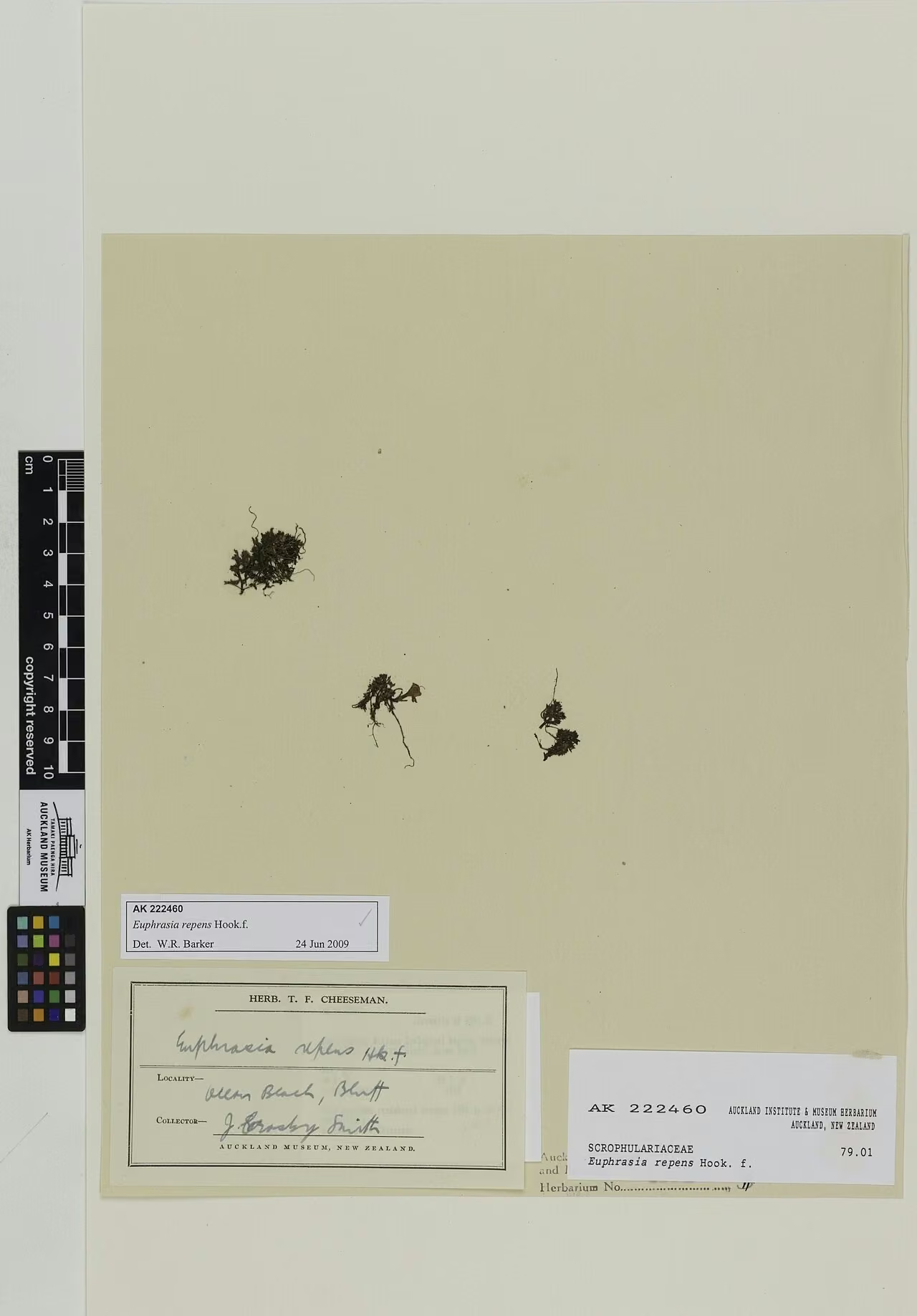
Eyebright
Euphrasia repens
Last updated:
Euphrasia repens is a slender, succulent annual eyebright endemic to the coasts of Foveaux Strait. Its creeping branches root at the nodes, often knitting into tight mats on sandy, shingly and boggy ground from coastal Fiordland to Toetoes Bay and on the coasts and sand pans of Stewart Island/Rakiura and nearby islets. The leaves are only 2.5 to 6 mm long with finger-like segments at the tip, and the white flowers, 6 to 13 mm long, appear from January to March. Its name means creeping. It is a hemiparasite and is now ranked Threatened - Nationally Vulnerable. Explore more native flowering plants in our native plant guide.
Plant Description
Euphrasia repens is a slender, succulent annual herb that usually forms matted patches. Its branches creep and root at the nodes. The leaves are stalkless and partly sheathing at the base, 2.5 to 4 mm long (up to 6 mm) and 1 to 3 mm wide, oblong to wedge-shaped, with the upper fifth to third divided like fingers into three to five (rarely seven) narrow pointed segments.
The flowers are usually borne singly, almost stalkless or on stalks up to 10 mm long. The calyx is 3 to 5 mm long and divided about halfway into pointed lobes. The white corolla is 6 to 13 mm long, with a slender tube up to 9 mm long that is much longer than the calyx, and the anthers are yellow to golden brown. The capsule is shorter than the calyx and densely bristly at the tip, holding two narrowly elliptic seeds 1.1 to 1.4 mm long in each chamber.
It is most similar to Euphrasia dyeri, a plant of inland montane bogs. Euphrasia repens is separated by its coastal sand habitat, its creeping and rooting stems that often form tight mats, and its smaller leaves with less divided tips.
Quick Facts
| Scientific Name | Euphrasia repens |
|---|---|
| Height | Prostrate, a few centimetres |
| Spread | Forms small tight mats |
| Water Needs | Damp; coastal sand pans and boggy hollows |
| Light | Full sun on open coastal ground |
| Frost Tolerance | No information available; its coastal sites have mild winters |
| Salt Tolerance | Tolerant; grows on coastal sand and shingle exposed to salt spray |
| Growth Rate | Fast; completes its life cycle in one season |
| Lifespan | Annual |
Climate Best Suited to
Suits the cool, windy, moist maritime climate of Foveaux Strait and Rakiura, with mild winters and cool summers.
Regional Suitability
| City | Climate Suitability |
|---|---|
| Auckland | Low |
| Wellington | Low |
| Christchurch | Low |
| Dunedin | Low |
Plant Habitat
Euphrasia repens is endemic to the far south of New Zealand. It is found along coastal Fiordland and Southland east to Toetoes Bay, and on the coasts and sand pans of Stewart Island/Rakiura and adjacent islets.
It grows in sandy, shingly and boggy places on the coast of Foveaux Strait. Damp sand pans and the edges of coastal turf, where vegetation is low and open, provide the bare, moist ground it creeps across.
Growing Requirements
Soil Requirements
It roots into damp coastal sand, fine shingle and boggy peat close to the sea.
- Moist sand or shingle, often in hollows
- Low fertility, open ground
- Coastal turf margins with short host vegetation
Light Requirements
Its coastal habitats are open and exposed, with no overhead shade.
- Full sun and wind exposure
- Shaded out where taller grasses or weeds invade sand pans
Water Requirements
Sand pans and boggy coastal hollows stay damp through summer, keeping the shallow rooting stems moist.
- Needs damp ground during the growing season
- Changes to coastal drainage could dry its sites
Planting and Establishing
Euphrasia repens is not cultivated and, as a threatened annual hemiparasite, it should never be dug up or transplanted. Disturbing its mats risks destroying a whole local population.
Anyone visiting the Foveaux Strait coast or Rakiura's sand pans in late summer can look for its small white flowers on damp sand, taking care to walk around rather than across low coastal turf.
Ecological Role
As with all eyebrights, it is a hemiparasite, photosynthesising for itself while drawing water and nutrients from the roots of surrounding plants; its hosts have not been recorded. NZPCN states that its seeds are dispersed by wind and possibly water and ballistic projection from the bristly capsules.
Its slender-tubed white flowers are presumably insect-pollinated, but pollinators have not been studied. It belongs to the specialised low coastal turf community of the deep south, sharing damp sand pans with other small creeping herbs.
Uses & Significance
Garden Uses
It is not suitable for gardens and is not available in cultivation.
- Not grown commercially
- A conservation and survey priority rather than an ornamental
- Best observed in the wild
Ecological Value
As a threatened endemic of the Foveaux Strait coast, every population matters for its survival.
- Part of the distinctive coastal turf and sand pan flora of the far south
- Root hemiparasite linked to its host plants
- Indicator of intact, open coastal habitats
Landscaping Uses
This species has no role in landscaping. Coastal restoration within its range should avoid planting dense dune grasses or shrubs over open damp sand pans where it may grow.
Protecting open, low coastal turf and sand flats, rather than planting them up, is the most helpful landscape-scale action for this eyebright.
Seasonal Care Calendar
Spring
Seeds in the coastal sand germinate as the weather warms.
- Seedlings are tiny and very easily trampled
Summer
Flowering runs from January to March, when the white flowers dot the creeping mats.
- Best time to survey for it
Autumn
Capsules ripen between February and April, each containing only a few seeds.
- Plants die after seeding
Winter
The population survives as seed in the sand and peat over winter.
- Sites look bare
When to Prune and How Much
No pruning applies to this wild annual.
Avoid any disturbance to plants or seed-bearing sand during the flowering and seeding months.
How to Grow Eyebright
There is no record of Euphrasia repens being grown in cultivation. It is an annual that reproduces from seed, and like other eyebrights it is a root hemiparasite; NZPCN notes for a related New Zealand eyebright that such plants cannot be cultivated without first studying their host relationships. Because the species is Threatened - Nationally Vulnerable, any seed collection or growing trial should be left to the Department of Conservation or an approved conservation programme. What follows is an outline of how such a trial might be designed, not a proven method.
From Seed (Conservation Trials Only)
Each capsule holds very few seeds, just two per chamber, so seed is scarce and wild collection must be minimal. Ripe capsules occur from February to April.
A trial would sow seed on damp sand alongside the small coastal turf plants that grow around wild colonies, since these are the most likely hosts.
Germination requirements are not known. Sowing soon after collection and keeping pots outdoors through winter would follow the plant's natural cycle, in which seed shed in autumn germinates the following spring. Any seedlings raised should be returned to protected sites near their origin under the guidance of DOC.
- Work only under a DOC authority
- Note the plant species growing in contact with wild mats
- Collect a small number of ripe capsules
- Sow seed on damp, low-nutrient sand in pots planted with those turf species
- Keep pots moist and in full light in a cool, sheltered position
- Record germination, host contact and seed set
Pests & Diseases
No pests or diseases are recorded for Euphrasia repens.
NZPCN does not list specific threats, but its uplisting to Nationally Vulnerable indicates a declining population. Plants of open coastal sand and turf are typically vulnerable to trampling, vehicles on beaches and invasion of open ground by taller weeds and grasses.
Cultural Significance
No Māori name or traditional use has been recorded for this species. The genus name Euphrasia means eye-medicine, from historic European herbal use of other eyebrights.
The species name repens comes from the Latin repere, to creep, describing its rooting, mat-forming stems. It was described by Joseph Dalton Hooker, and Euphrasia umbellata Petrie is now treated as a synonym.
Bonus Tip
When exploring Rakiura's sand pans or the Southland coast between January and March, scan damp open sand for tiny white flowers held just above flat mats. Photograph a leaf tip closely: finger-like divisions on leaves only a few millimetres long, combined with a coastal site, point to Euphrasia repens. Report finds on iNaturalist NZ, as records of this threatened plant are valuable.
Related Plants
Explore other native plants that share similar characteristics or habitats with Eyebright (Euphrasia repens), offering further insights into New Zealand's diverse flora. These related species provide context and opportunities for complementary planting in your garden.
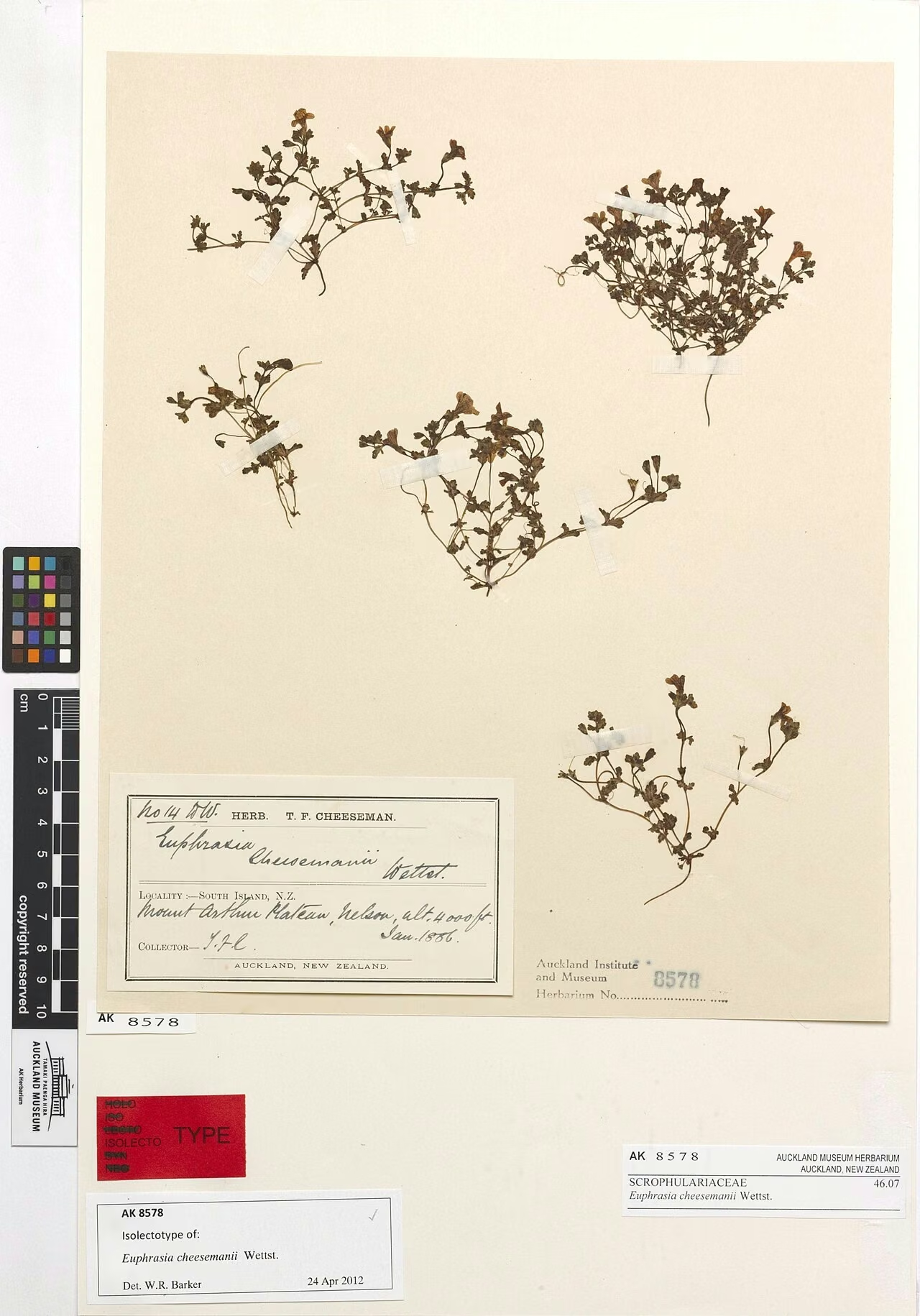
Euphrasia cheesemanii
Euphrasia cheesemanii
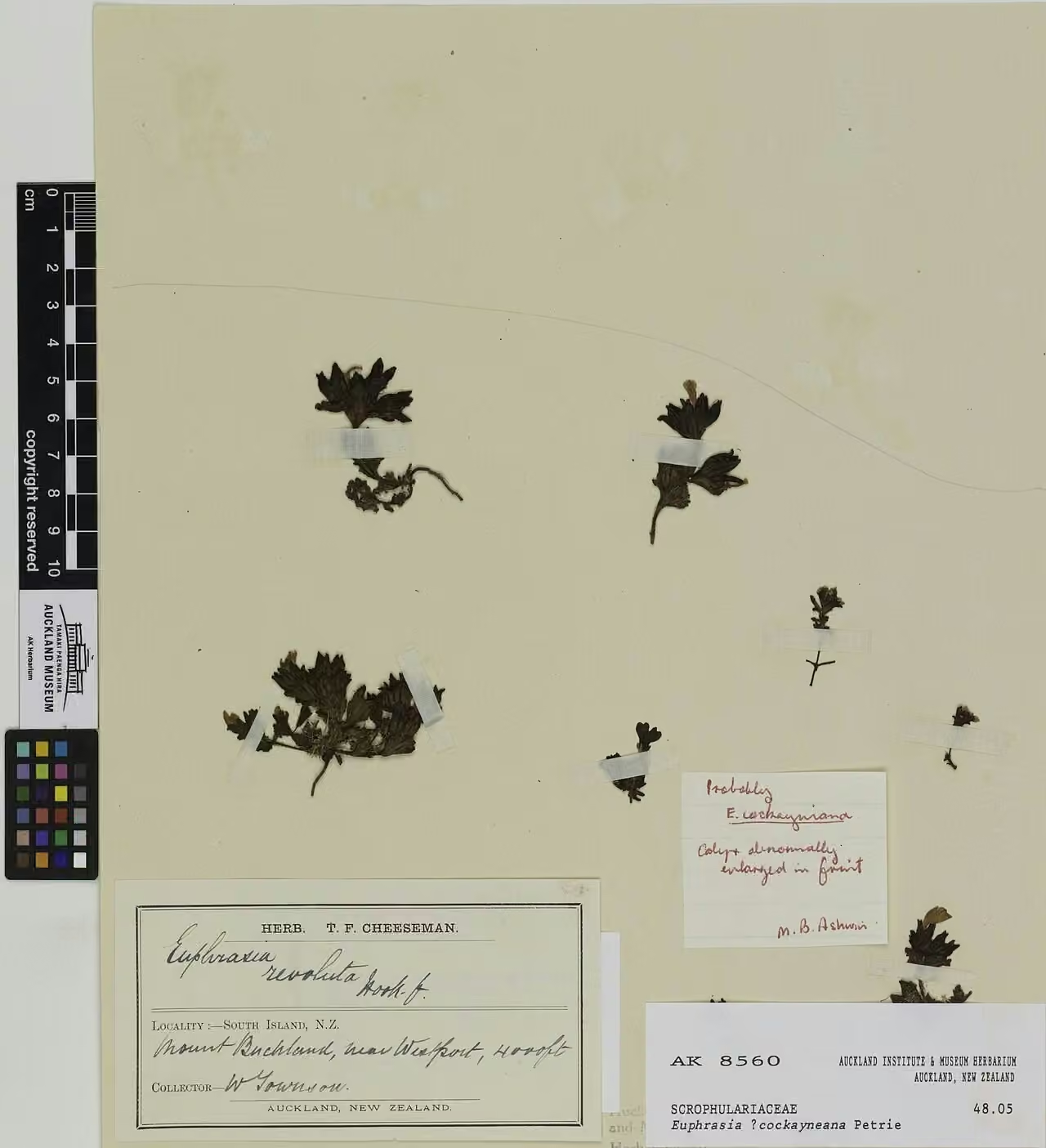
Yellow Eyebright
Euphrasia cockayneana
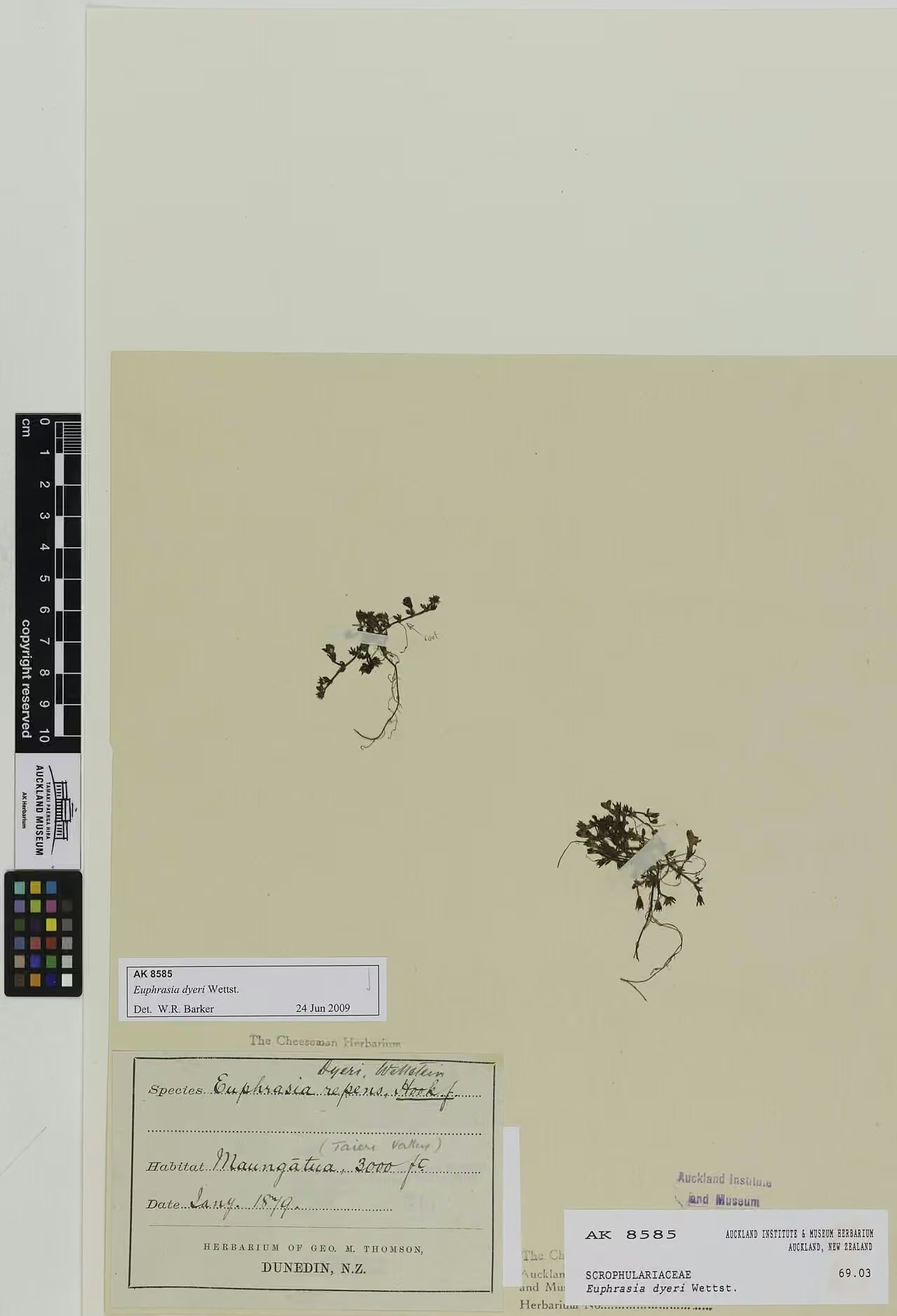
Creeping Eyebright
Euphrasia dyeri
Euphrasia integrifolia
Euphrasia integrifolia
Euphrasia townsonii
Euphrasia townsonii
Euphrasia zelandica
Euphrasia zelandica
Ewartia
Ewartiothamnus sinclairii
Serpentinite Fescue
Festuca ultramafica
Plant Conservation
Euphrasia repens was uplisted to Threatened - Nationally Vulnerable in 2023, with qualifiers Sp (sparse), RR (range restricted), DPS and DPT (data poor on population size and trend). Earlier assessments ranked it Range Restricted (2004), Naturally Uncommon (2009 and 2012) and Declining (2017).
Its restricted coastal range around Foveaux Strait leaves it exposed to anything that degrades open sand and coastal turf. Keeping vehicles off beaches and sand pans, controlling weeds that invade open coastal ground and surveying known sites would all help.
Frequently Asked Questions
Where does Euphrasia repens grow?
It grows only on the coasts of Foveaux Strait, from coastal Fiordland east to Toetoes Bay, and on the coasts and sand pans of Stewart Island/Rakiura and adjacent islets, in sandy, shingly and boggy places.
Is Euphrasia repens endangered?
It is ranked Threatened - Nationally Vulnerable in the 2023 New Zealand threat assessment, an uplisting from At Risk - Declining in 2017, with data on its population size and trend noted as poor.
How does Euphrasia repens differ from Euphrasia dyeri?
E. repens grows on coastal sand and usually creeps and roots to form tight mats with leaves 2.5 to 6 mm long, while E. dyeri grows in montane bogs, roots only slightly and is not mat-forming.
Is Euphrasia repens an annual?
Yes. NZPCN describes it as a slender succulent annual herb, so populations depend on seed being produced and germinating each year.
Sources and Further Reading
The botanical, growing, and conservation details for Eyebright (Euphrasia repens) on this page draw on the New Zealand plant references below. Consult them for full technical records and the latest distribution data.