Eyebright
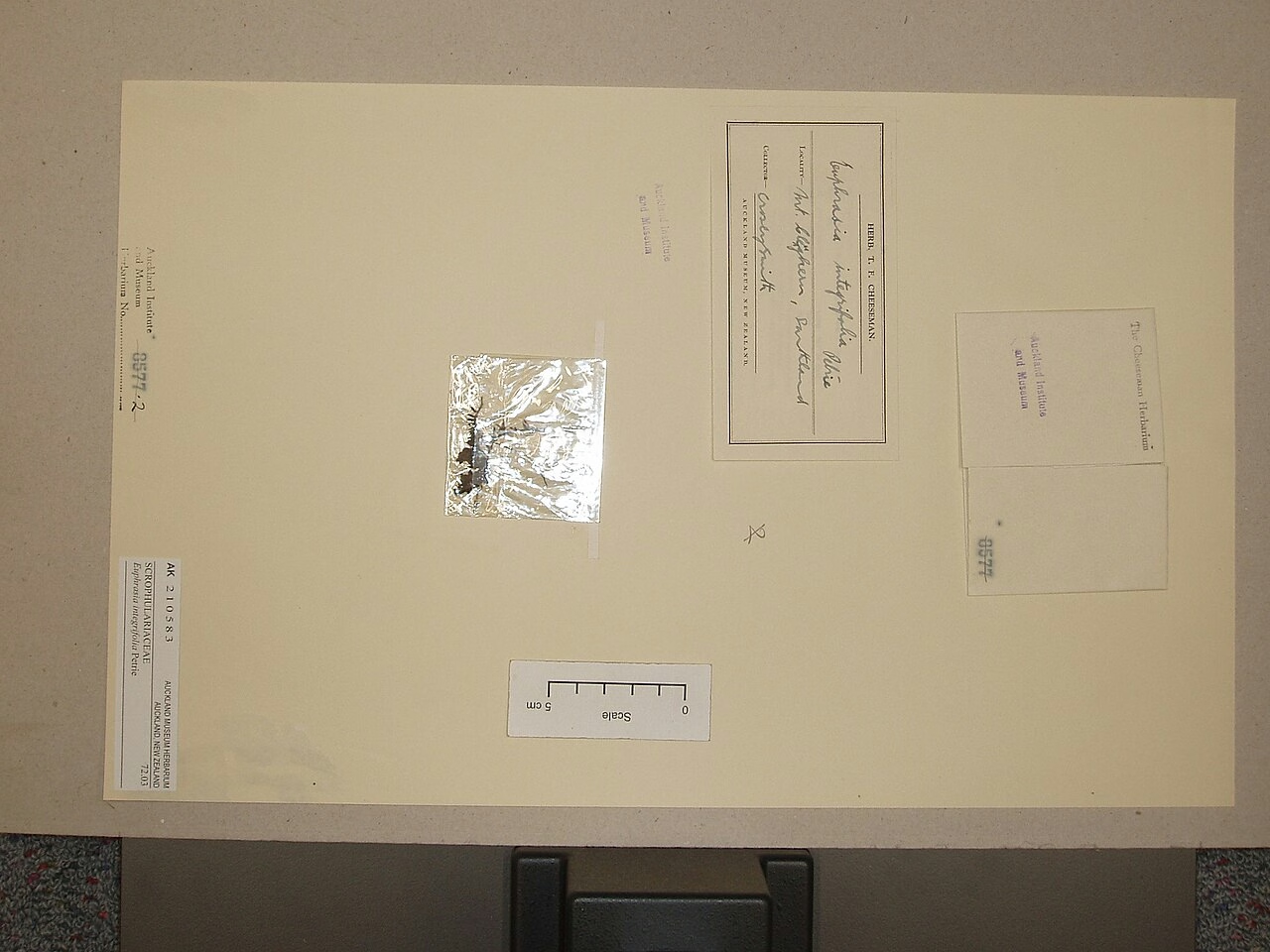
Euphrasia integrifolia
Last updated:
Euphrasia integrifolia is a diminutive, hairless, succulent eyebright endemic to the South Island and thought to be centred on Fiordland. It creeps across damp alpine meadows and bogs, its branches rooting at the nodes and turning up at the tips to form loose matted patches. Its succulent leaves are only 3 to 4 mm long, and it bears a few white flowers 8 to 13 mm long near the branch tips. Collections come from Wilmot Pass, Mt Cleughearn, Lake Hauroko and the Princess Range. It is ranked At Risk - Naturally Uncommon, but because it is so easily overlooked its true abundance is uncertain. Explore more native flowering plants in our native plant guide.
Plant Description
Euphrasia integrifolia is a tiny, prostrate, hairless and succulent herb that forms diffuse matted patches. Its branches root at the nodes as they creep and ascend at their tips. The leaves are succulent, stalkless, 3 to 4 mm long, obovoid with a drawn-out acute tip, and untoothed.
The flowers are few, near the branch tips, and either nearly stalkless or on stalks about as long as the leaves. The calyx is 3 to 5 mm long, divided halfway into sharp, triangular, succulent lobes. The corolla is white, 8 to 13 mm long, with a tube up to 10 mm long that far exceeds the calyx, and the lobes of the lower lip are up to 2 mm wide and entire. The anthers are brown with hairy margins.
NZPCN suggests its closest relative may be Euphrasia disperma, from which it differs in having branches that root abundantly as they creep and a shorter floral tube. Its hairless, untoothed, succulent leaves are another useful clue when examining it with a hand lens.
Quick Facts
| Scientific Name | Euphrasia integrifolia |
|---|---|
| Height | Prostrate, a few centimetres at most |
| Spread | Forms diffuse matted patches |
| Water Needs | Wet; damp alpine meadows and bogs |
| Light | Open alpine sites |
| Frost Tolerance | High; alpine |
| Salt Tolerance | No information available |
| Growth Rate | No information available |
| Lifespan | Not documented |
Climate Best Suited to
Suits the cold, extremely wet alpine climate of Fiordland, with heavy rainfall, frequent cloud and long winters.
Regional Suitability
| City | Climate Suitability |
|---|---|
| Auckland | Low |
| Wellington | Low |
| Christchurch | Low |
| Dunedin | Low |
Plant Habitat
Euphrasia integrifolia is endemic to the South Island and thought to occur only in Fiordland. Specimens have been collected from Wilmot Pass, Mt Cleughearn (the type locality), Lake Hauroko and the Princess Range. It has also been recorded, without specimens, from the Takitimu, Thomson, Garvie and Umbrella Mountains in Southland and the Old Man Range in Otago.
Its habitat is damp alpine meadows and bogs, where it creeps among low herbs, mosses and sedges. NZPCN reported in 2001 that it was common in some parts of Fiordland.
Growing Requirements
Soil Requirements
It roots into wet, peaty alpine soils in herbfield and bog.
- Saturated or constantly damp peat
- Low fertility
- Open turf where creeping stems can root
Light Requirements
Its alpine meadow and bog habitat is open and treeless.
- Full exposure in open alpine vegetation
- Not found under shrub cover
Water Requirements
Fiordland's very high rainfall keeps its alpine bogs and meadows wet year round.
- Requires constant moisture
- Unsuited to any site that dries in summer
Planting and Establishing
This species is not in cultivation and cannot be planted with any expectation of success. NZPCN states it is impossible to cultivate without a careful study of its host relationships.
Most of its known sites lie within Fiordland National Park, so the best way to encounter it is on alpine routes such as those near Wilmot Pass, keeping to tracks and leaving plants undisturbed.
Ecological Role
As a hemiparasite, Euphrasia integrifolia attaches to the roots of surrounding plants to supplement its own photosynthesis; the host species have not been identified. NZPCN records that its seeds are dispersed by wind, water and ballistic projection from the capsule.
Its white tubular flowers suggest insect pollination, but pollinators have not been studied. Flowering and fruiting times have also not been recorded, which shows how little is known about this small Fiordland plant.
Uses & Significance
Garden Uses
It has no garden use; it is a plant to record and protect in the wild.
- Not cultivated
- Valuable for alpine botanical surveys
- Worth photographing and reporting when found
Ecological Value
It is one of the distinctive small endemics of Fiordland's alpine wetlands.
- Range-restricted endemic of alpine bogs
- Root hemiparasite interacting with its host plants
- Adds to the diversity of alpine herbfield
Landscaping Uses
There is no landscaping role for this species, as it cannot be cultivated. Its conservation value is best served by keeping its alpine habitat intact.
Visitors to Fiordland's alpine meadows can help by avoiding off-track trampling of boggy ground, where small creeping plants such as this are easily crushed.
Seasonal Care Calendar
Spring
Snow melts from its alpine sites late in the season and growth resumes; details of its seasonal cycle are not documented.
- Sites may be snow-covered into late spring
Summer
Flowering is presumed to occur in summer, as in other alpine eyebrights, but NZPCN records no flowering period.
- Best season to search for it
Autumn
Capsules presumably ripen in late summer or autumn; fruiting times have not been recorded.
- Record any observations of fruit
Winter
Its alpine sites are cold and often snow-covered through winter.
- Not accessible or visible
When to Prune and How Much
No pruning applies to this wild alpine plant.
Do not pick or collect it; its status is uncertain and it should be left undisturbed.
How to Grow Eyebright
No propagation of Euphrasia integrifolia has been achieved or documented. NZPCN states plainly that, as a hemiparasite, it is impossible to cultivate without first undertaking a careful study of its host relationships. Its known sites are mostly in Fiordland National Park, where collecting requires a Department of Conservation permit. The notes below describe how such a study might begin, rather than a method gardeners can follow.
From Seed (Research Only)
The plant produces capsules with seeds that are dispersed by wind, water and ballistic projection. Seed would be the preferred material for any trial, since it avoids damaging wild plants. Seed timing would need to be established by field observation, because fruiting periods are not recorded.
A trial should pair seed with the plants that grow immediately beside it in the wild, recording which species seedlings attach to.
- Obtain a DOC permit before collecting anything in a national park
- Record the plant species growing in contact with wild Euphrasia integrifolia
- Collect a small amount of ripe seed when capsules split
- Sow on wet peat in pots containing those neighbouring species
- Keep pots cold, wet and in good light outdoors
- Document germination and host attachment to inform future work
From Rooted Stem Pieces (Untested)
Because its branches root at the nodes, rooted pieces could in principle be grown on with a host, but this has not been tried and would disturb wild plants, so it is not recommended outside a formal conservation programme.
- Use only with a permit and expert guidance
- Pot a rooted piece together with its surrounding host turf intact
Pests & Diseases
No pests or diseases are recorded for Euphrasia integrifolia.
Potential pressures on its habitat include trampling and browsing by introduced animals such as deer in alpine herbfields, though no specific impacts on this species have been documented.
Cultural Significance
No Māori name or traditional use is recorded for this species. The genus name Euphrasia means eye-medicine, a reference to European herbal traditions involving other eyebrights.
Its specific name, integrifolia, means entire-leaved, describing its small succulent leaves, which have smooth margins rather than the toothed leaves seen in many other New Zealand eyebrights.
Bonus Tip
If you are walking in Fiordland's alpine country and see a tiny white-flowered plant creeping and rooting through a wet meadow, look at the leaves: if they are succulent, hairless, 3 to 4 mm long and without teeth, you may have found Euphrasia integrifolia. A photo uploaded to iNaturalist NZ with location details is a valuable record of a poorly known species.
Related Plants
Explore other native plants that share similar characteristics or habitats with Eyebright (Euphrasia integrifolia), offering further insights into New Zealand's diverse flora. These related species provide context and opportunities for complementary planting in your garden.
Euchiton ruahinicus
Euchiton ruahinicus
Euphrasia cheesemanii
Euphrasia cheesemanii
Yellow Eyebright
Euphrasia cockayneana
Creeping Eyebright
Euphrasia dyeri
Euphrasia repens
Euphrasia repens
Euphrasia townsonii
Euphrasia townsonii
Euphrasia zelandica
Euphrasia zelandica
Ewartia
Ewartiothamnus sinclairii
Plant Conservation
Euphrasia integrifolia is ranked At Risk - Naturally Uncommon (2023), with qualifiers Sp (sparse), RR (range restricted), DPS (data poor: size) and DPT (data poor: trend). It is assessed this way because it has a small natural range in Fiordland and possibly nearby ranges, and because so little data exist.
NZPCN notes that its status is uncertain because it is small and easily overlooked, although it was reported as common in parts of Fiordland in 2001. Surveys to confirm the unvouchered Southland and Otago records would greatly improve knowledge of its range.
Frequently Asked Questions
Where is Euphrasia integrifolia found?
It is believed to occur only in Fiordland, with collections from Wilmot Pass, Mt Cleughearn, Lake Hauroko and the Princess Range, and unconfirmed sight records from Southland ranges and the Old Man Range.
Why can't Euphrasia integrifolia be cultivated?
NZPCN explains that it is a hemiparasite and is impossible to cultivate without first carefully studying which host plants it relies on.
What does integrifolia mean?
The Latin name means entire-leaved, describing its small succulent leaves, which have smooth margins without teeth.
Sources and Further Reading
The botanical, growing, and conservation details for Eyebright (Euphrasia integrifolia) on this page draw on the New Zealand plant references below. Consult them for full technical records and the latest distribution data.