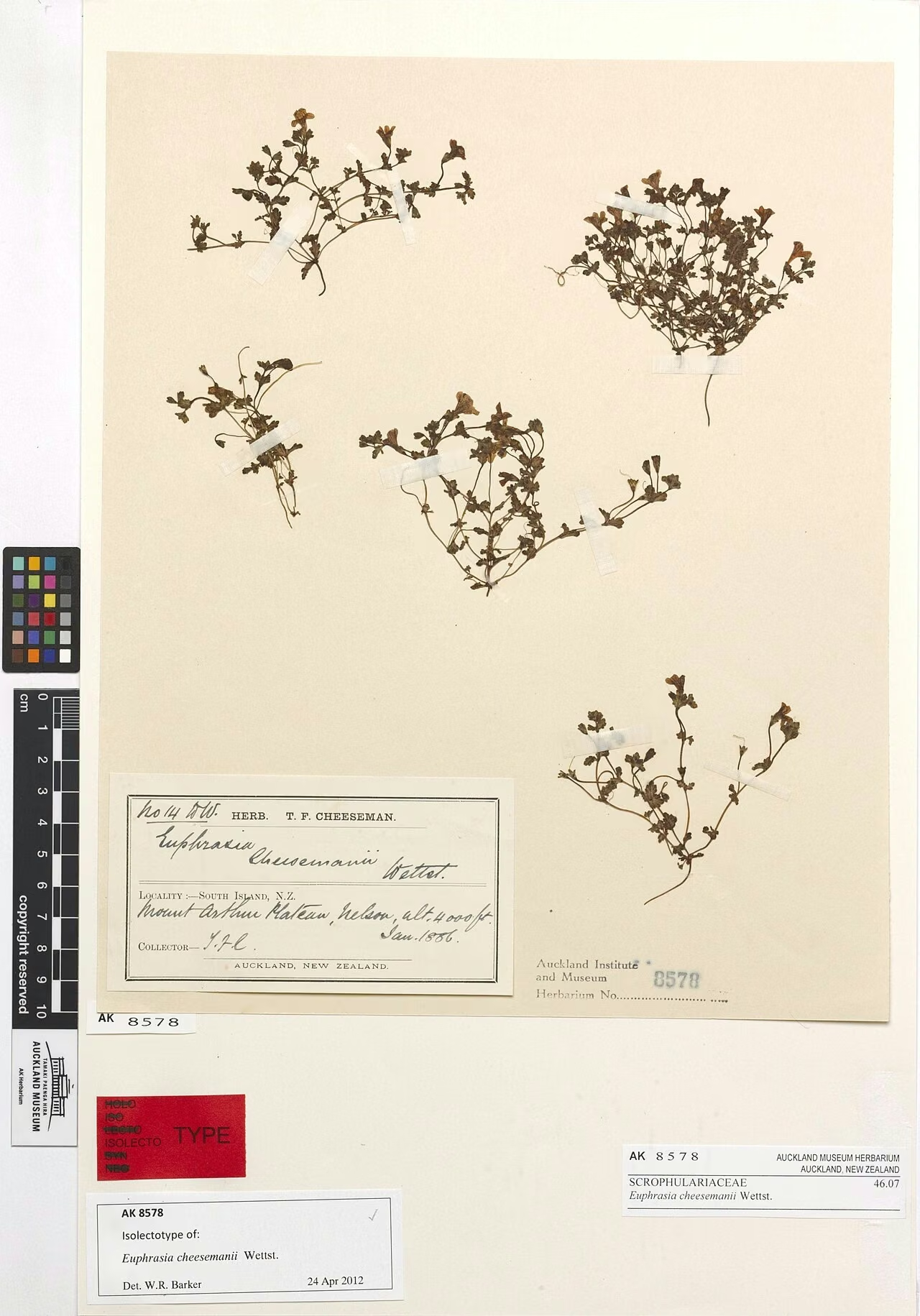
Eyebright
Euphrasia cheesemanii
Last updated:
Euphrasia cheesemanii is a delicate annual eyebright endemic to the South Island of New Zealand. It grows only 50 to 100 mm tall, with branching stems, small widely spaced scalloped leaves and a few white flowers 8 to 12 mm across scattered on the upper branches in summer. It is confined to montane and subalpine wet places and swamp margins from north-west Nelson to the Brunner Range and Mount Mantell. Like other eyebrights it is a hemiparasite, drawing some of its nutrients from neighbouring plants. Its narrow range has earned it a ranking of At Risk - Naturally Uncommon. Explore more native flowering plants in our native plant guide.
Plant Description
Euphrasia cheesemanii is a slender annual herb 50 to 100 mm tall, with stems that branch as they grow. The leaves are small, 4 to 10 mm long and 3 to 8 mm wide, set well apart along the stems, and have scalloped (crenate) margins with rounded teeth.
The flowers are white and 8 to 12 mm across, carried few at a time and scattered on the upper parts of the branches. As in other eyebrights, the two-lipped corolla is designed to be visited by insects. They are followed by small capsules that split to release tiny seeds.
Within its range it could be confused with forms of Euphrasia australis that have blunt leaf teeth. NZPCN states that E. cheesemanii differs in pubescence (the type and amount of hair), in the characters of its anthers and in its number of ovules, so careful examination with a lens is needed to confirm identification.
Quick Facts
| Scientific Name | Euphrasia cheesemanii |
|---|---|
| Height | 0.05-0.1 m |
| Spread | A single small branching plant, under 0.1 m |
| Water Needs | Wet; grows in wet ground and swamp margins |
| Light | Open, sunny wetland sites |
| Frost Tolerance | High; montane to subalpine |
| Salt Tolerance | No information available |
| Growth Rate | Fast; completes its life cycle in one season |
| Lifespan | Annual |
Climate Best Suited to
Suits the cool, very wet montane and subalpine climate of the north-western South Island, where rainfall is high and summers are mild.
Regional Suitability
| City | Climate Suitability |
|---|---|
| Auckland | Low |
| Wellington | Low |
| Christchurch | Low |
| Dunedin | Low |
Plant Habitat
Euphrasia cheesemanii is endemic to the South Island, where it ranges from north-west Nelson south to the Brunner Range and Mount Mantell in the Buller district.
It grows in montane to subalpine wet places and at the edges of swamps. These are open, damp sites with short vegetation, where a small annual can find light and the host plants it partly depends on.
Growing Requirements
Soil Requirements
It grows in wet, usually peaty or mineral-poor ground at swamp margins and seepages.
- Permanently damp, low-fertility soil
- Short, open vegetation that provides host roots
- No fertiliser: rich soils favour competing plants
Light Requirements
As a tiny annual it needs open sites where taller plants do not cast shade.
- Full sun in open wetland turf
- Shading by shrubs or rank grass suppresses it
Water Requirements
Its habitat stays wet through the growing season, which matches the high rainfall of north-west Nelson and Buller.
- Soil must not dry out while it is growing
- Drainage of wetlands removes its habitat
Planting and Establishing
Euphrasia cheesemanii is not grown in cultivation and should not be dug from the wild. As an annual hemiparasite, it cannot be transplanted successfully as an established plant; any attempt to grow it would need to start from seed sown among suitable host plants.
The best way to enjoy it is to look for it in flower between December and February in wet montane sites of north-west Nelson, taking care not to trample the fragile swamp margins.
Ecological Role
Eyebrights are hemiparasites: they photosynthesise but also attach to the roots of nearby plants, often grasses, to obtain water and nutrients. The particular hosts used by E. cheesemanii have not been documented. NZPCN records that its seeds are dispersed by wind, water and possibly ballistic projection from the opening capsule.
The white flowers are adapted for insect visitors, though the actual pollinators of this species have not been studied. As an annual, its persistence depends on setting seed every year, so it relies on open wet ground continuing to be available.
Uses & Significance
Garden Uses
It is not a garden plant. Its value lies in the wild wetland communities where it grows.
- Not available in nurseries
- Not suitable for transplanting
- Best appreciated in the field and through photographs
Ecological Value
As a narrow-range endemic it adds to the distinctive flora of north-west Nelson's mountain wetlands.
- Part of montane and subalpine wetland herb communities
- Hemiparasitism can reduce the vigour of dominant grasses, helping small herbs coexist
- A naturally uncommon species with a restricted range
Landscaping Uses
This species has no place in conventional landscaping because it cannot be reliably cultivated and lives for only one season. Wetland restoration within its range should focus on protecting existing hydrology and open turf rather than planting it.
Gardeners wanting the eyebright look should choose other natives that are occasionally grown by specialists, and accept that most Euphrasia are short-lived and difficult in cultivation.
Seasonal Care Calendar
Spring
Seeds shed the previous season germinate in the damp ground as temperatures rise.
- Seedlings are tiny and easily overlooked
Summer
Flowering runs from December to February, with a few white flowers scattered on the upper branches.
- Best time to look for and photograph it
Autumn
Capsules ripen from January to March and release seed before the plants die.
- The plant completes its life cycle
Winter
The species survives the cold months as seed in the soil.
- No living plants above ground
When to Prune and How Much
No pruning is required or appropriate. The plant is an annual that dies once its seed is shed.
Leaving dead plants in place in the wild allows any remaining seed to fall near the parent site.
How to Grow Eyebright
There is no published, proven method for growing Euphrasia cheesemanii. It reproduces only by seed, and as a hemiparasite it needs to attach to the roots of a host plant to grow well. NZPCN comments for a related New Zealand eyebright that these plants cannot be cultivated without first studying their host relationships. Any propagation should therefore be treated as an experiment, carried out with permission and using only a small amount of seed, ideally by a botanic garden or conservation programme rather than a home gardener.
From Seed with a Host Plant
Capsules ripen from January to March. Because the hosts of this species are not known, a trial would need to pair seed with short native grasses or sedges from the same wetland, sown together so that seedlings can find host roots soon after germination.
Germination requirements have not been studied for this species. Sowing in autumn and leaving pots outdoors over winter exposes seed to natural cool, moist conditions similar to those in the wild. Expect low success rates at first.
- Obtain permission before collecting any seed
- Collect a few ripe capsules just as they begin to split
- Establish small native grasses in a pot of damp, low-fertility peaty mix
- Sprinkle the seed onto the surface around the host plants
- Keep the pot constantly moist and outdoors in a cool, bright place
- Record germination, host contact and flowering to build knowledge of the species
Pests & Diseases
No pests or diseases are recorded for Euphrasia cheesemanii.
Its main pressures are habitat-related: changes to drainage, trampling of wet ground and invasion of swamp margins by taller weeds that shade out small annuals.
Cultural Significance
No Māori name or traditional use has been recorded for this species. The genus name Euphrasia means eye-medicine, from the use of European eyebright in herbal remedies for the eyes, a tradition that does not relate to New Zealand species.
The species commemorates Thomas Frederick Cheeseman, curator of the Auckland Museum and author of the 1906 Manual of the New Zealand Flora, one of the foundational works of New Zealand botany.
Bonus Tip
If you find a small white eyebright in a north-west Nelson wetland, photograph the leaves from above and the hairs on the stems and calyx with a close-up lens before uploading it to iNaturalist NZ. These details are what separate E. cheesemanii from blunt-toothed forms of E. australis, and good records help track this naturally uncommon plant.
Related Plants
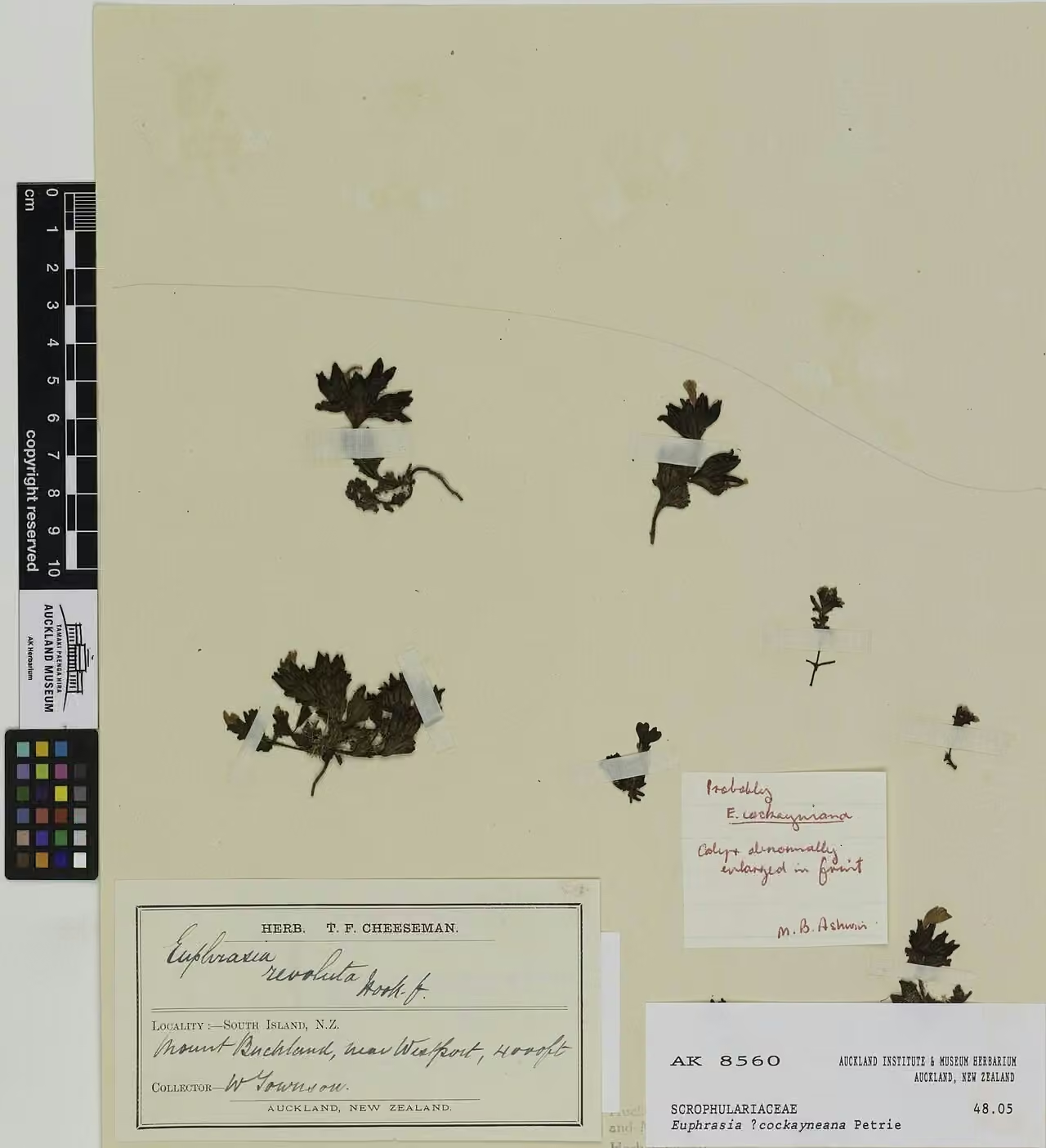
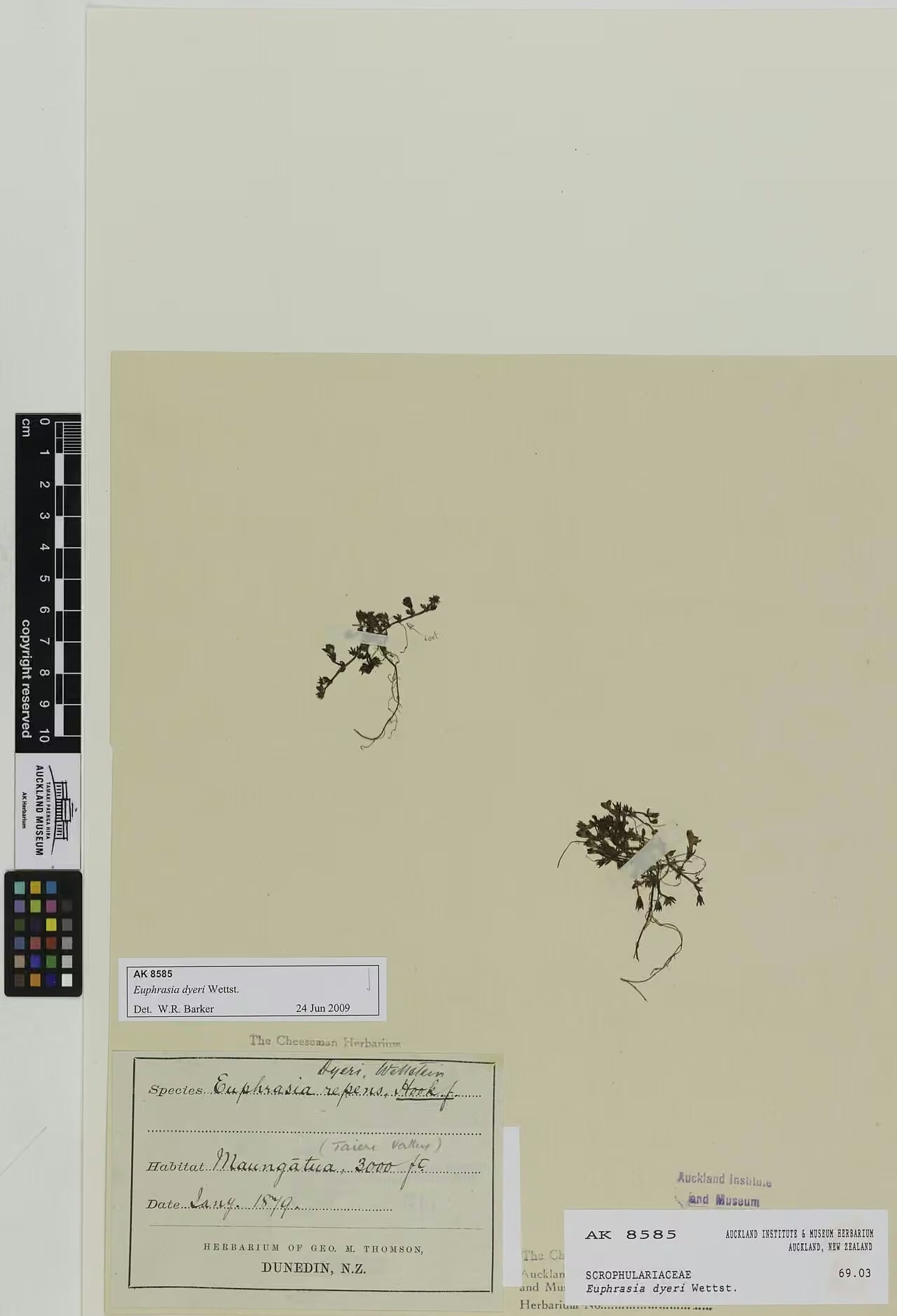
Explore other native plants that share similar characteristics or habitats with Eyebright (Euphrasia cheesemanii), offering further insights into New Zealand's diverse flora. These related species provide context and opportunities for complementary planting in your garden.
Plant Conservation
Euphrasia cheesemanii is ranked At Risk - Naturally Uncommon (2023) with the qualifier RR, Range Restricted. It was listed as Not Threatened from 2004 to 2017, and the change reflects better appreciation of how limited its range is.
Because it lives in a small area of montane and subalpine wetland, anything that alters water levels or allows weeds to invade could affect it. Protecting wetland hydrology, avoiding damage from vehicles and stock, and recording populations are the main actions that help.
Frequently Asked Questions
Where does Euphrasia cheesemanii grow?
It is found only in the north-western South Island, from north-west Nelson south to the Brunner Range and Mount Mantell, in montane to subalpine wet places and around the edges of swamps.
Who is Euphrasia cheesemanii named after?
It honours Thomas Frederick Cheeseman (1846-1923), the Auckland Museum botanist who wrote the 1906 Manual of the New Zealand Flora.
How can you tell Euphrasia cheesemanii from Euphrasia australis?
Some forms of E. australis with blunt leaf teeth look similar, but NZPCN notes that E. cheesemanii differs in its hairiness, its anther characters and the number of ovules in the capsule.
Sources and Further Reading
The botanical, growing, and conservation details for Eyebright (Euphrasia cheesemanii) on this page draw on the New Zealand plant references below. Consult them for full technical records and the latest distribution data.