Cudweed
Euchiton limosus
Last updated:
Euchiton limosus is a stoloniferous perennial cudweed in the daisy family, native to New Zealand's North and South Islands and also to south-eastern Australia, where it is called swamp cudweed. As its name, meaning growing in mud, suggests, it is a wetland plant of swamps, stream margins and wet ground. Its stems are 10 to 50 cm tall, decumbent to erect and sometimes much-branched, with narrow leaves that are hairless above and densely white-felted beneath, ending in dense, globular clusters of tiny flower heads. It is ranked Not Threatened nationally, though it is regarded as naturally uncommon in Northland. Explore more native ground covers in our native plant guide.
Plant Description
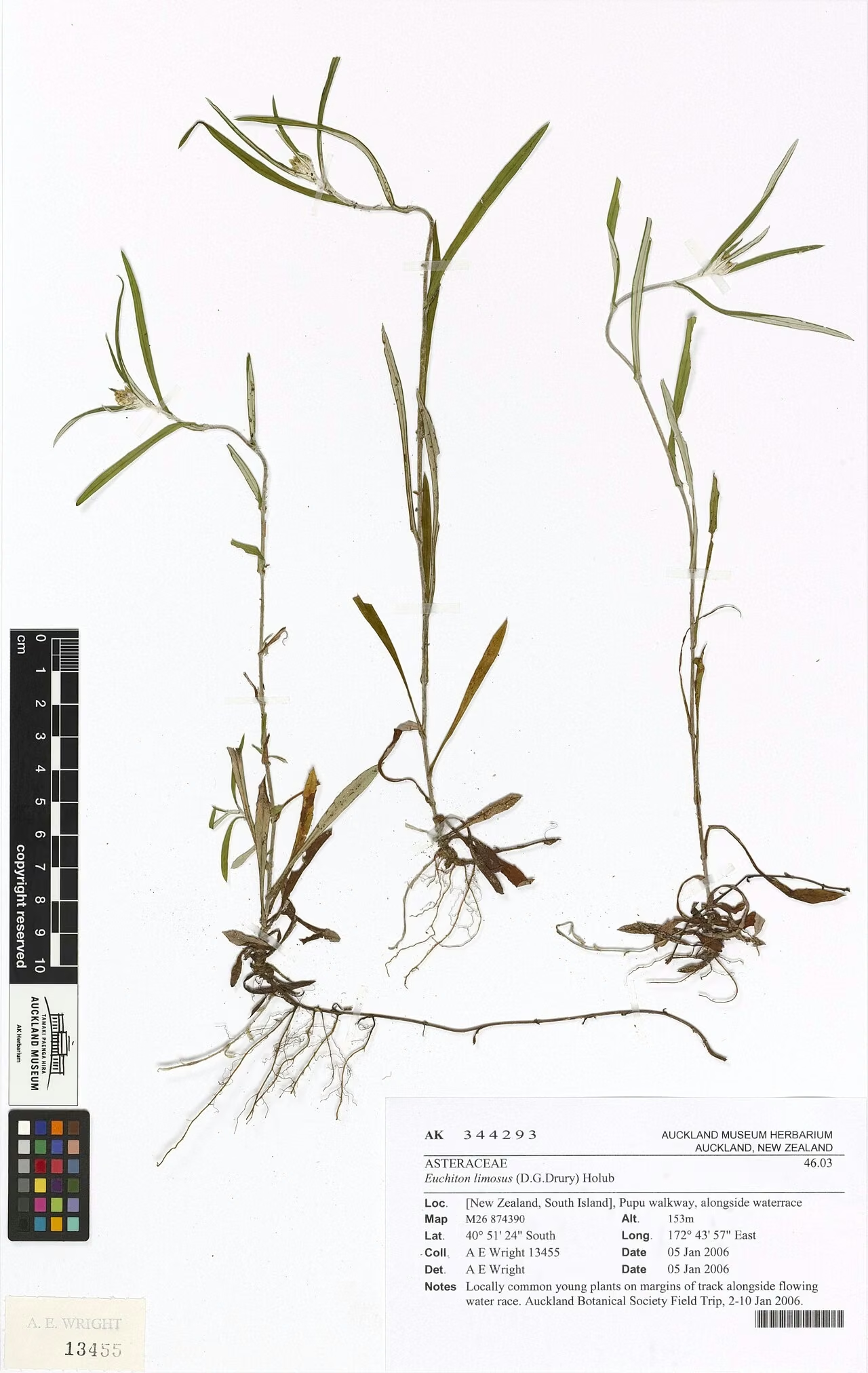
Euchiton limosus is a stoloniferous perennial with one to many stems that are decumbent to erect, usually simple but sometimes much-branched, about 10 to 50 cm tall. The leaves are narrow-oblong to oblanceolate, mostly 15 to 50 mm long, hairless on the upper surface and densely white-tomentose underneath. Australian descriptions note that stem leaves alternate up the stems with ear-shaped (auriculate) bases, and that the basal leaves wither early.
The flower heads are tiny, about 1 to 2 mm in diameter and 3 to 4 mm long, with six to numerous heads crowded into dense, globular terminal clusters about 5 to 15 mm across. The involucral bracts are elliptic, blunt to notched at the tip and 3.2 to 4 mm long. The heads look purplish rather than showy, and the small fruits carry a pappus.
Its leafy, often branched stems, early-withering basal leaves and wetland habitat separate it from the rosette-forming creeping cudweeds such as Euchiton japonicus and Euchiton audax, which keep their basal leaves and favour drier, open ground.
Quick Facts
| Scientific Name | Euchiton limosus |
|---|---|
| Height | 0.1-0.5 m |
| Spread | Sprawling patches via stolons |
| Water Needs | High; swamps and wet margins |
| Light | Full sun to partial shade |
| Frost Tolerance | Moderate |
| Salt Tolerance | Low; recorded behind coastal dunes but not on the shore itself |
| Growth Rate | Moderate |
| Lifespan | Perennial |
Climate Best Suited to
Suits mild to cool, moist climates with permanently wet ground; it relies more on site wetness than on regional rainfall.
Regional Suitability
| City | Climate Suitability |
|---|---|
| Auckland | Medium |
| Wellington | High |
| Christchurch | Medium |
| Dunedin | Medium |
Plant Habitat
Euchiton limosus is indigenous to the North and South Islands of New Zealand and is also native to south-eastern Australia, including the New South Wales tablelands, Kosciuszko National Park and the ACT. New Zealand herbarium records come from places including the Rangitoto Range, the Wellington and Gisborne regions and Westland.
It is a wetland plant of swamps, stream margins and wet ground, and in Australia also grows in rainforest. New Zealand collections include grazed swamps behind coastal dunes, open edges of swampy ground and even artificial swamps on farms at forest boundaries.
Growing Requirements
Soil Requirements
It roots into wet, often muddy soils in swamps and along streams, and tolerates periodic saturation.
- Wet silt, mud or peaty loam
- Tolerates poorly drained ground
- Benefits from some organic matter
Light Requirements
It grows on open swamp edges and stream margins, and in Australia also in rainforest, so it handles both sun and part shade.
- Full sun to partial shade
- Avoid deep shade under dense cover
- Open swamp edges suit it well
Water Requirements
Consistently wet conditions are essential; this is not a plant for dry beds.
- Keep soil wet or saturated
- Suits pond margins, rain gardens and swales
- A pot standing in a saucer of water works well
Planting and Establishing
Plant in spring into the damp margin of a pond, swale or bog garden, at a level where the soil stays wet but the crown is not permanently submerged. Space plants about 20 to 30 cm apart.
Because it can be overtopped by vigorous wetland grasses and sedges, place it where it will have some open space, such as the shallow, frequently disturbed edge of a wetland.
Ecological Role
Its tiny, clustered flower heads are visited by small insects, though no specific pollinator studies were found. NZPCN records that its pappus-bearing seeds are dispersed by wind and water, which suits a plant that colonises the edges of swamps and streams.
It is one of the small native herbs of open wetland margins, a habitat much reduced in New Zealand by drainage. Its appearance in farm swamps shows it can persist in modified wetlands where competition is kept low.
Uses & Significance
Garden Uses
Euchiton limosus is a modest plant suited to wetland restoration and native bog gardens rather than ornamental borders.
- Bog gardens and pond edges
- Rain gardens and stormwater swales
- Wetland restoration plantings within its range
Ecological Value
It adds diversity to the low herb layer of native wetlands.
- Native component of swamp and stream-margin communities
- Colonises bare wet ground after disturbance
- Small flowers for wetland insects
Landscaping Uses
Use it as an informal filler between clumps of native sedges and rushes at the wet edge of a pond, where its white-backed leaves add a soft silver tone.
It is not a feature plant, but in larger wetland restorations it helps create a natural, layered look in the low herb zone.
Seasonal Care Calendar
Spring
New stems grow up from the stolons and leaves expand.
- Plant into wet margins
- Clear smothering weeds
Summer
Dense clusters of purplish flower heads form; New Zealand flowering months are not given in the sources consulted, and in New South Wales it flowers throughout the year.
- Keep the soil wet in dry spells
- Watch for seed heads fluffing up
Autumn
Seed disperses on wind and water and stolons continue to spread.
- Collect seed if wanted
- Divide established patches
Winter
Growth slows; plants persist in wet ground.
- Little care needed
- Avoid trampling saturated margins
When to Prune and How Much
No pruning is required. Cut back old flowering stems once seed has been shed if you want a tidier wetland edge.
Thin out neighbouring grasses and sedges if they begin to overwhelm the patch, rather than cutting the cudweed itself.
How to Grow Cudweed
No specific propagation notes for Euchiton limosus were found in NZPCN or the Flora of New Zealand. The methods below follow from its known features: it is stoloniferous, so it can be divided, and it produces small pappus-bearing seeds dispersed by wind and water. Like other wetland herbs, both seedlings and divisions should be kept constantly moist. Collect only from cultivated plants or, with permission, from abundant wild populations, and use local material for restoration projects. Divisions usually establish faster than seedlings.
From Seed
Seed is produced in the dense terminal clusters and is easily blown away when ripe, so gather heads just as they become fluffy.
- Cut ripe flower clusters into a paper bag
- Rub out the seed and sow on the surface of a moist, fine seed mix
- Do not cover the seed; press it lightly onto the mix
- Stand the tray in a shallow dish of water so the mix stays wet
- Pot up seedlings when they have several leaves and keep them standing in water
By Division of Stolons
Established plants spread by stolons, and rooted sections can be separated to start new patches.
- In spring, lift a section of an established clump with its rooted stolons
- Cut it into pieces, each with roots and some shoots
- Pot into a wet, organic potting mix or plant straight into a wet margin
- Keep saturated until new growth shows the pieces have established
Pests & Diseases
No specific pests are recorded for this species. Slugs and snails may graze young shoots in damp conditions.
In the wild, the main pressures are competition from vigorous wetland weeds and grasses, and loss of habitat through drainage, rather than pests.
Cultural Significance
No traditional Māori name or use for Euchiton limosus was found in the sources consulted.
It was first described by D.G. Drury in 1972 as Gnaphalium limosum in the New Zealand Journal of Botany, and was later moved to Euchiton by Holub. The genus name comes from the Greek eu (good) and chiton (tunic or covering).
Bonus Tip
When you find a cudweed in a swamp with leafy stems but no basal rosette, turn over a stem leaf: a white-felted underside with ear-shaped lobes clasping the stem is a strong pointer to Euchiton limosus rather than the rosette-forming lawn cudweeds.
Related Plants
Explore other native plants that share similar characteristics or habitats with Cudweed (Euchiton limosus), offering further insights into New Zealand's diverse flora. These related species provide context and opportunities for complementary planting in your garden.
Wilson's Willowherb
Epilobium wilsonii
Eryngium undulatum
Eryngium undulatum
Euchiton audax
Euchiton audax
Euchiton paludosus
Euchiton paludosus

Native Cudweed
Euchiton polylepis
Euchiton ruahinicus
Euchiton ruahinicus
Euphrasia cheesemanii
Euphrasia cheesemanii
Involucratus Plant
Involucratus Plant
Plant Conservation
Euchiton limosus is ranked Not Threatened (2023) and has been assessed as Not Threatened in every assessment since 2004. Regionally it is At Risk - Regionally Naturally Uncommon in Northland (2026), Data Deficient in Auckland and Not Threatened in Otago and Wellington (2025).
Because it depends on wetlands, protecting and restoring swamps and stream margins, and controlling invasive wetland weeds, is the most effective way to support it.
Frequently Asked Questions
What does limosus mean in Euchiton limosus?
The epithet limosus means growing in mud, which reflects its preference for swamps, stream margins and other wet ground.
Is Euchiton limosus a wetland plant?
Yes. NZPCN gives it a wetland indicator status of Facultative Wetland, meaning it is usually a hydrophyte but is occasionally found away from wetlands.
How is Euchiton limosus different from other New Zealand cudweeds?
It is a taller cudweed of wet ground, with stems up to 50 cm that are often decumbent or much-branched, leaves white-felted beneath with ear-shaped bases, and basal leaves that wither early, unlike the persistent rosettes of creeping cudweeds.
Is Euchiton limosus native to New Zealand?
Yes. It is indigenous to the North and South Islands but not endemic, since it also grows naturally in south-eastern Australia.
Sources and Further Reading
The botanical, growing, and conservation details for Cudweed (Euchiton limosus) on this page draw on the New Zealand plant references below. Consult them for full technical records and the latest distribution data.