Rock Willowherb
Epilobium petraeum
Last updated:
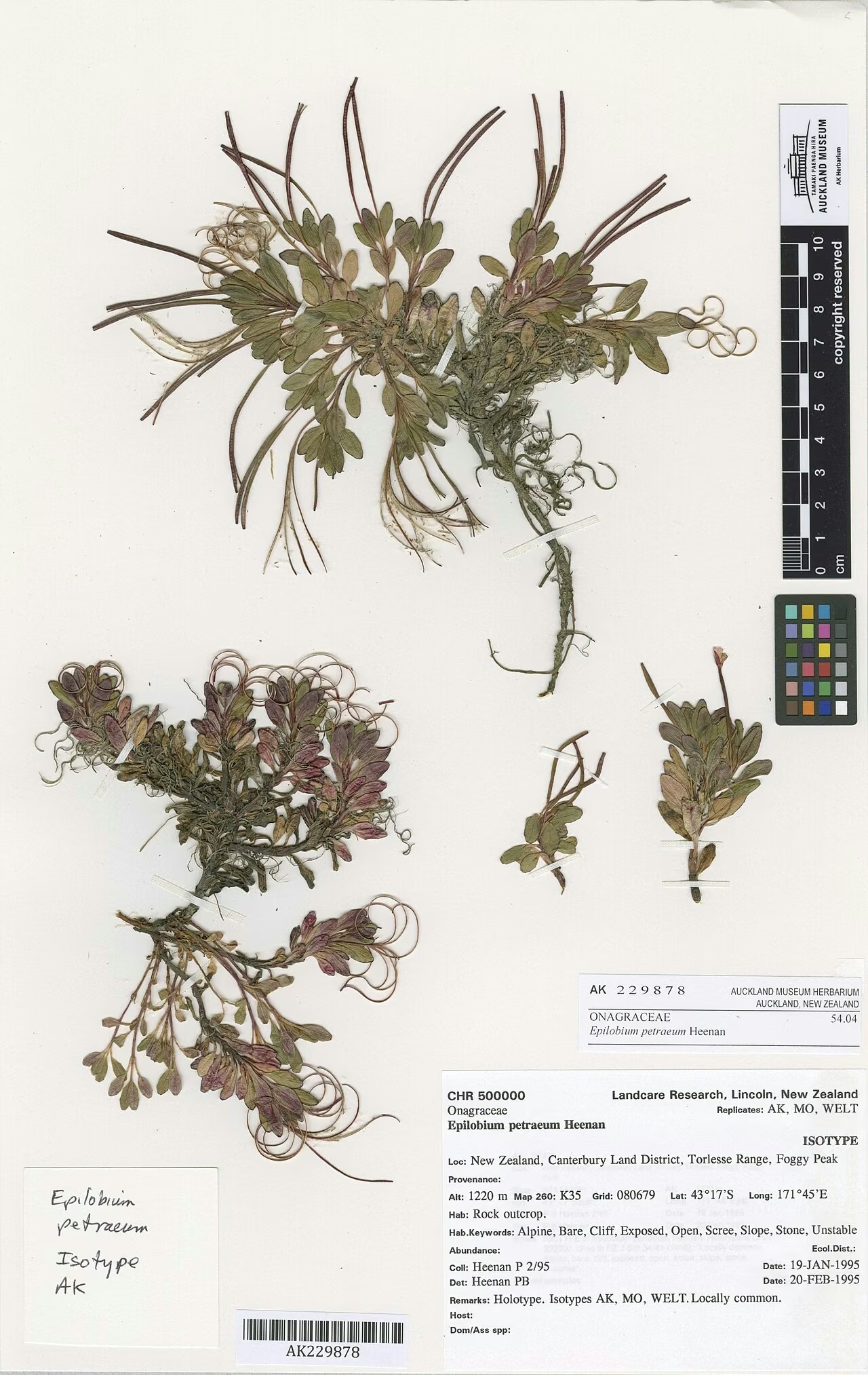
Rock willowherb (Epilobium petraeum) is a compact, hairless alpine willowherb endemic to the South Island, forming low shrublets up to 40 cm across and about 10 cm tall. Its erect red stems carry glossy, dark green leaves with red midribs and margins, white flowers open from pink buds in December and January, and its long capsules and their stalks turn scarlet. It grows on exposed, steep greywacke outcrops and scree from Mt Fyffe in the Kaikoura Ranges south to the Mt Cook region. It was described by Peter Heenan in 1996 and is ranked At Risk - Naturally Uncommon. Explore more native flowering plants in our native plant guide.
Plant Description
Epilobium petraeum is a compact, densely spreading, entirely hairless herb forming shrublets up to 40 cm across and about 10 cm tall. Older stems are prostrate or spreading, while new stems are erect and red, and they do not root at the nodes. The leaves are opposite, glossy, ovate to broadly elliptic, 15 to 24 mm long and 4 to 7 mm wide, dark green above and sometimes flushed red, red beneath, usually with a red margin and midrib, three to five teeth on each side, and a blunt or slightly notched tip. Slender channelled leaf stalks 5 to 7 mm long hold the leaves, which are longer than the gaps between them.
Flowers are borne conspicuously at the top of the stems. Pink buds open to erect white flowers with four obovate petals 5 to 6 mm long and red sepals. The capsules are 35 to 55 mm long and, together with their 10 to 24 mm stalks, turn scarlet-red, releasing pale brown seeds with a white tuft of hairs. It flowers in December and January and fruits from January to March.
It is most similar to E. brevipes, a shrubby willowherb of similar habitats. E. brevipes has leaves that become alternate towards the stem tips, narrower leaves with pointed tips bearing a gum-like apiculus, and a minute tuft of hairs where leaf meets stem.
Quick Facts
| Scientific Name | Epilobium petraeum |
|---|---|
| Height | Up to 0.1 m |
| Spread | Up to 0.4 m |
| Water Needs | Low to moderate; sharp drainage |
| Light | Full sun |
| Frost Tolerance | High; high alpine |
| Salt Tolerance | No information available |
| Growth Rate | Slow to moderate |
| Lifespan | Perennial |
Climate Best Suited to
Suits cold, dry-to-moist high alpine climates with bright sun and cold winters east of the Main Divide. NZPCN notes it is intolerant of warm, humid climates.
Regional Suitability
| City | Climate Suitability |
|---|---|
| Auckland | Low |
| Wellington | Low |
| Christchurch | Medium |
| Dunedin | Medium |
Plant Habitat
Rock willowherb is endemic to the South Island, ranging from the Kaikoura Ranges (Mt Fyffe) south to the Mt Cook region of Canterbury. NZPCN describes it as a widespread but naturally uncommon, biologically sparse species of high alpine rock habitats.
It grows on exposed, steep, partially stable and sparsely vegetated greywacke rock outcrops, on stable to partially stable scree in and around the margins of outcrops, and occasionally on partially stable, exposed stream margins.
Growing Requirements
Soil Requirements
In the wild it roots into greywacke rock and scree. NZPCN recommends a fertile but free-draining soil in cultivation.
- Gritty, free-draining mix
- Moderate fertility
- No standing water around the crown
Light Requirements
It grows on exposed outcrops and does best in full sun.
- Full sun
- Open, airy site
Water Requirements
Scree and rock outcrops drain rapidly but may stay cool and moist below the surface. Aim for even moisture with perfect drainage.
- Water in dry spells
- Avoid wet foliage in humid weather
- Use free-draining pots
Planting and Establishing
Grow rock willowherb in a pot in an alpine house or in a sunny rock garden, as NZPCN suggests, using a fertile but free-draining gritty mix. Crevices between rocks or a raised scree bed suit its compact habit.
Avoid warm, humid, sheltered spots; in northern districts it is best kept in an alpine house with plenty of ventilation.
Ecological Role
Rock willowherb is part of the sparse plant life of eastern South Island greywacke outcrops and scree, where few plants can establish on the steep, shifting ground. Its minute seeds have a tuft of hairs and are dispersed by wind (Thorsen et al. 2009), allowing it to reach scattered rock habitats.
The insects that pollinate its white flowers are not recorded in the sources consulted.
Uses & Significance
Garden Uses
An attractive specimen for alpine collectors, valued for its red stems, glossy foliage and scarlet capsules.
- Alpine house pots
- Rock and crevice gardens
- Scree beds in cool districts
Ecological Value
It is one of the specialised plants of high alpine greywacke rock in the eastern South Island.
- Endemic to the eastern South Island
- Colonises unstable rock and scree
- Range-restricted and naturally sparse
Landscaping Uses
Place rock willowherb where its red stems and scarlet seed capsules can be seen against grey stone, such as at the front of a raised rock bed or in a shallow trough.
Its compact, glossy mounds contrast well with grey-leaved alpine daisies and cushion plants that share its needs.
Seasonal Care Calendar
Spring
New red stems push up from the spreading older growth.
- Top-dress with grit
- Begin light watering
Summer
Pink buds open to white flowers in December and January.
- Ensure good ventilation
- Water in dry spells
Autumn
Capsules and their stalks turn scarlet and split from January to March.
- Collect seed from cultivated plants
- Sow fresh
Winter
The plant rests through cold weather, which it tolerates well.
- Keep potted plants dry-ish
- No feeding
When to Prune and How Much
Pruning is rarely needed. Cut away spent fruiting stems once the seed has been shed if you want a neater mound.
Remove any old stems that have died back, cutting cleanly to healthy growth.
How to Grow Rock Willowherb
NZPCN describes rock willowherb as easily grown in a pot kept in an alpine house or in a rock garden, preferring fertile, free-draining soil and full sun, and intolerant of warm, humid climates. It does not set out a specific method, but seed is the natural route: plants flower in December and January and ripen capsules between January and March, and the pale brown seeds carry a tuft of hairs that detaches easily. Unlike the creeping willowherbs, its stems do not root at the nodes, so division is not practical, but short cuttings of new stems are worth trying, as with other shrubby willowherbs. As an At Risk species of hard-to-reach alpine rock, source seed or cuttings from cultivated plants rather than wild populations.
From Seed
Collect seed from cultivated plants as the scarlet capsules split in late summer.
- Gather capsules as they begin to open between January and March
- Sow seed fresh on the surface of a gritty seed mix
- Keep the tray cool, bright and well ventilated
- Keep just moist, never sodden
- Pot seedlings into gritty, fertile mix once they have a few leaf pairs
From Cuttings
Short tips of new, non-flowering stems can be tried in late spring.
- Take 3 to 4 cm tips of non-flowering red stems
- Remove the lowest pair of leaves
- Insert into pumice or coarse sand
- Keep cool and lightly moist in good light, without a humid cover
- Pot on once roots form
Pests & Diseases
No specific pests or diseases are recorded for rock willowherb in the sources consulted. NZPCN notes its intolerance of warm, humid climates, where rot and mildew are the likely problems.
In the wild, NZPCN lists no specific threats and reports no evidence of decline.
Cultural Significance
No traditional Māori name or use is recorded for Epilobium petraeum in the sources consulted.
It is a recent addition to the New Zealand flora, described as a new species by Peter Heenan in 1996. The epithet petraeum means rock-loving, a reference to its greywacke outcrop habitat.
Bonus Tip
For the best colour, grow rock willowherb in full sun in a lean but fertile gritty mix: the red stems, red leaf undersides and scarlet capsules that distinguish this species are most striking when the plant is grown hard in bright, cool conditions.
Related Plants
Explore other native plants that share similar characteristics or habitats with Rock Willowherb (Epilobium petraeum), offering further insights into New Zealand's diverse flora. These related species provide context and opportunities for complementary planting in your garden.
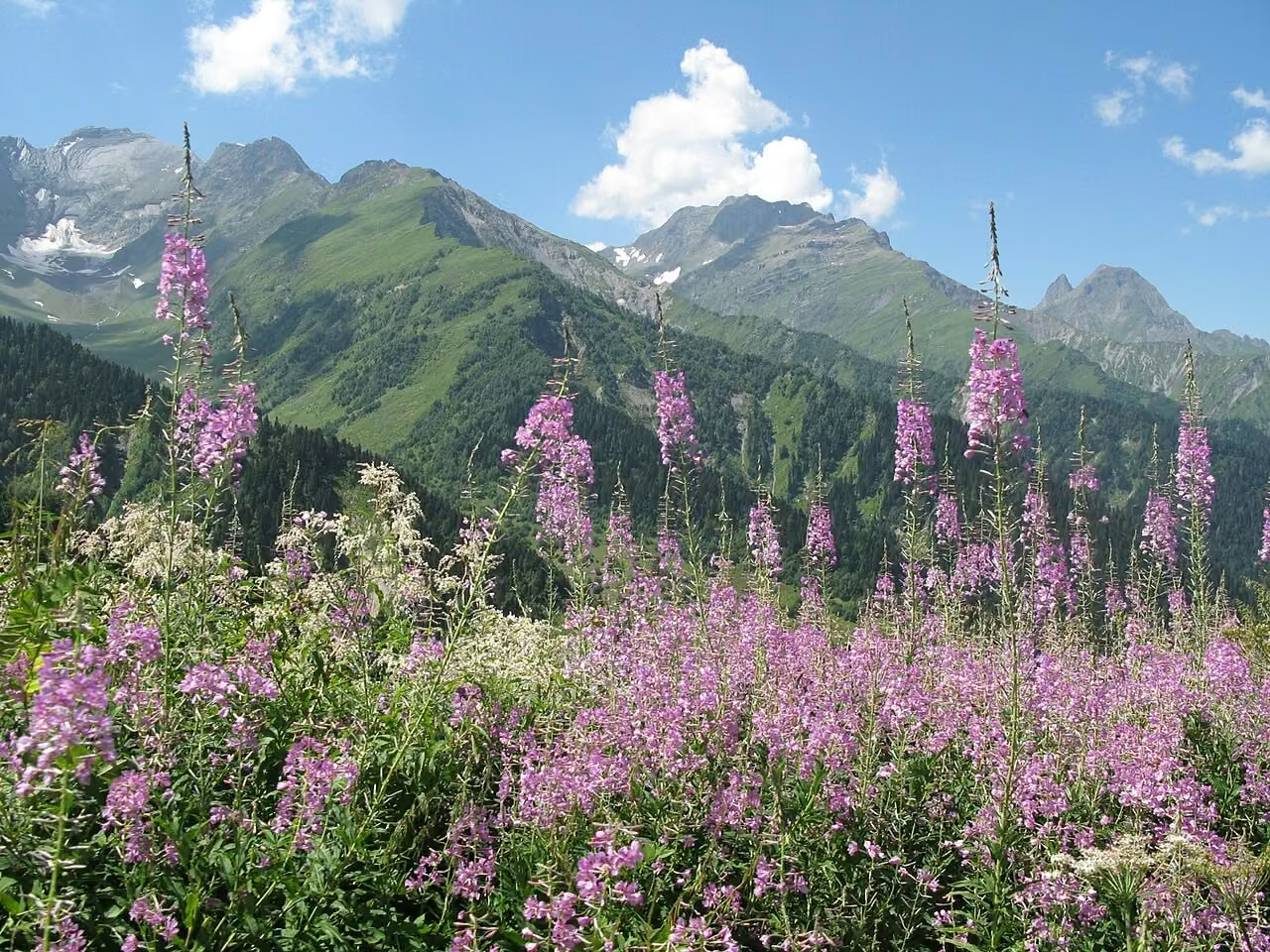
Epilobium microphyllum
Epilobium microphyllum
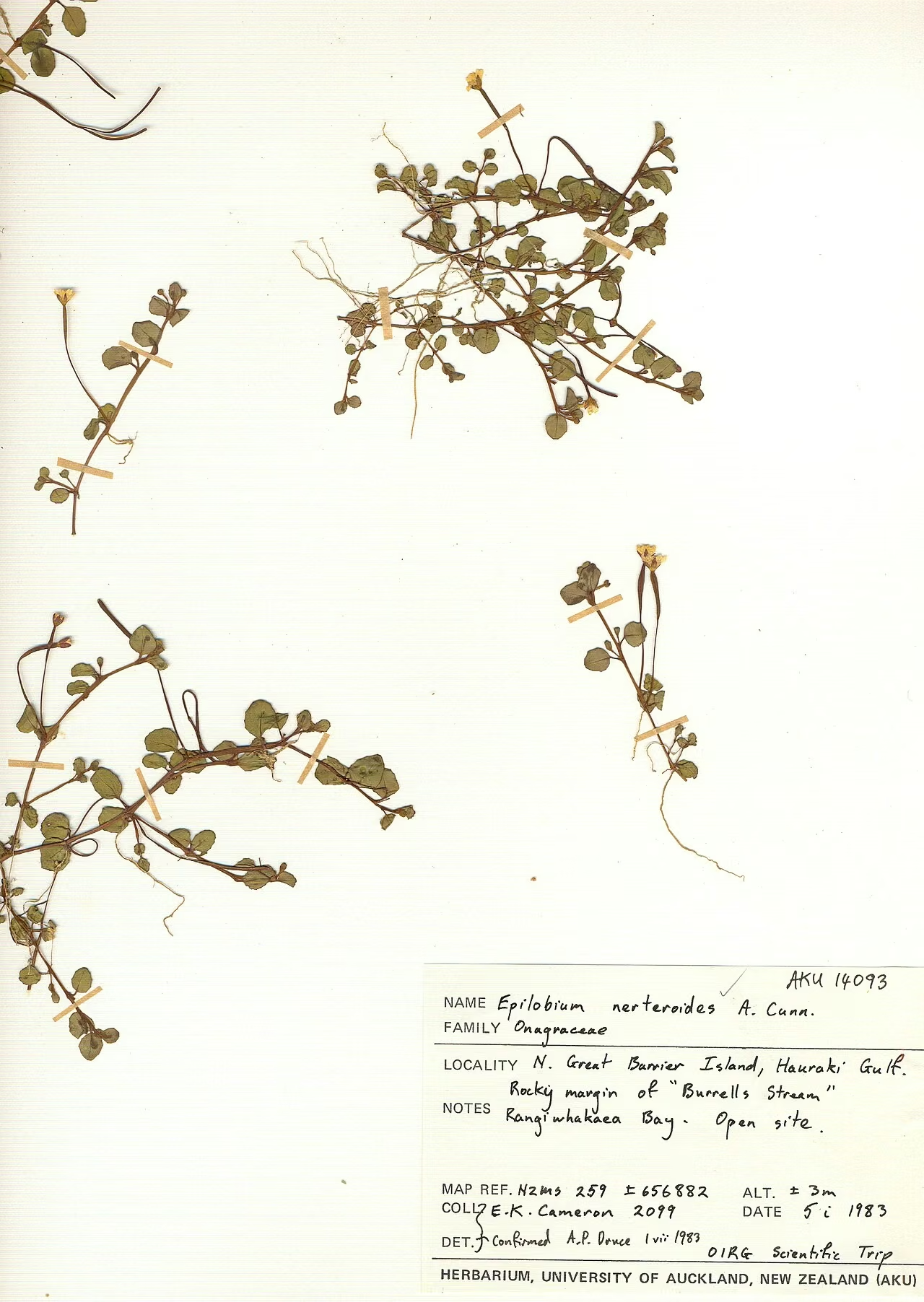
Epilobium nerteroides
Epilobium nerteroides
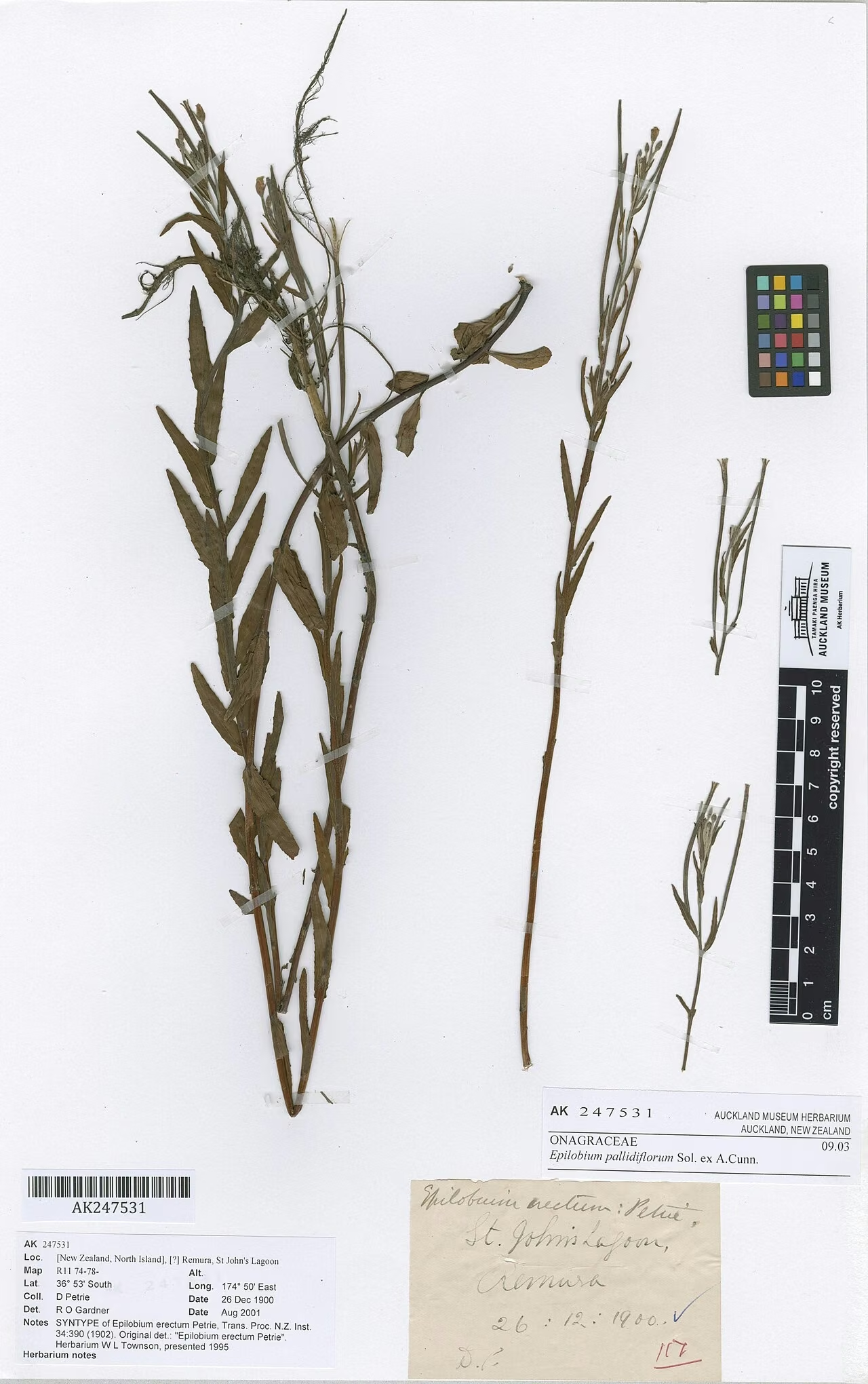
Swamp Willowherb
Epilobium pallidiflorum
Epilobium pernitens
Epilobium pernitens
Grassland Willowherb
Epilobium pictum
Epilobium porphyrium
Epilobium porphyrium
Epilobium rostratum
Epilobium rostratum
Round-Leaved Willowherb
Epilobium rotundifolium
Plant Conservation
Rock willowherb is ranked At Risk - Naturally Uncommon (2023) with the qualifiers RR (Range Restricted) and Sp (Sparse). It was listed as Sparse in 2004 and has been Naturally Uncommon since 2009.
NZPCN describes it as widespread but naturally uncommon and biologically sparse, with no evidence of decline. Its remote, rocky alpine habitat offers natural protection.
Frequently Asked Questions
Where does rock willowherb grow?
It is endemic to the South Island from the Kaikoura Ranges (Mt Fyffe) south to the Mt Cook region of Canterbury, on exposed, steep, sparsely vegetated greywacke outcrops, nearby scree and occasionally exposed stream margins.
How is Epilobium petraeum different from Epilobium brevipes?
E. brevipes has leaves that become alternate towards the stem tips, narrower pointed leaves with a gum-like apiculus at the tip and a minute tuft of hairs at the leaf junction; E. petraeum is entirely hairless with blunt or notched leaf tips.
Can rock willowherb be grown in gardens?
NZPCN says it is easily grown in a pot in an alpine house or in a rock garden, in fertile, free-draining soil and full sun, but it is intolerant of warm, humid climates.
Is rock willowherb endangered?
It is ranked At Risk - Naturally Uncommon because it is a range-restricted, sparse species of high alpine rock. NZPCN notes there is no evidence that it is declining.
Sources and Further Reading
The botanical, growing, and conservation details for Rock Willowherb (Epilobium petraeum) on this page draw on the New Zealand plant references below. Consult them for full technical records and the latest distribution data.