Willowherb
Epilobium hectorii
Last updated:
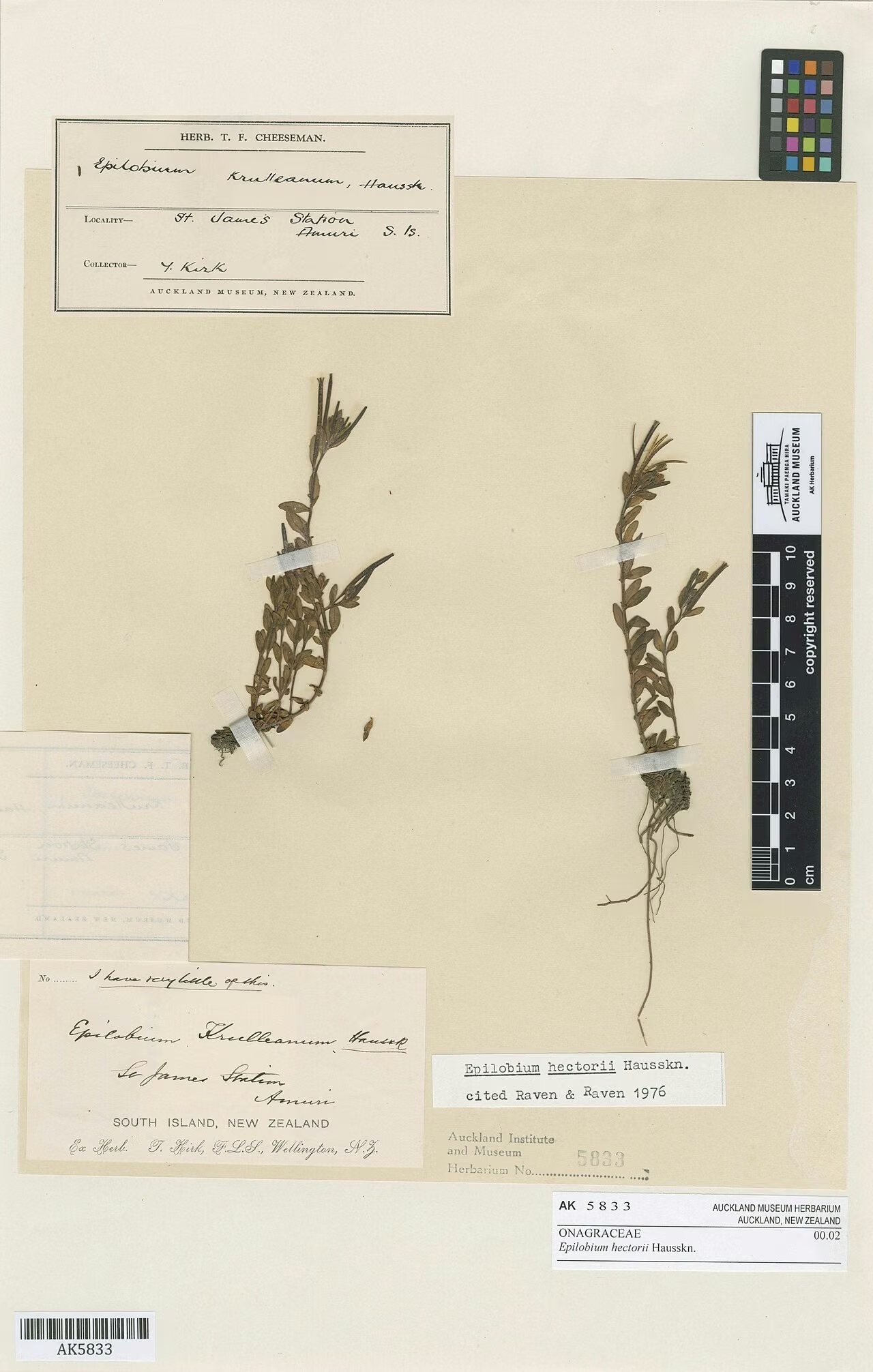
Epilobium hectorii is a delicate, slender willowherb 5 to 25 cm tall, densely covered in short crisp hairs, with narrow bluish-green to bronze-green leaves and small white flowers that often flush pink after pollination. It is endemic to New Zealand, ranging from the Central Volcanic Plateau and Kaimanawa Ranges south to Southland, mainly on the eastern side of the country. It grows on open stony ground, in braided river beds, tussock grassland and frost flats from montane to alpine elevations. Named after the geologist Sir James Hector, it was reassessed in 2023 as At Risk - Declining. Explore more native flowering plants in our native plant guide.
Plant Description
Epilobium hectorii is a delicate, tufted perennial herb 50 to 250 mm tall, often much branched and perennating from buds near the base. It is densely covered with short, crisp hairs, which the Flora notes are mostly confined to lines along the stem. The opposite leaves are narrowly elliptic, dull bluish-green to bronze-green and somewhat glaucous, 3 to 20 mm long and 1 to 4 mm wide, with 0 to 10 weak teeth on each side.
The flowers are erect, with petals 2.5 to 8.2 mm long, white or sometimes whitish-pink, and if white they flush pink after pollination. The capsules are 18 to 28 mm long, glaucous and finely hairy, with denser lines of hairs along the valve edges, on stalks 13 to 27 mm long. The orange-brown seeds are 0.8 to 1.3 mm long and finely reticulate.
NZPCN separates it from relatives such as Epilobium krulleanum by its glaucous, bronze-green narrow leaves that equal or exceed the internodes, erect inflorescences, petals white at opening, a hairless floral tube, an evenly hairy ovary and finely reticulate seeds.
Quick Facts
| Scientific Name | Epilobium hectorii |
|---|---|
| Height | 0.05-0.25 m |
| Spread | Small tufts |
| Water Needs | Low to moderate; free-draining |
| Light | Full sun |
| Frost Tolerance | High; grows on frost flats |
| Salt Tolerance | No information available |
| Growth Rate | Moderate |
| Lifespan | Perennial |
Climate Best Suited to
Suits cold, dry, continental climates with hard frosts and hot summers, such as the inland basins and eastern ranges. Humid conditions do not suit it.
Regional Suitability
| City | Climate Suitability |
|---|---|
| Auckland | Low |
| Wellington | Low |
| Christchurch | Medium |
| Dunedin | Medium |
Plant Habitat
Epilobium hectorii is endemic to the North and South Islands. It ranges from the Central Volcanic Plateau and the Kaimanawa Ranges south to Southland, mostly in the drier eastern parts of the country.
It grows from montane to alpine elevations on open stony ground, within braided river beds, in tussock grassland and in frost flats, where it is often found in ablation areas, the bare, wind-scoured patches between tussocks.
Growing Requirements
Soil Requirements
It roots into stony, gravelly ground and thin soils with little competition.
- Very free-draining gravel or grit
- Low fertility
- Open, unshaded ground
Light Requirements
A plant of bare, open river beds and frost flats that needs full sun.
- Full sun
- No overhanging plants
Water Requirements
Its habitats are often dry at the surface, though braided river beds keep moisture deeper down.
- Water sparingly once established
- Avoid humid, poorly drained positions
Planting and Establishing
Plant into a gravel garden, scree or trough of very gritty mix in full sun. Keep surrounding vegetation low, as it grows naturally on sparse, open ground.
In humid districts, grow it in a pot or trough that can be moved under cover during prolonged muggy weather.
Ecological Role
Epilobium hectorii is part of the specialised flora of braided river beds, frost flats and ablation areas, open habitats shaped by floods, frost heave and wind. Its plumed seeds are wind dispersed, which suits colonising fresh gravel.
Invasive weeds that stabilise and close over braided river beds reduce the open ground it depends on. Its pollinators are not recorded in the sources consulted.
Uses & Significance
Garden Uses
NZPCN says it is easily grown from fresh seed, which makes it a good subject for specialist alpine and gravel gardens.
- Scree and gravel gardens
- Alpine troughs
- Braided river restoration
Ecological Value
It belongs to the distinctive eastern dryland and braided river flora, which has been heavily affected by weeds and land development.
- Endemic to New Zealand
- Characteristic of frost flats and river beds
- Declining, so cultivated stock is useful
Landscaping Uses
Use it as a small, fine-textured plant in gravel gardens, where its bronze-green leaves and tiny white to pink flowers suit a dryland planting scheme.
Pair it with other plants of eastern river beds and frost flats that also need open, stony ground and low competition.
Seasonal Care Calendar
Spring
New shoots grow from buds near the base.
- Top-dress with gravel
- Remove weed seedlings
Summer
Flowering runs from November to February, with small white flowers that turn pink after pollination.
- Water only in prolonged drought
- Keep the plant uncrowded
Autumn
Capsules ripen from December to April and release wind-borne seed.
- Collect fresh seed
- Sow straight away
Winter
It tolerates hard frosts typical of its frost flat habitat.
- Protect from winter wet in pots
- No feeding needed
When to Prune and How Much
No pruning is needed. Spent flowering stems can be removed once seed has been shed.
Do not cut back to the base in autumn, as the plant renews itself from buds near the base.
How to Grow Willowherb
NZPCN states that Epilobium hectorii is easily grown from fresh seed and dislikes humid conditions. Seed is the practical method because the plant forms small, slender tufts that do not offer much material for division or cuttings. It flowers from November to February and ripens capsules from December to April, and the seeds are wind dispersed, so collect them as the capsules begin to split. Because the species is now ranked At Risk - Declining, take only small amounts of seed, preferably from cultivated plants, and get permission before collecting on public conservation land or in braided river beds. Raise seedlings in a very gritty mix with plenty of light and airflow, since humid, stagnant conditions are the main cause of losses.
From Seed
Fresh seed is the recommended method and germinates readily.
Seedlings are small, so handle them gently and pot them on before roots tangle.
Sow as soon as possible after collection rather than storing the seed, since NZPCN specifically recommends fresh seed. A clay pan or shallow pot stood outdoors in an open, breezy position mimics the exposed gravel where seedlings establish naturally, and keeps the surface from staying wet for long.
- Collect capsules as they begin to split in summer or autumn
- Sow on the surface of a gritty seed mix
- Cover with a fine layer of grit
- Keep just moist in a bright, airy place
- Prick out seedlings into individual pots of gritty mix
- Plant out into scree or a trough once established
Pests & Diseases
No specific pests are recorded in the sources consulted. In cultivation, rot and mildew in humid weather are the main risks.
In the wild, competition from invasive weeds on river beds and frost flats is a more serious problem than pests.
Cultural Significance
No traditional Māori name or use is recorded for Epilobium hectorii in the sources consulted.
The species honours Sir James Hector, the nineteenth-century geologist and botanist who directed the Geological Survey and the Colonial Museum in Wellington and collected widely in the South Island mountains.
Bonus Tip
If you have an eastern South Island garden with a stony patch that bakes in summer and freezes in winter, this is the kind of place Epilobium hectorii likes. Keep it weed-free and leave some capsules to shed seed, and it may establish a small self-sustaining colony.
Related Plants
Explore other native plants that share similar characteristics or habitats with Willowherb (Epilobium hectorii), offering further insights into New Zealand's diverse flora. These related species provide context and opportunities for complementary planting in your garden.
Epilobium billardiereanum
Epilobium billardiereanum
Marsh Willowherb
Epilobium chionanthum
Mountain Willowherb
Epilobium chlorifolium
Epilobium cinereum
Epilobium cinereum
Epilobium insulare
Epilobium insulare
Epilobium margaretiae
Epilobium margaretiae
Epilobium microphyllum
Epilobium microphyllum
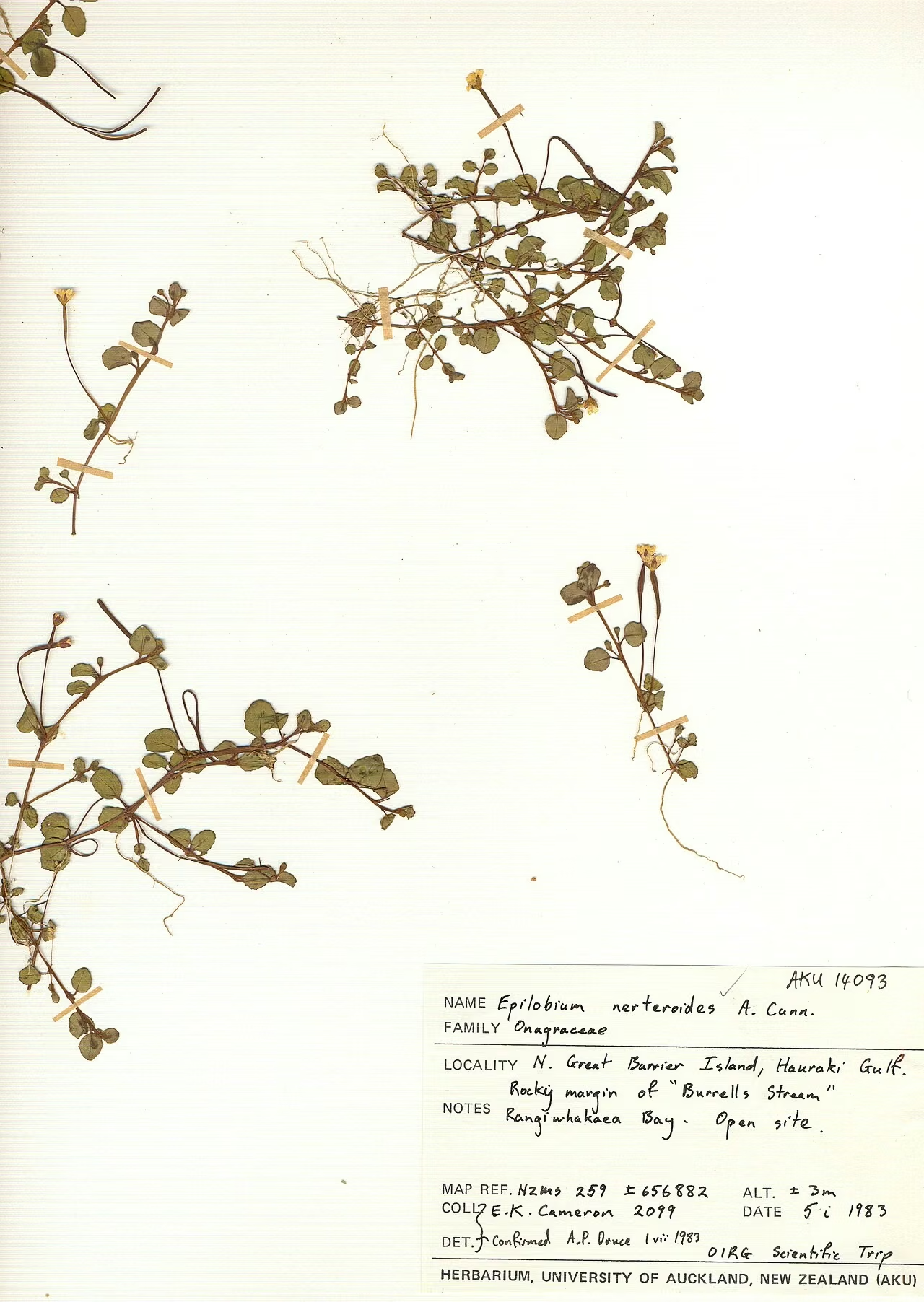
Epilobium nerteroides
Epilobium nerteroides
Plant Conservation
Epilobium hectorii was ranked Not Threatened from 2004 to 2017, but NZPCN now ranks it At Risk - Declining (2023), with the data-poor qualifiers DPR, DPS and DPT, which flag uncertainty about recognition, population size and trend.
The sources consulted do not list specific threats, but its open braided river, tussock grassland and frost flat habitats are widely affected by weed invasion and land development. Protecting these habitats and controlling weeds will help it.
Frequently Asked Questions
Where is Epilobium hectorii found?
It is endemic to the North and South Islands, from the Central Volcanic Plateau and Kaimanawa Ranges south to Southland, with a mainly easterly distribution in montane to alpine country.
Who was Epilobium hectorii named after?
It honours Sir James Hector, the nineteenth-century geologist and botanist who led New Zealand's Colonial Museum and Geological Survey.
What habitat does Epilobium hectorii need?
It grows in open, stony places: braided river beds, tussock grassland, frost flats and ablation areas, from montane to alpine elevations.
How do you tell Epilobium hectorii from other small willowherbs?
NZPCN notes its glaucous to bronze-green narrow leaves as long as or longer than the internodes, with up to 10 weak teeth, erect flower shoots, white petals at opening and finely reticulate seeds.
Sources and Further Reading
The botanical, growing, and conservation details for Willowherb (Epilobium hectorii) on this page draw on the New Zealand plant references below. Consult them for full technical records and the latest distribution data.