Elingamita
Elingamita johnsonii
Last updated:
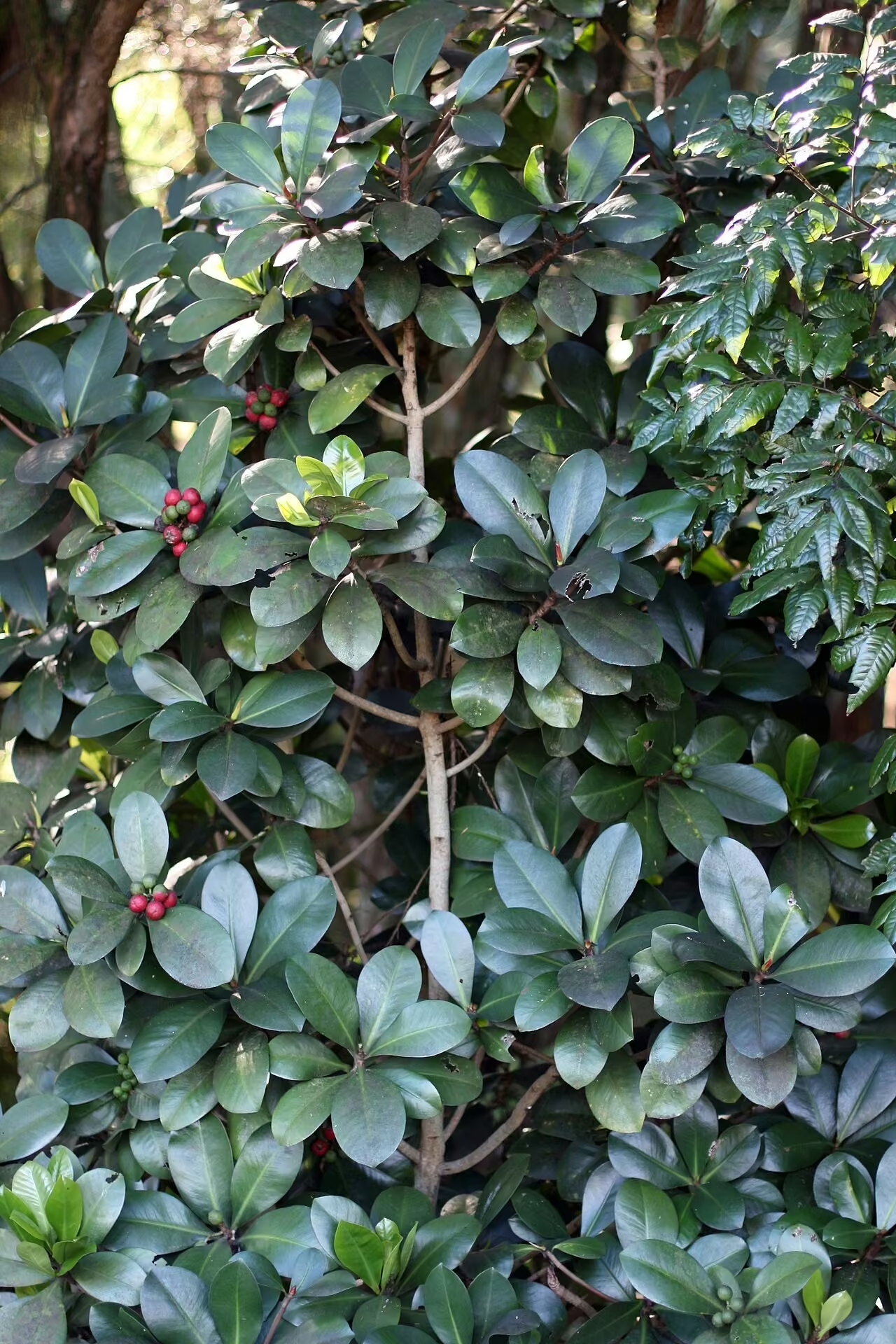
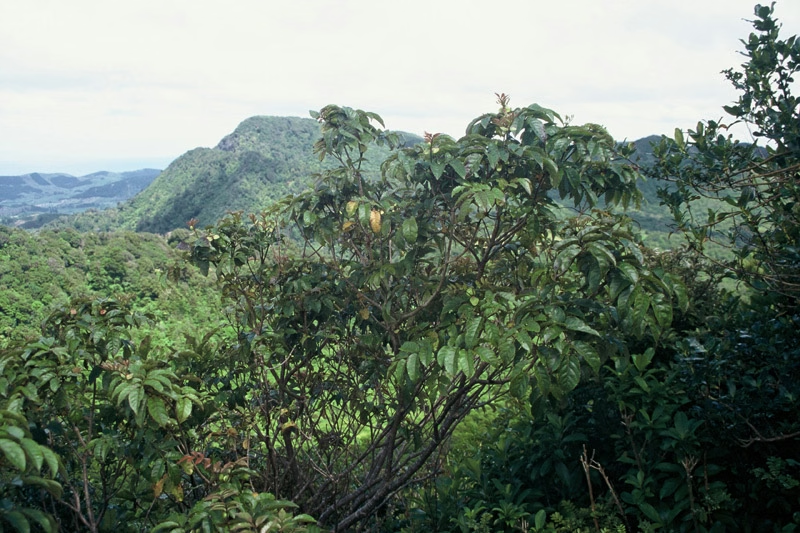
Elingamita (Elingamita johnsonii) is a small tree up to 8 m tall found naturally only on West Island and two nearby rocky islets in the Three Kings Islands, about 55 km north-west of Cape Rēinga. It has stout greyish stems, large glossy dark green leaves and heavy, grape-like bunches of bright red fruit that take about a year to ripen. It is the only species in its genus, which is found nowhere else, and was discovered as recently as 1950. Ranked At Risk - Naturally Uncommon, it is now widely grown in frost-free northern gardens, which helps safeguard it against fire or other disasters on its tiny island home. Explore more New Zealand native trees in our native plant guide.
Plant Description
Elingamita johnsonii is a dioecious tree up to 8 m tall, with separate male and female plants. Its trunks and stems are unusual: greyish, stout and almost swollen in appearance. The leaves are 10 to 18 cm long and 4 to 9 cm wide, obovate, rigidly leathery and glossy dark green, carried on succulent leaf stalks. Held up to the light, they show small pale dots in the leaf tissue.
Small flowers are produced mainly from February to May, and sometimes again from August to November. The fruit takes about a year to mature, so fruit can be present on female trees at any time of year. Ripe fruit are globose drupes up to 20 mm across, bright red with white flesh and a single seed, hanging in large grape-like bunches.
There is nothing else quite like it in the New Zealand flora. NZPCN singles out the greyish, almost turgid trunks and stems, the entire, glossy dark green leaves and the bunches of red fruit as very distinctive. It belongs to the Primulaceae, the family that includes māpou (Myrsine), but its exact relationships within the family are still not settled.
Quick Facts
| Scientific Name | Elingamita johnsonii |
|---|---|
| Height | Up to 8 m |
| Spread | 2-4 m |
| Water Needs | Moderate; prefers free-draining soil |
| Light | Semi-shade when young, full sun when established |
| Frost Tolerance | Low; frost tender |
| Salt Tolerance | High; grows in exposed coastal sites |
| Growth Rate | Moderate |
| Lifespan | Long-lived perennial tree |
Climate Best Suited to
Suits a warm, frost-free, oceanic climate like that of the Three Kings Islands. It is sensitive to cold and does best in northern coastal gardens.
Regional Suitability
| City | Climate Suitability |
|---|---|
| Auckland | High |
| Wellington | Medium |
| Christchurch | Low |
| Dunedin | Low |
Plant Habitat
In the wild Elingamita is confined to the Three Kings Islands. It grows on West Island and on two rocky islets in the nearby Princes Group, so the entire natural population occupies a very small area of land.
On West Island it grows in pōhutukawa forest and coastal shrubland, usually as an understorey shrub or small tree, but it also emerges through the canopy on exposed sites. The islands are subtropical, windy and salt-laden, with no frost.
Growing Requirements
Soil Requirements
It needs fertile, free-draining soil. On its home islands it grows on thin soils over rock under coastal forest.
- Fertile, free-draining loam
- Avoid heavy, waterlogged clay
- Benefits from mulch to keep roots cool
Light Requirements
NZPCN notes that seedlings establish rapidly in semi-shade while established plants thrive in full sun.
- Semi-shade for young plants
- Full sun for mature, fruiting trees
- Shelter from cold winds in cooler districts
Water Requirements
It handles the summer dryness of offshore islands but grows best with steady moisture in well-drained soil.
- Water young trees through their first summers
- Do not allow soil to become waterlogged
- Mulch to reduce moisture stress
Planting and Establishing
Plant Elingamita in a frost-free, sheltered spot with fertile, well-drained soil. In Auckland, Northland and similar coastal climates it can go straight into the open garden; in cooler districts it is best tried against a warm wall or kept in a large container that can be moved under cover.
If you want the red fruit, plant at least one male and one female tree near each other. Young plants appreciate some overhead shade from neighbouring shrubs while they establish, then can be allowed into full sun.
Ecological Role
On the Three Kings, Elingamita is part of a distinctive island flora that includes several other endemic plants. Its bright red, fleshy fruit are typical of plants dispersed by birds, although the specific dispersers on the islands are not documented in the sources consulted.
The fruit is known to be very palatable to rats, which is one reason rodent incursions on the Three Kings would be a serious threat to its regeneration. Its pollinators have not been described in the sources consulted.
Uses & Significance
Garden Uses
It is a striking specimen tree for frost-free gardens, valued for its bold foliage and heavy crops of red fruit.
- Specimen tree for coastal northern gardens
- Large container plant in cooler areas
- Conversation piece for collectors of rare natives
Ecological Value
As a monotypic endemic genus with a tiny natural range, it represents a unique branch of New Zealand's evolutionary history.
- One of New Zealand's endemic monotypic genera
- Key component of West Island coastal forest
- Cultivated populations provide insurance against loss of the wild stand
Landscaping Uses
Use Elingamita as a focal small tree where its glossy foliage and red fruit clusters can be seen at close range, such as near a patio or entrance. Its large, rigid leaves give a lush, subtropical feel that combines well with other northern island natives.
In coastal gardens it can be planted in groups with other salt-tolerant natives to form a sheltered grove, keeping at least one female tree in a prominent position for its fruit display.
Seasonal Care Calendar
Spring
A second, smaller flowering sometimes occurs from August to November, and new growth begins as the weather warms.
- Apply mulch and a light feed
- Plant new trees once frost risk is past
Summer
Fruit set the previous year continues to develop and colour on female trees.
- Water young trees during dry spells
- Watch for scale insects
Autumn
The main flowering period runs from February to May, often while ripe red fruit from the previous season are still on the tree.
- Collect ripe fruit for seed sowing
- Enjoy the red fruit clusters
Winter
Fruit can remain on female trees through winter. Plants are frost tender.
- Protect from frost in cooler districts
- Move container plants under cover if cold
When to Prune and How Much
Little pruning is needed. Remove dead or damaged branches and any lower limbs that get in the way, ideally in spring after the risk of cold weather has passed.
Because fruit takes a year to ripen, avoid heavy pruning of female trees or you will remove the developing fruit clusters.
How to Grow Elingamita
NZPCN describes Elingamita as easy from seed, although seed can take up to a year to germinate, while cuttings are slow to strike. Seed is therefore the usual method. Because the species is dioecious, seedlings will be a mixture of male and female plants and their sex cannot be known until they flower, so raise several if you want fruit. Fruit take about a year to ripen on the tree, and each contains a single seed. Seedlings establish quickly in semi-shade and can be grown on in fertile, free-draining potting mix before planting out. Never collect seed or plant material from the Three Kings Islands, which are a nature reserve with restricted access; use fruit from cultivated trees, which are now quite widely grown in northern New Zealand.
From Seed
Use fully ripe, bright red fruit from cultivated female trees. Patience is needed, as germination can take up to a year.
- Pick ripe red fruit from a cultivated female tree
- Remove the white flesh and clean the single seed
- Sow into a free-draining seed mix, just covered
- Keep in a warm, sheltered, semi-shaded spot and lightly moist
- Wait up to a year for germination without discarding the tray
- Pot seedlings on individually and keep frost-free
From Cuttings
Cuttings are possible but slow to strike. They are useful for propagating a known female tree for fruit.
- Take semi-hardwood cuttings in late summer or autumn
- Reduce leaf area by trimming the large leaves
- Insert into a free-draining propagating mix
- Keep warm with bottom heat and high humidity
- Allow several months for roots to form before potting on
Pests & Diseases
No serious pests are specifically recorded for Elingamita in cultivation. As with many glossy-leaved shrubs, scale insects and sooty mould may occasionally appear, and frost is the main cause of damage outside the far north.
In the wild, rats would be a significant threat because the fruit is very palatable to them. Fire is also a major risk given how small the natural population is.
Cultural Significance
No traditional Māori name or use is recorded for Elingamita in the sources consulted. The tree was not known to science until 1950, and was formally described by the botanist G.T.S. Baylis in 1951.
Its name commemorates the SS Elingamite, a passenger steamer wrecked on West Island in 1902, one of New Zealand's notable shipwrecks. NZPCN records that the red fruit are edible, tasting somewhat like an oily, salty apple.
Bonus Tip
When buying Elingamita for fruit, ask the nursery whether plants have been sexed, ideally grown from cuttings of a known female tree, and plant a male nearby. Seedlings take years to flower, so buying unsexed seedlings can leave you with a fruitless pair.
Related Plants
Explore other native plants that share similar characteristics or habitats with Elingamita (Elingamita johnsonii), offering further insights into New Zealand's diverse flora. These related species provide context and opportunities for complementary planting in your garden.

Plant Conservation
Elingamita johnsonii is ranked At Risk - Naturally Uncommon (2023), with qualifiers for conservation dependence, inherent rarity and vulnerability to stochastic events. Its entire wild population lies on one small island and two islets, so a single fire or rodent invasion could devastate it.
The Three Kings Islands are a nature reserve with restricted access, and keeping them free of rodents and fire is vital. Widespread cultivation in mainland gardens provides an important safety net for the species.
Frequently Asked Questions
Where does Elingamita come from?
It is endemic to the Three Kings Islands north-west of Cape Rēinga, where the whole wild population grows on West Island and two nearby rocky islets in the Princes Group.
Why is it called Elingamita?
The genus is named after the steamer SS Elingamite, which was wrecked on West Island in 1902, the island where the tree was later discovered in 1950.
Is Elingamita fruit edible?
Yes. NZPCN records that the red, fleshy fruit are edible, with flesh tasting somewhat like an oily, salty apple. Each fruit contains a single seed.
Why is my Elingamita not fruiting?
Elingamita is dioecious, so separate male and female trees are needed for fruit. A lone tree, or two trees of the same sex, will not produce the red bunches.
Sources and Further Reading
The botanical, growing, and conservation details for Elingamita (Elingamita johnsonii) on this page draw on the New Zealand plant references below. Consult them for full technical records and the latest distribution data.