Grass Tree
Dracophyllum pearsonii
Last updated:
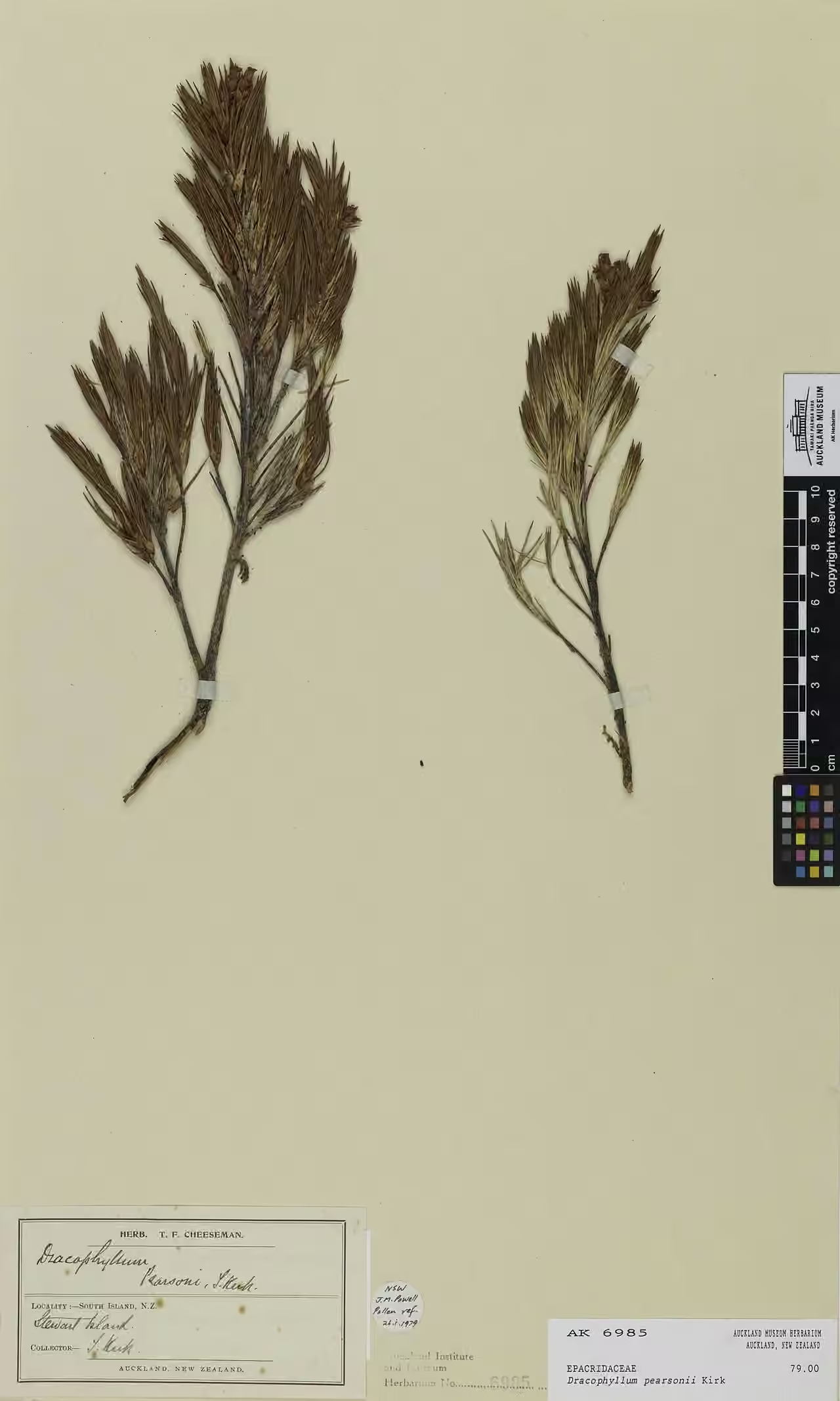
Dracophyllum pearsonii is a low, spreading, brownish shrub 0.3 to 0.5 m tall that grows mainly on the mountain tops of Stewart Island/Rakiura. Its much-branched stems are densely clothed in hard, narrow, sharp-pointed leaves 2 to 3 cm long with finely toothed margins, and in summer it bears short racemes of three to six small white tubular flowers near the branch tips. It grows in open subalpine shrubland, herbfield and grassland on slopes, ridges and plateaux, chiefly on Mount Anglem/Hananui and the Rakeahua tops, with scarce records in Fiordland. It is endemic and ranked At Risk - Naturally Uncommon. Explore more native shrubs in our native plant guide.
Plant Description
Dracophyllum pearsonii is an erect to spreading, much-branched shrub 0.3 to 0.5 m tall with dark grey bark and a brownish overall colour. The branchlets are about 5 cm long, ascending, and densely clad in overlapping (imbricate) leaves.
Each leaf has a sheathing base 4 to 6 mm long and 2 to 4 mm wide fringed with fine hairs, and a hard, linear-subulate blade 19 to 32 mm long and 0.8 to 1.5 mm wide. The blade margins are minutely toothed and the tip is sharp and pungent. The flowers are borne in racemes 12 to 20 mm long of three to six flowers near the tips of the branchlets. They have ovate, pointed sepals and a small white corolla tube about 3 mm long, and are followed by obovoid capsules.
Its combination of low, spreading habit, densely packed hard leaves with toothed margins, and short few-flowered racemes helps distinguish it from other small Dracophyllum on Rakiura and in Fiordland, though Dracophyllum species can be difficult to tell apart and specialist keys are recommended for confirmation.
Quick Facts
| Scientific Name | Dracophyllum pearsonii |
|---|---|
| Height | 0.3-0.5 m |
| Spread | Spreading; no published width found |
| Water Needs | Moderate to high; wet, cloudy upland climate |
| Light | Full sun in open subalpine sites |
| Frost Tolerance | High; montane to alpine species |
| Salt Tolerance | No information available; grows on exposed island uplands but not on the shore |
| Growth Rate | Slow |
| Lifespan | Long-lived perennial shrub |
Climate Best Suited to
Suits the cool, very wet, windy and cloudy climate of the Stewart Island and Fiordland uplands. It is unsuited to warm or dry lowland climates.
Regional Suitability
| City | Climate Suitability |
|---|---|
| Auckland | Low |
| Wellington | Low |
| Christchurch | Low |
| Dunedin | Low |
Plant Habitat
Dracophyllum pearsonii is endemic to New Zealand. Most populations are on Stewart Island/Rakiura, principally on Mount Anglem/Hananui, the island's highest peak, and the Rakeahua tops. It also occurs, though scarcely, in Fiordland National Park on the South Island. The type specimen came from Stewart Island.
It grows in the montane to alpine zones, in open sites on mountain slopes, ridges and plateaux within subalpine shrubland, herbfield or grassland. These upland areas are exposed to strong winds, frequent cloud and very high rainfall.
Growing Requirements
Soil Requirements
In the wild it grows in the thin, often peaty and infertile soils of exposed southern uplands.
- Low-fertility, acidic peat or mineral soil
- Moist but not stagnant
- Rocky or gravelly ground on ridges
Light Requirements
It occupies open sites among low shrubland, herbfield and grassland.
- Full sun and exposure
- Shading by taller shrubs would disadvantage it
Water Requirements
The Rakiura and Fiordland uplands receive very high rainfall and frequent mist, keeping the soil moist for most of the year.
- Regular moisture from rain and cloud
- Soil should not dry out
- Free drainage on slopes and ridges
Planting and Establishing
Dracophyllum pearsonii is not commercially available, and NZPCN describes it as difficult to propagate and advises that it should not be removed from the wild. It is not a plant for general gardens.
Anyone wishing to see it should plan a tramp to the upland areas of Rakiura, such as the route to Mount Anglem/Hananui, in summer, when it is in flower.
Ecological Role
Its small white tubular flowers appear from December to February and produce nectar for insects during the short upland summer. The minute seeds are released from capsules between February and April and are dispersed by wind. Specific pollinators are not documented in the sources consulted.
As a low, dense shrub in open subalpine vegetation it contributes to the structure of Rakiura's distinctive upland plant communities, which contain a number of species found nowhere else or that reach their southern limits there.
Uses & Significance
Garden Uses
It has no practical garden use because it is difficult to propagate, not commercially available and should not be taken from the wild.
- Of interest to botanists and alpine enthusiasts
- Potential subject for conservation cultivation only
Ecological Value
It is a characteristic, uncommon shrub of the Stewart Island uplands.
- Summer nectar for upland insects
- Part of the endemic subalpine flora of Rakiura
- Adds structure to herbfield and low shrubland
Landscaping Uses
This species is not used in landscaping. Its low, brownish, densely leafy form is best seen in the open upland vegetation of Rakiura, where it mingles with tussock, herbs and other small shrubs.
Gardeners wanting a similar texture can use commercially grown small native shrubs with fine, stiff foliage in a cool, moist rock garden instead.
Seasonal Care Calendar
Spring
New leaves form at the branch tips as upland temperatures rise.
- Growth resumes slowly
- Flower buds develop
Summer
Short racemes of small white tubular flowers open from December to February.
- Main flowering period
- Best time to look for it on Rakiura's tops
Autumn
Obovoid capsules ripen from February to April and release minute wind-blown seeds.
- Seed dispersal
- Growth slows with cooler weather
Winter
The shrub endures cold, wind and occasional snow on exposed uplands.
- Dormant period
- Hard leaves resist cold and wind
When to Prune and How Much
No pruning is needed or appropriate. Its compact, spreading form is shaped by exposure to wind and cold.
Should plants ever be held in conservation cultivation, only dead stems should be removed, as Dracophyllum species recover slowly from cutting.
How to Grow Grass Tree
NZPCN describes Dracophyllum pearsonii as difficult to propagate and states that it should not be removed from the wild. No species-specific propagation records were found in the sources consulted. The methods below are the general approaches used for subalpine Dracophyllum, and any collection on Rakiura National Park or in Fiordland requires authority from the Department of Conservation.
From Seed
Capsules ripen between February and April. The seeds are minute and wind dispersed, so capsules should be collected just as they begin to split. Germination in Dracophyllum is generally slow and irregular.
- Collect ripening capsules in late summer or early autumn under permit
- Air-dry in a paper envelope to release the seed
- Surface-sow onto a fine, acidic peat and grit mix
- Keep the mix moist and cool, and do not cover the seed
- Leave the tray outdoors through winter to experience natural cold
- Expect germination to take many months and be uneven
- Pot seedlings individually once large enough and grow on in a cool, bright, humid place
From Cuttings
Semi-hardwood cuttings are sometimes attempted with small Dracophyllum species, but rooting tends to be slow and unreliable.
Because Dracophyllum roots are fine and sensitive to disturbance, any rooted cutting should be potted on carefully with the root ball intact and kept cool and moist through its first summer.
- Take short side shoots in late summer
- Insert into a moist mix of peat and coarse sand
- Keep cool and humid with gentle bottom heat
- Check for roots only after several months
Pests & Diseases
No specific pests or diseases are recorded for Dracophyllum pearsonii. Its harsh upland habitat limits most invertebrate pests.
Browsing by introduced deer on Stewart Island affects many upland and forest plants, but the sources consulted do not report specific damage to this species. Its ranking reflects natural scarcity rather than documented decline.
Cultural Significance
No Māori name or traditional use specific to this species is recorded in the sources consulted. The genus name Dracophyllum means dragon leaf.
Thomas Kirk described the species in 1885 from a specimen collected on Stewart Island by W.L. Pearson, which is held at Te Papa. Mount Anglem, where it is most often recorded, is known in te reo Māori as Hananui.
Bonus Tip
When tramping on Rakiura's tops, run a finger gently along a leaf of any low brownish Dracophyllum you find: the hard leaves of Dracophyllum pearsonii have finely toothed margins and a sharp, prickly tip, which together with the short three- to six-flowered racemes near the branch ends help confirm it.
Related Plants
Explore other native plants that share similar characteristics or habitats with Grass Tree (Dracophyllum pearsonii), offering further insights into New Zealand's diverse flora. These related species provide context and opportunities for complementary planting in your garden.
Mokimoki
Doodia mollis
Doodia squarrosa
Doodia squarrosa
Marble Inaka
Dracophyllum marmoricola
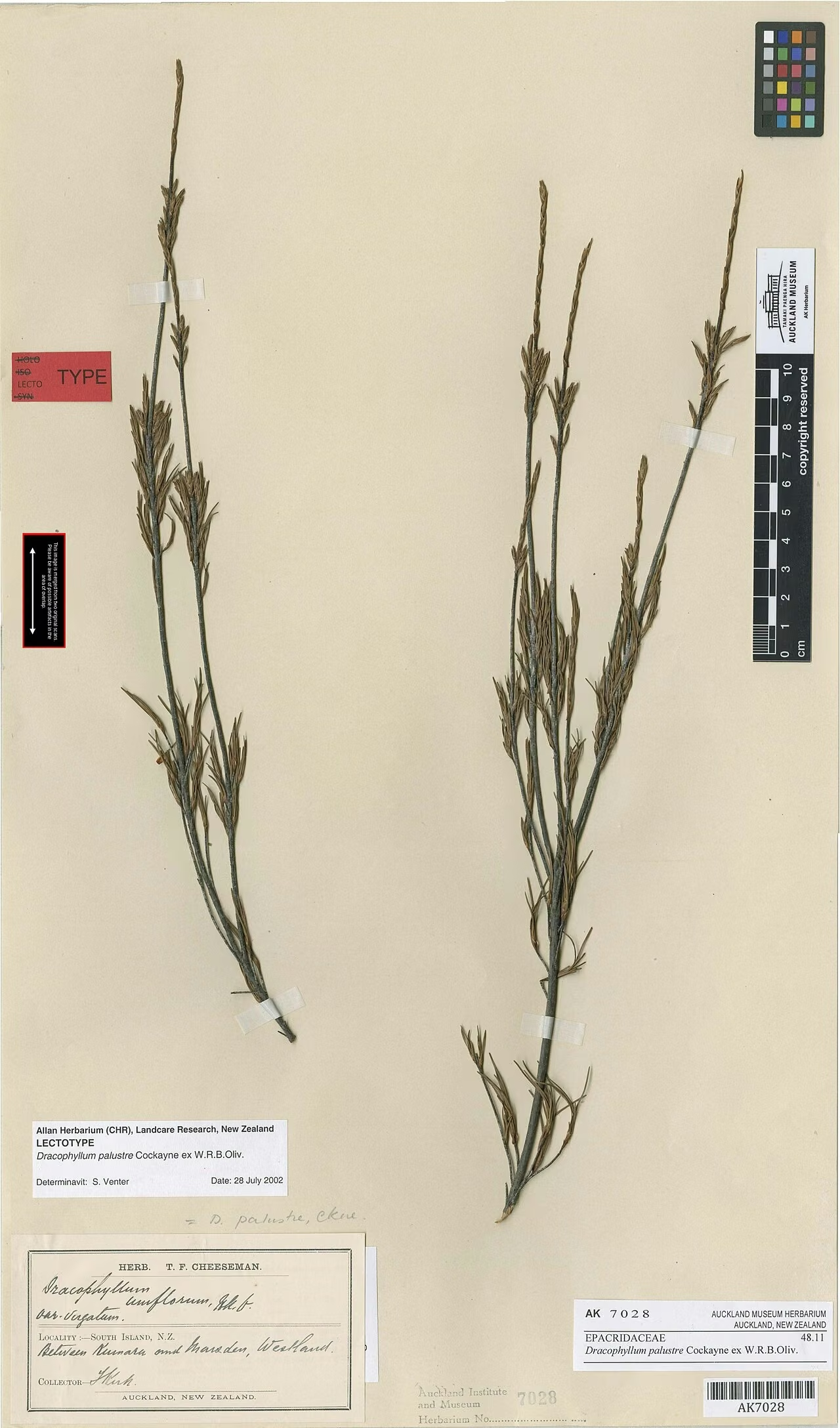
Swamp Neinei
Dracophyllum palustre
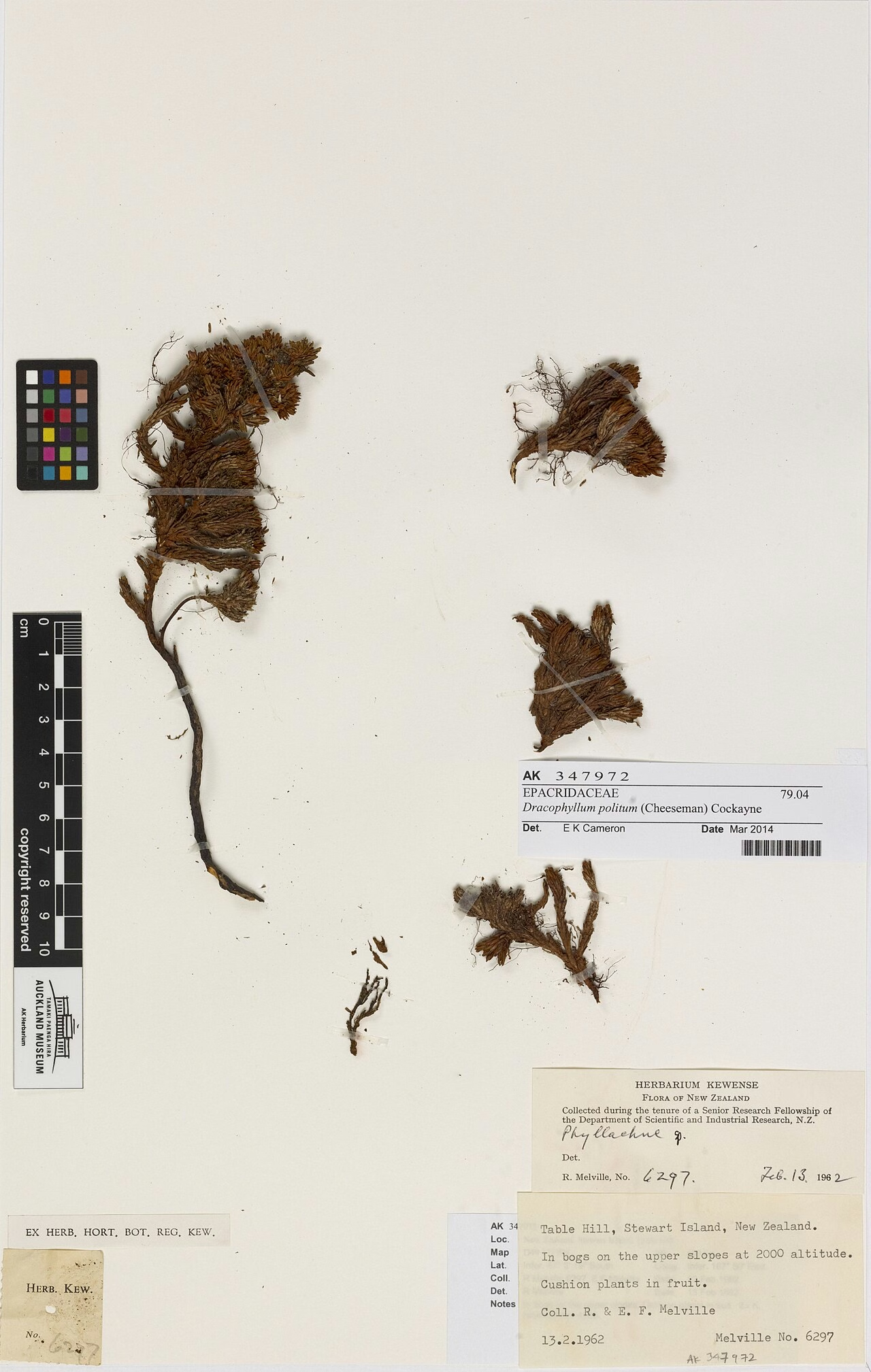
Dracophyllum politum
Dracophyllum politum
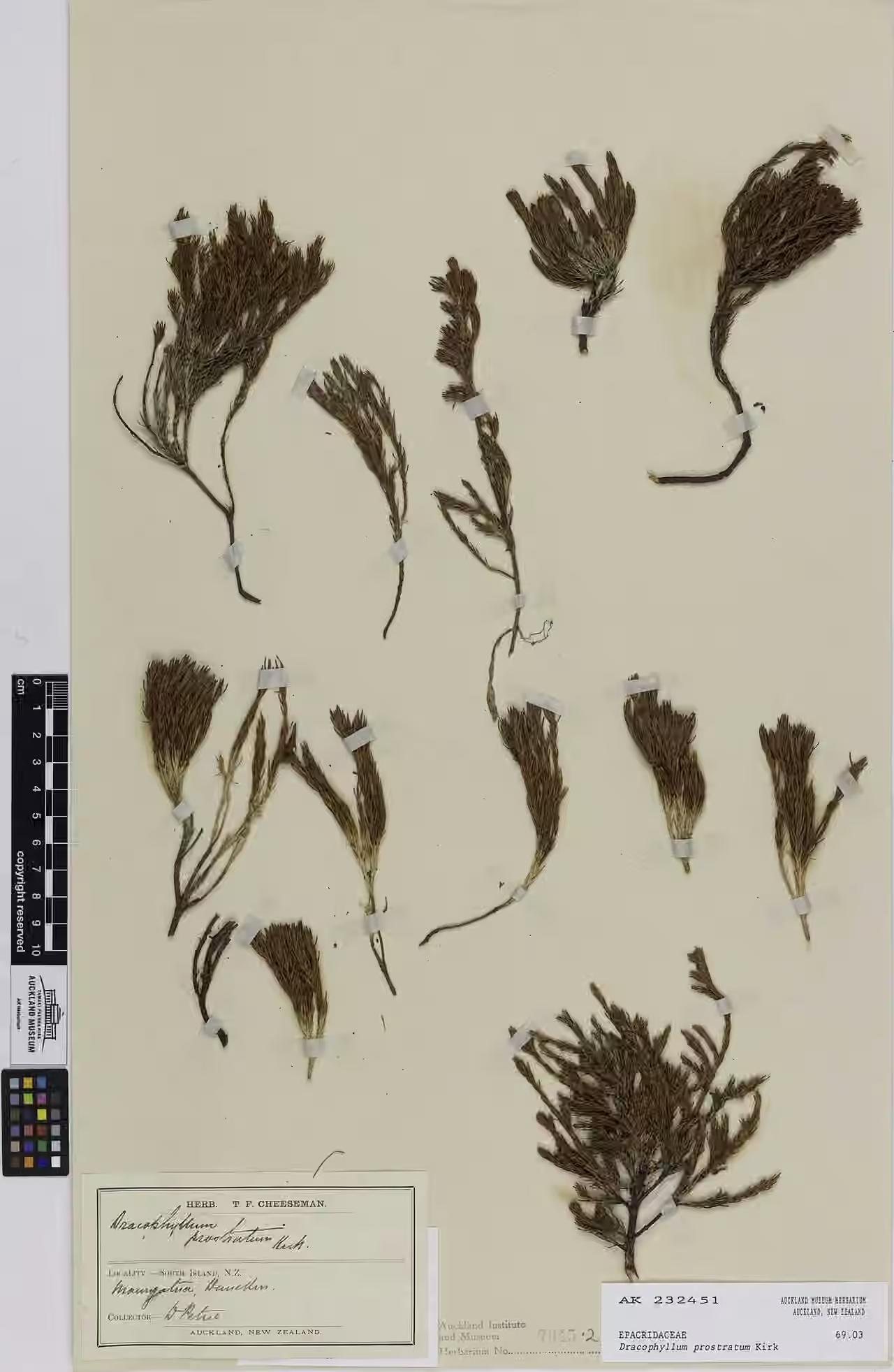
Dracophyllum prostratum
Dracophyllum prostratum
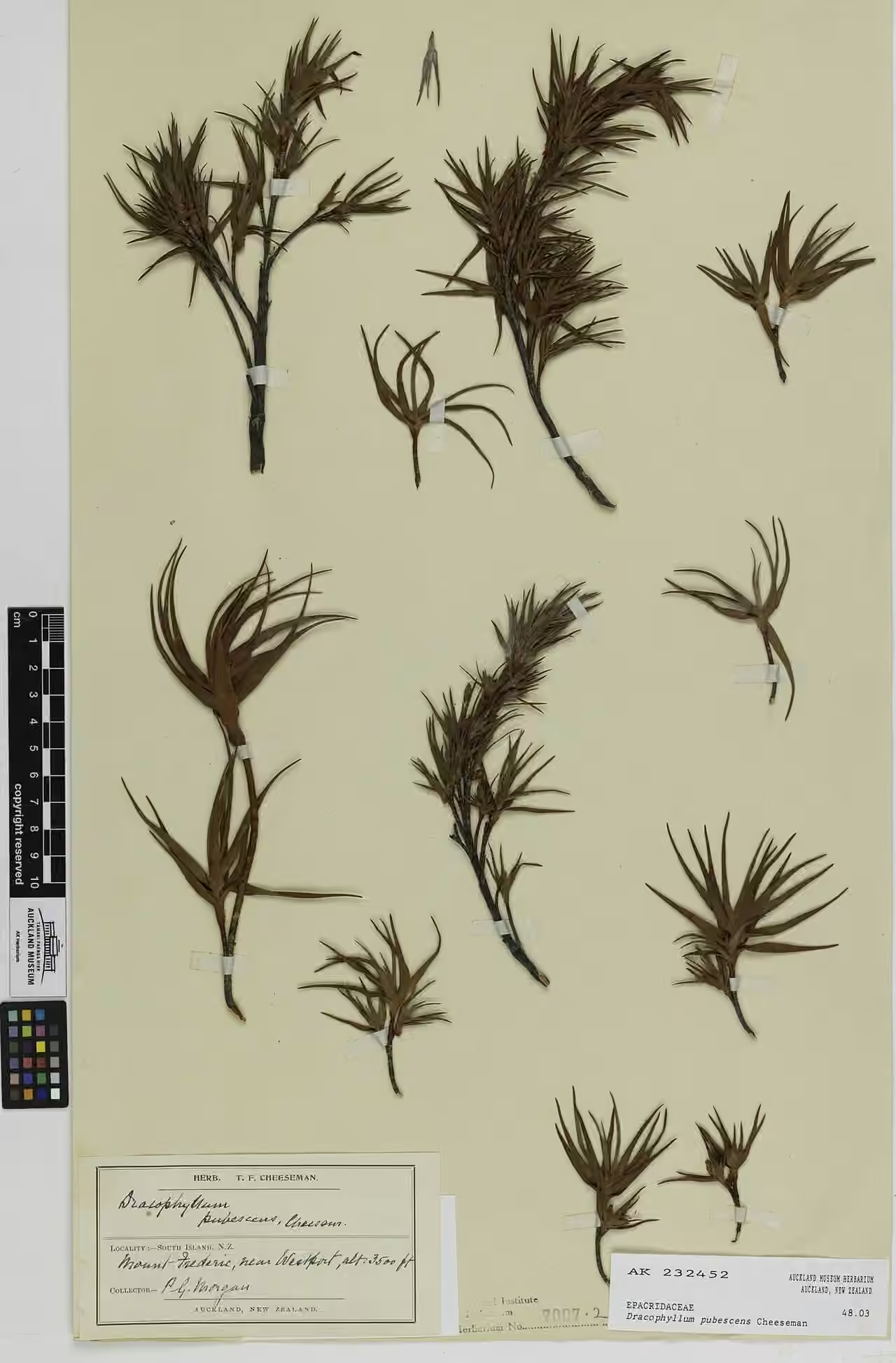
Dracophyllum pubescens
Dracophyllum pubescens
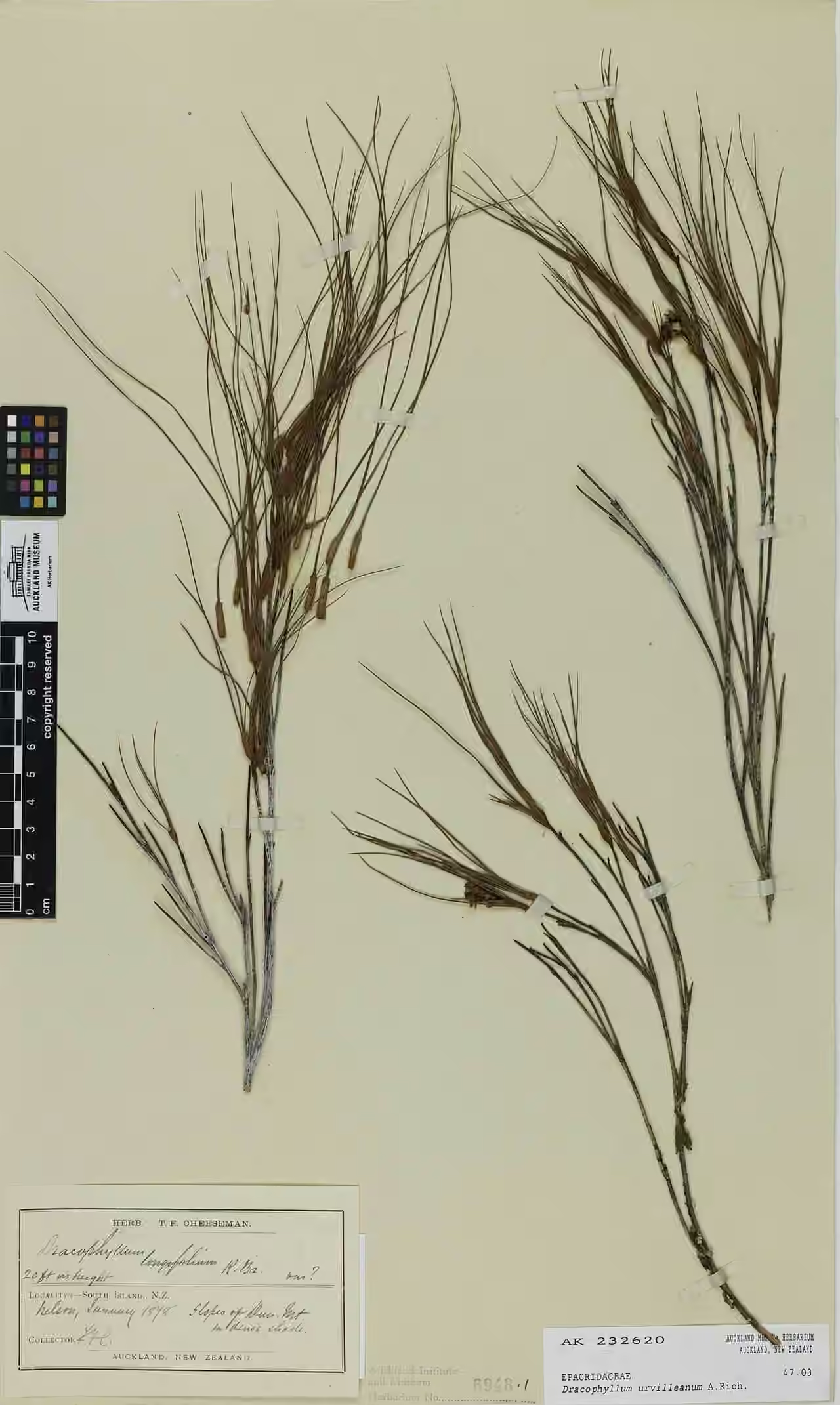
D'Urville's Grass Tree
Dracophyllum urvilleanum
Plant Conservation
Dracophyllum pearsonii is ranked At Risk - Naturally Uncommon (2023) with the qualifiers Sparse and Data Poor: Size, meaning it occurs in small, scattered populations whose total size is not well known.
Most of its range lies within Rakiura National Park and Fiordland National Park, which provide protection. Further survey work to clarify its population size, staying on tracks in upland areas and continued control of browsing animals all support its long-term security.
Frequently Asked Questions
Where is Dracophyllum pearsonii found?
It grows mainly on Stewart Island/Rakiura, especially on Mount Anglem/Hananui and the Rakeahua tops, and is scarce in Fiordland National Park, in montane to alpine shrubland, herbfield and grassland.
What does Dracophyllum pearsonii look like?
It is a low, much-branched brownish shrub with dark grey bark and densely overlapping, hard, narrow leaves 19 to 32 mm long with finely toothed edges and sharp tips, and short racemes of small white tubular flowers.
When does Dracophyllum pearsonii flower?
NZPCN records flowering from December to February, with the small obovoid capsules ripening from February to April.
Is Dracophyllum pearsonii available to buy?
No. NZPCN notes it is not commercially available, is difficult to propagate and should not be removed from the wild.
Sources and Further Reading
The botanical, growing, and conservation details for Grass Tree (Dracophyllum pearsonii) on this page draw on the New Zealand plant references below. Consult them for full technical records and the latest distribution data.