Rasp Fern
Doodia squarrosa
Last updated:
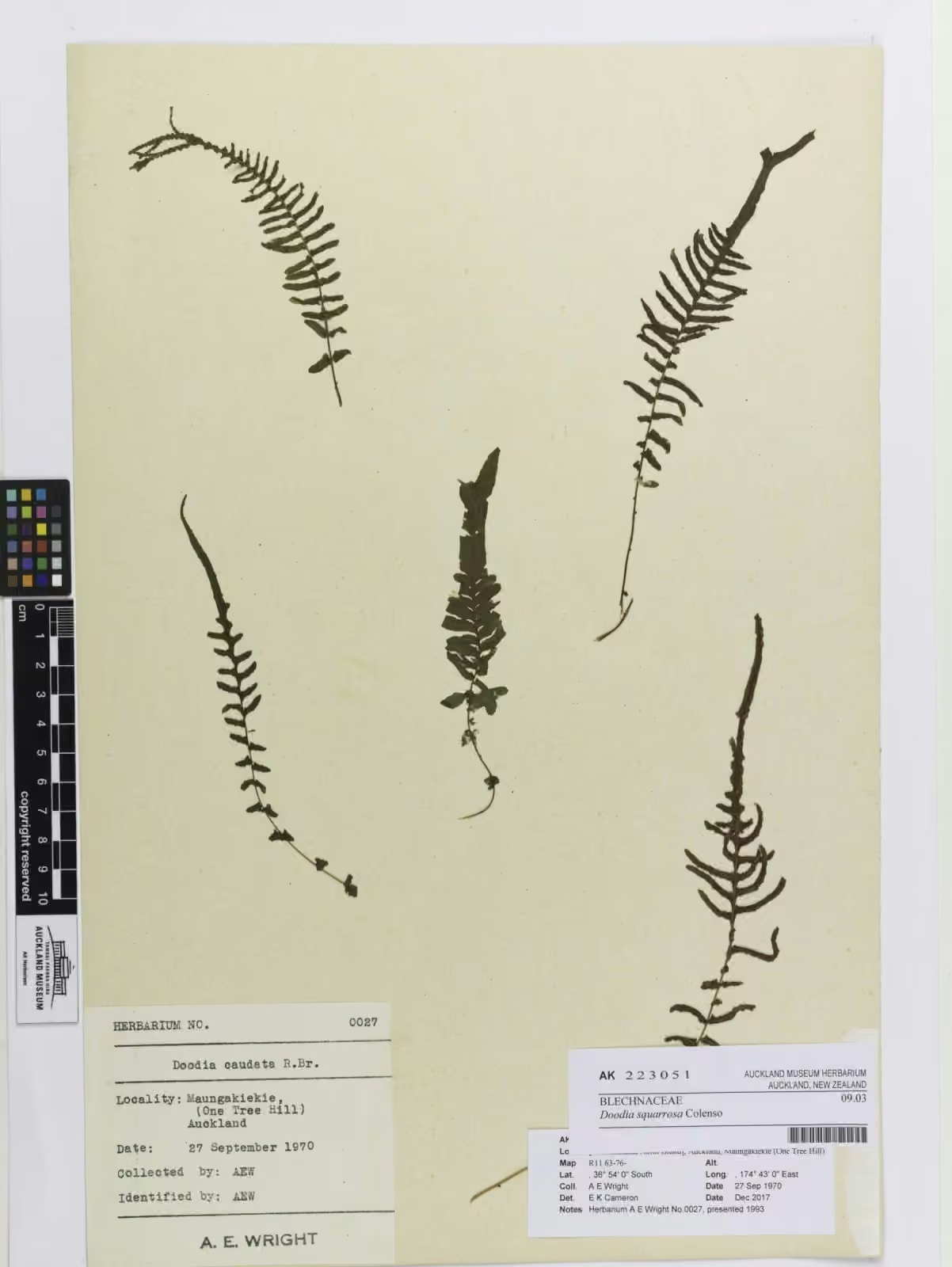
Doodia squarrosa, now called Blechnum zeelandicum, is a tufted rasp fern endemic to New Zealand. It forms a low rosette of prostrate sterile fronds with taller, erect fertile fronds in the centre, up to about 50 cm long, that open pink and mature to dark green. The fertile fronds end in a conspicuously long terminal segment. It grows in coastal and lowland alluvial forest, on river banks often within the flood zone, near waterfalls and in geothermal areas from Northland to Wellington, and on Macauley Island. It is At Risk - Naturally Uncommon, yet NZPCN describes it as very fast growing and an excellent pot plant. Explore more native ferns in our native plant guide.
Plant Description
Doodia squarrosa has a short, erect rhizome bearing scales, with stipes 5 to 20 cm long that carry sparse brown scales. Its fronds are weakly dimorphic. The sterile fronds are smaller and lie flat in a prostrate rosette, 8.5 to 43 cm long with 9 to 28 pairs of pinnae, while the fertile fronds rise erect from the centre and are 11 to 53 cm long with 12 to 38 pairs of pinnae.
The fronds are fleshy, usually pink when young and maturing to dark green, and the veins join to form a network. The terminal pinna of the fertile frond is notably elongated, giving the frond a tail-like tip. Sori are elongated and covered by linear indusia, arranged along the pinna midribs.
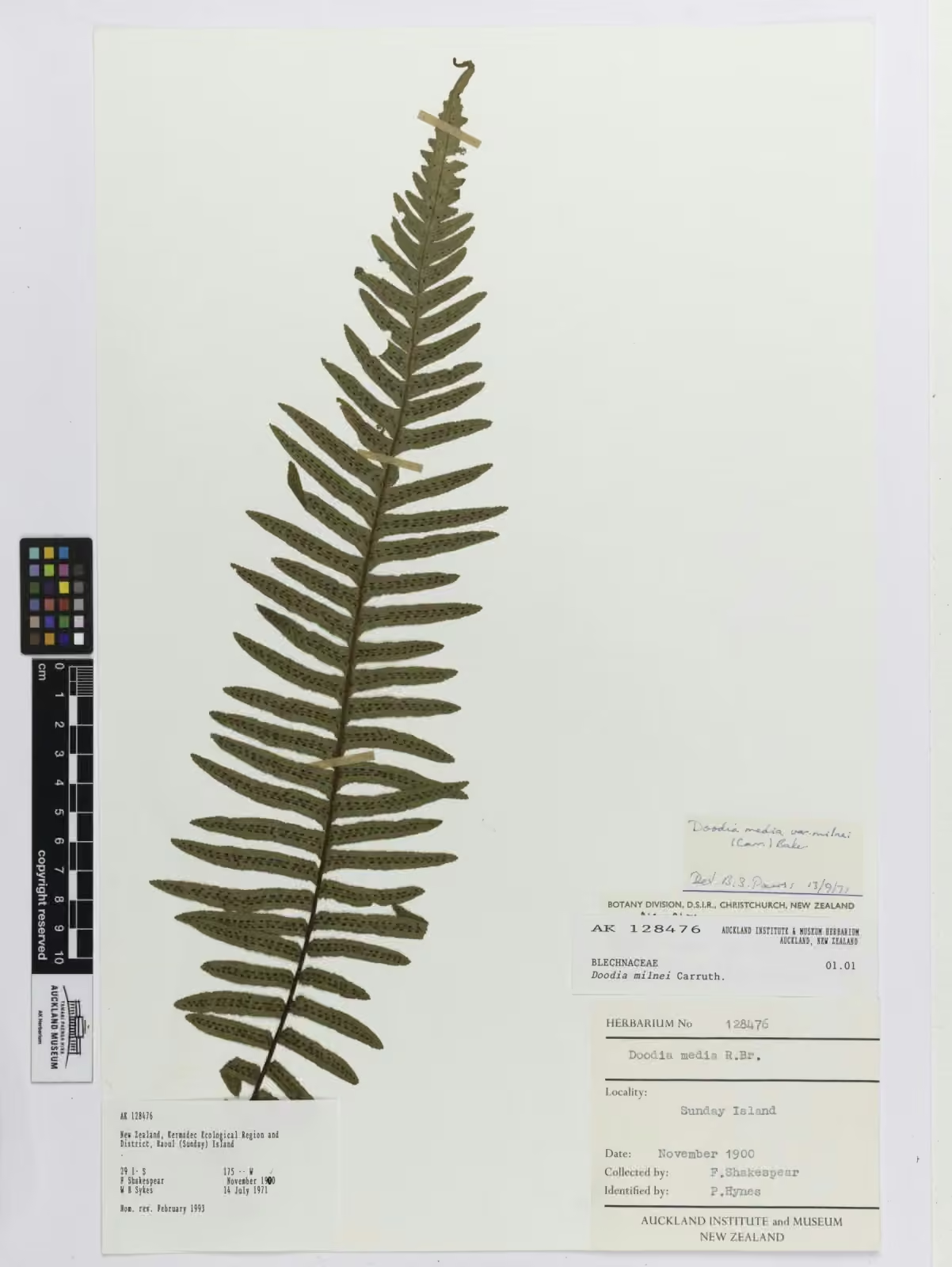
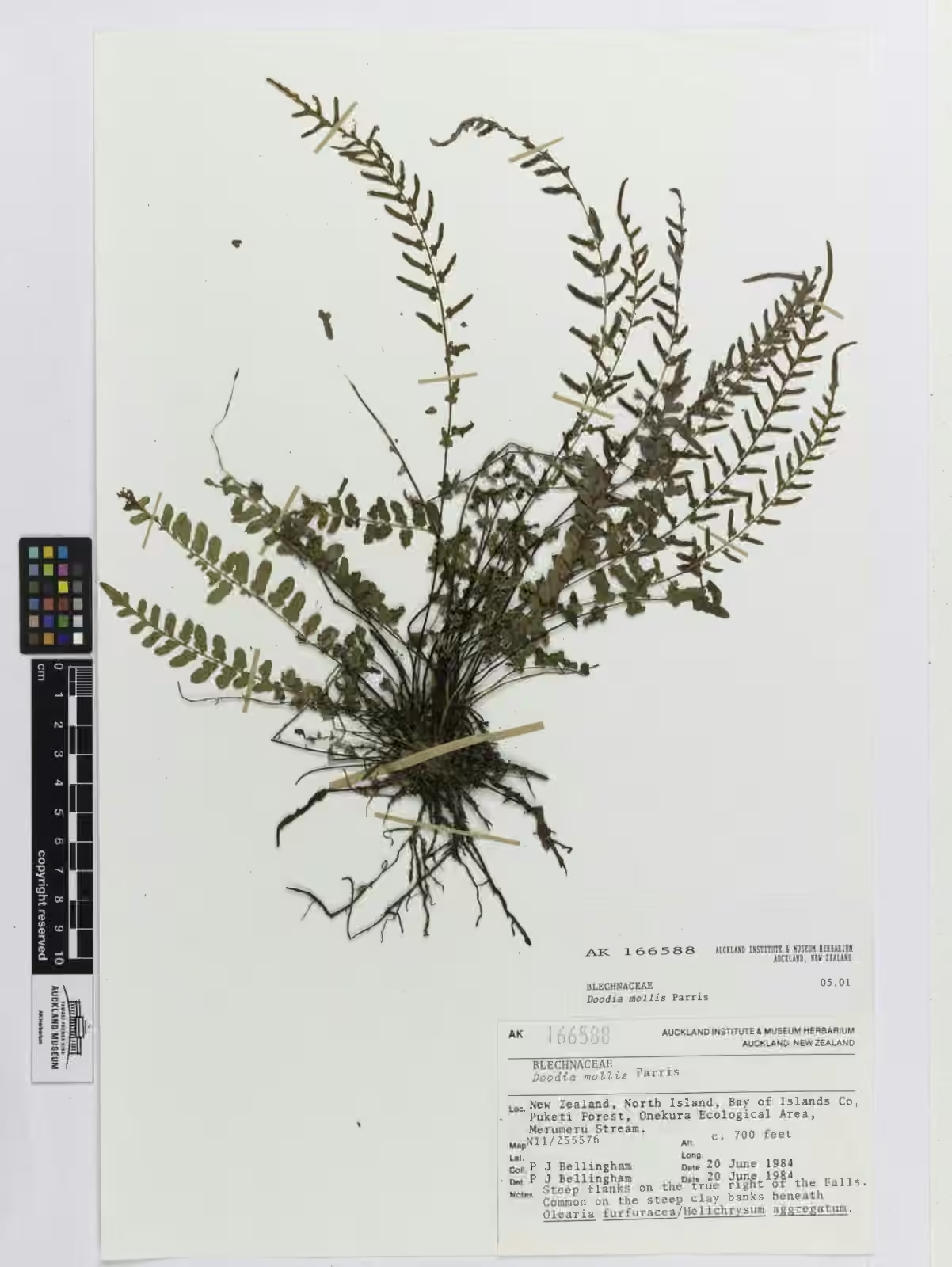
It is very similar to Doodia mollis (Blechnum molle), which has a much shorter terminal segment and hairs on the rachis. It differs from the common rasp fern, Doodia australis (Blechnum parrisiae), and from the Kermadec Doodia milnei in having pinnae joined to the rachis only in the distal half to third of the frond. It is tetraploid (2n = 128) rather than hexaploid like Doodia mollis, and it may hybridise with Doodia australis.
Quick Facts
| Scientific Name | Doodia squarrosa |
|---|---|
| Height | Fertile fronds 0.11-0.53 m long |
| Spread | About 0.3-0.6 m |
| Water Needs | Moderate; adaptable |
| Light | Dappled light to sun |
| Frost Tolerance | Low to moderate; a lowland North Island species |
| Salt Tolerance | Low to moderate; grows on coastal slopes but not exposed shores |
| Growth Rate | Fast |
| Lifespan | Perennial |
Climate Best Suited to
Suits the mild lowland climate of the North Island, from subtropical Northland to the Wellington region. It is best in frost-light, humid sites.
Regional Suitability
| City | Climate Suitability |
|---|---|
| Auckland | High |
| Wellington | Medium |
| Christchurch | Low |
| Dunedin | Low |
Plant Habitat
Doodia squarrosa is endemic to New Zealand. It is found in the North Island from Kaitāia south to Porirua, in Northland, Auckland, the Volcanic Plateau, Gisborne and the southern North Island, at altitudes of about 15 to 300 m. It also grows on Macauley Island in the Kermadec Islands, and it has been reported as naturalised in South Africa.
Its habitats are coastal and lowland alluvial forest, river banks (often within the flood zone), near waterfalls and in geothermal areas, usually in dappled light or sun and often on base-rich substrates. The Flora of New Zealand adds podocarp-broadleaf forest, mānuka and kānuka scrub, coastal slopes, river terraces, shaded overhangs, rock crevices, road and clay banks, cliff bases and fallen logs.
Growing Requirements
Soil Requirements
It favours base-rich substrates in the wild but NZPCN notes it does well in a variety of soils in cultivation.
- Free-draining loam, alluvial silt or rocky soil
- Tolerates clay banks and rock crevices
- A little lime or crushed shell can mimic base-rich sites
Light Requirements
In the wild it usually grows in dappled light or sunny situations rather than deep shade.
- Dappled shade to morning sun
- Copes with brighter light than many ferns
- Protect from harsh, drying afternoon sun
Water Requirements
It grows near rivers and waterfalls but also on clay banks, so it adapts to a range of moisture levels.
- Keep evenly moist while establishing
- Tolerates periodic flooding in river settings
- Avoid prolonged drought in pots
Planting and Establishing
Plant in spring or autumn into a weed-free site, as NZPCN notes the species is intolerant of competition from weeds. Stream banks, rocky outcrops and shady garden edges suit it, and it also does well in pots.
Space plants about 30 to 40 cm apart and mulch with leaf litter to suppress weeds. Keep the area weeded for the first few seasons until the rosette is established.
Ecological Role
Doodia squarrosa reproduces by spores and colonises open, disturbed sites such as river banks scoured by floods, road banks and geothermal ground. Its preference for base-rich substrates and warm geothermal areas sets it apart from many ferns.
It is part of a group of closely related New Zealand rasp ferns and may hybridise with Doodia australis. Its intolerance of weeds means invasive plants along rivers can crowd it out. Specific animal associations are not recorded in the sources consulted.
Uses & Significance
Garden Uses
A fast-growing, adaptable native fern for pots and lightly shaded garden spots.
- Container plant for decks and courtyards
- Rock gardens and stream banks
- Restoration of riparian and geothermal sites within its range
Ecological Value
It is an uncommon endemic fern that adds diversity to river margins and geothermal vegetation.
- Colonises flood-disturbed river banks
- Part of distinctive geothermal plant communities
- Contributes to the diversity of New Zealand rasp ferns
Landscaping Uses
Its flat rosettes of sterile fronds with erect fertile fronds give a layered, architectural look, while flushes of pink new growth add colour. It suits the front of shaded borders, rocky crevices and the edges of water features.
Use it in groups among boulders or with other small native ferns and sedges. Its fast growth makes it useful for filling gaps quickly, provided weeds are kept away.
Seasonal Care Calendar
Spring
Pink new fronds flush from the crown.
- Weed around plants
- Mulch with leaf litter
Summer
Fertile fronds stand upright with long tips and ripening sori.
- Water in dry spells
- Gather spores when sori brown
Autumn
Growth continues in mild weather; a good planting time.
- Plant or repot
- Tidy dead fronds
Winter
Growth slows; fronds persist in mild districts.
- Protect from frost in cold areas
- Keep pots from waterlogging
When to Prune and How Much
Remove dead or damaged fronds at the base as they occur, especially old fertile fronds that have shed their spores. This keeps the rosette tidy and encourages new pink growth.
No other pruning is needed. Keep the area around the plant free of weeds and grasses rather than cutting back the fern itself.
How to Grow Rasp Fern
NZPCN describes Doodia squarrosa as easy to raise from fresh spores and very fast growing. This makes spore propagation the best method, and wild plants should be left in place. Because it may hybridise with Doodia australis, gather spores from correctly identified plants. For restoration, use spores collected from the same district to keep local genetic character.
From Spores
Choose a fertile frond, recognisable by its erect habit and long terminal segment, when the sori have turned brown. Dry it in a paper envelope for a few days and sow the released spores promptly.
Sporelings of this species develop quickly compared with many native ferns, and NZPCN notes it is very fast growing, so young plants can often be potted on within their first season. Keep the young pots weed-free, because competition sets them back.
- Sterilise a shallow pot of fine, moist seed-raising mix with boiling water
- Once cool, sprinkle the spores thinly on the surface
- Cover with clear plastic to maintain high humidity
- Keep in a warm place with bright, indirect light
- Water from below to avoid disturbing the prothalli
- Lift the cover gradually as young fronds appear
- Transplant small clumps into pots and grow on until large enough to plant out
By Division
Large potted plants occasionally develop multiple crowns that can be separated. This should be done in spring when new growth is starting.
- Remove the plant from its pot and identify separate crowns
- Cut them apart with a clean knife, retaining roots on each
- Repot into fresh mix and keep shaded and moist until settled
Pests & Diseases
No serious pests are recorded. Slugs and snails may eat young fronds, and potted plants may occasionally host mealybugs or scale insects.
The main threat noted by NZPCN is weeds: the species is intolerant of competition, so invasive grasses and weeds along river banks and in disturbed sites can displace it.
Cultural Significance
No Māori name or traditional use is recorded for Doodia squarrosa in the sources consulted. The species was described by William Colenso, the nineteenth-century missionary, printer and botanist who collected widely in the North Island.
The genus name honours Samuel Doody, a seventeenth-century London apothecary. The epithet squarrosa means rough or spreading, and the newer name Blechnum zeelandicum refers to New Zealand.
Bonus Tip
If you have a geothermal or lime-influenced garden spot, this is one fern that may thrive there: in the wild it is often found near geothermal streams and on base-rich substrates, conditions many other native ferns avoid.
Related Plants
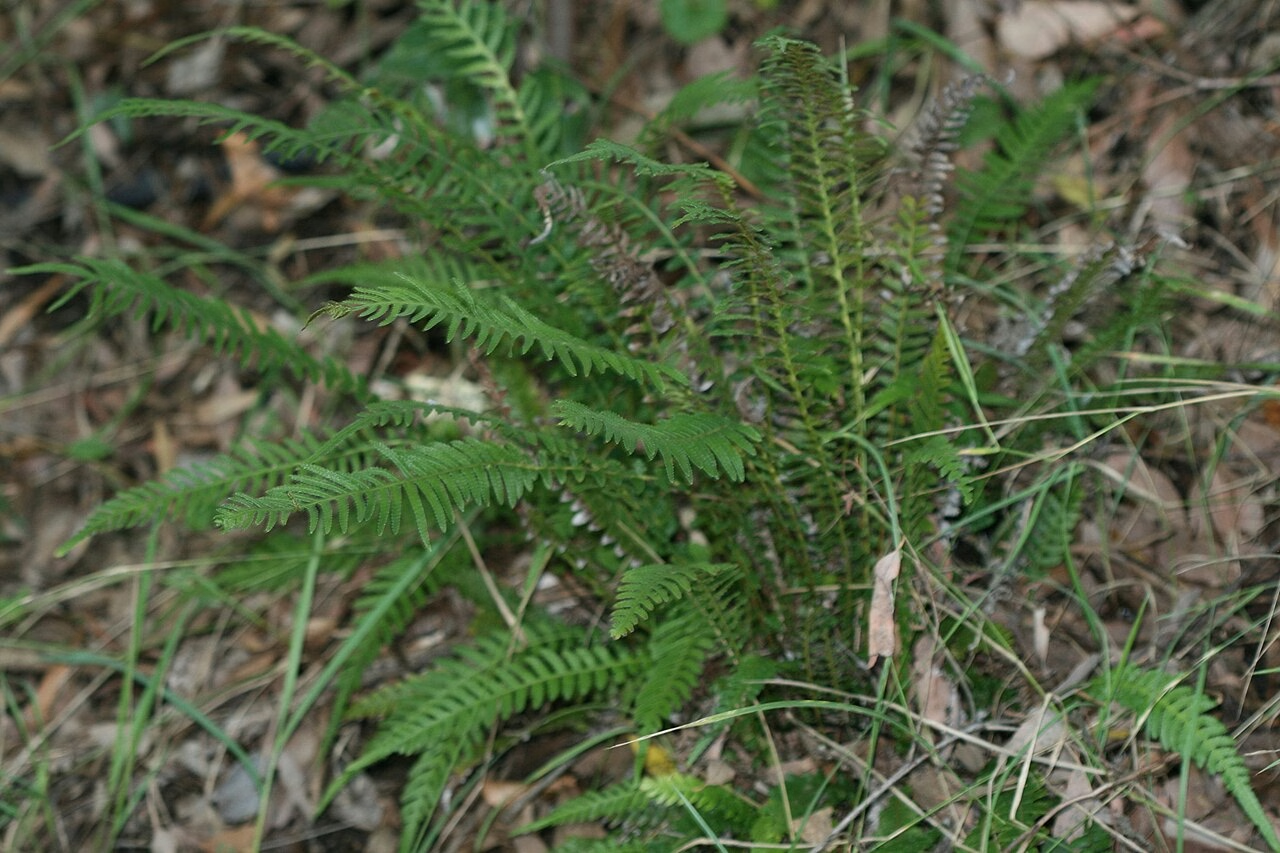
Explore other native plants that share similar characteristics or habitats with Rasp Fern (Doodia squarrosa), offering further insights into New Zealand's diverse flora. These related species provide context and opportunities for complementary planting in your garden.
Plant Conservation
Doodia squarrosa is ranked At Risk - Naturally Uncommon (2023) with the qualifiers Sparse, Data Poor: Recognition and Data Poor: Trend, reflecting both its scattered distribution and confusion with similar rasp ferns.
Weed control along rivers and in geothermal areas is the most practical way to help it. Protecting riparian margins from stock and including spore-raised plants in restoration projects within its range also helps.
Frequently Asked Questions
How do you identify Doodia squarrosa?
Look for a tufted rasp fern with prostrate sterile fronds, erect fertile fronds and a markedly elongated terminal segment at the tip of the fertile frond. Young fronds are pink and the pinnae are joined to the rachis only in the upper part of the frond.
Where is Doodia squarrosa found?
It occurs in the North Island from Kaitāia to Porirua, between about 15 and 300 m altitude, and on Macauley Island in the Kermadecs, often on river banks, near waterfalls and around geothermal streams.
Does Doodia squarrosa make a good pot plant?
Yes. NZPCN describes it as very fast growing and an excellent pot plant that copes with a variety of soils, light levels and moisture, but it does not tolerate competition from weeds.
Why is Doodia squarrosa also called Blechnum zeelandicum?
DNA studies by Perrie and colleagues in 2014 showed that keeping Doodia as a separate genus left Blechnum unnatural, so the rasp ferns were merged into Blechnum, and this species is now listed in the Flora of New Zealand as Blechnum zeelandicum.
Sources and Further Reading
The botanical, growing, and conservation details for Rasp Fern (Doodia squarrosa) on this page draw on the New Zealand plant references below. Consult them for full technical records and the latest distribution data.