Mokimoki
Doodia mollis
Last updated:
Doodia mollis, recorded by NZPCN under the names mokimoki and mukimuki and now known as Blechnum molle, is a small tufted rasp fern endemic to New Zealand. It has a low rosette of short, broad-segmented sterile fronds and taller, erect fertile fronds, 8 to 26 cm long, that open pink and mature to yellow-green, giving off a faint sweet scent when crushed. It grows in damp coastal and lowland forest, often on river margins and in alluvial forest, from Northland to the Waikato and Bay of Plenty, with outliers further south and on Macauley Island. It is At Risk - Naturally Uncommon but grows easily from spores. Explore more native ferns in our native plant guide.
Plant Description
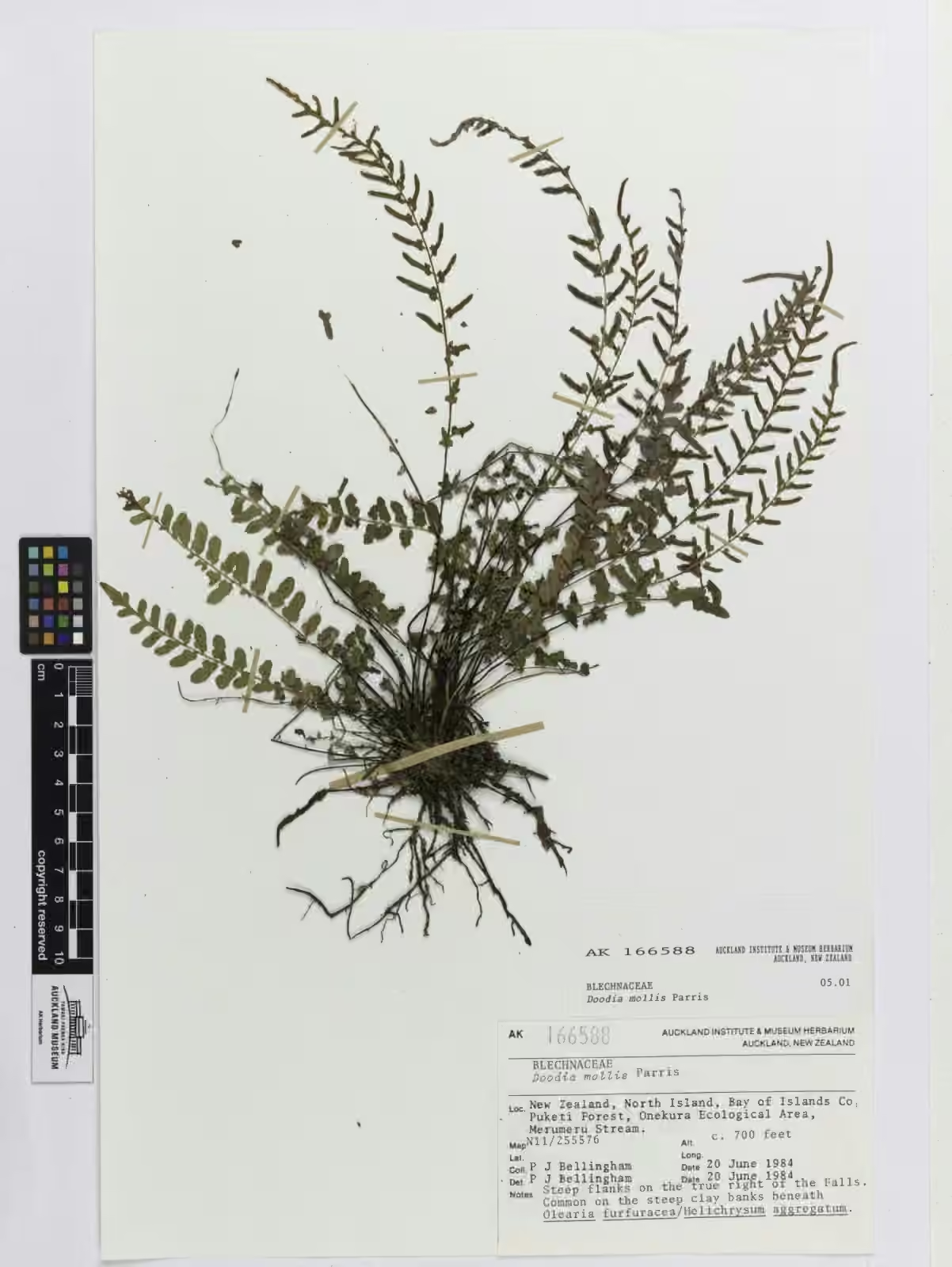
Doodia mollis is a small, tufted terrestrial fern with an erect rhizome up to about 3 cm tall. Its fronds are weakly dimorphic. The sterile fronds spread outward or lie almost flat in a rosette and have short, broad pinnae, while the fertile fronds stand erect in the centre with longer, narrower pinnae. NZPCN gives fronds as 8 to 26 cm long and 1.5 to 5 cm wide, while the Flora of New Zealand records fertile fronds up to 62 cm.
The fronds are firmly fleshy yet herbaceous, pink or pinkish-green when young and maturing to pale yellow-green or green, and carry minute hairs. Sterile fronds have 7 to 21 pairs of pinnae and fertile fronds 8 to 32 pairs. A faint sweet scent is released when the fronds are crushed. Sori are elongated and sit in rows along the pinna midribs.
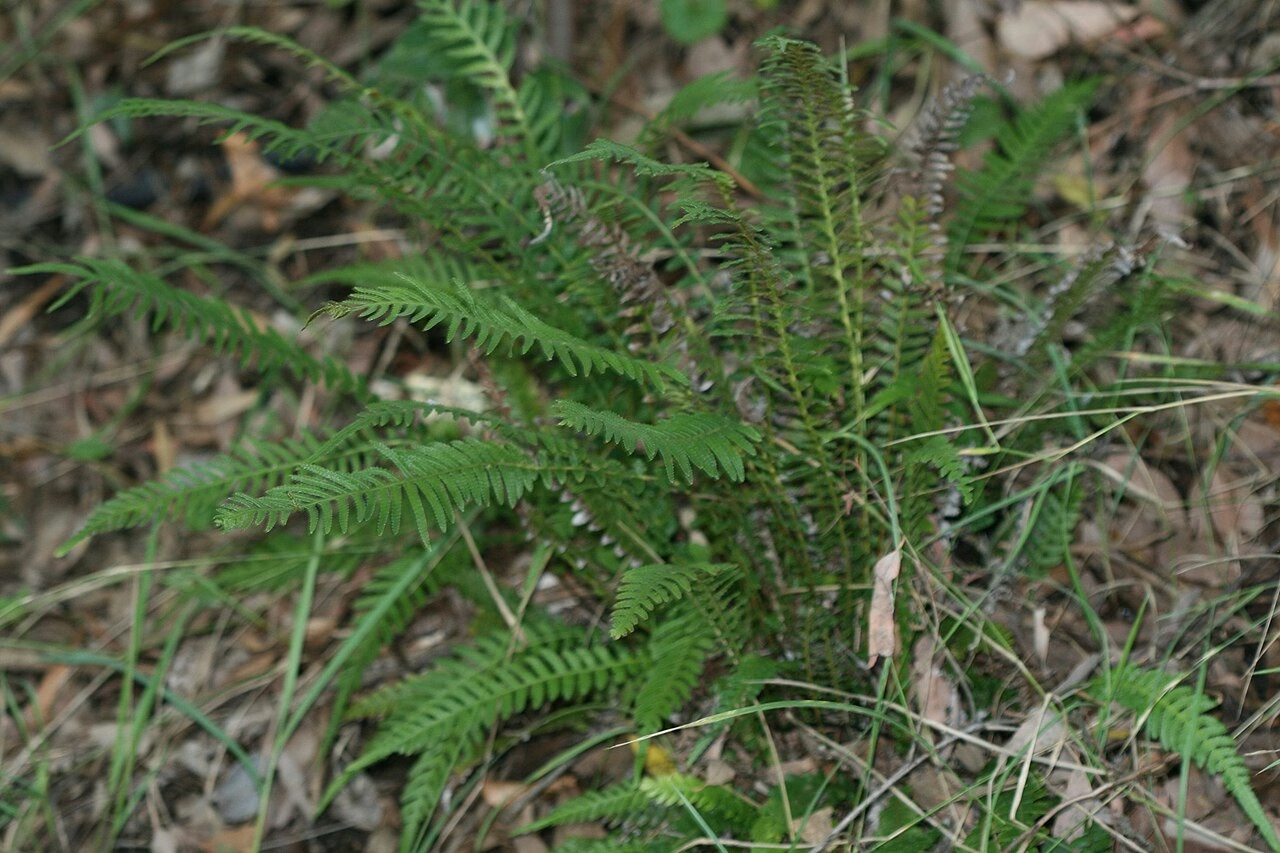
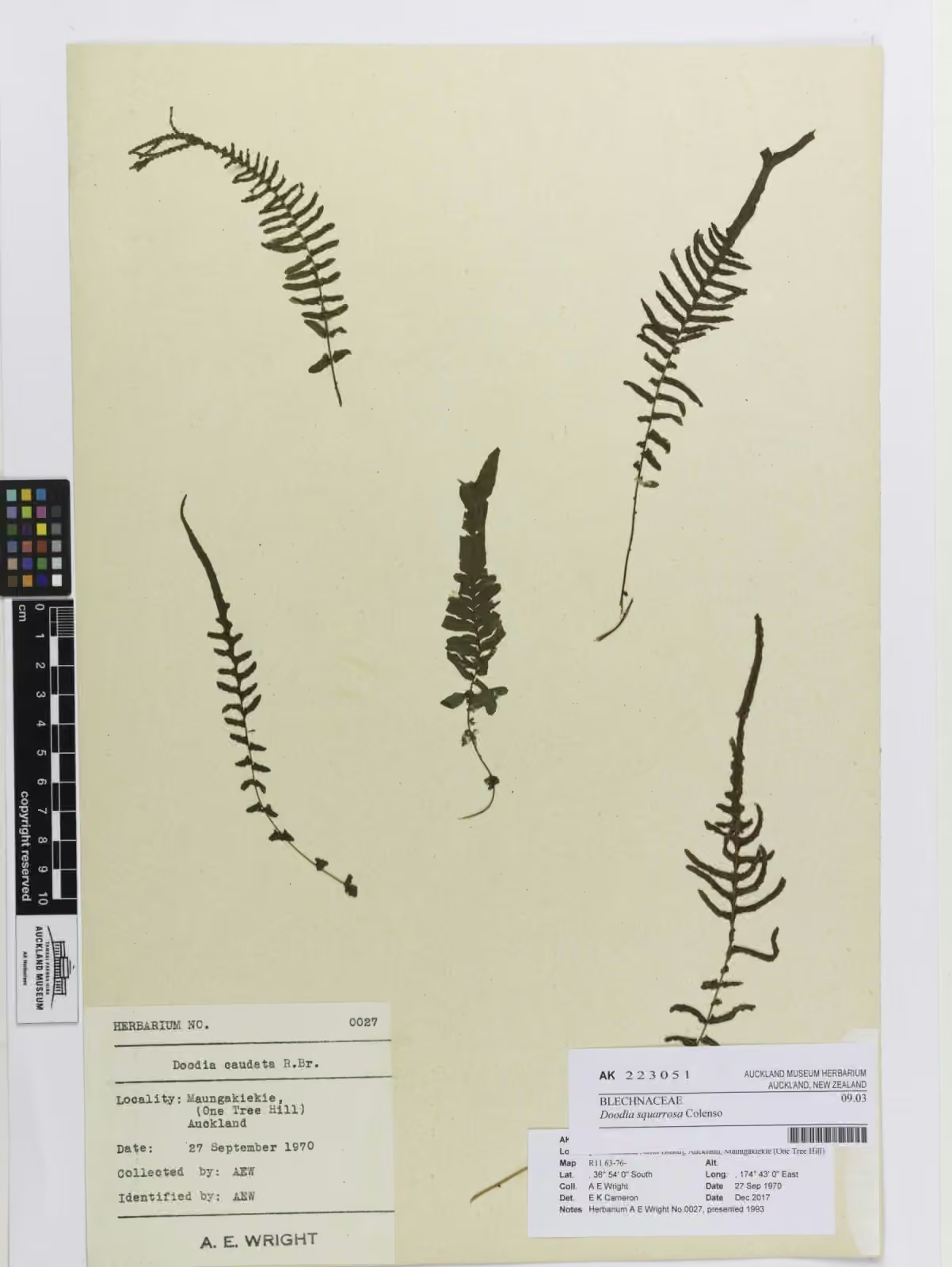
It closely resembles Doodia squarrosa (Blechnum zeelandicum), which has a much longer terminal frond segment and lacks hairs on the rachis. It differs from the common rasp fern, Doodia australis (Blechnum parrisiae), in having pinnae joined to the rachis only in the upper third of the frond. It hybridises with Blechnum parrisiae, producing the hybrid named Blechnum ×digenum, and may also cross with Doodia squarrosa.
Quick Facts
| Scientific Name | Doodia mollis |
|---|---|
| Height | Fertile fronds up to about 0.26 m (NZ Flora gives up to 0.62 m) |
| Spread | About 0.2-0.4 m |
| Water Needs | Moderate to high; prefers damp sites |
| Light | Shade to dappled light |
| Frost Tolerance | Low to moderate; a lowland northern species |
| Salt Tolerance | Low to moderate; grows in coastal bush but not on exposed shores |
| Growth Rate | Moderate |
| Lifespan | Perennial |
Climate Best Suited to
Suits mild, humid lowland climates of the northern and central North Island. It prefers sheltered, frost-light sites.
Regional Suitability
| City | Climate Suitability |
|---|---|
| Auckland | High |
| Wellington | Medium |
| Christchurch | Low |
| Dunedin | Low |
Plant Habitat
This fern is endemic to New Zealand. On the mainland it occurs in the North Island from Awanui and Kaitāia south to the Hamilton Basin, Kāwhia, the Hauraki Plains and the coastal Bay of Plenty, with scattered eastern records from Gisborne, Napier and southern Wairarapa. It is also found on Macauley Island in the Kermadec group. It grows from sea level to about 220 m.
It usually grows in coastal to lowland forest, often along river margins or in alluvial forest, especially on damp sites or deep, fertile forest soils. The Flora of New Zealand also records it in podocarp-broadleaf forest, under kānuka, in open scrub and coastal bush, on stream banks, tree bases, clay banks, rocky bluffs and among damp rocks.
Growing Requirements
Soil Requirements
It favours deep, fertile, moist forest soils such as river alluvium, though it also grows on clay banks and among rocks.
- Rich, humus-laden loam
- Consistently moist but not stagnant
- Leaf mould or compost mulch
Light Requirements
In the wild it grows under forest or scrub canopies and on sheltered banks.
- Light to moderate shade
- Morning sun is tolerated
- Avoid hot, exposed afternoon sun
Water Requirements
It is typically found in damp sites such as stream banks and river flats, so even moisture suits it best.
- Water regularly in dry weather
- Mulch to keep the soil cool and damp
- Good drainage around the crown prevents rot
Planting and Establishing
Plant in autumn or spring in a sheltered, shaded part of the garden with fertile, moist soil. A stream bank, the shady side of a path or the base of a tree with leaf litter mimics its natural habitat.
Because it is small, place it near the front of a planting where its pink new fronds can be appreciated. It also makes a good pot plant on a shady deck, as NZPCN notes it does well in containers.
Ecological Role
Doodia mollis reproduces by wind-dispersed spores and forms small tufted plants on the forest floor and on banks. Its association with alluvial forest and river margins reflects a preference for fertile, periodically disturbed soils.
It is one of a group of closely related rasp ferns that hybridise where they meet, including Doodia squarrosa and Doodia australis. Specific insect or animal associations are not recorded in the sources consulted.
Uses & Significance
Garden Uses
A neat, compact native fern for shady, moist spots and containers.
- Shade gardens and woodland edges
- Pot plant for shady patios
- Riparian restoration planting within its natural range
Ecological Value
As an uncommon endemic fern of lowland alluvial forest, it is a useful species to include in restoration of those increasingly rare habitats within its range.
- Ground layer of lowland and riparian forest
- Supports genetic diversity among New Zealand rasp ferns
- Helps bind soil on stream banks
Landscaping Uses
Its pink-flushed new growth provides seasonal colour in a shady planting, contrasting with the green of mature fronds. Group several plants together to create a low carpet under trees or shrubs.
Combine it with other small native ferns and forest-floor plants such as Nertera or small sedges for a naturalistic woodland effect.
Seasonal Care Calendar
Spring
Fresh pink fronds emerge from the crown.
- Mulch with leaf mould
- Water if spring is dry
Summer
Fertile fronds stand upright and bear sori.
- Keep soil moist
- Collect spores when sori turn brown
Autumn
Growth slows; this is a good time for planting.
- Plant new specimens
- Remove tattered fronds
Winter
The plant is mostly dormant and keeps its fronds in mild areas.
- Protect from heavy frost
- Avoid waterlogging
When to Prune and How Much
Simply remove dead or yellowing fronds at the base when they appear. This keeps the rosette tidy and allows light to reach the new pink fronds.
Avoid cutting healthy fronds, as this small fern has limited foliage and relies on it to stay vigorous.
How to Grow Mokimoki
NZPCN describes Doodia mollis as easily grown from fresh spores, and spore-raised plants are the best way to obtain it, since wild plants should not be dug up. Because it hybridises with Doodia australis and Doodia squarrosa, collect spores from plants that are clearly identified and, where possible, growing apart from other rasp ferns. Plants for restoration work should be raised from local populations.
From Spores
Fertile fronds are the upright ones with narrower pinnae. Pick one when the sori on the undersides have turned brown and place it in a paper bag for a couple of days to release spores.
Germination usually takes a few weeks in warmth, and the first green prothalli look like a fine moss over the surface. Keeping the container sealed and out of direct sun at this stage prevents drying, which is the commonest cause of failure.
- Prepare a fine, sterilised peat or seed-raising mix in a shallow pot
- Sow spores thinly over the surface while they are fresh
- Cover with clear plastic or glass to keep humidity high
- Place in a warm, shaded spot with bright indirect light
- Keep the surface moist with boiled water
- When young fronds appear, harden off gradually by opening the cover
- Pot sporelings individually and grow on in shade
By Division
Established plants in cultivation sometimes form more than one crown. These can be carefully separated in spring.
- Lift the clump in spring
- Split crowns gently, keeping roots attached to each
- Replant into moist, humus-rich mix and keep shaded until established
Pests & Diseases
No significant pests or diseases are recorded for this fern. Slugs and snails may damage new fronds in the garden, and drying out in summer is the most common cause of decline in cultivation.
In the wild, clearance and drainage of lowland alluvial forest, together with weed invasion and stock trampling of stream margins, reduce the habitat available to it.
Cultural Significance
NZPCN lists mokimoki and mukimuki as names for Doodia mollis. The name mokimoki is more widely associated with the fragrant fern Microsorum scandens, and the faint sweet scent of crushed Doodia mollis fronds may explain the shared name, though the sources consulted do not say so. No traditional Māori use specific to this species was found.
The species was described by Barbara Parris, and earlier New Zealand authors, including the 1961 Flora, confused it with the Australian Doodia caudata. The epithet mollis means soft.
Bonus Tip
To confirm identity, look at the tip of a fertile frond: Doodia mollis has a short terminal segment and hairy rachis, whereas the similar Doodia squarrosa has a conspicuously long, tail-like tip segment.
Related Plants
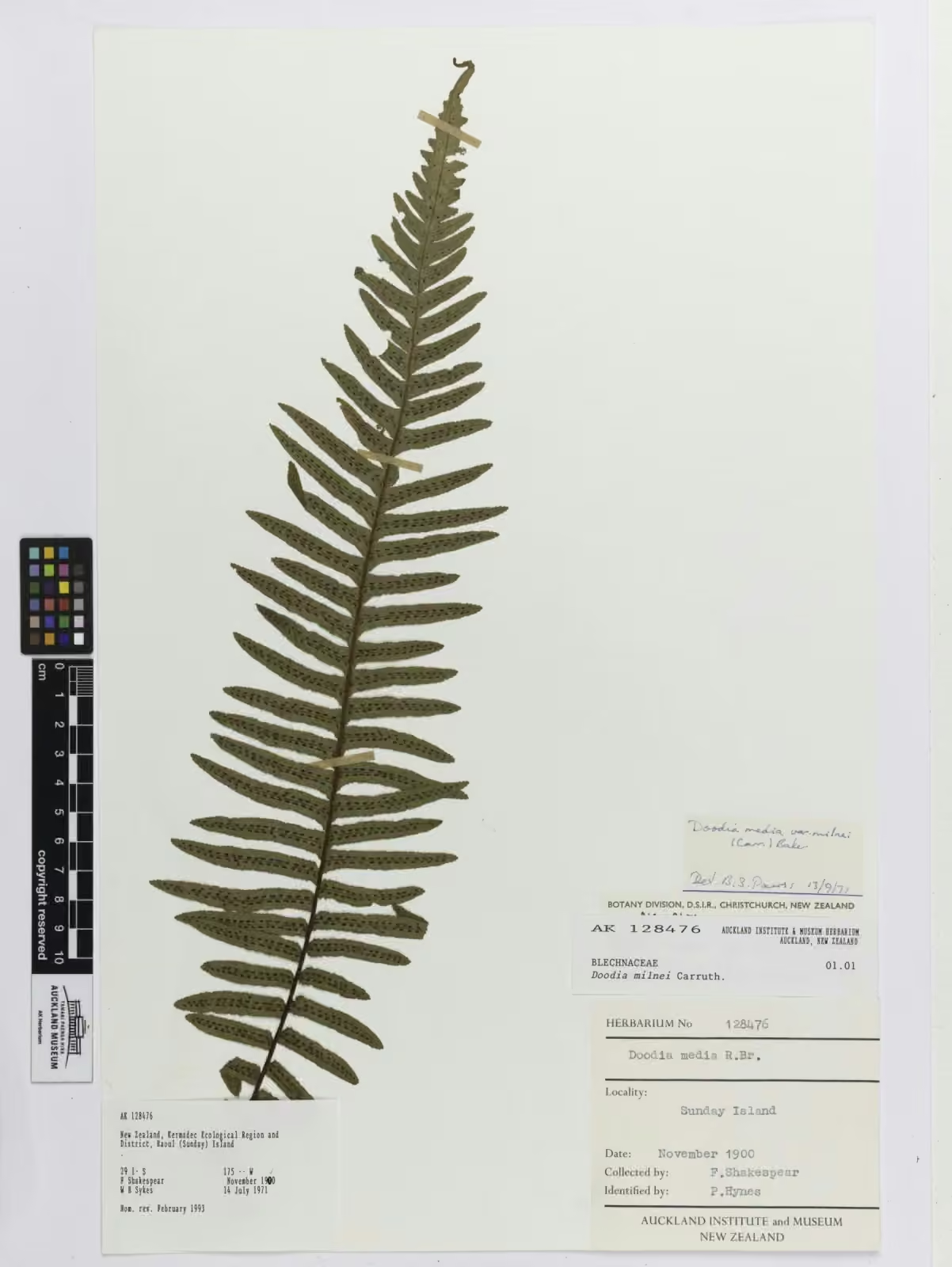
Explore other native plants that share similar characteristics or habitats with Mokimoki (Doodia mollis), offering further insights into New Zealand's diverse flora. These related species provide context and opportunities for complementary planting in your garden.
Plant Conservation
Doodia mollis is ranked At Risk - Naturally Uncommon (2023) with the qualifiers Sparse and Data Poor: Recognition. Regionally, it is listed as Regionally Naturally Uncommon in Northland, Regionally Endangered in Auckland and Regionally Critical in Wellington.
Protecting and restoring lowland alluvial forest and riparian margins, fencing streams from stock and controlling weeds will benefit it. Growing it from spores in local nurseries for restoration plantings within its range can help maintain populations.
Frequently Asked Questions
What does Doodia mollis look like?
It is a small tufted fern with two kinds of fronds: low, spreading sterile fronds with short, broad pinnae, and upright fertile fronds with longer, narrower pinnae. Young fronds are pink and the fronds are firmly fleshy.
How do you tell Blechnum molle from Blechnum zeelandicum?
Blechnum molle has a much shorter terminal segment at the frond tip and hairs on the rachis, while Blechnum zeelandicum (Doodia squarrosa) has a much longer terminal segment and pinnae joined further down the rachis.
Is Doodia mollis rare?
It is ranked At Risk - Naturally Uncommon nationally, and regionally it is considered Endangered in Auckland and Critical in the Wellington region, where only scattered populations exist.
Is mokimoki easy to grow?
Yes. NZPCN says it is easily grown from fresh spores and, despite looking delicate, does well as a pot plant.
Sources and Further Reading
The botanical, growing, and conservation details for Mokimoki (Doodia mollis) on this page draw on the New Zealand plant references below. Consult them for full technical records and the latest distribution data.