Rasp Fern
Doodia milnei
Last updated:
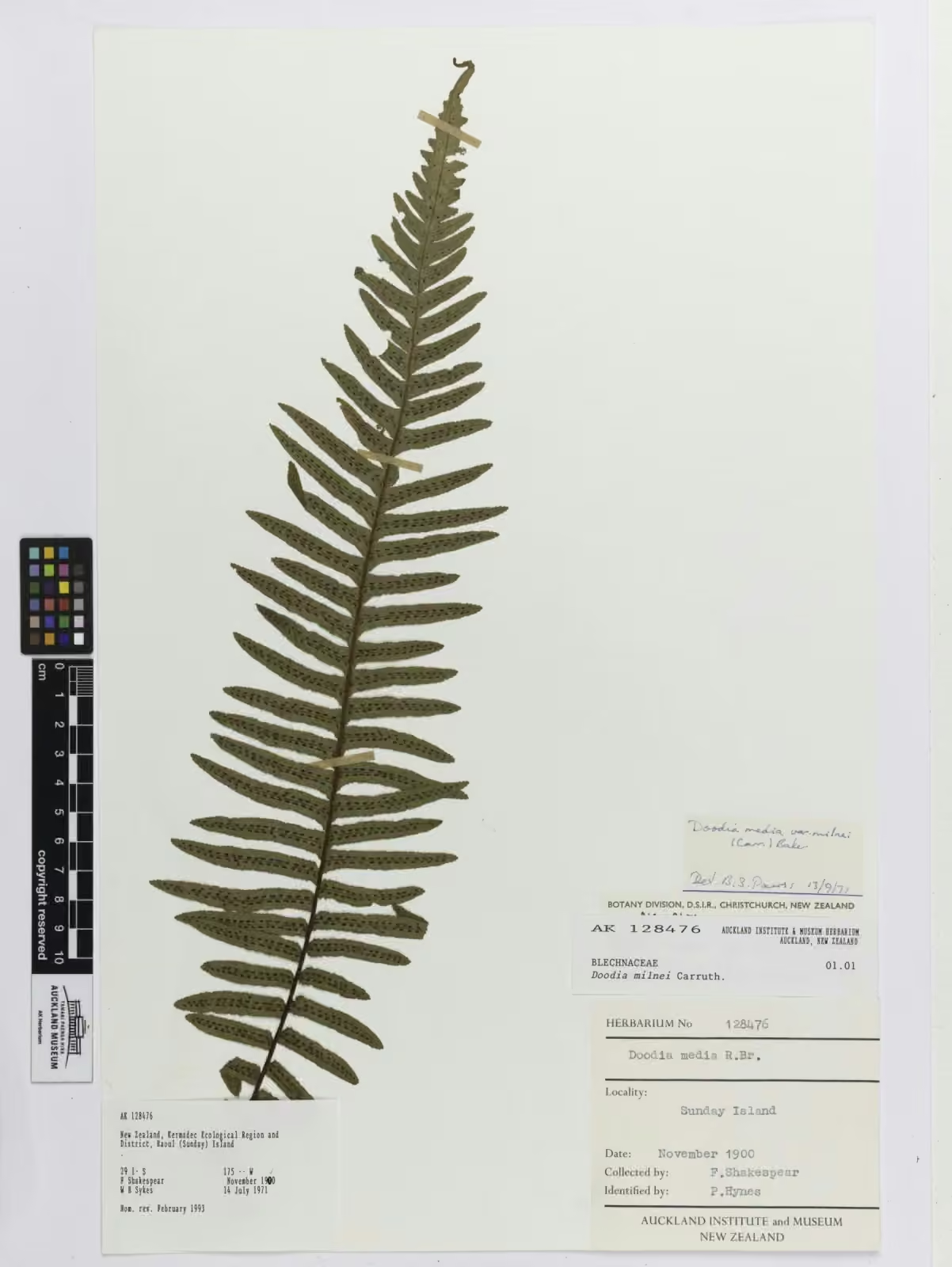
Doodia milnei, now known as Blechnum kermadecense, is a rasp fern found only on Raoul and Macauley islands in the Kermadec group. It forms an erect, sometimes short-trunked crown of bright green, once-divided fronds up to about 77 cm long, much larger and softer than the mainland rasp ferns. It grows in dry Kermadec pōhutukawa forest, among rocks, on cliffs and in clearings, and under Kermadec ngaio on Macauley Island. It is ranked At Risk - Naturally Uncommon only because its natural range is so small. In cultivation it grows easily from spores but needs warmth, sun and free-draining soil. Explore more native ferns in our native plant guide.
Plant Description
Doodia milnei has an erect rhizome up to about 13 cm long, covered in black-brown scales, which sometimes forms a small trunk up to about 10 cm. The fronds are monomorphic, meaning fertile and sterile fronds look alike, and are 31 to 77 cm long overall with red or yellow-brown rachises. The blade is elliptic and once-pinnate, 27 to 54 cm long and 9 to 25 cm wide.
There are 17 to 35 pairs of pinnae, longest in the middle of the blade at 4.4 to 14 cm long and 3 to 15 mm wide. The veins join to form a network, and the sori are elongated and separate, in one or two rows either side of each pinna midrib, protected by narrow, linear indusia. The whole plant is a vibrant green.
It is easily separated from mainland rasp ferns by its uniform fronds and large, rather membranous pinnae. Compared with the common rasp fern, Blechnum parrisiae, it has sparse or no hairs on the rachis and blade and lacks the pink flush on young fronds.
Quick Facts
| Scientific Name | Doodia milnei |
|---|---|
| Height | Fronds 0.3-0.77 m long |
| Spread | About 0.5-1 m |
| Water Needs | Low to moderate; prefers dry, free-draining soil |
| Light | Sun to dappled shade |
| Frost Tolerance | Low; cold intolerant |
| Salt Tolerance | Moderate; grows in coastal island forest |
| Growth Rate | Moderate |
| Lifespan | Perennial |
Climate Best Suited to
Suits the warm, subtropical oceanic climate of the Kermadec Islands. It is cold intolerant and will only grow outdoors in frost-free mainland districts.
Regional Suitability
| City | Climate Suitability |
|---|---|
| Auckland | High |
| Wellington | Low |
| Christchurch | Low |
| Dunedin | Low |
Plant Habitat
This fern is endemic to the Kermadec Islands, about 1000 km north-east of the North Island. It is known from Raoul Island and Macauley Island, at altitudes of roughly 90 to 300 m. The type specimen was collected on Raoul Island by W.G. Milne in 1854, the collector the species is named after.
It grows in coastal and lowland habitats, usually in dry Kermadec pōhutukawa (Metrosideros kermadecensis) forest, where it occupies clearings, tracksides, banks, cliff faces, leaf litter and gaps among scoria and boulders. On Macauley Island it grows under sparse Kermadec ngaio. It is rarely found in the wetter parts of the forest.
Growing Requirements
Soil Requirements
On the islands it roots into volcanic soils, scoria and leaf litter among rocks, and NZPCN notes it grows easily in most soils provided drainage is good.
- Free-draining, light soil or volcanic scoria mix
- Leaf litter or compost mulch
- Avoid heavy, wet clay
Light Requirements
It grows in clearings, on tracksides and under open pōhutukawa canopies, and prefers a sunny situation in cultivation.
- Full sun to light shade in warm districts
- Tolerates the dappled light of open forest
- Avoid deep, damp shade
Water Requirements
Unusually for a fern, it prefers fairly dry conditions once established.
- Water during establishment, then sparingly
- Let the surface dry between waterings
- Excess moisture in cool weather can cause rot
Planting and Establishing
Plant in spring or early summer in a warm, sheltered and frost-free position. A rocky bank, raised bed or the base of a sunny wall gives the free drainage and warmth it enjoys. Work in grit or scoria if the soil is heavy.
Set the crown at the original soil level so the erect rhizome does not sit in water, and allow around 1 m for the fronds to spread. In cooler areas grow it in a large pot that can be moved under cover in winter.
Ecological Role
Doodia milnei is part of the distinctive fern flora of the Kermadec Islands, which includes several endemic species. It disperses by wind-borne spores and colonises open, disturbed ground such as clearings and tracksides, as well as stable rocky sites under forest.
No particular animal associations with this species are documented in the sources consulted. Its main ecological role is as a ground-layer plant on rocky banks, scoria and leaf litter beneath the open canopy of dry Kermadec pōhutukawa forest.
Uses & Significance
Garden Uses
A handsome, large rasp fern for warm, dry gardens where many ferns would struggle.
- Sunny rock gardens and dry banks in frost-free areas
- Large containers on sheltered patios
- Collections of Kermadec or offshore island plants
Ecological Value
As a Kermadec endemic it contributes to the unique biodiversity of New Zealand's northernmost islands.
- Ground cover in dry pōhutukawa forest
- Colonises clearings and rocky ground
- Part of the endemic Kermadec fern flora
Landscaping Uses
Its upright crown of bright green, ladder-like fronds gives a lush, subtropical look while tolerating drier conditions than most ferns. Use it as a feature among rocks or beside paths where the long fronds can arch freely.
It combines well with other warm-climate island plants such as Kermadec pōhutukawa, and with low succulents or coastal grasses that share its liking for free-draining soil.
Seasonal Care Calendar
Spring
New fronds emerge from the erect rhizome as the weather warms.
- Apply a light mulch of leaf litter
- Water new plantings
Summer
The main growth period, with fertile fronds producing rows of sori.
- Water occasionally in prolonged drought
- Collect ripe spores for propagation
Autumn
Growth slows and older fronds begin to age.
- Remove damaged fronds
- Reduce watering
Winter
The plant is vulnerable to cold and frost outside the far north.
- Protect from frost or bring pots under cover
- Keep soil on the dry side
When to Prune and How Much
Only remove dead or damaged fronds, cutting them at the base. This is best done in late winter or early spring before new fronds unroll, so they are not damaged.
Do not cut into the rhizome crown, as the plant does not readily spread sideways and relies on its single growing point.
How to Grow Rasp Fern
NZPCN notes that Doodia milnei is easily grown and that fresh spores germinate well. Because it grows from an erect rhizome rather than a creeping one, spores are the main method of increase. Wild plants on the Kermadec Islands are protected within a nature reserve and must not be collected, so spores should come from cultivated plants. Sporelings grow on readily in warmth but should be kept frost-free through their first winters.
From Spores
Pick a fertile frond when the long sori have turned brown but before all spores have been shed. Place it in a paper envelope for a few days to release the fine spores, then sow them while fresh.
- Fill a small pot with fine seed-raising or peat-based mix and sterilise it with boiling water
- Allow the mix to cool, then dust the spores thinly over the surface
- Seal the pot in a clear bag or cover with glass to hold humidity
- Keep in a warm, bright spot out of direct sun
- Water from below with boiled water as needed
- Once small fronds appear, gradually lower the humidity
- Prick out clumps of sporelings into individual pots and grow on in warmth
By Division
Older plants occasionally produce side crowns, which can be separated in spring. Only attempt this when a clear offset with its own roots is present.
- Lift the plant in spring and look for a separate crown
- Cut the offset away with a sharp knife, keeping roots attached
- Pot into a free-draining mix and keep warm until established
Pests & Diseases
No specific pests or diseases are recorded for this fern. In cultivation, slugs and snails may damage emerging fronds, and plants kept too wet in cold weather can suffer from crown rot.
On the Kermadec Islands, past browsing by feral goats and predation by rats affected forest understoreys; both have been eradicated from Raoul Island. Weeds remain a management concern on the islands.
Cultural Significance
No Māori name or traditional use for this Kermadec fern is recorded in the sources consulted. The epithet milnei honours William Grant Milne, who collected the type specimen on Raoul Island in 1854.
Its newer name, Blechnum kermadecense, was given by Leon Perrie and Patrick Brownsey when Doodia was merged into Blechnum, and simply means from the Kermadec Islands.
Bonus Tip
Treat this as a dry-garden fern: NZPCN advises a sunny position in free-draining, dry soil, so it will do better on a warm rocky bank in Auckland or Northland than in the damp, shady corner where most ferns are planted.
Related Plants
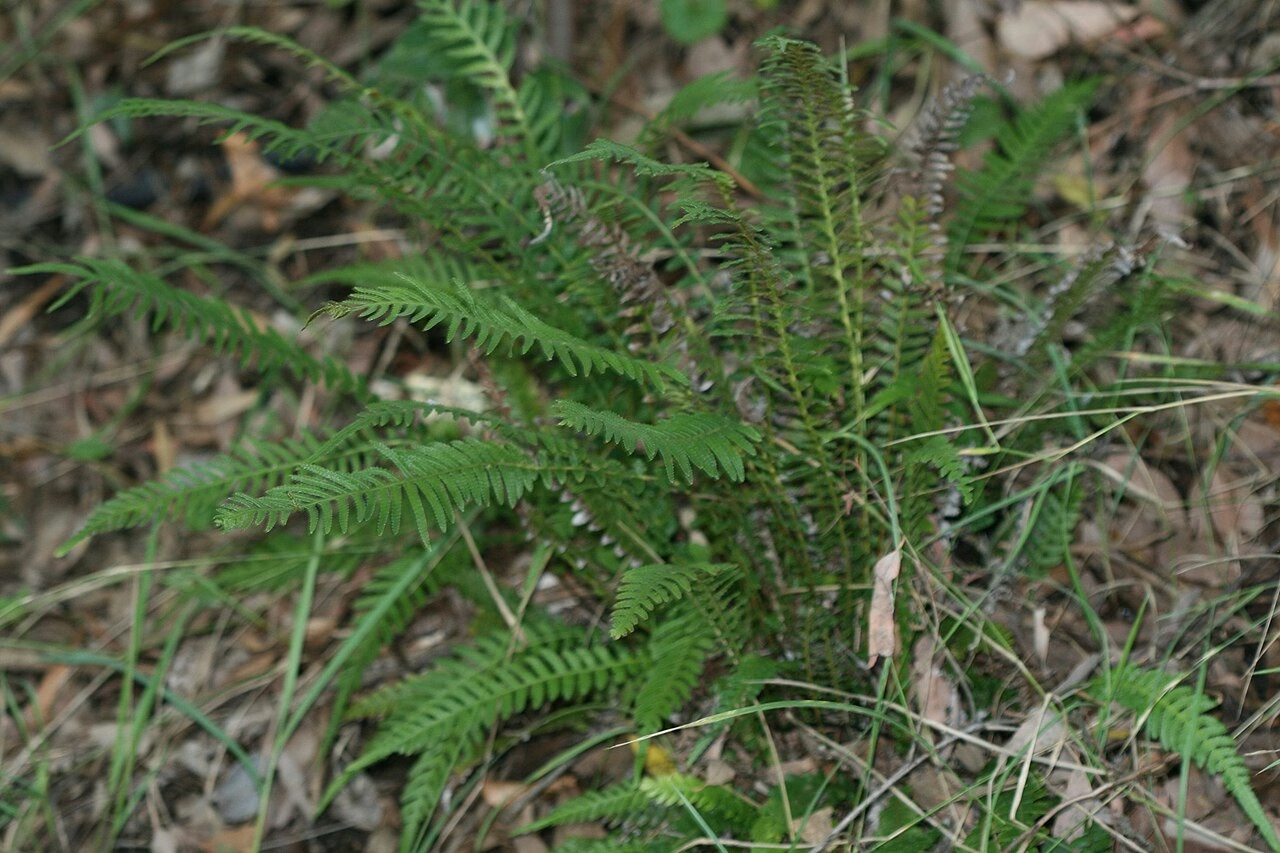
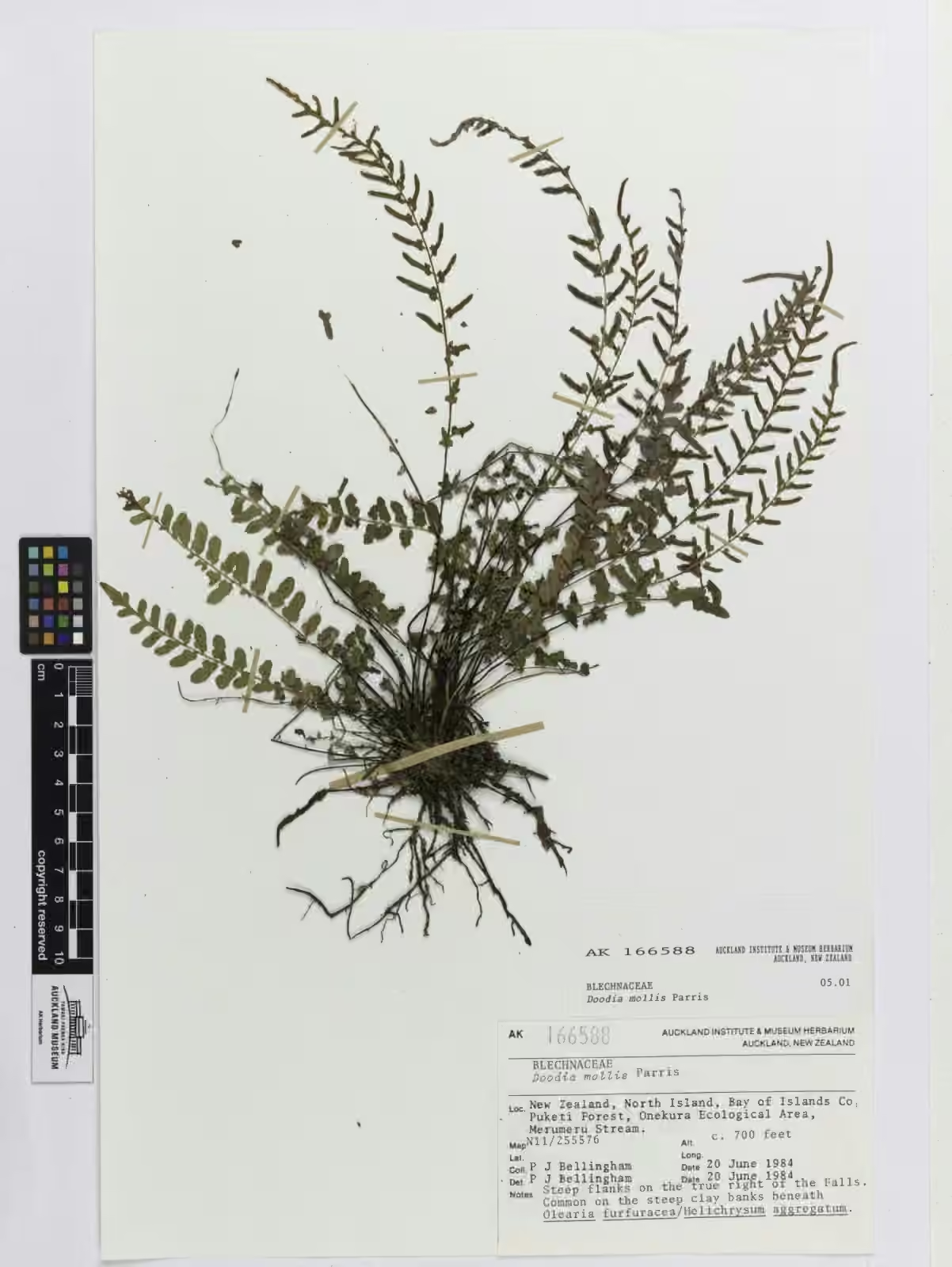
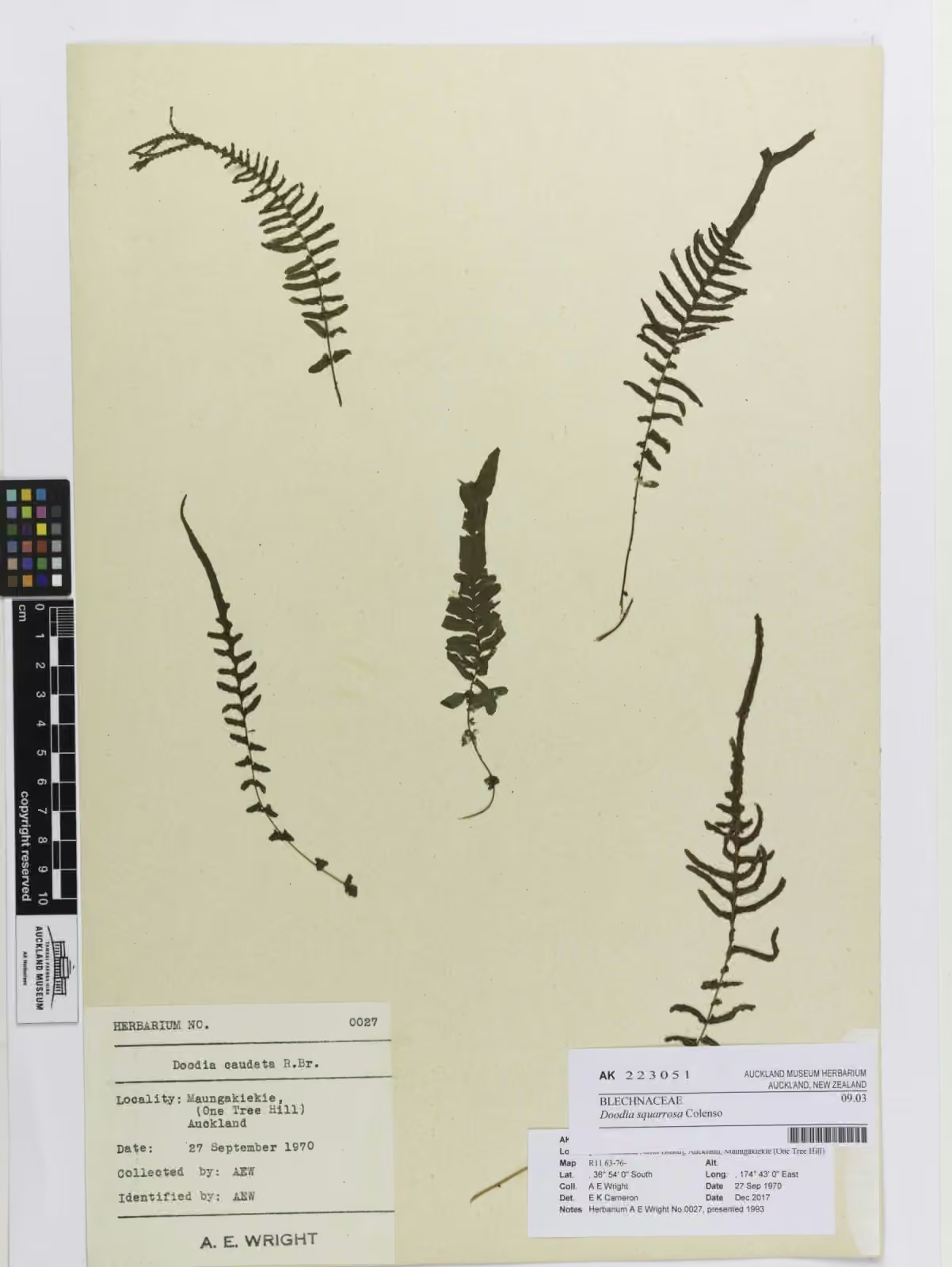
Explore other native plants that share similar characteristics or habitats with Rasp Fern (Doodia milnei), offering further insights into New Zealand's diverse flora. These related species provide context and opportunities for complementary planting in your garden.
Plant Conservation
Doodia milnei is ranked At Risk - Naturally Uncommon (2023) with the qualifiers Island Endemic and Range Restricted. NZPCN notes it is listed only because it is a naturally range-restricted island endemic, not because it is declining.
The Kermadec Islands are a nature reserve managed by the Department of Conservation, and ongoing biosecurity and weed control there protect this and other endemic plants. Growing it in mainland gardens from cultivated spores also provides a safeguard.
Frequently Asked Questions
Where does Doodia milnei grow?
It is endemic to the Kermadec Islands, on Raoul Island and Macauley Island, where it grows at about 90 to 300 m in dry Kermadec pōhutukawa forest, clearings, tracksides and rocky ground.
How is Blechnum kermadecense different from the mainland rasp fern?
Its fronds are all alike rather than separated into sterile and fertile forms, its pinnae are longer and thinner, it has few or no hairs, and its young fronds are not pink-tinged like those of Blechnum parrisiae.
Can Kermadec rasp fern be grown on the mainland?
NZPCN says it grows easily in most soils from fresh spores, but it is cold intolerant and prefers a sunny position with free-draining, dry soil, so it suits frost-free northern gardens.
Sources and Further Reading
The botanical, growing, and conservation details for Rasp Fern (Doodia milnei) on this page draw on the New Zealand plant references below. Consult them for full technical records and the latest distribution data.