Jellybeans
Disphyma clavellatum
Last updated:
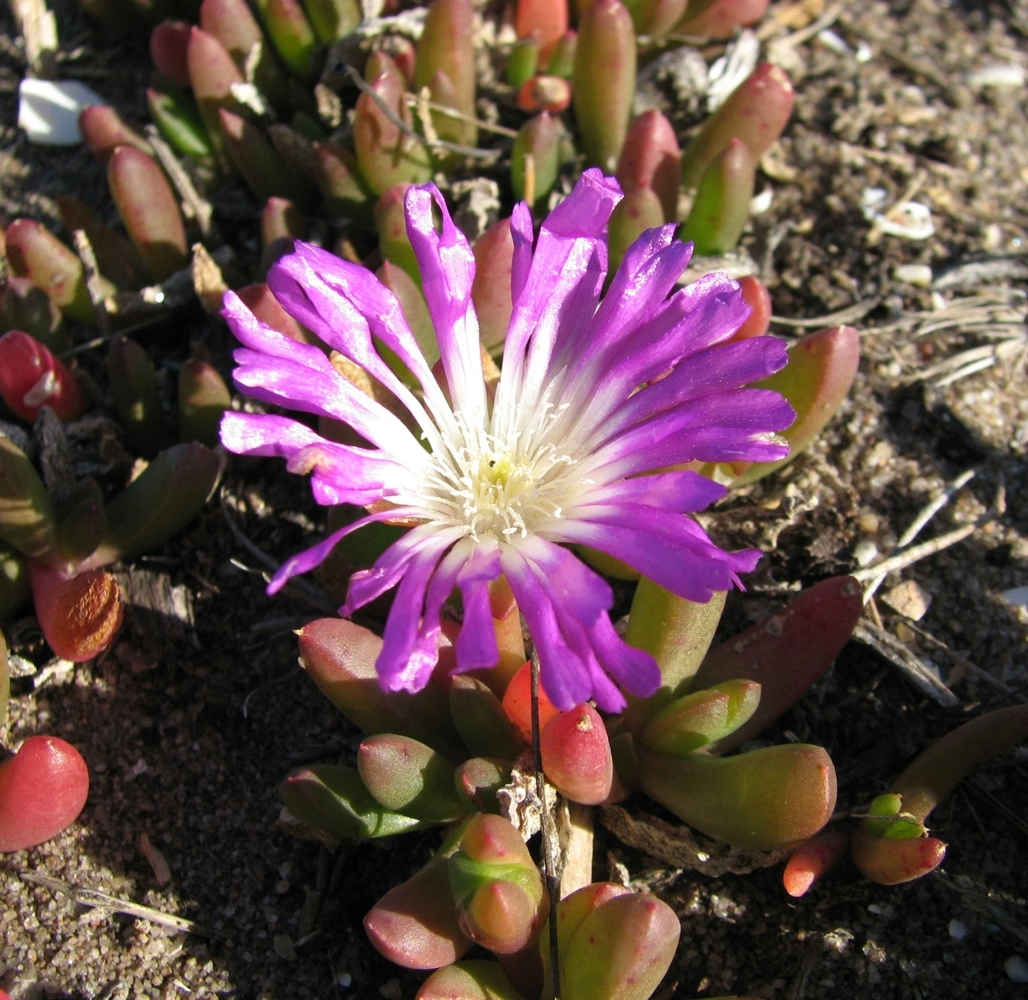
Jellybeans (Disphyma clavellatum) is a trailing, succulent ice plant with fleshy, club-shaped leaves and showy purple flowers 2 to 4 cm across with white centres. It grows in saltmarsh and estuaries, often where the tide floods it. It is native to Australia, where it is called round-leaved pigface, and is believed to have reached New Zealand naturally within roughly the last 50 years. Here it is known only from Waimea Inlet near Nelson and Riverton Estuary in Southland, and is classed as a Non-resident Native - Coloniser. It is closely related to New Zealand's endemic horokaka (Disphyma australe). Explore more native ground covers in our native plant guide.
Plant Description
Disphyma clavellatum is a trailing, succulent herb with prostrate, rounded, hairless stems. The leaves are fleshy, rounded in cross-section or weakly three-angled, club-shaped (clavate), blunt with a tiny point at the tip, and taper to a short base joined to the opposite leaf. They are usually 20 to 30 mm long (ranging from 5 to 50 mm) and 5 to 6 mm thick, with finely papillate margins.
The flowers are 20 to 40 mm across, with a smooth, hairless calyx. The petals are purple with a white base, arranged in two rows and 10 to 30 mm long; the white bases turn purple when dried. The stamens are 5 to 7 mm long with filaments hairy at the base and whitish-yellow anthers. The fruit is a capsule 5 to 12 mm across whose valves have widely spreading keels, and the pale brown to brown seeds are about 1 mm long.
It is distinguished from New Zealand's other Disphyma by its rounded or weakly three-angled, club-shaped, bluntly pointed leaves and its two-rowed purple petals with a white base. Ice plants of the introduced genus Carpobrotus are much larger, with long, sharply three-angled leaves.
Quick Facts
| Scientific Name | Disphyma clavellatum |
|---|---|
| Height | Under 0.1 m; prostrate |
| Spread | Trailing stems forming mats; up to about 2 m long in Australia |
| Water Needs | Low to moderate; tolerates tidal flooding |
| Light | Full sun |
| Frost Tolerance | Moderate; grows as far south as Riverton |
| Salt Tolerance | Very high; grows in saltmarsh flooded at high tide |
| Growth Rate | Moderate to fast |
| Lifespan | Perennial |
Climate Best Suited to
A coastal plant of temperate estuaries, it copes with the mild climate of Nelson and the cooler, windier conditions of Southland. Its saltmarsh habitat buffers it from severe frost.
Regional Suitability
| City | Climate Suitability |
|---|---|
| Auckland | Medium |
| Wellington | Medium |
| Christchurch | Medium |
| Dunedin | Medium |
Plant Habitat
In New Zealand Disphyma clavellatum is recorded only from two South Island sites: Waimea Inlet near Nelson and Riverton Estuary in Southland. It is native to Australia; some authorities include it within Disphyma crassifolium, a species that also occurs in South Africa. NZPCN presumes it is a relatively recent natural arrival, within roughly the last 50 years.
It grows in saltmarsh and estuaries, often in places flooded at high tide. In Australia it is recorded from coastal dunes and samphire flats on sand, loam and clay.
Growing Requirements
Soil Requirements
It grows in the saline silts and sands of saltmarsh and estuary margins.
- Saline, tidal soils are tolerated
- Sand, silt, loam or clay
- Free-draining sandy mix suits potted plants
Light Requirements
Saltmarsh is open and sunny, and this ice plant needs full light.
- Full sun
- Avoid shade from taller rushes or shrubs
Water Requirements
Its fleshy leaves store water, letting it cope with both salty tidal flooding and dry spells between tides.
- Tolerates periodic flooding by seawater
- In gardens water sparingly once established
Planting and Establishing
Disphyma clavellatum is not a typical nursery plant, and because New Zealand has the closely related endemic horokaka (Disphyma australe), gardeners and restoration projects should normally use that species instead.
If grown, plant rooted pieces into a sunny, free-draining sandy or gritty position. It should not be planted into estuaries outside its known New Zealand sites, where it could compete with local saltmarsh plants.
Ecological Role
Its large, bright purple flowers open from November to January and are likely visited by insects, although specific pollinators are not recorded in the sources consulted. Capsules ripen from December to April and release small seeds about 1 mm long.
As a recent natural coloniser, it is an example of the steady arrival of Australian plants in New Zealand on wind, water or birds. Within its saltmarsh sites it forms trailing mats among other low succulent and salt-tolerant plants.
Uses & Significance
Garden Uses
Its use in New Zealand gardens is limited; the endemic horokaka is the better choice for a native ice plant.
- Coastal and succulent gardens
- Containers and rockeries in full sun
- Botanical collections illustrating natural colonisers
Ecological Value
It is a small but scientifically interesting part of the saltmarsh flora at two New Zealand estuaries.
- Documents natural trans-Tasman plant dispersal
- Contributes flowers to saltmarsh in early summer
- Adds cover on tidal flats
Landscaping Uses
In a coastal garden it can trail over sand or rocks, the fleshy jellybean-like leaves forming a low mat studded with purple flowers in early summer.
Because the endemic horokaka fills the same role and is far more widely available, jellybeans is best left for collections and its natural estuary sites.
Seasonal Care Calendar
Spring
New stems extend across the saltmarsh as temperatures rise.
- Take rooted pieces now
- Check plants after spring storms
Summer
Flowering peaks from November to January, with purple, white-centred flowers.
- Photograph flowering plants at Waimea Inlet
- Capsules begin to ripen in December
Autumn
Fruiting continues until April as capsules mature and release seed.
- Collect fresh seed if growing in cultivation
- Little maintenance needed
Winter
Growth slows over the cooler months.
- Avoid waterlogging potted plants
- Protect from hard frost in colder gardens
When to Prune and How Much
No regular pruning is needed. Trim trailing stems back if they spread beyond their allotted space in a garden.
Remove any dead or rotting stems after wet winters to keep the mat healthy.
How to Grow Jellybeans
NZPCN records that Disphyma clavellatum is easily grown from rooted pieces, by division of whole plants and from fresh seed. Like other ice plants, its trailing stems root where they touch the ground, so a single plant quickly provides material for more. However, because it is a recent natural arrival known from just two New Zealand estuaries, and because the endemic horokaka is available for coastal plantings, there is little reason to propagate it widely here. Material should not be taken from the wild sites, and cultivated plants should be kept away from natural saltmarsh to avoid spreading it beyond its current range.
From Cuttings and Rooted Pieces
The prostrate stems often root at the nodes, and NZPCN notes it is easily grown from rooted pieces. Pieces that already carry roots establish fastest.
- Cut a length of stem with several leaves, ideally with roots
- Let the cut end dry for a day
- Insert into a sandy, free-draining mix
- Keep in bright light and water sparingly until growth resumes
From Seed
Fruiting runs from December to April. Collect ripe capsules and sow the fresh, roughly 1 mm seeds.
- Gather ripe capsules from cultivated plants
- Sow seed on the surface of a gritty seed mix
- Keep lightly moist and warm in good light
- Pot on seedlings once they have several pairs of leaves
By Division
NZPCN also lists division of whole plants. An established mat can be lifted and separated into several rooted portions, each of which can be replanted straight away.
- Lift the plant carefully in spring
- Pull apart rooted sections of the mat
- Replant into sandy soil in full sun
Pests & Diseases
No pests or diseases are recorded for this species in New Zealand. In cultivation, the main risk is rot in wet, heavy or poorly drained soils.
At its wild sites, the saltmarsh can be affected by weeds, sedimentation and disturbance, which may influence how well it persists.
Cultural Significance
No Māori name or traditional Māori use is recorded for Disphyma clavellatum in the sources consulted. The related endemic Disphyma australe is known as horokaka, but that name should not be assumed to apply to this recent arrival.
It was first described in 1803 by Adrian Hardy Haworth as Mesembryanthemum clavellatum, and Robert Chinnock moved it to Disphyma in 1976. The genus name means two nodules, and clavellatum refers to its small club-shaped leaves.
Bonus Tip
If you are exploring Waimea Inlet or Riverton Estuary in early summer, compare any ice plants you find: jellybeans has short, rounded, club-shaped leaves and purple petals with a distinctly white base. Record your sightings on iNaturalist NZ, as tracking this recent coloniser helps botanists understand how it is spreading.
Related Plants
Explore other native plants that share similar characteristics or habitats with Jellybeans (Disphyma clavellatum), offering further insights into New Zealand's diverse flora. These related species provide context and opportunities for complementary planting in your garden.
Short-Hair Plume Grass
Pentapogon inaequiglumis
Purple Plume Grass
Pentapogon micranthus
Dicranopteris linearis
Dicranopteris linearis
Austral Lady Fern
Diplazium australe
White Snow Marguerite
Dolichoglottis scorzoneroides
Prickly Rasp Fern
Doodia aspera
Doodia milnei
Doodia milnei
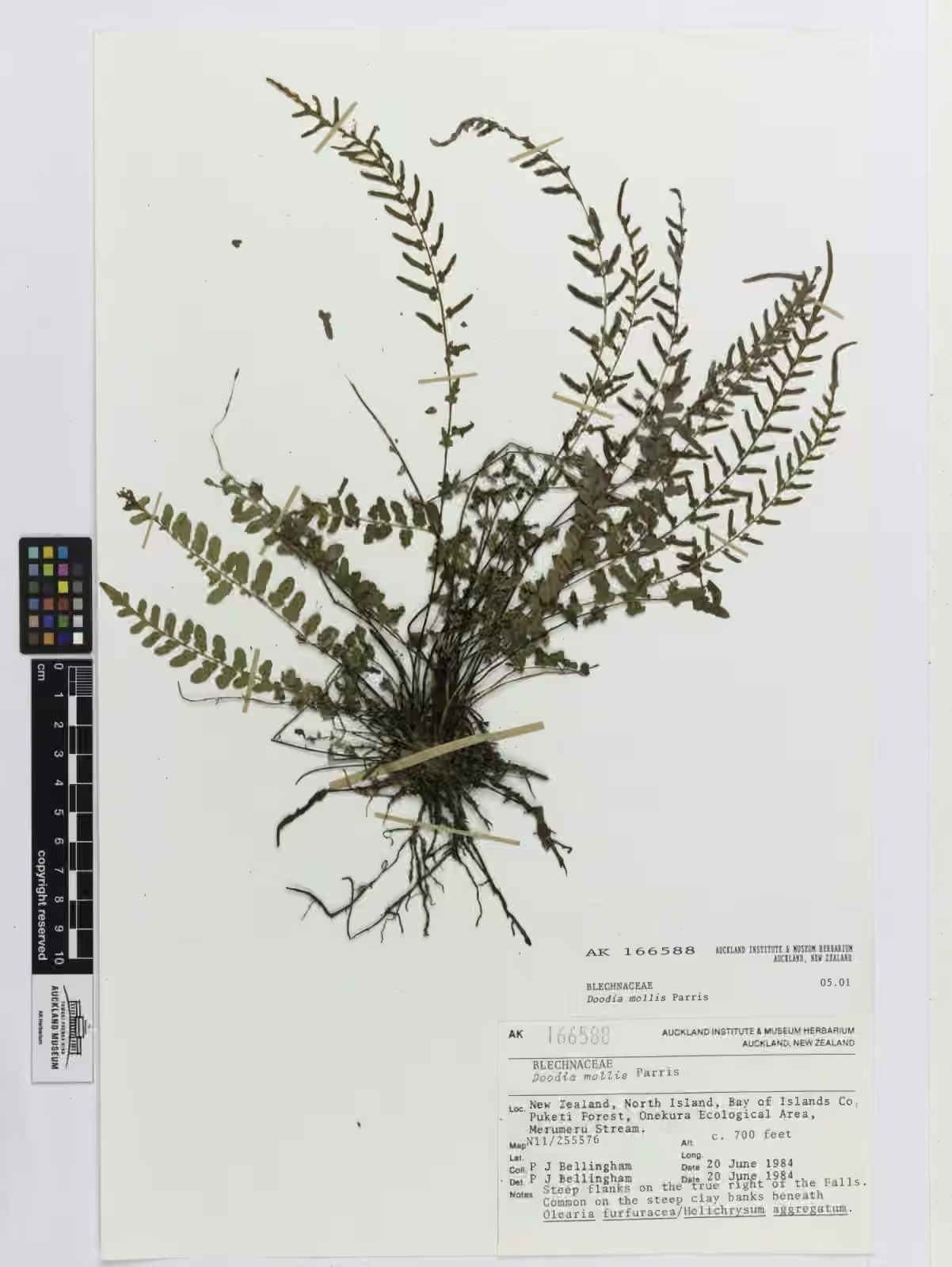
Mokimoki
Doodia mollis
Plant Conservation
Disphyma clavellatum is classed as Non-resident Native - Coloniser (2023) with the qualifier Secure Overseas, the same classification it received in 2009, 2012 and 2017. This category covers native species that have arrived naturally in New Zealand only recently.
It needs no specific conservation action here, as it is secure in Australia. Protecting the saltmarshes of Waimea Inlet and Riverton Estuary benefits it along with the many native plants and birds that depend on these estuaries.
Frequently Asked Questions
Why is Disphyma clavellatum called jellybeans?
Its fleshy, rounded, club-shaped leaves, 5 to 50 mm long, look a little like jellybeans strung along its trailing stems.
Is Disphyma clavellatum a New Zealand native?
It is treated as indigenous but is classed as a Non-resident Native - Coloniser, because it is thought to have arrived naturally from Australia within about the last 50 years.
Where does jellybeans grow in New Zealand?
It is recorded only from Waimea Inlet near Nelson and Riverton Estuary in Southland, in saltmarsh and estuary sites that are often flooded at high tide.
How is jellybeans different from horokaka?
Disphyma clavellatum has rounded or weakly three-angled, club-shaped leaves and purple petals with a white base, while the endemic horokaka (Disphyma australe) is the common native ice plant of New Zealand coasts.
Sources and Further Reading
The botanical, growing, and conservation details for Jellybeans (Disphyma clavellatum) on this page draw on the New Zealand plant references below. Consult them for full technical records and the latest distribution data.