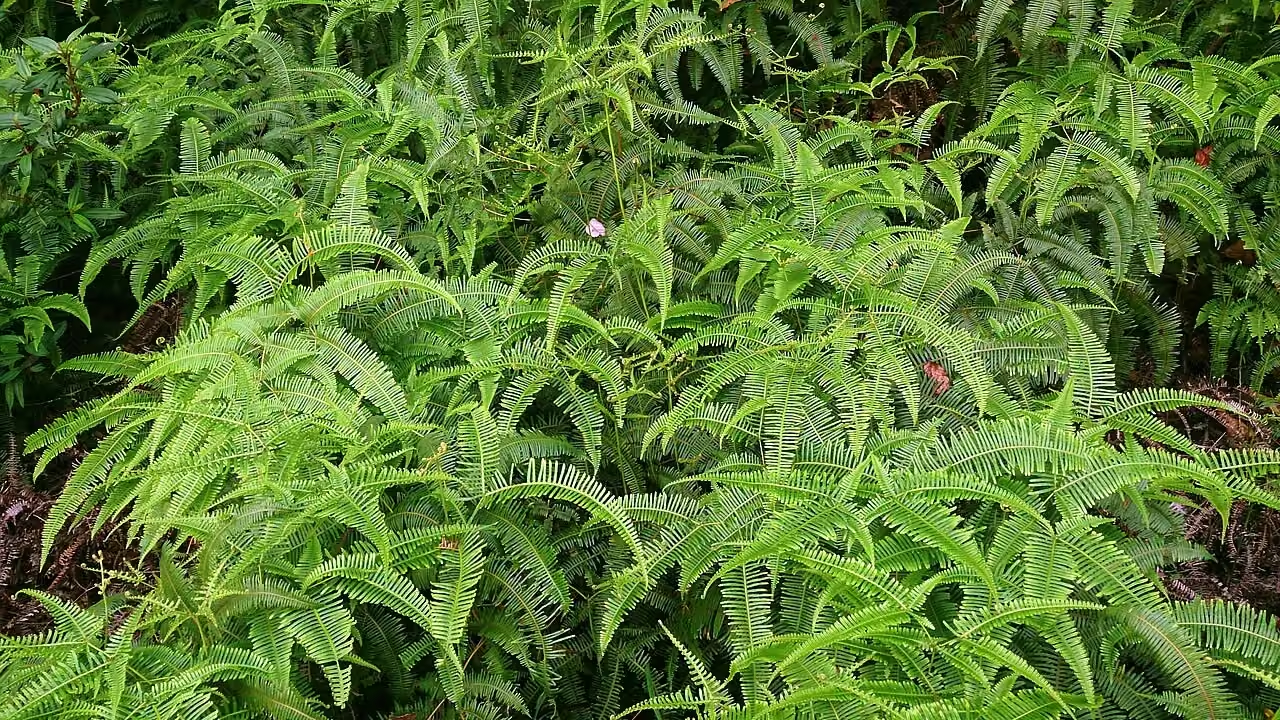
Forked Fern
Dicranopteris linearis
Last updated:
Dicranopteris linearis is a scrambling, forking fern that, in New Zealand, grows only on geothermally heated ground. Its long-creeping, hairy rhizomes send up fronds up to about 1.2 m long that fork repeatedly, each fork ending in a resting bud, with narrow comb-like leaflets that are whitish beneath. It is one of the most widespread ferns of the Old World tropics, where it is often called Old World forked fern, but here it survives only around steaming vents, hot ground and sinter fields between Rotorua and Taupō, with a few sites near Kawerau and Whakatāne. It is ranked Threatened - Nationally Endangered. Explore more native ferns in our native plant guide.
Plant Description
Dicranopteris linearis is a terrestrial fern with long-creeping rhizomes 1.5 to 3.5 mm across, clothed in red-brown hairs, often clustered around the growing tips and frond bases. Fronds are 140 to 1220 mm long on smooth stipes up to 960 mm long. The frond forks in a pseudodichotomous pattern: the main rachis ends in a hairy bud flanked by small accessory leaflets, and each branch forks again, with leaflets carried only on the final branches.
The ultimate leaflets are narrowly ovate, 90 to 300 mm long, with 25 to 54 pairs of narrow, parallel-sided segments 11 to 42 mm long and 2 to 4.5 mm wide, notched at the tip and arising almost at right angles from the midrib. The upper surface is green and the underside usually glaucous (whitish), with red-brown branched hairs near the midvein and tiny red-brown glands on the veins. The sori are round and lack an indusium, with 6 to 20 on each side of the midvein, each holding 7 to 12 sporangia. The Flora of New Zealand notes that normal spore development may be uncommon in New Zealand plants.
It is the only Dicranopteris in New Zealand. It resembles the related tangle ferns (Gleichenia) and umbrella ferns (Sticherus), but those have scaly rhizomes and smaller groups of sporangia, and Sticherus has costal segments on the secondary branches that Dicranopteris lacks. In New Zealand it is the only member of the family Gleicheniaceae confined entirely to geothermal sites.
Quick Facts
| Scientific Name | Dicranopteris linearis |
|---|---|
| Height | Fronds 0.14-1.2 m long; can scramble higher through scrub |
| Spread | Spreads indefinitely by long-creeping rhizomes, forming patches |
| Water Needs | Moist; prefers damp soil |
| Light | Sunny to lightly shaded |
| Frost Tolerance | Low; frost and cold sensitive |
| Salt Tolerance | No information available |
| Growth Rate | Fast once established |
| Lifespan | Long-lived perennial |
Climate Best Suited to
A tropical and subtropical fern that in New Zealand depends on geothermal heat in the soil. The cold winters of the central North Island would otherwise exclude it, and it is frost and cold sensitive.
Regional Suitability
| City | Climate Suitability |
|---|---|
| Auckland | Low |
| Wellington | Low |
| Christchurch | Low |
| Dunedin | Low |
Plant Habitat
In New Zealand Dicranopteris linearis is confined to the North Island, to geothermal areas largely between Lake Taupō and the Rotorua lakes, with a few populations between Kawerau and Whakatāne. It ranges from about 20 m above sea level near Whakatāne to about 500 m between Rotorua and Taupō. Overseas it is found across tropical Africa and Asia, New Guinea, northern and eastern Australia and many Pacific islands including Fiji, Samoa, Tonga, the Cook Islands and Hawaiʻi.
Its New Zealand habitat is heated soil, sinter fields and the margins of geysers, hot pools and steam vents. It often grows among geothermal kānuka scrub with Nephrolepis flexuosa, Christella dentata and Gleichenia species, and can be locally common. NZPCN notes it is tolerant of extreme heat and of some shading, and it actively colonised the newly created Karapiti geothermal field near Taupō.
Growing Requirements
Soil Requirements
It grows on warm, geothermally heated soils and sinter, often acidic and altered by steam and hot water.
- Warm soil is essential in New Zealand conditions
- Damp soil is preferred
- Tolerates the thin, mineral soils of sinter fields
Light Requirements
NZPCN advises a sunny site, and it grows in open geothermal ground and within low kānuka scrub.
- Sun to light shade
- Scrambles up through scrub to reach light
Water Requirements
It prefers damp soil, often kept moist by steam and seepage around vents and hot pools.
- Keep soil moist but not stagnant
- Warm, humid air around vents suits it
Planting and Establishing
Outside geothermal areas this fern is very difficult to grow in New Zealand because it is frost and cold sensitive. It is best appreciated in the wild at geothermal reserves such as Craters of the Moon (Karapiti) near Taupō.
Where it is grown for conservation, rooted rhizome pieces are planted into damp soil in a sunny, warm, frost-free position, ideally on heated ground or in a heated glasshouse. Once established it grows quickly.
Ecological Role
Overseas Dicranopteris linearis is a classic pioneer fern that colonises bare ground such as lava flows and landslips, building up dense, layered thickets of forking fronds. In New Zealand it plays a similar role on geothermal ground, where it has spread naturally onto newly heated areas like the Karapiti field.
Within geothermal scrub it grows alongside kānuka, Nephrolepis flexuosa, Christella dentata and Gleichenia, forming part of a distinctive thermal plant community that mixes tropical ferns with heat-tolerant natives. As spore development may be uncommon here, spread by rhizomes is likely to be important.
Uses & Significance
Garden Uses
It has very limited garden use in New Zealand because it needs warm soil and protection from frost.
- Heated glasshouse or fernery collections
- Interpretive plantings at geothermal parks
- Conservation collections using material of New Zealand origin
Ecological Value
It is a key member of New Zealand's rare geothermal vegetation, an ecosystem found nowhere else in the country.
- A tropical fern surviving at the southern edge of its range
- Pioneer coloniser of new geothermal ground
- New Zealand plants may be a distinct chromosomal race
Landscaping Uses
In geothermal parks it creates sprawling, bright green tangles across warm ground, with the whitish undersides of the leaflets showing when fronds move. Its forking architecture makes an interesting contrast with the upright fronds of other thermal ferns.
It is not a plant for ordinary landscaping in New Zealand and should not be moved from wild geothermal sites.
Seasonal Care Calendar
Spring
New fronds expand from the terminal buds as temperatures rise.
- Watch the forking buds open
- Best time to establish rooted pieces in cultivation
Summer
Growth is most active, and fronds may extend through surrounding scrub.
- Keep cultivated plants moist
- Look for sori on the undersides of fertile leaflets
Autumn
Growth slows as the air cools, though heated ground keeps roots warm.
- Protect cultivated plants before the first frost
- Leave old fronds in place
Winter
Plants rely on geothermal soil warmth to survive the cold central North Island winter.
- Frost can damage exposed fronds
- In cultivation keep frost-free
When to Prune and How Much
No pruning is needed in the wild. The dead stipes persist and help support new growth scrambling through the thicket.
In cultivation, remove only fully dead or frost-damaged fronds, cutting them at the base, and leave the living forking network intact.
How to Grow Forked Fern
NZPCN describes Dicranopteris linearis as easy to propagate from rooted pieces, noting that once established it grows quickly, prefers a sunny site in damp soil, and is frost and cold sensitive. Because the Flora of New Zealand reports that normal spore development may be uncommon in New Zealand plants, vegetative propagation is the practical method. As a Nationally Endangered species confined to geothermal sites, it must not be dug from the wild; any propagation should be done by conservation organisations with permission and using existing cultivated stock, and plants are best kept in warm, frost-free conditions.
From Rhizome Pieces
The long-creeping rhizomes root along their length, so a section with a growing tip, roots and at least one frond can be separated to form a new plant.
- Choose a vigorous cultivated plant in late spring
- Cut a section of rhizome with a growing tip, roots and a frond
- Pot into a moist, free-draining, slightly acidic fern mix
- Keep warm, humid and in bright light, away from frost
- Plant out or pot on once new fronds appear
From Spores
Spores can be sown in the usual way for ferns, but viable spores may be scarce on New Zealand plants, so expect poor or no germination.
- Collect fertile leaflets with ripe sori onto paper
- Sow spores on sterilised fine mix in a sealed container
- Keep warm and in indirect light
- Transplant small sporophytes when large enough to handle
Pests & Diseases
No specific pests or diseases are recorded for this species in New Zealand. NZPCN notes that some smaller populations might be threatened by introduced weeds tolerant of heated soils, but there is no hard evidence to confirm this.
The sources consulted do not detail the causes of its significant historical decline. Because it depends entirely on active geothermal ground, any change to that heat source or physical loss of a site directly affects it.
Cultural Significance
No Māori name or traditional Māori use is recorded for this species in the sources consulted. Elsewhere in its range it has been used medicinally, for example in parts of Southeast Asia and New Guinea, and its fiddleheads are used in floral arrangements, but these uses are not documented in New Zealand.
It was first described as Polypodium lineare by Nicolaas Burman in 1768 and transferred to Dicranopteris by Lucien Underwood in 1907. The name linearis refers to its narrow, parallel-sided leaf segments.
Bonus Tip
When visiting a geothermal walkway such as Craters of the Moon, look for a fern whose fronds fork again and again with a fuzzy bud sitting in each fork. Turn a leaflet over gently: the whitish underside and round, naked sori confirm Dicranopteris, but stay on the boardwalk, as the ground around it can be dangerously hot.
Related Plants
Explore other native plants that share similar characteristics or habitats with Forked Fern (Dicranopteris linearis), offering further insights into New Zealand's diverse flora. These related species provide context and opportunities for complementary planting in your garden.
Deschampsia tenella
Deschampsia tenella
Short-Hair Plume Grass
Pentapogon inaequiglumis
Purple Plume Grass
Pentapogon micranthus
Austral Lady Fern
Diplazium australe
Jellybeans
Disphyma clavellatum
White Snow Marguerite
Dolichoglottis scorzoneroides
Prickly Rasp Fern
Doodia aspera
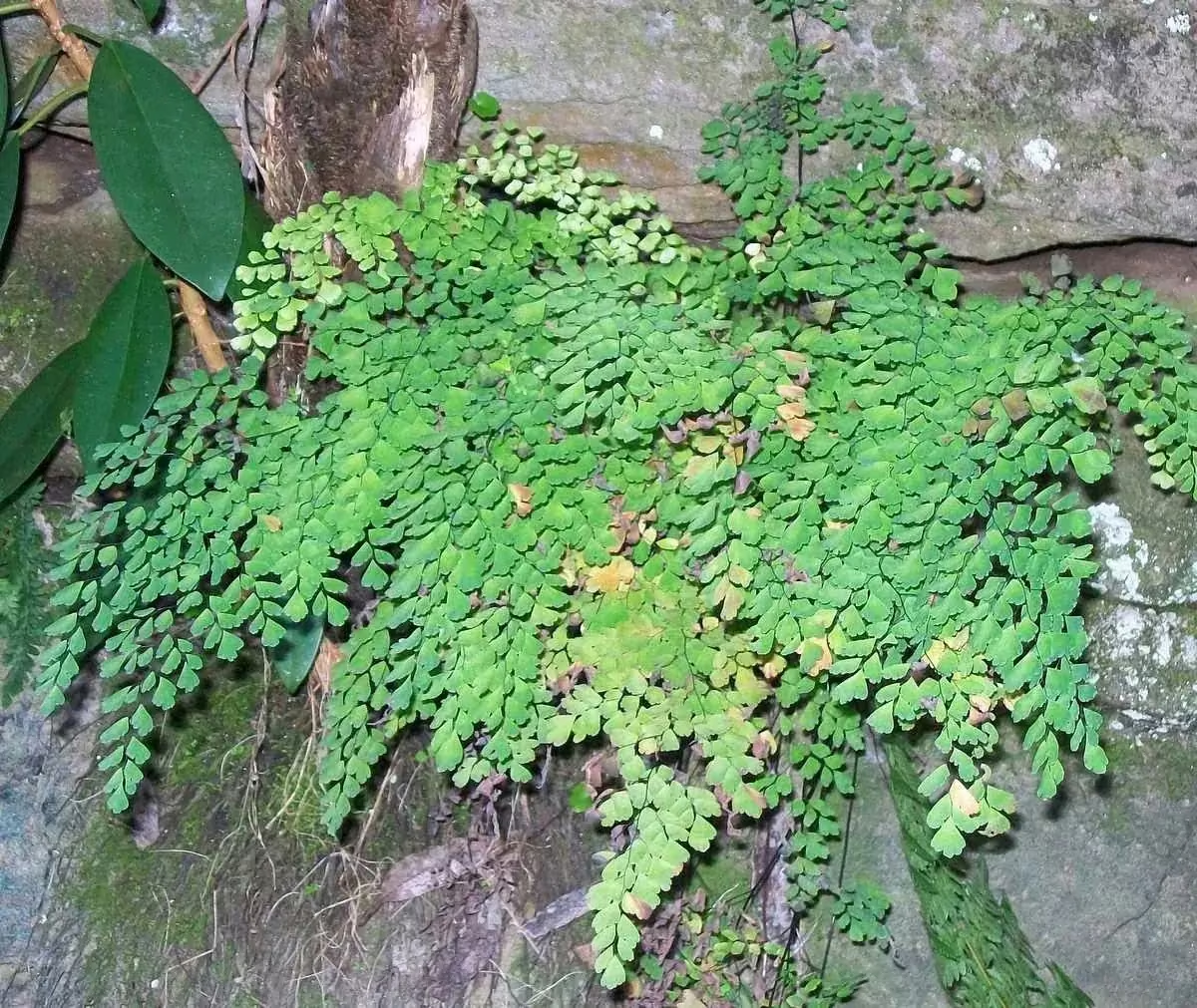
True Maidenhair Fern
True Maidenhair Fern
Plant Conservation
Dicranopteris linearis is ranked Threatened - Nationally Endangered (2023) with the qualifiers Range Restricted and Secure Overseas. The ranking reflects historical decline to what is now a very small area of occupancy; NZPCN considers the population stable now after significant earlier losses.
Protecting geothermal ecosystems from development, weed invasion and disturbance is the key to its survival. Many of its sites lie within reserves around Rotorua and Taupō, and visitors help by keeping to tracks.
Frequently Asked Questions
Why does Dicranopteris linearis only grow on geothermal ground in New Zealand?
It is a tropical and subtropical fern that is frost and cold sensitive. In New Zealand the warmth of geothermally heated soil around vents, hot pools and steaming ground lets it survive where the climate would otherwise be too cold.
Where can you see Dicranopteris linearis in New Zealand?
It grows on geothermal ground largely between Lake Taupō and the Rotorua lakes, with a few populations between Kawerau and Whakatāne. It has colonised the Karapiti geothermal field near Taupō.
How is Dicranopteris different from tangle fern and umbrella fern?
Unlike Gleichenia and Sticherus, Dicranopteris has hairy rather than scaly rhizomes, leaflets only on the final branches, and sori of 6 to 10 or more sporangia rather than small groups.
Is Dicranopteris linearis endangered in New Zealand?
Yes. It is ranked Threatened - Nationally Endangered because of historical decline to a very small area of occupancy, although NZPCN considers the population now stable.
Sources and Further Reading
The botanical, growing, and conservation details for Forked Fern (Dicranopteris linearis) on this page draw on the New Zealand plant references below. Consult them for full technical records and the latest distribution data.