Coprosma
Coprosma crenulata
Last updated:
Coprosma crenulata is a low, sprawling shrub endemic to the South Island and Stewart Island/Rakiura, growing up to 0.3 m tall with long trailing branches and straw-coloured, four-angled, hairy twigs. Its thick, glossy, leathery leaves are 9 to 20 mm long, broadest near the dented tip, and minutely notched along the margin towards the apex, a feature that gives the plant its name but needs a hand lens to see. Bright red fruits follow the small flowers. It is often common yet inconspicuous in subalpine scrub, snow tussock and herbfield on permanently damp, peaty sites from 700 to 1400 m, and is ranked Not Threatened. Explore more native ground covers in our native plant guide.
Plant Description
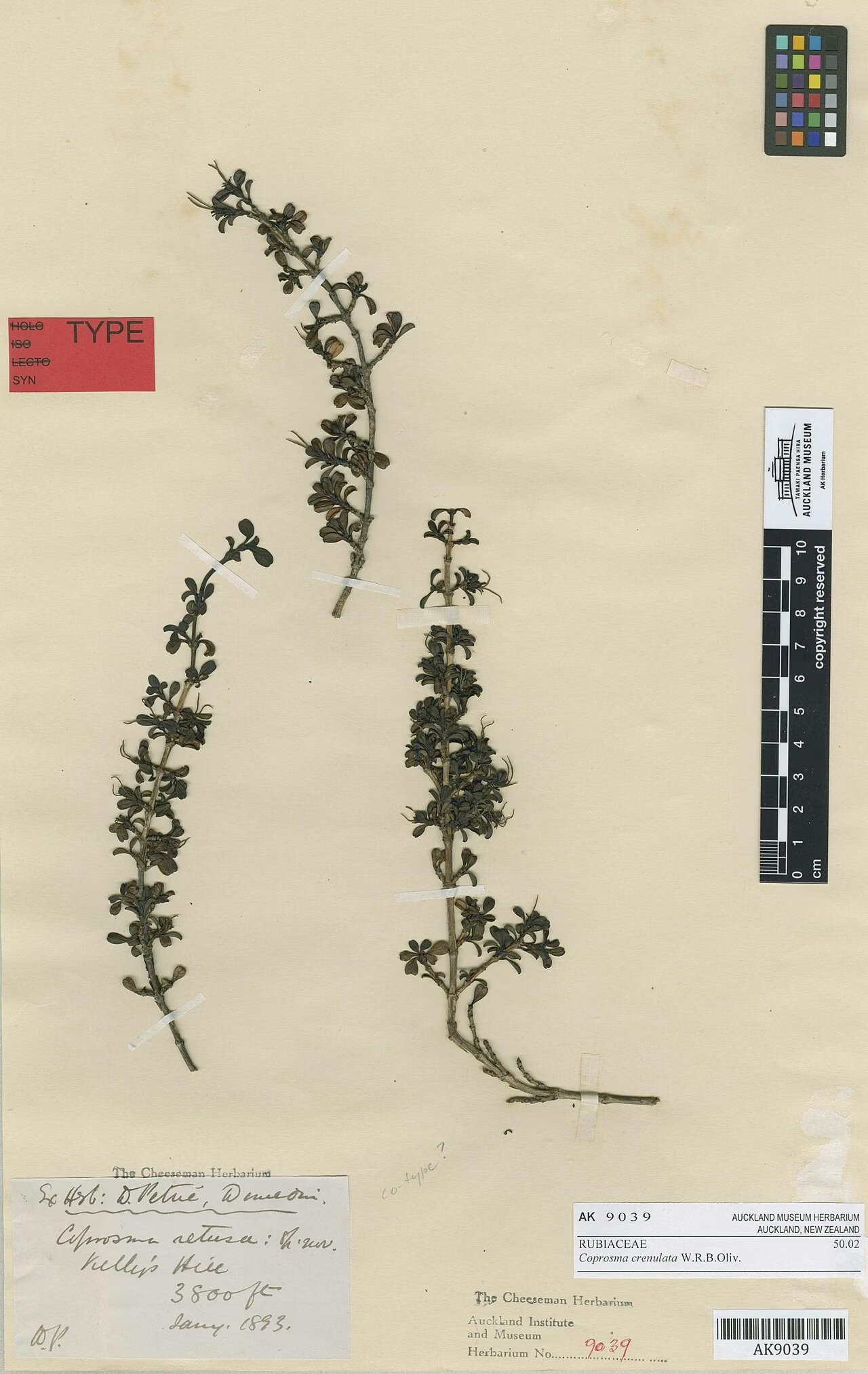
Coprosma crenulata is a procumbent shrub up to 0.3 m high with long trailing branches and light grey bark. The numerous young branchlets are straw-coloured, more or less four-angled and hairy. Its leaves sit on short, stout stalks, and the stipules between each leaf pair are short and squared-off with three conspicuous small teeth and fine marginal hairs.
The leaf blades are thick, leathery and hairless, obovate to obovate-oblong, usually 9 to 10 mm long (up to 20 mm) and 3 to 5 mm wide, narrowing in a wedge to the base and dented (retuse) at the tip. The margins are thickened and minutely crenulate towards the apex, and the leaves give off a faint unpleasant smell when bruised. The midrib is prominent beneath and sunken above. As in most Coprosma, male and female flowers are separate: male flowers have a funnel-shaped corolla about 6 mm long with five pointed lobes, and female flowers have tiny calyx teeth and a corolla cut halfway into five lobes. The fruit is a yellowish-red to bright red ovoid drupe about 6 mm long.
NZPCN lists several similar species. Coprosma depressa has thinner, rounder leaves and large whitish papery stipules; C. cheesemanii has much narrower, pointed, thinner leaves; and C. cuneata has similarly shaped but narrower, less leathery leaves, dark brown bark and triangular hairy stipules. A plant related to C. colensoi has leaves curved back at the tip but not dented, single-toothed stipules and hanging flowers, and lacks the crenulate margins.
Quick Facts
| Scientific Name | Coprosma crenulata |
|---|---|
| Height | Up to 0.3 m |
| Spread | Long trailing branches; spread not recorded |
| Water Needs | High; permanently damp sites |
| Light | Full sun to light shade in open subalpine scrub |
| Frost Tolerance | High; montane to subalpine |
| Salt Tolerance | No information available |
| Growth Rate | Slow |
| Lifespan | Long-lived perennial shrub |
Climate Best Suited to
It suits cool, wet montane and subalpine climates in the western and southern South Island and Rakiura, with frequent rain, mist and winter snow.
Regional Suitability
| City | Climate Suitability |
|---|---|
| Auckland | Low |
| Wellington | Low |
| Christchurch | Low |
| Dunedin | Medium |
Plant Habitat
Coprosma crenulata occurs in the South Island from western Nelson southwards and on Stewart Island/Rakiura. It is a montane to subalpine plant recorded between about 700 and 1400 m.
NZPCN describes it as often common yet rather inconspicuous in open subalpine scrub, mixed snow tussock and scrub, and herbfield on permanently damp, often peaty sites. On the national wetland plant list it is rated FACU (facultative upland), meaning it usually grows away from true wetlands even though it favours damp ground.
Growing Requirements
Soil Requirements
It favours permanently damp, often peaty soils in subalpine scrub and tussock.
- Peaty, acidic, low-fertility soil
- Constant moisture
- Avoid rich, heavily fertilised garden soil
Light Requirements
It grows in open scrub and tussock, sprawling among other low vegetation.
- Full sun to light shade
- Open conditions where it is not overtopped
Water Requirements
Its habitat stays wet year-round, so it is not drought-tolerant.
- Keep the soil consistently moist
- Mulch to retain moisture in drier gardens
Planting and Establishing
Coprosma crenulata is rarely sold, but it may be grown by alpine plant enthusiasts in cool, moist gardens. Plant it where its trailing branches can spread over a damp, peaty bank or between rocks.
Because the plants are either male or female, a female plant needs a male nearby to set its red fruit. Plant in autumn or spring in cooler districts, and water well until established.
Ecological Role
The fleshy red drupes are dispersed by fruit-eating animals (frugivory), according to NZPCN citing Thorsen et al. (2009). Like most Coprosma, the separate male and female flowers are small and green to yellowish, with protruding stamens and long stigmas typical of wind pollination in the genus.
Its long fruiting season, from February to June and sometimes into September, provides food in subalpine areas into the colder months. Specific insect associates were not found in the sources consulted.
Uses & Significance
Garden Uses
A specialist plant for cool, damp alpine or bog gardens.
- Trailing over rocks in a damp alpine garden
- Peaty bog garden margins
- Native collections of small-leaved Coprosma
Ecological Value
It is a common component of damp subalpine scrub and tussock in the southern South Island.
- Fruit available from late summer into winter
- Low cover on damp peaty ground
- Part of the diverse endemic Coprosma flora
Landscaping Uses
Its low, sprawling habit and glossy, slightly yellowish foliage make it a textural ground-hugging plant for cool-climate rock gardens. Female plants add bright red fruit in autumn.
It is best used in small groups with a male plant for pollination, alongside snow tussocks or other subalpine shrubs.
Seasonal Care Calendar
Spring
New growth begins on the trailing stems.
- Mulch to keep roots moist
- Weed around young plants
Summer
Flowering takes place in January and February.
- Water during dry spells
- Check that male and female plants are near each other
Autumn
Bright red fruits ripen from February onwards.
- Collect ripe fruit for seed
- Leave some fruit for birds
Winter
Fruit may persist into winter, occasionally until September.
- No pruning needed
- Protect from waterlogging in heavy clay
When to Prune and How Much
Little pruning is needed. Trailing stems can be shortened in spring if they spread beyond their space.
Avoid hard pruning into old wood on such a slow-growing plant; light trimming of tips is enough to keep it neat.
How to Grow Coprosma
No propagation account specific to Coprosma crenulata was found in the sources consulted. The methods below use general practice for small-leaved Coprosma, which in New Zealand nurseries are usually grown from fresh seed or semi-hardwood cuttings. Because the species is dioecious, cuttings reproduce the sex of the parent plant, so take material from both male and female plants if you want fruit. Its fruits ripen between February and June, giving an autumn window for seed collection. As it naturally grows on cool, permanently damp peaty ground, propagation mixes should hold moisture well while still draining, and young plants are best kept cool and lightly shaded during summer.
From Seed
Each fruit holds hard seeds (pyrenes) inside the red flesh. Germination in Coprosma is often slow and uneven, so be patient.
- Collect fully ripe red fruit in autumn
- Squash and wash off the flesh, then sow the seeds straight away
- Cover lightly with seed mix and keep cool and moist outdoors
- Expect seedlings over several months and pot them on when they have a few pairs of leaves
From Cuttings
Semi-hardwood cuttings taken from the trailing stems are the quickest way to get plants of known sex. Rooted sections of stem may also be found where branches touch damp ground.
- Take 5 to 8 cm semi-hardwood tip cuttings in late summer or autumn
- Remove the lower leaves and insert into a free-draining propagation mix
- Keep in a humid, shaded spot until roots form
- Pot on into a peaty, moisture-retentive mix and harden off before planting
Pests & Diseases
No specific pests are recorded for this species. Like other small-leaved Coprosma it may occasionally be affected by scale insects in sheltered gardens.
In the wild, browsing animals can damage subalpine shrubs, but no threats specific to Coprosma crenulata are documented.
Cultural Significance
No Māori name or traditional use specific to Coprosma crenulata is recorded in the sources consulted.
The species was first described by Donald Petrie in 1894 as Coprosma retusa, but that name was already in use, and W.R.B. Oliver renamed it Coprosma crenulata in 1917. The epithet comes from the Latin for small notches, describing the finely crenulate leaf margins. Oliver placed it close to C. serrulata because of these crenulate leaf edges, its toothed stipules and its flowers.
Bonus Tip
Carry a hand lens when botanising in subalpine scrub. The fine crenulations near the tip of each leaf, together with the short three-toothed stipules, are the quickest way to confirm Coprosma crenulata and separate it from the many other low trailing Coprosma species in the same habitat.
Related Plants
Explore other native plants that share similar characteristics or habitats with Coprosma (Coprosma crenulata), offering further insights into New Zealand's diverse flora. These related species provide context and opportunities for complementary planting in your garden.
Colobanthus canaliculatus
Colobanthus canaliculatus
Colobanthus monticola
Colobanthus monticola
Colobanthus muelleri
Colobanthus muelleri
Colobanthus strictus
Colobanthus strictus
Coprosma decurva
Coprosma decurva
Coprosma depressa
Coprosma depressa
Coprosma distantia
Coprosma distantia
Coprosma elatirioides
Coprosma elatirioides
Plant Conservation
Coprosma crenulata is ranked Not Threatened (2023) and has held that ranking in every national assessment since 2004. It is also Regionally Not Threatened in Otago (2025).
Much of its subalpine habitat lies within national parks and conservation land. Protecting damp peaty subalpine sites from drainage, fire and weed invasion helps maintain its populations.
Frequently Asked Questions
How do you identify Coprosma crenulata?
Look for a low trailing shrub with thick, leathery obovate leaves that are dented at the tip and finely crenulate (minutely notched) near the apex, plus short stipules bearing three conspicuous teeth. Crushed leaves have a faintly unpleasant smell.
Where does Coprosma crenulata grow?
It grows in the South Island from western Nelson southwards and on Stewart Island/Rakiura, in montane to subalpine scrub, snow tussock and herbfield from about 700 to 1400 m, usually on permanently damp, peaty ground.
What is the difference between Coprosma crenulata and Coprosma depressa?
Coprosma depressa has thinner, rounder leaves and relatively large, whitish, papery stipules. Coprosma crenulata has glossier, thicker, more leathery leaves with obviously dented tips and short, three-toothed stipules.
When does Coprosma crenulata fruit?
NZPCN records flowering in January and February and fruiting from February to June, occasionally into September, with bright red ovoid fruit about 6 mm long.
Sources and Further Reading
The botanical, growing, and conservation details for Coprosma (Coprosma crenulata) on this page draw on the New Zealand plant references below. Consult them for full technical records and the latest distribution data.