Colobanthus
Colobanthus monticola
Last updated:
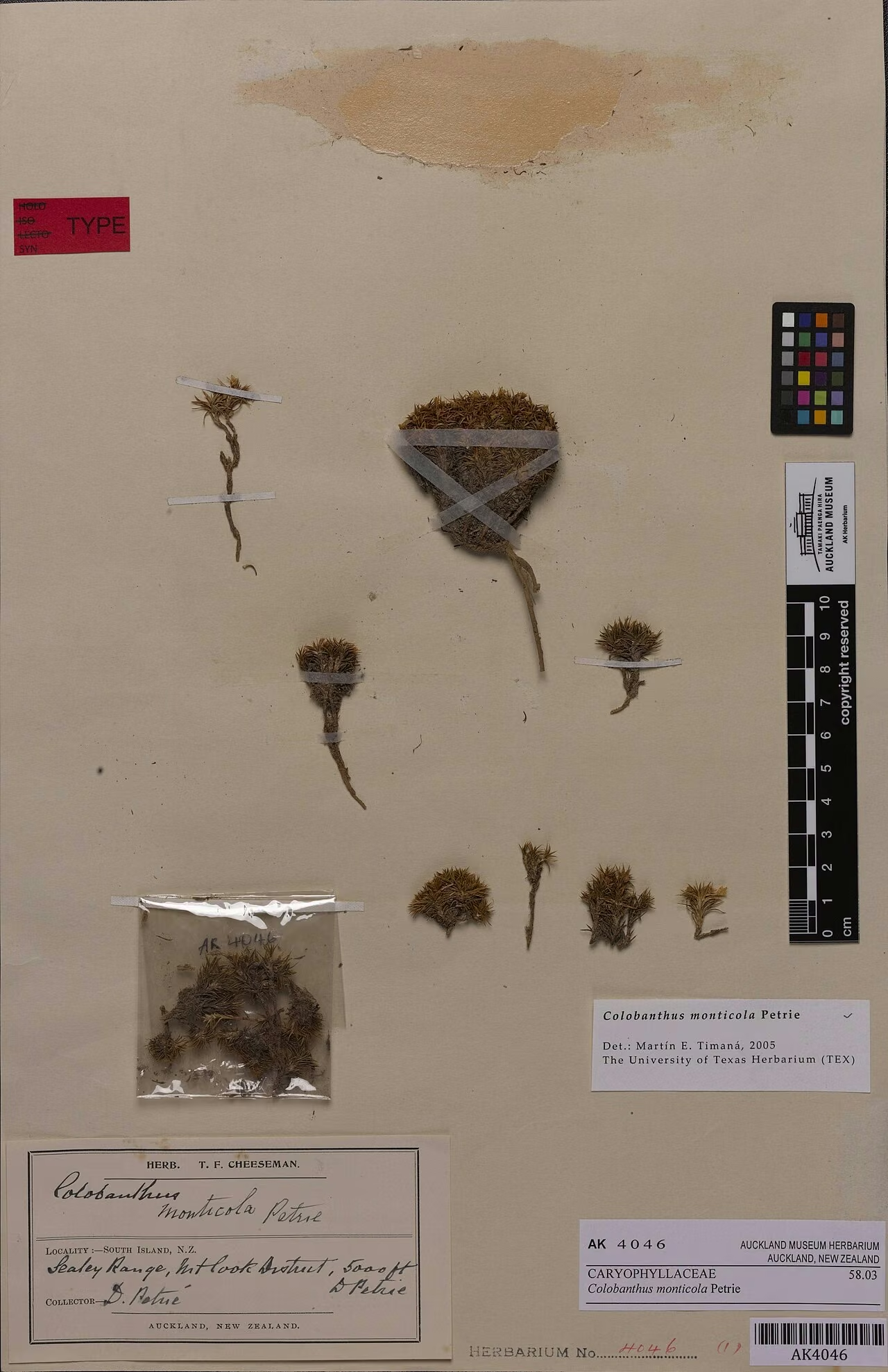
Colobanthus monticola is a small cushion-forming alpine herb in the carnation family (Caryophyllaceae), found only in the mountains of the South Island from the Aoraki/Mt Cook district southwards. It builds cushions several centimetres across and 2 to 4 cm deep from crowded leafy branches, each leaf about 5 mm long with thickened edges and a short needle tip. Its tiny petal-less flowers have only four sepals, a useful feature for separating it from most other New Zealand Colobanthus. It was described from rocky faces on the Sealy Range above the Hooker Valley and is ranked Not Threatened. Explore more native ground covers in our native plant guide.
Plant Description
Colobanthus monticola forms a cushion several centimetres across and 2 to 4 cm deep. Its branches are many and close-set, up to 4 cm long and leafy throughout. The leaves are closely spaced but spread outwards; each has a short but obvious sheath and a linear, awl-shaped blade about 5 mm long. Unlike several relatives, the blade has no visible midrib, but its margins are strongly thickened and run together into a short needle-like tip.
The flowers sit on short stalks that sometimes lengthen to stand above the leaves when in fruit. There are no petals; the four sepals are about 3 mm long, narrow and awl-shaped, strongly bordered near the short pointed tip. The stamens and styles are short. The capsule splits almost to its base into four broad lobes, which often grow longer than the sepals as the fruit matures.
The four-part flowers distinguish it from Colobanthus canaliculatus, C. muelleri and C. strictus, which have five sepals. Its leaves, at about 5 mm, are a little longer than those of C. canaliculatus but far shorter than the 10 to 20 mm leaves of C. strictus and C. muelleri.
Quick Facts
| Scientific Name | Colobanthus monticola |
|---|---|
| Height | Cushions 2-4 cm deep |
| Spread | Several cm across |
| Water Needs | Moist, freely draining alpine rock |
| Light | Full sun on open rock faces |
| Frost Tolerance | High; a high-mountain species |
| Salt Tolerance | No information available |
| Growth Rate | Slow |
| Lifespan | Perennial |
Climate Best Suited to
It suits the cold, high-mountain climate of the central and southern Southern Alps, with heavy frosts, snow and cool, short summers.
Regional Suitability
| City | Climate Suitability |
|---|---|
| Auckland | Low |
| Wellington | Low |
| Christchurch | Low |
| Dunedin | Low |
Plant Habitat
Colobanthus monticola is confined to the South Island, where Allan (1961) records it from the mountains from Mt Cook southwards. Donald Petrie described it in 1912 from material he collected on 19 February 1911 on the Sealy Range in the Aoraki/Mt Cook district, at about 5000 to 5500 ft (roughly 1500 to 1700 m). It is also known from Otago, where it has been assessed regionally.
The type locality is recorded as rocky faces, and the species appears to be a plant of alpine rock. More detailed habitat information was not found in the sources consulted.
Growing Requirements
Soil Requirements
It grows on rocky faces in the alpine zone, rooting into crevices with little true soil.
- Mineral grit and rock crevices
- Very low fertility
- Excellent drainage
Light Requirements
Open rock faces in the high mountains receive full sun and strong ultraviolet light when not cloud-covered.
- Full sun
- No competition from taller plants
Water Requirements
Alpine rock faces are wetted by rain, cloud and snowmelt but drain almost immediately.
- Steady moisture at the roots
- No standing water around the cushion
Planting and Establishing
There is no record of this species being grown in gardens, and it is not sold by nurseries. It should be left in its natural mountain habitat.
Anyone holding legally obtained material for research or a botanic garden collection would need to treat it as a high-alpine crevice plant, wedged between stones in a deep, very gritty mix in a cold, well-ventilated alpine house.
Ecological Role
Like other New Zealand Colobanthus, its winged seeds are thought to be dispersed by water and possibly by wind and ballistic release from the opening capsule (NZPCN, citing Thorsen et al. 2009). The broad capsule lobes that extend beyond the sepals may help hold seed until it is shaken or washed out.
Pollinators and animal associates of this species have not been documented in the sources consulted.
Uses & Significance
Garden Uses
It is essentially a wild plant with no established garden use.
- Research or botanic garden alpine collections only
- Best appreciated in the field in the Aoraki/Mt Cook and southern ranges
Ecological Value
It is a characteristic small cushion of the alpine rock flora of the southern Southern Alps.
- Endemic to South Island mountains
- One of the few colonisers able to establish on bare rock faces
- Adds to the diversity of New Zealand alpine Caryophyllaceae
Landscaping Uses
Colobanthus monticola is not used in landscaping. Its value is as part of the natural alpine landscape, where its tight cushions fill cracks in rock faces.
For a cushion effect in a home rock garden, choose nursery-grown alpine plants instead.
Seasonal Care Calendar
Spring
Growth begins once snow clears from the rock faces in late spring.
- No action needed in the wild
- Watch for snowmelt moisture on cushions
Summer
Flowering is recorded in December and January, with tiny four-sepalled green flowers.
- Use a hand lens to count the four sepals
- Avoid standing on cushions
Autumn
Fruiting is recorded from February to April, when the four-lobed capsules open.
- Leave wild seed undisturbed
- Note capsule lobes extending beyond the sepals
Winter
The cushions are dormant through the alpine winter under frost and snow.
- No intervention needed
When to Prune and How Much
No pruning is required. The cushion shape is formed by tightly packed leafy branches up to 4 cm long, and cutting would only open it to damage.
Dead shoots on any cultivated plant can be removed with tweezers.
How to Grow Colobanthus
No propagation information specific to Colobanthus monticola was found, and it does not appear to be in cultivation. What follows is the general approach used for small alpine cushion plants in the carnation family, based on the species' recorded flowering (December to January) and fruiting (February to April) times. Material should come only from plants already legally held in cultivation or collected under permit for conservation purposes; wild cushions are small and slow-growing and should not be disturbed. High-alpine species from the Southern Alps often resent warm, humid lowland conditions, so any attempt is likely to need a cold frame or alpine house with strong air movement.
From Seed
Seed ripens in late summer and autumn as the capsule splits into four broad lobes. Sow it fresh so that it experiences natural winter cold, which many alpine seeds need before they germinate.
- Collect capsules as they begin to split between February and April
- Sow seed thinly on a very gritty mix and cover with a thin layer of fine grit
- Keep the pot outside in a cold, bright position over winter
- Move seedlings to individual deep pots in spring once large enough to handle
From Cuttings
Small rosette shoots can be detached from the edge of a cultivated cushion and rooted, but losses are common.
- Take a few shoots from the margin of a healthy cultivated cushion in early summer
- Insert them into pure pumice or coarse sand
- Keep cool, lightly shaded and barely moist
- Pot on gently once fresh growth appears
Pests & Diseases
No pests or diseases are recorded for this species in the sources consulted. Rot in warm, wet conditions would be the main risk in cultivation.
In the wild, no specific threats are documented.
Cultural Significance
No Māori name or traditional use is recorded for Colobanthus monticola in the sources consulted.
Donald Petrie, a Dunedin school inspector and botanist who described many New Zealand alpine plants, named the species in 1912 from his own collection on the Sealy Range above the Hooker Valley.
Bonus Tip
If you find a small Colobanthus cushion on alpine rock in the Aoraki/Mt Cook area, count the sepals on a flower or fruit with a hand lens. Four sepals and a capsule split almost to the base into four broad lobes indicate Colobanthus monticola.
Related Plants
Explore other native plants that share similar characteristics or habitats with Colobanthus (Colobanthus monticola), offering further insights into New Zealand's diverse flora. These related species provide context and opportunities for complementary planting in your garden.
Colobanthus apetalus
Colobanthus apetalus
Colobanthus brevisepalus
Colobanthus brevisepalus
Colobanthus buchananii
Colobanthus buchananii
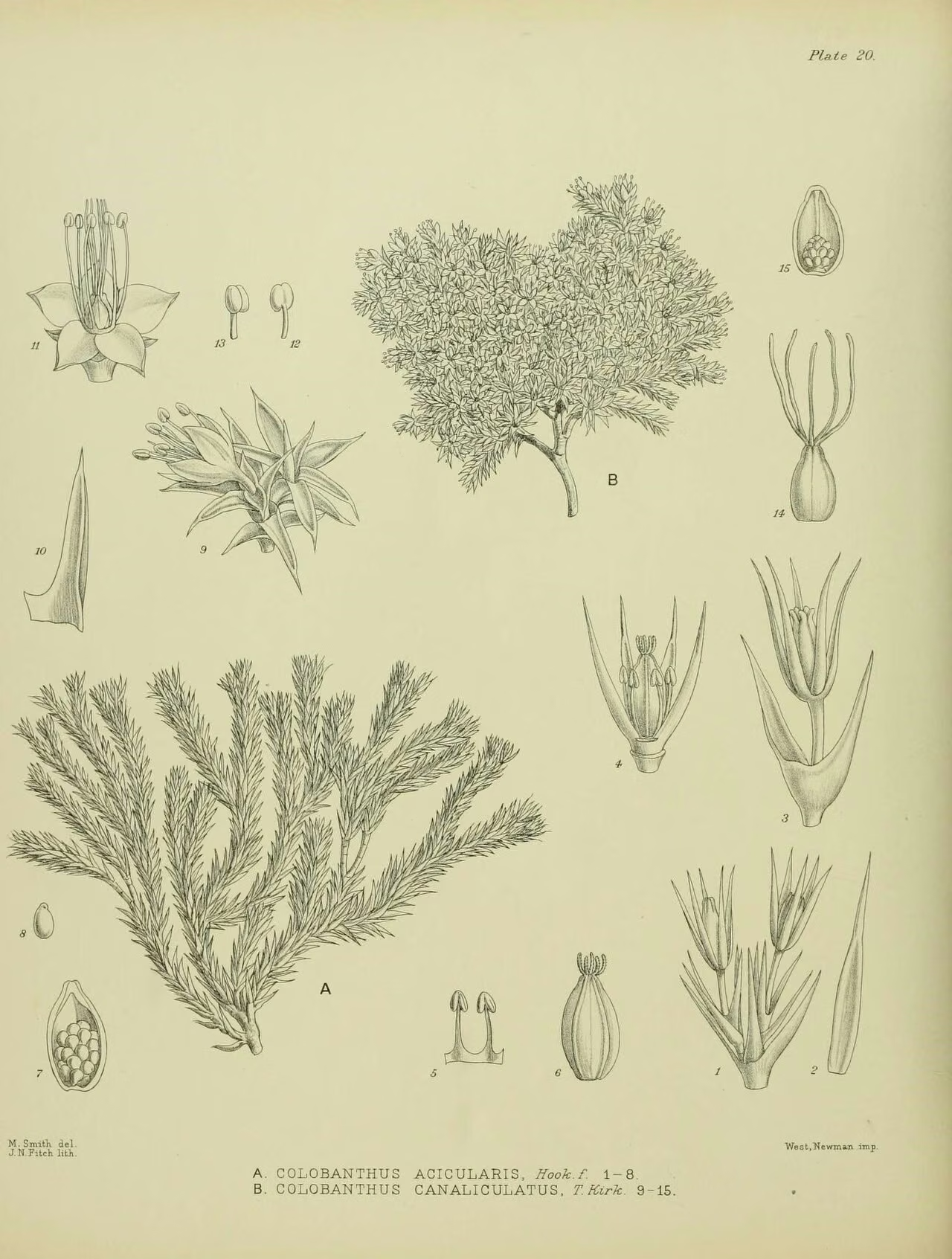
Colobanthus canaliculatus
Colobanthus canaliculatus
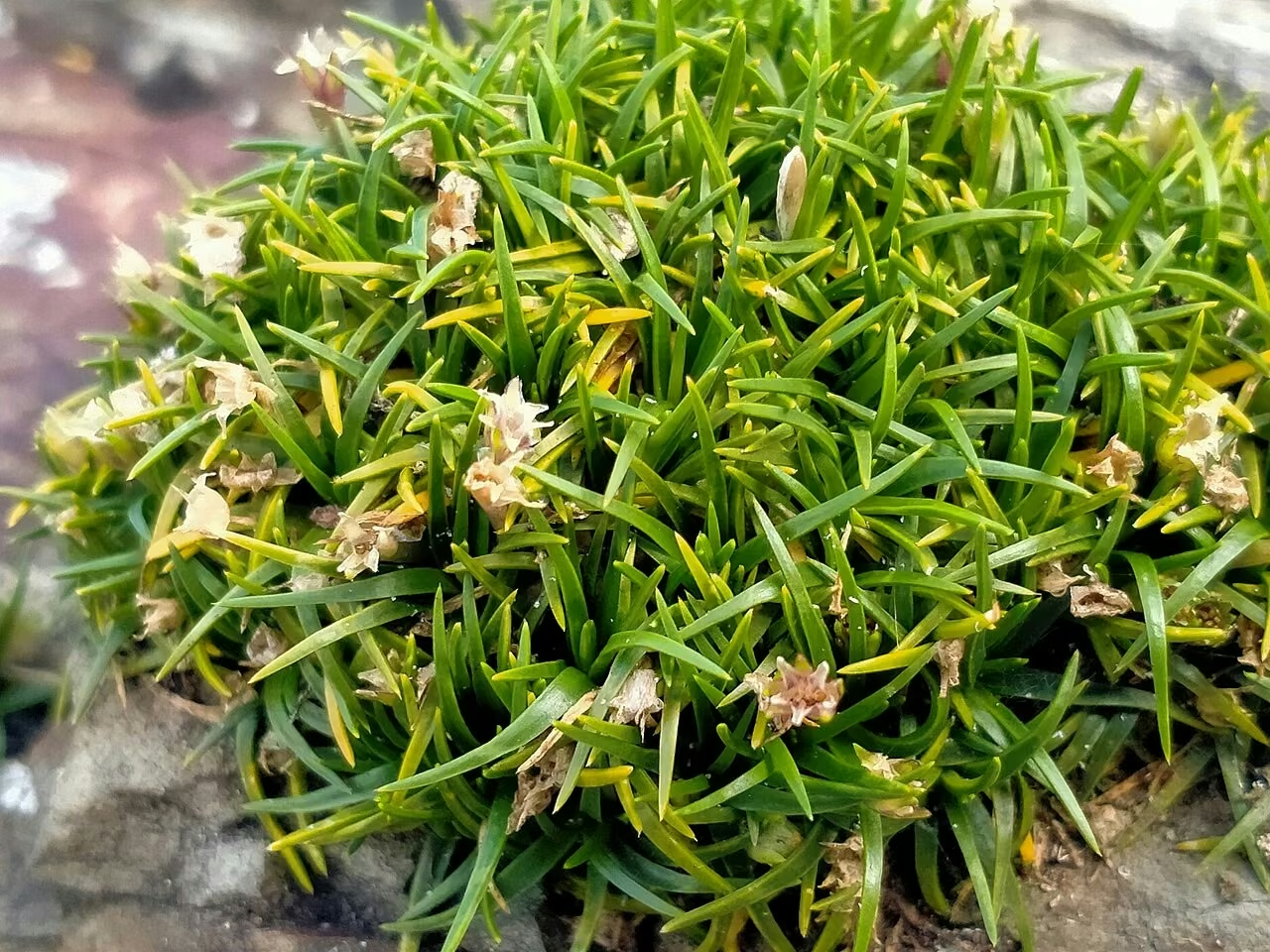
Colobanthus muelleri
Colobanthus muelleri
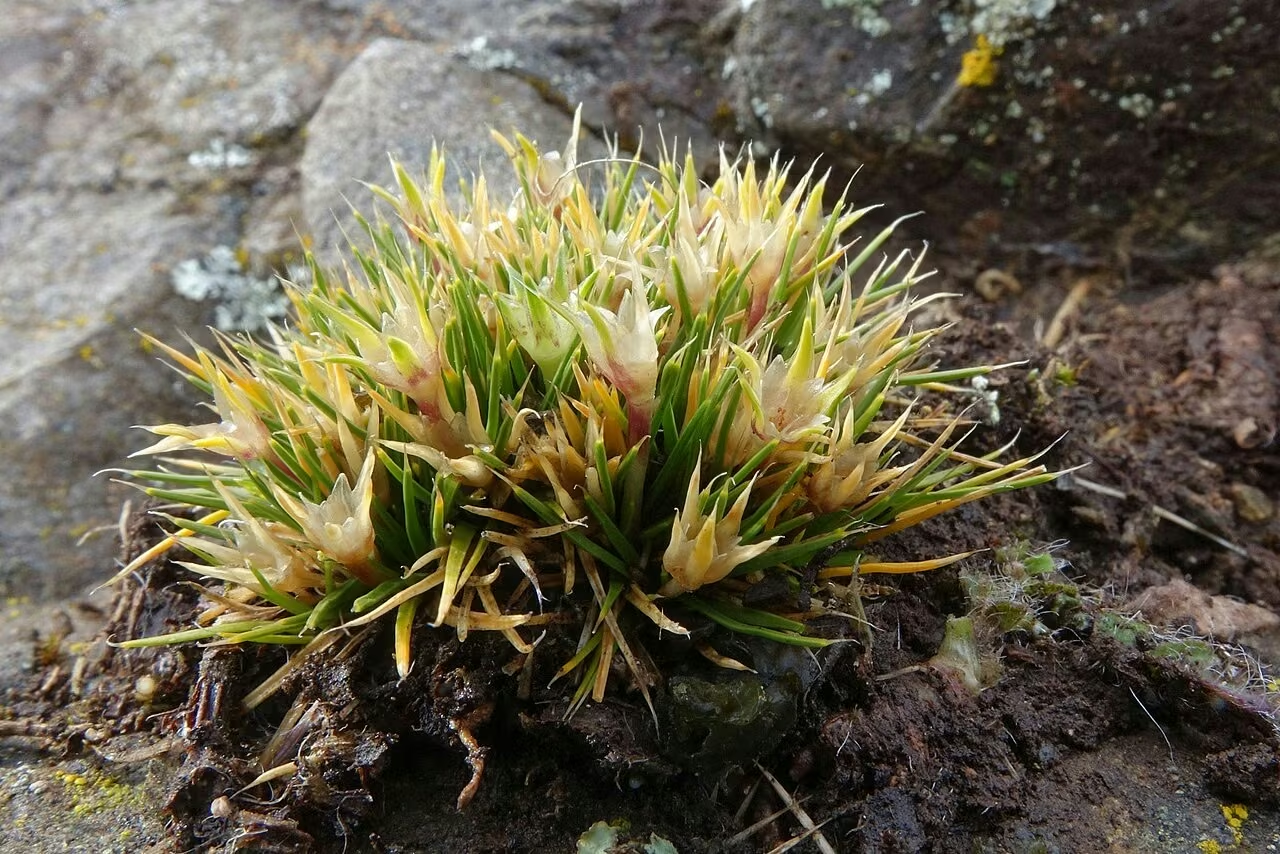
Colobanthus strictus
Colobanthus strictus
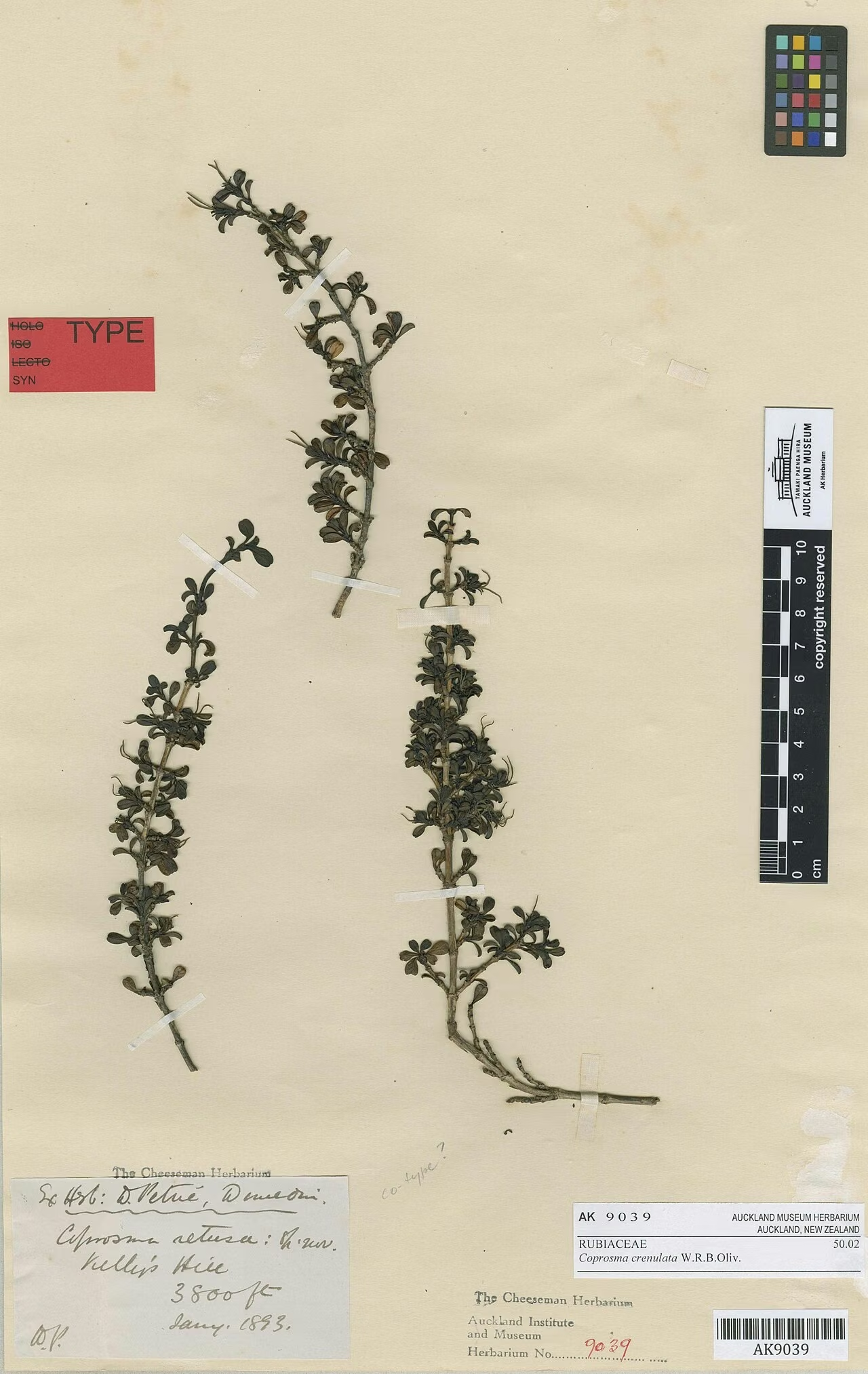
Coprosma crenulata
Coprosma crenulata
Coprosma decurva
Coprosma decurva
Plant Conservation
Colobanthus monticola is ranked Not Threatened nationally (2023), unchanged since 2004. However, the 2025 Otago regional assessment lists it as Regionally Data Deficient, meaning there is too little information to judge its status there.
Much of its known range lies within Aoraki/Mount Cook National Park and other public conservation land. Better survey records, such as photographed iNaturalist observations with close-ups of the flowers, would help clarify its distribution.
Frequently Asked Questions
Where is Colobanthus monticola found?
It is endemic to the South Island, where Allan's Flora records it from the mountains from Mt Cook southwards. The type collection came from rocky faces on the Sealy Range at about 5500 ft (around 1680 m).
How can you identify Colobanthus monticola?
Look for a dense cushion 2 to 4 cm deep with leaves about 5 mm long that lack a midrib but have strongly thickened margins, and flowers with four sepals. The capsule splits almost to the base into four broad lobes.
What does monticola mean?
Monticola is Latin for mountain dweller, a fitting name for a cushion plant described from high rock faces in the Aoraki/Mt Cook district.
Can Colobanthus monticola be grown in a garden?
It is not available in the nursery trade and no cultivation records were found. It would need specialist alpine conditions and should never be collected from the wild.
Sources and Further Reading
The botanical, growing, and conservation details for Colobanthus (Colobanthus monticola) on this page draw on the New Zealand plant references below. Consult them for full technical records and the latest distribution data.