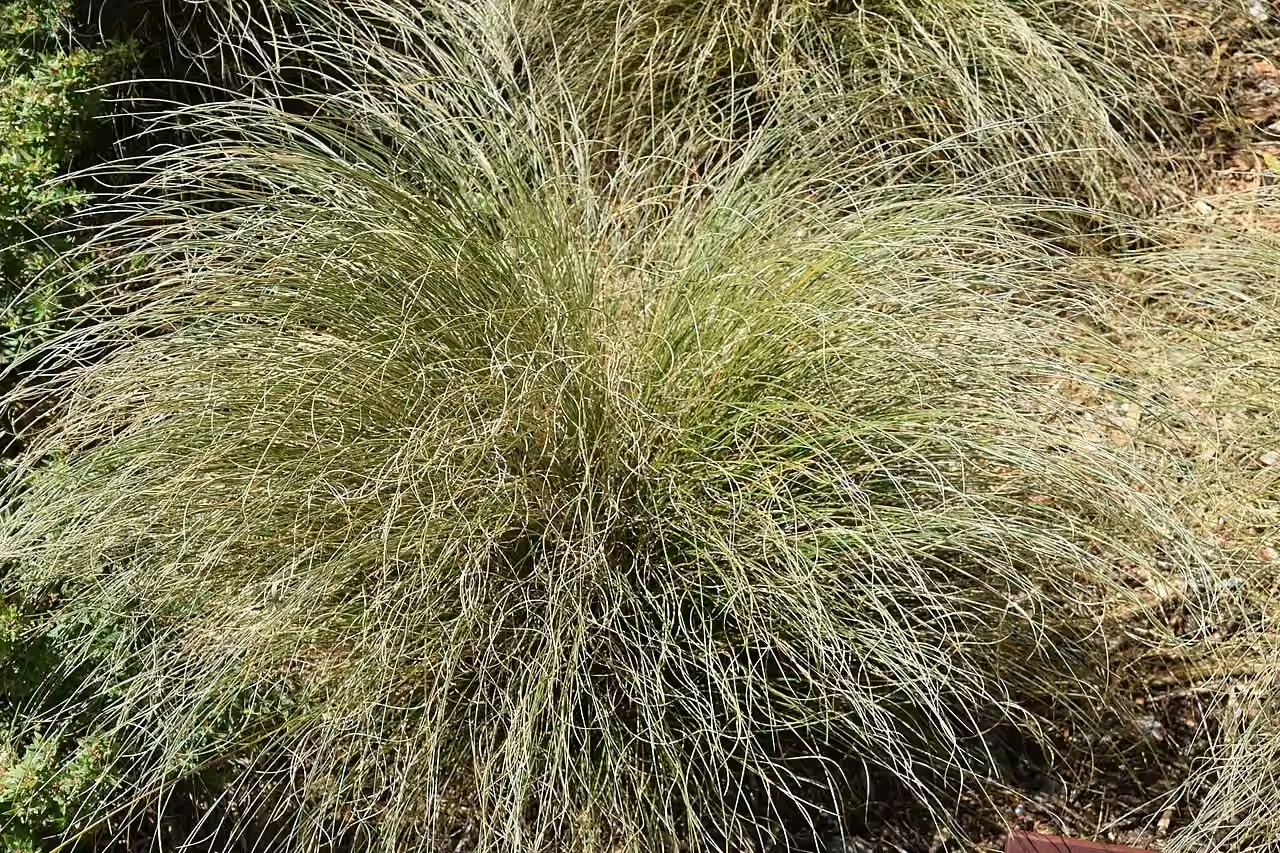
Terete-Leaved Snow Tussock
Chionochloa teretifolia
Last updated:
Terete-leaved snow tussock (Chionochloa teretifolia) is a small, sparsely tufted snow tussock endemic to the far south of the South Island. It forms a few pale shoots rising from darkened old leaf sheaths, with fine, rolled leaves up to 40 cm long that twist above and carry long white hairs underneath. Flowering stems reach about 50 cm. It grows in Fiordland and Southland from lowland to alpine elevations, in grassland and herbfield on leached, podzolised hill slopes and peaty soils. It is rated Not Threatened and is notable as one of the smallest and most finely leaved members of the snow tussock genus. Explore more native grasses and flaxes in our native plant guide.
Plant Description
Chionochloa teretifolia is a small tussock made up of relatively few pale shoots that emerge from darkened, persistent old leaf sheaths. The sheaths reach about 150 mm long and are pale green, sometimes with reddish or purple tints. The leaf blades are very narrow, up to 400 mm long but only about 1 mm across, and rolled so that they look rounded (terete). They twist towards their tips, carry long white hairs on the underside, and are deciduous, falling from the sheath rather than persisting as dead blades on the plant.
Flowering stems (culms) reach up to 500 mm, with hairless internodes. The flower head is up to 150 mm long, open, with flexuous branches carrying only a few spikelets, each holding up to six florets tinged purple. Flowers appear from October to December and seed ripens from December to April; the florets are dispersed by wind.
Among the snow tussocks it is easily picked by its small size, sparse habit and very fine, hairy, twisting leaves. Most other Chionochloa species in the south, such as the larger snow tussocks of Fiordland, form much bigger, denser tussocks with broader, flat or folded leaves that are not shed so cleanly from the sheath.
Quick Facts
| Scientific Name | Chionochloa teretifolia |
|---|---|
| Height | Foliage to about 0.4 m; flowering stems to 0.5 m |
| Spread | Small, sparsely tufted clump (no reliable published figure) |
| Water Needs | Moist; tolerates peaty, periodically wet ground |
| Light | Full sun (open grassland and herbfield) |
| Frost Tolerance | High; grows up to alpine elevations |
| Salt Tolerance | No information available; not a coastal species |
| Growth Rate | Slow |
| Lifespan | Perennial |
Climate Best Suited to
Suited to the cool, wet, oceanic climate of Fiordland and Southland, with frequent rain, low summer temperatures and regular frost and snow at higher altitudes. It is unlikely to thrive in warm, humid northern lowlands.
Regional Suitability
| City | Climate Suitability |
|---|---|
| Auckland | Low |
| Wellington | Low |
| Christchurch | Low |
| Dunedin | Medium |
Plant Habitat
Terete-leaved snow tussock is endemic to the southern South Island, where NZPCN records it only from Fiordland and Southland. The lectotype specimen was collected in the Longwood Range of western Southland, and herbarium collections come from Fiordland valleys and ranges. It spans a wide altitudinal range, from lowland sites up into the alpine zone.
Its habitat is open grassland and herbfield growing over leached or podzolised hill slopes and peaty soils, which are typical of the very high rainfall south-west of New Zealand. It is rated as a facultative wetland plant, meaning it occurs both in wet, boggy ground and in drier, non-wetland sites.
Growing Requirements
Soil Requirements
In the wild it grows on infertile, acidic, leached soils and peat, so it does not need rich garden soil and may be disadvantaged by fertiliser.
- Peaty, acidic or podzolised soils match its natural sites
- Low fertility is normal; avoid heavy feeding
- Moisture-retentive but not stagnant ground
Light Requirements
It is a plant of open, treeless grassland and herbfield and should be given full sun with little competition from taller plants.
- Full sun
- Keep clear of overhanging shrubs and vigorous grasses that could smother a small tussock
Water Requirements
Its home range has some of the highest rainfall in New Zealand, and it tolerates periodically wet peat. In cultivation it should not be allowed to dry out for long periods.
- Keep the root zone consistently moist
- Suits boggy or seepage edges in a rock or alpine garden
- Drought is likely to be harmful, especially in warm districts
Planting and Establishing
This species is not sold commercially, so planting is mainly relevant to restoration projects within its natural range in Fiordland and Southland, where locally sourced seed should be used. Plant small tussocks into open, peaty ground in autumn or early spring so that roots establish during cool, moist weather.
Firm the soil gently around the plant without burying the base of the shoots, water in well, and protect young plants from rabbits, hares and deer where these are present. Spacing a few tens of centimetres apart mimics the sparse tussock cover of its natural grasslands.
Ecological Role
Like other Chionochloa, terete-leaved snow tussock is wind pollinated and its seed is dispersed by wind. Snow tussocks as a group often flower heavily in some years and sparsely in others, but specific masting data for this species have not been published.
As part of the low tussock grassland and herbfield cover on southern hill slopes and peat, it contributes to the ground cover that shelters small herbs and invertebrates and helps hold leached soils in place. Detailed studies of the insects or birds associated specifically with this species were not found.
Uses & Significance
Garden Uses
This is essentially a botanical and restoration plant rather than a garden plant, as it is not commercially available. Enthusiasts of southern alpine plants could grow it from legally sourced seed in a cool, moist rock or bog garden.
- Specialist alpine or bog garden in cool southern districts
- Restoration planting within its natural range
- Botanical collections of the Chionochloa genus
Ecological Value
It forms part of the native tussock grassland and herbfield of Fiordland and Southland, a vegetation type that protects water yield and soils on wet hill country.
- Contributes to native ground cover on leached and peaty slopes
- Provides wind-dispersed seed and shelter for small herbs and invertebrates
- Part of the distinctive southern snow tussock flora
Landscaping Uses
In a southern alpine or bog garden its fine, twisting, hair-fringed leaves and pale shoots give a soft, wispy texture that contrasts well with cushion plants, mosses and broad-leaved herbs such as small celmisias. Its small size means it is best planted where it can be seen at close range rather than used for mass effect.
Group several plants in an open, peaty pocket rather than mixing them with vigorous grasses, which would quickly overwhelm such a sparse tussock.
Seasonal Care Calendar
Spring
New pale shoots grow and flowering begins from October.
- Flowering from October
- Check moisture as days lengthen
Summer
Flowering finishes by December and seed starts ripening on the open, purple-tinged heads.
- Seed ripens from December
- Do not let the root zone dry out
Autumn
Seed continues to ripen and shed until about April, making this the time to collect seed for propagation.
- Collect ripe florets before they blow away
- Good season for planting
Winter
Growth is slow or dormant; in the wild plants at higher altitude may sit under snow.
- No feeding needed
- Protect pots from waterlogging in prolonged wet spells
When to Prune and How Much
Pruning is not required. The leaf blades are deciduous and fall away from their sheaths naturally, and the darkened old sheaths at the base are a normal feature of the plant that help protect the shoots.
If a cultivated plant becomes untidy, old flowering stems can be removed after seed has been collected, but avoid cutting into the leafy shoots.
How to Grow Terete-Leaved Snow Tussock
No published propagation protocol specific to Chionochloa teretifolia was found, and NZPCN does not give propagation notes for it. The guidance below is based on the methods generally used for snow tussocks and on the species' own biology: it sets seed from December to April, its florets are wind dispersed, and it forms a clump of several shoots that can in principle be divided. Because it is not sold, material should come only from legally collected seed or plants within its Fiordland and Southland range, with landowner or Department of Conservation permission where required.
From Seed
Seed is the most practical way to raise plants and keeps the genetic diversity needed for restoration work. Collect seed heads once the florets are ripe and loose, usually between late summer and early autumn, before wind scatters them.
- Gather ripe florets on a dry day and spread them out to dry for a few days.
- Sow fresh on the surface of a free-draining, peaty seed mix and cover very lightly.
- Keep the tray cool, evenly moist and in good light, outdoors or in a cold frame.
- Expect slow and possibly uneven germination; do not discard trays too early.
- Pot seedlings individually once they have several leaves and grow them on for a season before planting out.
By Division
Established clumps with several shoots can be gently split, which reproduces the parent exactly. Because this species is small and sparse, only well-grown cultivated plants should be divided.
- Divide in early spring or autumn when the weather is cool and moist.
- Lift the clump and tease it into pieces, each with a few shoots and its own roots.
- Trim long leaves back slightly to reduce water loss.
- Pot divisions into a moist, peaty mix and keep sheltered until new growth appears.
Pests & Diseases
No pest or disease problems specific to this species are documented. In the wild, introduced browsers such as deer, hares and rabbits graze many southern tussocks and herbs and may affect it locally.
In cultivation the main risks are drying out, excessive heat and humidity, and smothering by vigorous weeds or grasses rather than particular insects.
Cultural Significance
No Māori name or traditional use specific to Chionochloa teretifolia is recorded in the sources consulted. Its genus name Chionochloa means snow grass, and teretifolia refers to its rounded, terete leaves.
The species was described from the Longwood Range in Southland, where the lectotype was collected in 1913, and it is part of the distinctive tussock flora of the far south of New Zealand.
Bonus Tip
To confirm this species in the field, look closely at a leaf: a blade only about 1 mm wide, rolled into a rounded thread, twisting near the tip and fringed with long white hairs underneath is the key combination that separates it from the larger snow tussocks it often grows near in Fiordland and Southland.
Related Plants
Explore other native plants that share similar characteristics or habitats with Terete-Leaved Snow Tussock (Chionochloa teretifolia), offering further insights into New Zealand's diverse flora. These related species provide context and opportunities for complementary planting in your garden.
Pungent Snow Tussock
Chionochloa crassiuscula subsp. crassiuscula
Red Hills Snow Tussock
Chionochloa defracta
Slim Snow Tussock
Chionochloa macra
Squat Snow Tussock
Chionochloa ovata
Veronica chionohebe
Veronica chionohebe
Veronica thomsonii
Veronica thomsonii
Leafless Clematis
Clematis afoliata
Clematis marata
Clematis marata
Plant Conservation
Terete-leaved snow tussock has been classed as Not Threatened in every assessment from 2004 to 2023. Much of its range lies within Fiordland National Park and other protected land in the south-west, which helps secure its populations.
Its main potential pressures are browsing by introduced deer and hares and any conversion of lowland peaty grassland. Continued browser control in Fiordland and protection of remaining southern tussock grasslands are the measures that benefit it most.
Frequently Asked Questions
Where does terete-leaved snow tussock grow?
It is endemic to the South Island and recorded only from Fiordland and Southland, including the Longwood Range, from lowland to alpine grassland and herbfield on leached or peaty soils.
What does terete mean in Chionochloa teretifolia?
Terete means rounded in cross-section rather than flat or angular, describing the very narrow rolled leaves, which are only about 1 mm wide.
Is Chionochloa teretifolia threatened?
No. It has been assessed as Not Threatened in every New Zealand threat classification from 2004 to 2023.
Can I buy terete-leaved snow tussock for my garden?
NZPCN records it as not commercially available, so it is essentially absent from nurseries; gardeners wanting a snow tussock usually grow more widespread Chionochloa species instead.
Sources and Further Reading
The botanical, growing, and conservation details for Terete-Leaved Snow Tussock (Chionochloa teretifolia) on this page draw on the New Zealand plant references below. Consult them for full technical records and the latest distribution data.