Squat Snow Tussock
Chionochloa ovata
Last updated:
Squat snow tussock (Chionochloa ovata), also called Fiordland snow tussock, is a small, sparsely tufted snow tussock found only in Fiordland. Its flat, sharp-tipped leaves reach 25 cm long and sit on shoots wrapped in many old fibrous sheaths, while flowering stems up to 45 cm carry strongly purple florets. It grows in subalpine to alpine grassland on wet or seasonally poorly drained ground and in damp rock crevices. NZPCN reports that it is easily grown from fresh seed or rooted pieces if kept permanently damp. It is ranked At Risk - Declining. Explore more native grasses and flaxes in our native plant guide.
Plant Description
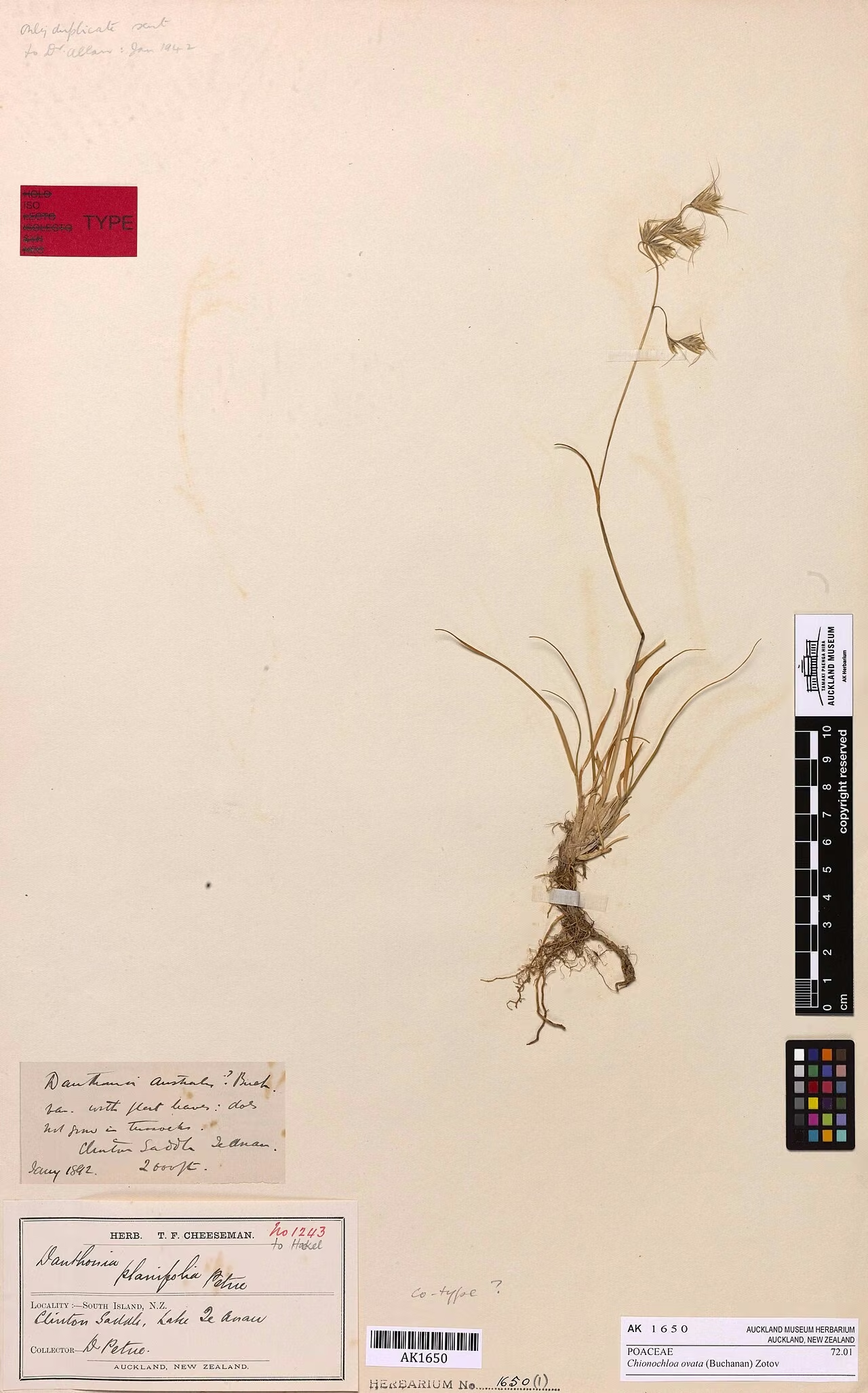
Chionochloa ovata is a sparse tussock whose shoots are clothed in many old, fibrous, entire sheaths up to 10 cm long. The leaf blades are flat, up to 25 cm long and 5 mm wide, with a sharp tip, and they eventually break off at the ligule, leaving the sheaths behind. The sheaths, flowering stems and spikelets are often flushed purple or golden.
The flowering stems, up to 45 cm tall, rise above the leaves and carry a compact flower head up to 10 cm long. Each spikelet holds up to eight strongly purpled florets, and the lemmas are densely hairy on the margins with a central awn up to 20 mm long. Flowering occurs from October to December and fruit ripens from December to April, with the florets spread by wind.
Its small size, short flat pungent leaves, fibrous persistent sheaths and strongly purple florets distinguish it from the larger snow tussocks of Fiordland, such as Chionochloa crassiuscula and C. pallens, which form bigger and denser tussocks.
Quick Facts
| Scientific Name | Chionochloa ovata |
|---|---|
| Height | Leaves to 0.25 m; flowering stems to 0.45 m |
| Spread | Small, sparse tussock (no published width) |
| Water Needs | High; must never dry out |
| Light | Semi-shade in cultivation; open grassland in the wild |
| Frost Tolerance | High; subalpine to alpine |
| Salt Tolerance | No information available |
| Growth Rate | Slow |
| Lifespan | Perennial |
Climate Best Suited to
Adapted to the very wet, cool climate of Fiordland's mountains, with high rainfall, frequent cloud, snow in winter and cool summers. Warm or dry districts are unsuitable.
Regional Suitability
| City | Climate Suitability |
|---|---|
| Auckland | Low |
| Wellington | Low |
| Christchurch | Low |
| Dunedin | Medium |
Plant Habitat
Squat snow tussock is endemic to the South Island and confined to Fiordland, where much of its habitat lies within Fiordland National Park. Detailed locality and altitude data were not available in the sources consulted beyond its subalpine to alpine range.
It occupies the subalpine and alpine zones, inhabiting wet or seasonally poorly drained ground within grasslands and colonising damp sites in rock crevices. NZPCN rates it as a facultative wetland plant, meaning it grows both in wet and in non-wetland sites.
Growing Requirements
Soil Requirements
In Fiordland it grows on peaty, acidic, often waterlogged soils. NZPCN recommends a permanently damp, acidic soil in cultivation.
- Acidic, peaty soil
- Constant moisture without stagnation
- No fertiliser required
Light Requirements
Wild plants grow in open grassland under Fiordland's cloudy skies, and NZPCN recommends semi-shade in cultivation to keep plants cool.
- Semi-shade in gardens
- Protect from hot afternoon sun
Water Requirements
NZPCN is emphatic that plants must never be allowed to dry out, reflecting its wet, poorly drained natural sites.
- Keep soil permanently damp
- Bog garden edges or a pot in a water saucer suit it
- Rainwater is preferable to hard tap water
Planting and Establishing
Plant squat snow tussock into a cool, semi-shaded, acidic peat bed or bog margin where the soil never dries. Spring planting allows roots to settle before summer, which is the most dangerous season for drought stress.
Set plants at their existing depth, water in thoroughly and mulch with moss or fine bark. For restoration in Fiordland, use only seed or rooted pieces sourced locally with Department of Conservation approval.
Ecological Role
Like other snow tussocks it is wind pollinated, and its florets are dispersed by wind between December and April. As a colonist of damp rock crevices and wet hollows, it can occupy small niches that larger tussocks cannot.
In Fiordland's subalpine grasslands it forms part of the mosaic of tussocks, herbs and mosses on peaty ground near the treeline. Studies of the invertebrates or birds associated specifically with this species were not found.
Uses & Significance
Garden Uses
Because NZPCN reports it as easily grown when kept damp, it is one of the more manageable snow tussocks for an alpine enthusiast in cool districts.
- Bog garden and peat bed
- Shaded rock crevice plantings
- Containers kept constantly moist
Ecological Value
It is part of the endemic subalpine flora of Fiordland, filling wet hollows and rock crevices within grasslands near the treeline.
- Colonises damp crevices and poorly drained ground
- Contributes to Fiordland's distinctive tussock flora
- Helps bind peaty soils
Landscaping Uses
Its small size and purple-flushed flower heads make it suitable for close viewing in a trough, raised bog bed or shady rock garden. The fibrous old sheaths give the base a soft, shaggy texture.
Combine it with mosses, small ferns and other moisture-loving alpines, and place it where it can be watered easily during summer.
Seasonal Care Calendar
Spring
Flowering begins in October, with purple florets held above the leaves.
- Flowering from October
- Increase watering as temperatures rise
Summer
Flowering ends by December and seed begins to ripen. Never allow plants to dry out.
- Seed ripens from December
- Keep shaded and damp
Autumn
Seed continues to ripen until about April; sow it fresh.
- Collect and sow fresh seed
- Divide rooted pieces
Winter
Plants are dormant and in the wild may lie under snow.
- Keep pots moist but not frozen solid
- No feeding needed
When to Prune and How Much
No pruning is required. The leaves disarticulate at the ligule as they age, and the old fibrous sheaths are a characteristic feature that should be left in place.
Old flowering stems can be removed after the seed has been shed.
How to Grow Squat Snow Tussock
NZPCN reports that squat snow tussock is easily grown from fresh seed and from rooted pieces, which makes it one of the more straightforward members of the genus to propagate. The key requirement is moisture: plants prefer permanently damp, acidic soil and semi-shade and must never be allowed to dry out at any stage. Seed ripens between December and April. Because wild plants occur only in Fiordland, mostly within the national park, collecting requires Department of Conservation authorisation, and cultivated plants are the preferred source for further propagation. Label each batch with its collection site.
From Seed
Fresh seed germinates readily according to NZPCN. Sow soon after collection rather than storing it.
- Collect heads when the purple florets loosen, from December to April.
- Sow fresh onto a moist, acidic, peaty seed mix and cover lightly.
- Stand the tray in a shallow saucer of water in semi-shade.
- Prick out seedlings into individual pots of peaty mix once they are large enough to handle.
- Keep constantly moist and grow on before planting out.
By Division
Rooted pieces taken from an established plant establish well, according to NZPCN, and give a sizeable plant more quickly than seed.
- Lift or tease apart a cultivated tussock in spring or autumn.
- Detach rooted shoots, each with a portion of the fibrous base.
- Pot into damp, acidic peaty mix and place in semi-shade.
- Keep moist until new leaves appear, then plant out.
Pests & Diseases
NZPCN states that no serious threats to this species are known, and no specific pests or diseases are recorded. Red deer browse in Fiordland's subalpine grasslands and may graze tussocks locally.
In cultivation, drying out is by far the most common cause of failure.
Cultural Significance
No Māori name or traditional use specific to Chionochloa ovata was found in the sources consulted. The epithet ovata means egg-shaped, and the genus name means snow grass.
John Buchanan described it in 1879 as Danthonia ovata, and Donald Petrie later described Danthonia planifolia, now treated as the same species. Victor Zotov transferred it to Chionochloa in 1963.
Bonus Tip
If you are trying an alpine snow tussock for the first time, squat snow tussock is a sensible choice: it stays small, NZPCN rates it as easy from fresh seed or rooted pieces, and a pot of acidic peat mix stood in a saucer of rainwater in a shady corner meets its main need for constant moisture.
Related Plants
Explore other native plants that share similar characteristics or habitats with Squat Snow Tussock (Chionochloa ovata), offering further insights into New Zealand's diverse flora. These related species provide context and opportunities for complementary planting in your garden.
Narrow-Leaved Bush Tussock
Chionochloa cheesemanii
Pungent Snow Tussock
Chionochloa crassiuscula subsp. crassiuscula
Red Hills Snow Tussock
Chionochloa defracta
Slim Snow Tussock
Chionochloa macra
Terete-Leaved Snow Tussock
Chionochloa teretifolia
Veronica chionohebe
Veronica chionohebe

Veronica thomsonii
Veronica thomsonii
Leafless Clematis
Clematis afoliata
Plant Conservation
Squat snow tussock is ranked At Risk - Declining (2023) with qualifiers including Sparse, Conservation Dependent, Range Restricted and data poor. Otago lists it as Regionally Vulnerable (2025).
Its entire range lies in Fiordland, much of it within Fiordland National Park. Continued deer control and monitoring of its sparse populations are the most useful measures, along with better data on its population trends.
Frequently Asked Questions
Where does Chionochloa ovata grow?
It is endemic to Fiordland in the South Island, growing in subalpine to alpine grassland on wet or poorly drained ground and in damp rock crevices.
Why is it called squat snow tussock?
It is a small, sparse tussock whose leaves are only up to 25 cm long, much shorter and squatter than the tall snow tussocks that dominate many South Island ranges.
How do you grow squat snow tussock?
NZPCN says it is easily grown from fresh seed and rooted pieces. It prefers permanently damp, acidic soil and semi-shade, and must never be allowed to dry out.
Is Fiordland snow tussock threatened?
It is ranked At Risk - Declining (2023) and is Regionally Vulnerable in Otago, even though NZPCN notes that no serious threats to it are known.
Sources and Further Reading
The botanical, growing, and conservation details for Squat Snow Tussock (Chionochloa ovata) on this page draw on the New Zealand plant references below. Consult them for full technical records and the latest distribution data.