Leafless Clematis
Clematis afoliata
Last updated:
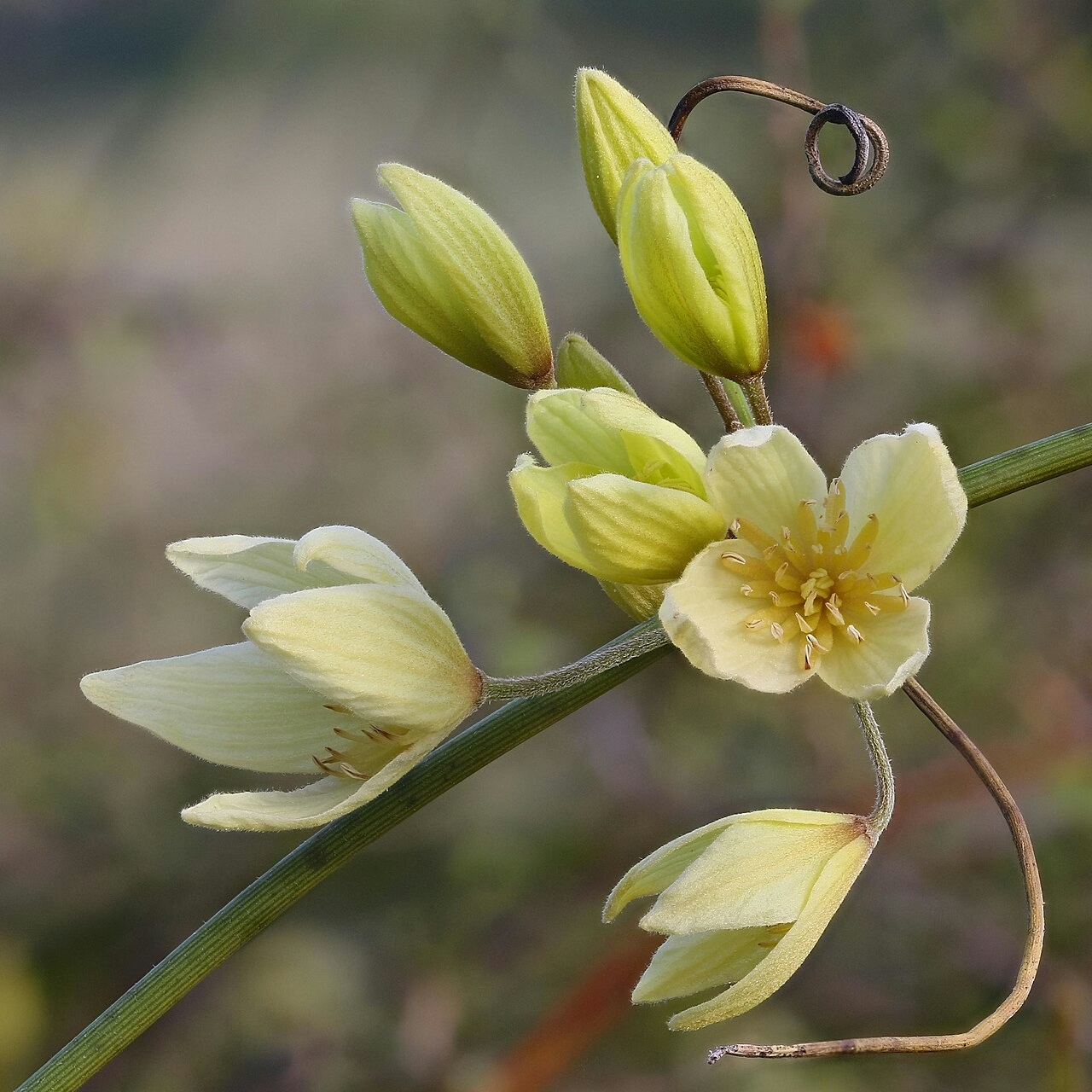
Leafless clematis (Clematis afoliata) is an endemic New Zealand climber whose leaves are reduced to twining stalks, leaving a tangle of stiff, wiry, grooved green stems up to 3 m long. It usually forms dense mounds that look like a heap of tangled wire draped over rocks and shrubs. It grows in open rocky shrubland and, in the South Island, tussock grassland on the dry eastern side of both main islands, mainly Marlborough and Canterbury, with smaller populations in Wairarapa and Wellington. In spring it bears fragrant, greenish-yellow flowers, followed by fluffy wind-dispersed seed heads. Explore more native climbers in our native plant guide.
Plant Description
Clematis afoliata is an evergreen woody climber that rarely looks like a typical vine. Its stems grow up to 3 m long and are stiff, wiry and finely grooved, about 3 to 4 mm thick, and they are bound together by the twining leaf stalks into large bundles. The result is a mound that resembles a big tangle of green wire or thick string sprawled over rocks or low shrubs.
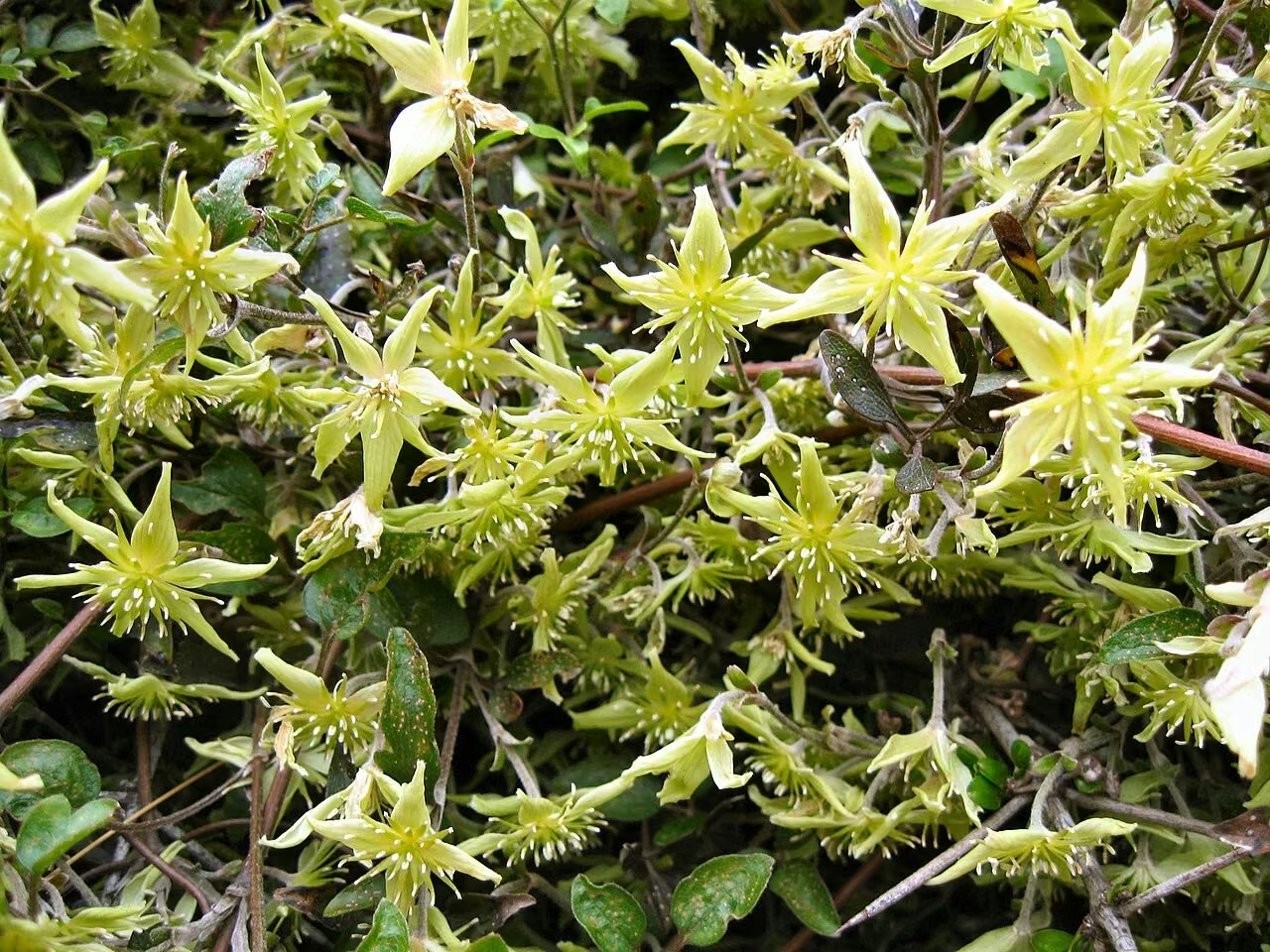
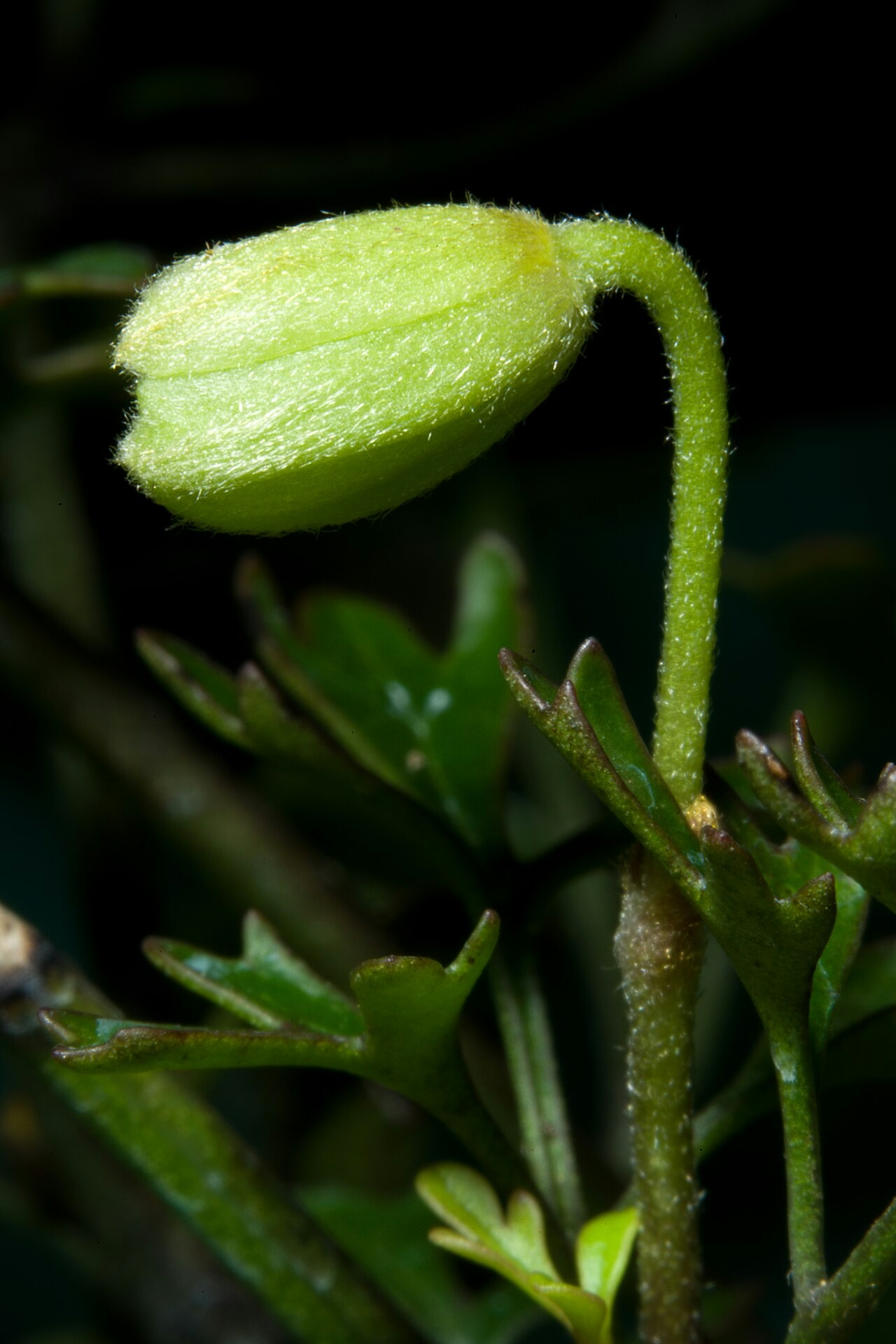
The leaves are reduced to bare petioles and petiolules, 3 to 10 cm long, which twine around anything they touch. True leaflets are usually missing, although small three-part leaves can appear on seedlings and on plants growing in shade. The flowers are unisexual, with male and female flowers on separate plants, and appear singly or in clusters of two or three in the leaf axils. Each has four or five greenish-yellow, hairy, ovate-lanceolate sepals 15 to 25 mm long, and they are pleasantly fragrant.
Female flowers develop into heads of hairy, reddish-brown achenes 2 to 4 mm long, each carrying a feathery style about 2 cm long that catches the wind. No other New Zealand clematis is effectively leafless, so the rush-like mass of stems is distinctive; other native species have obvious leaflets.
Quick Facts
| Scientific Name | Clematis afoliata |
|---|---|
| Height | Mounds about 0.5-1 m; stems up to 3 m long |
| Spread | Tangled mounds 1-2 m across |
| Water Needs | Low; tolerates summer drought |
| Light | Full sun |
| Frost Tolerance | High; grows in frosty inland basins |
| Salt Tolerance | No reliable information available |
| Growth Rate | Moderate |
| Lifespan | Long-lived perennial |
Climate Best Suited to
Suits the dry, sunny eastern climates of New Zealand with hot summers, frosty winters and summer drought. It dislikes humid, wet conditions with little sun.
Regional Suitability
| City | Climate Suitability |
|---|---|
| Auckland | Low |
| Wellington | Medium |
| Christchurch | High |
| Dunedin | Medium |
Plant Habitat
Leafless clematis follows the dry eastern flanks of New Zealand. In the North Island it occurs in Wairarapa and around Wellington and was formerly recorded in Hawke's Bay. In the South Island it is most widespread in Marlborough and Canterbury, extending into Otago where it is now regarded as regionally vulnerable.
It grows in open, sunny places: rocky outcrops, bluffs, stony slopes and open shrubland, and in the South Island also among tussock grassland. These are sites with strong sun and summer-dry conditions, where the leafless habit reduces water loss.
Growing Requirements
Soil Requirements
In the wild it grows in thin, stony, free-draining soils on rock outcrops, scree margins and dry slopes.
- Gritty or rocky soil with excellent drainage
- Low to moderate fertility is fine
- Avoid heavy, waterlogged clay
Light Requirements
This is a plant of open, sunny country and it grows and flowers best in full sun.
- Full sun for compact, leafless growth
- In shade it may produce leaflets and grow more loosely
Water Requirements
Its reduced leaves make it well adapted to drought, and it is one of the most dry-tolerant native climbers.
- Water young plants until established
- Established plants need little or no summer watering
- Overwatering in heavy soil can cause root rot
Planting and Establishing
Plant in spring or autumn into a sunny, free-draining spot, ideally where the stems can scramble over a rock, bank, fence or low shrub. Keep the root zone cool with stones or a mulch of gravel, as is usual for clematis.
Give it room to form its natural mound, roughly 1 to 2 m across. Plants are single-sexed, so grow several if you want seed heads, since only female plants produce them.
Ecological Role
Leafless clematis is part of the dry rocky shrubland and grassland communities of eastern New Zealand, where its tangled stems give shelter to small animals and insects among exposed rocks. Its fragrant flowers are visited by insects, and the feathery-tailed achenes are dispersed by wind.
NZPCN notes that competition from naturalised plants can prevent regeneration in some places, so it relies on open ground free from dense weedy grasses and shrubs.
Uses & Significance
Garden Uses
It is an unusual, sculptural plant for dry gardens where most climbers would struggle.
- Draped over rocks and walls in dry or rock gardens
- Scrambling over a low fence or trellis in full sun
- Native plantings in Marlborough, Canterbury and Wairarapa
- Large containers in a sunny, exposed spot
Ecological Value
It is a characteristic plant of eastern rocky shrubland and is worth including in restoration where it once grew.
- Provides cover among rocks in dry, open habitats
- Fragrant spring flowers for insects
- Locally rare in Wellington and Otago, so restoration plantings help
Landscaping Uses
Use leafless clematis as a textural feature: its mass of green wiry stems contrasts well with silver-leaved plants, tussocks and grey rocks. It suits gravel gardens and dry banks in eastern regions.
Because it can bundle its stems together into a large heap, place it where its mounding habit is an asset rather than where a neat, narrow climber is wanted.
Seasonal Care Calendar
Spring
Flowering runs from about August to November, with fragrant greenish-yellow flowers clustered along the stems.
- Enjoy the scent on warm days
- Plant new specimens in early spring
Summer
Female plants carry heads of fluffy seed from about November to January.
- Collect ripe seed when the tails turn silky
- No watering needed for established plants
Autumn
Growth slows as the dry summer ends.
- Autumn is a good time to plant
- Remove weedy grasses competing at the base
Winter
The evergreen stems persist through cold, frosty winters with little change.
- Avoid waterlogged soil
- Lightly tidy any dead stems
When to Prune and How Much
Little pruning is needed. Its natural form is a tangled mound, and heavy cutting spoils this look.
Remove dead or broken stems after flowering, and trim stems that stray onto paths. Because the stems are bundled together by tendrils, cut sections out carefully rather than pulling them.
How to Grow Leafless Clematis
No detailed propagation protocol for Clematis afoliata was found in the sources consulted, so the methods below follow the approach commonly used for New Zealand native clematis. Seed is the natural way the plant spreads: the feathery-tailed achenes ripen on female plants from about November to January and are carried off by the wind. Because the species is dioecious, only female plants that have grown near a male will set viable seed. Semi-hardwood cuttings are also a common way to raise native clematis and have the advantage of producing a plant of known sex. Raise plants from local stock where possible, especially for restoration.
From Seed
Collect seed heads when the achenes have turned reddish brown and the tails are silky, then sow fresh. Native clematis seed can be slow and uneven to germinate.
- Collect ripe seed heads from female plants in early to mid summer
- Trim the feathery tails if they make handling awkward
- Sow on the surface of a free-draining seed mix and cover lightly with grit
- Keep the tray just moist in a sheltered, bright place
- Pot on seedlings once they have formed twining stalks and a few roots
From Cuttings
Take cuttings of firm, current-season stems. Because the plant is single-sexed, cuttings let you choose a male or female plant deliberately.
- Cut 10-15 cm lengths of semi-hardwood stem in late summer or autumn
- Trim just below a node and remove soft tips
- Insert into a gritty, free-draining propagating mix
- Keep humid but not wet, out of direct sun, until rooted
- Harden off and pot on into a gritty mix
Pests & Diseases
No significant pests are recorded for this species in the sources consulted. In gardens the main risk is root rot in heavy, wet or humid conditions, which it does not tolerate well.
In the wild, competition from naturalised grasses and shrubs can smother seedlings and prevent regeneration.
Cultural Significance
No Māori name or traditional use for Clematis afoliata was found in the sources consulted.
The species epithet afoliata means without leaves, describing its most obvious feature. The genus name Clematis comes from the Greek word for a vine or climbing plant.
Bonus Tip
If you want the fluffy seed heads, buy or propagate more than one plant: leafless clematis is single-sexed, and a lone male will only ever flower. Taking cuttings from a known female plant is the surest way to get seed heads.
Related Plants
Explore other native plants that share similar characteristics or habitats with Leafless Clematis (Clematis afoliata), offering further insights into New Zealand's diverse flora. These related species provide context and opportunities for complementary planting in your garden.
Plant Conservation
Clematis afoliata is ranked Not Threatened (2023) with the qualifiers Data Poor Size and Data Poor Trend. Regionally it is Critical in Wellington and Vulnerable in Otago (2025), and it appears to have been lost from Hawke's Bay.
Threats include development of open rocky habitat and competition from naturalised plants. Protecting rocky outcrops from weeds and including eco-sourced plants in dry eastern restoration projects both help.
Frequently Asked Questions
Why does Clematis afoliata have no leaves?
Its leaves are reduced to twining stalks (petioles and petiolules) that act as tendrils. Leaflets are normally absent and appear only on young plants or those growing in shade, an adaptation to dry, sunny, exposed sites.
Where does leafless clematis grow in New Zealand?
It grows on the dry eastern side of the lower North Island (Wairarapa and Wellington, and historically Hawke's Bay) and the eastern South Island, where it is most common in Marlborough and Canterbury, in rocky shrubland and tussock grassland.
Are leafless clematis flowers scented?
Yes. The greenish-yellow to greenish-white flowers are fragrant. Plants are single-sexed, so male and female flowers are borne on separate plants between about August and November.
Is leafless clematis threatened?
It is ranked Not Threatened nationally, but it is Regionally Critical in the Wellington region, and development of open rocky habitats and competition from naturalised plants threaten regeneration in some areas.
Sources and Further Reading
The botanical, growing, and conservation details for Leafless Clematis (Clematis afoliata) on this page draw on the New Zealand plant references below. Consult them for full technical records and the latest distribution data.