Chervil
Chaerophyllum ramosum
Last updated:
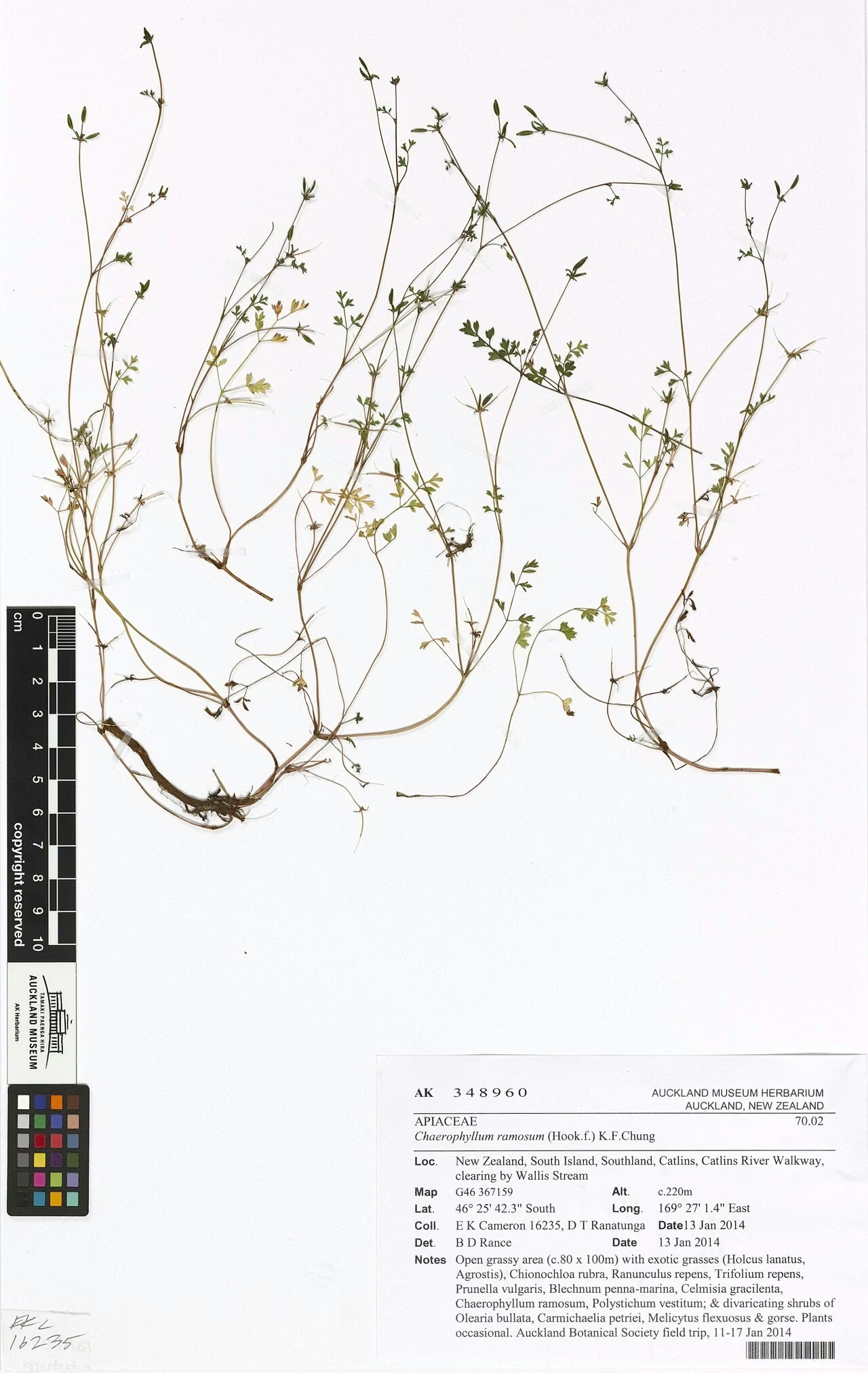
Chaerophyllum ramosum, long known as Oreomyrrhis ramosa and sometimes called myrrh, is a native member of the carrot family (Apiaceae). It is a lax perennial herb with slender, much-branched stems spreading up to about 60 cm, finely divided ferny leaves and small umbels of flowers on very slender stalks, followed by narrow, strongly ribbed fruits 5 to 6 mm long. Allan's Flora of New Zealand records it from montane grassland and open places in the North and South Islands, from the Ruahine Range southwards. It is currently ranked Data Deficient because too little is known to assess it reliably. Explore more native flowering plants in our native plant guide.
Plant Description
Chaerophyllum ramosum is a lax perennial herb with much-branched, slender, spreading stems up to about 60 cm long. Its leaves are pinnate to twice-pinnate on slender stalks up to about 15 cm long. The leaf blade is ovate-oblong in outline, with a few pairs of leaflets on very slender stalks up to 15 mm long, and the leaflets are coarsely toothed with small sharp points and narrowed at the base.
The umbels are carried on very slender stalks up to about 25 cm long and have 10 to 15 unequal, very slender rays. The fruits are linear, 5 to 6 mm long, strongly ribbed and hairless to finely hairy; NZPCN notes the hairy mericarps (fruit halves) are dispersed by wind and possibly by attaching to animals.
Allan (1961) noted considerable variation in leaflet size and hairiness between populations, and Kirk had earlier suggested it might prove a distinct species from Oreomyrrhis andicola. Its sprawling, branched habit with long slender stems helps separate it from the more compact rosette-forming native Chaerophyllum (Oreomyrrhis) species, but specialist identification is advisable.
Quick Facts
| Scientific Name | Chaerophyllum ramosum |
|---|---|
| Height | Low and sprawling; stems spreading up to about 60 cm long |
| Spread | Up to about 0.6 m |
| Water Needs | Moderate; recorded from both damp and drier sites |
| Light | Open grassland, full sun to light shade |
| Frost Tolerance | High; a montane species |
| Salt Tolerance | No information available; an inland montane plant |
| Growth Rate | No reliable information found |
| Lifespan | Perennial |
Climate Best Suited to
Suits cool montane climates of the lower North Island and South Island, with cold winters and moist growing seasons.
Regional Suitability
| City | Climate Suitability |
|---|---|
| Auckland | Low |
| Wellington | Medium |
| Christchurch | Medium |
| Dunedin | Medium |
Plant Habitat
Allan's Flora of New Zealand gives its range as the North and South Islands from the Ruahine Range southwards. The type specimen was collected by Hector and Buchanan in 1863 on river flats in the Otago lakes district. Regional assessments in 2025 ranked it Regionally Not Threatened in Otago but Regionally Naturally Uncommon in the Wellington region.
It grows in montane grassland and open places. NZPCN gives it a wetland indicator status of Facultative, meaning it commonly occurs either in wetlands or on drier ground.
Growing Requirements
Soil Requirements
Its recorded habitats, montane grassland and open places including river flats, suggest moist, fertile to moderately fertile grassland soils, though specific soil preferences are not documented.
- Grassland soils that hold some moisture
- Tolerates both damp and drier ground
- Avoid dense, competitive pasture grasses
Light Requirements
As a plant of open grassland it needs good light and is unlikely to persist under dense shrubs or tall grass.
- Open, sunny sites
- Low surrounding vegetation
Water Requirements
Its facultative wetland status shows it can grow in moist or drier sites, so moderate, reliable moisture is likely ideal.
- Keep evenly moist in cultivation
- Avoid long dry periods
Planting and Establishing
This species is rarely if ever offered by nurseries, and with its Data Deficient status any wild material should only be handled through conservation channels.
Where grown in a native collection, plant it into an open, sunny, moist but well-drained site among low tussocks, where its sprawling stems can weave through neighbouring plants.
Ecological Role
Chaerophyllum ramosum is a component of montane grassland, where its small umbels provide flowers for insects. Carrot-family flowers are commonly visited by flies and small native bees, but pollination of this species has not been studied in the sources consulted.
Its hairy fruit halves are dispersed by wind and possibly by attaching to animals or clothing.
Uses & Significance
Garden Uses
It has little established garden use; it is best suited to specialist native collections.
- Native montane grassland plantings
- Botanic garden collections of native Apiaceae
- Research into the identity of Oreomyrrhis forms
Ecological Value
It adds to the diversity of native herbs in montane grassland and is of scientific interest because its identity and status are poorly known.
- Native member of the carrot family
- Flowers for small insects in grassland
- A Data Deficient taxon needing survey and study
Landscaping Uses
It is not used in landscaping. In a naturalistic montane planting it could be grown among short tussocks, where its fine, ferny leaves and airy umbels add texture.
Its sprawling habit suits loose groundcover plantings rather than formal beds.
Seasonal Care Calendar
Spring
New leaves and stems grow as montane grasslands warm.
- Keep competing grasses short
- Water if spring is dry
Summer
Umbels develop on slender stalks; specific flowering months are not documented in the sources consulted.
- Record flowering times if observed
- Watch for developing ribbed fruits
Autumn
Fruits ripen and dry before dispersing on the wind.
- Collect ripe fruits from cultivated plants
- Leave some to self-sow
Winter
Growth slows in the cold montane winter.
- No action needed
- Avoid waterlogging in pots
When to Prune and How Much
No pruning is required. Spent flowering stems can be removed once seed has been collected.
Trim back straggling stems lightly if they invade neighbouring plants.
How to Grow Chervil
No published propagation protocol for Chaerophyllum ramosum was found in the sources consulted, and it is not a common nursery plant. Members of the carrot family, including other native Chaerophyllum and Oreomyrrhis species, are generally raised from fresh seed, and sprawling perennial herbs can often be increased by detaching rooted pieces, so these methods are described as reasonable approaches rather than proven ones. Because the species is Data Deficient and its identity is still poorly understood, wild collecting should be avoided, and anyone holding plants should record their origin carefully so the material is of value to research.
From Seed
The fruits split into two hairy mericarps when ripe. Seed of carrot-family plants often loses viability quickly, so fresh sowing is advisable.
- Collect ripe, dry fruits from cultivated plants
- Sow fresh onto a free-draining seed mix and cover lightly
- Place outdoors in a cool, sheltered spot and keep moist
- Be patient, as some Apiaceae need a cold period before germinating
- Pot seedlings individually once they have true leaves
By Division
Established clumps with several crowns may be carefully divided, as is usual for perennial native herbs.
Because the stems are slender and spreading rather than forming a dense clump, check whether any stems have rooted where they touch the soil; such rooted pieces can be detached and potted in the same way with less disturbance to the parent.
- Lift the plant in early spring
- Separate crowns, each with its own roots
- Pot into a moist, free-draining mix and keep in light shade until established
Pests & Diseases
No specific pests or diseases are recorded for this species. In grassland it is likely to suffer from competition with vigorous introduced pasture grasses.
Slugs and snails may damage seedlings. Browsing by introduced mammals is a general pressure on montane herbs, but no specific impacts on this species are documented.
Cultural Significance
No traditional Māori name or use for Chaerophyllum ramosum is recorded in the sources consulted. The common name myrrh appears to echo the old genus name Oreomyrrhis, which combines the Greek for mountain with myrrhis, a name long used for aromatic carrot-family herbs such as sweet cicely.
Joseph Hooker described it as Oreomyrrhis ramosa in 1864 from material collected by James Hector and John Buchanan during the Otago geological survey. The genus name Chaerophyllum comes from the Greek chairo, to please, and phyllon, leaf.
Bonus Tip
If you find a sprawling, ferny-leaved umbellifer in montane grassland from the Ruahines south, photograph the leaves, umbels and fruits and upload them to iNaturalist NZ. Because the species is Data Deficient, well-documented records can genuinely help botanists understand its distribution.
Related Plants
Explore other native plants that share similar characteristics or habitats with Chervil (Chaerophyllum ramosum), offering further insights into New Zealand's diverse flora. These related species provide context and opportunities for complementary planting in your garden.
Large Burr Grass
Cenchrus caliculatus
New Zealand Sneezewort
Centipeda aotearoana
Centrolepis strigosa
Centrolepis strigosa
Ceratocephala pungens
Ceratocephala pungens
Glaucous Goosefoot
Oxybasis ambigua
Beddie's Tussock
Chionochloa beddiei

Coastal Tussock
Chionochloa bromoides
Narrow-Leaved Bush Tussock
Chionochloa cheesemanii
Plant Conservation
Chaerophyllum ramosum is ranked Data Deficient (2023) with the qualifier Data Poor Recognition. It was previously listed as Not Threatened in 2004, 2009, 2012 and 2017. Regionally it is Not Threatened in Otago and Naturally Uncommon in Wellington (2025).
Clarifying how to distinguish it from related forms, and surveying its montane grassland habitats, are the main needs. Protecting native grassland from conversion and weed invasion will help it.
Frequently Asked Questions
What is Chaerophyllum ramosum?
It is a native perennial herb in the carrot family, previously called Oreomyrrhis ramosa, with sprawling slender stems, pinnate to twice-pinnate leaves and small umbels of flowers.
Why was Oreomyrrhis ramosa renamed Chaerophyllum ramosum?
In 2007 K.F. Chung used nuclear and chloroplast DNA sequences to show that Oreomyrrhis belongs within Chaerophyllum, so the New Zealand species were transferred to that genus.
Why is Chaerophyllum ramosum listed as Data Deficient?
In 2023 it was ranked Data Deficient with the qualifier Data Poor Recognition, meaning there is too little reliable information, including about how to recognise it, to assign a threat ranking.
Where does Chaerophyllum ramosum grow?
Allan's Flora of New Zealand describes it from montane grassland and open places in the North and South Islands, from the Ruahine Range southwards.
Sources and Further Reading
The botanical, growing, and conservation details for Chervil (Chaerophyllum ramosum) on this page draw on the New Zealand plant references below. Consult them for full technical records and the latest distribution data.