Mountain Daisy
Celmisia dubia
Last updated:
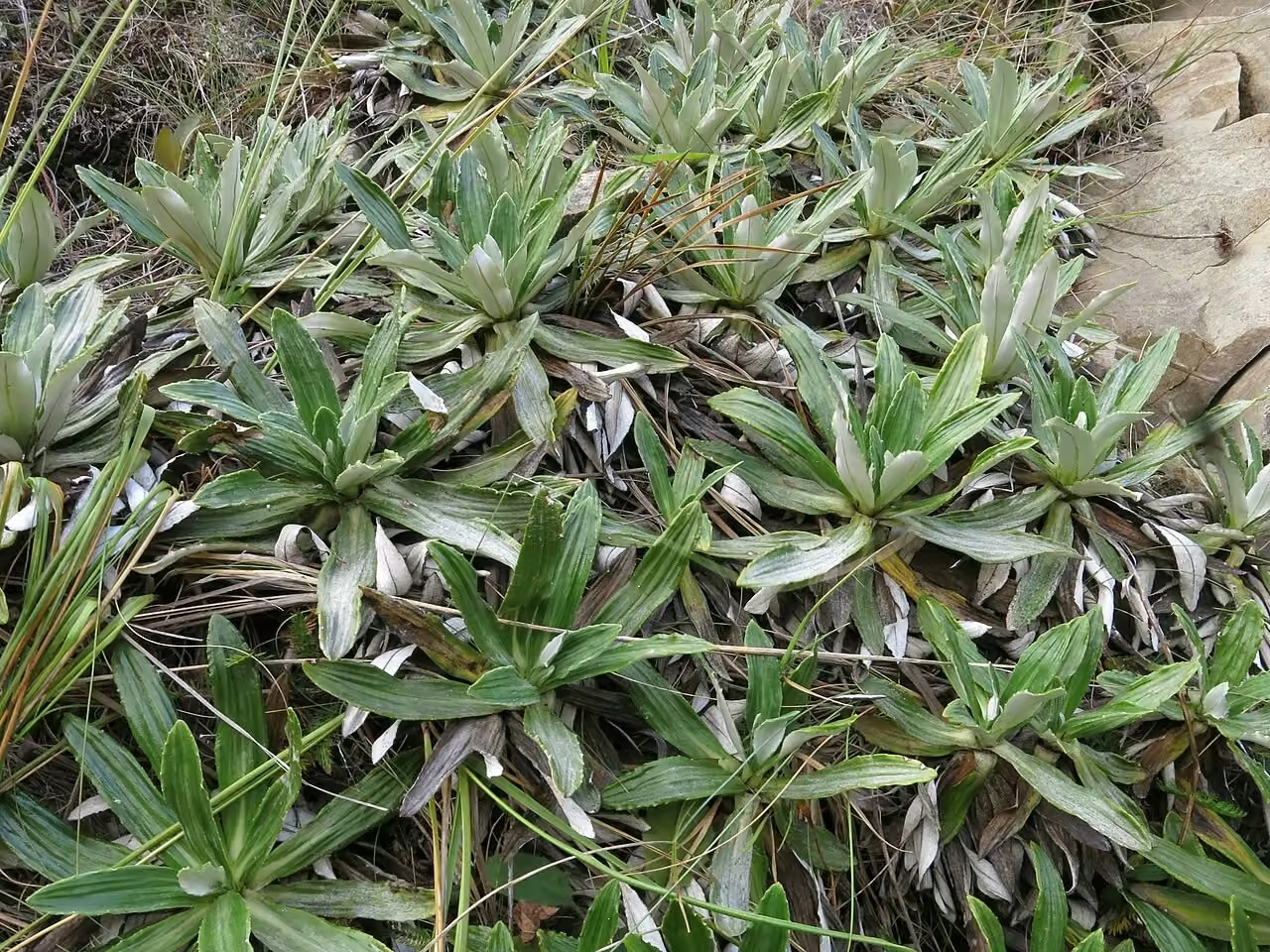
Celmisia dubia is a mountain daisy endemic to North-West Nelson and the northern West Coast of the South Island, from Boulder Lake and Gouland Downs south to Westport, including the Stockton and Denniston plateaux and the southern Paparoa Range. It forms patches of rosettes with leathery leaves usually about 8 cm long, coated above in a dull lead-coloured skin and felted beneath. Purple stems up to 25 cm tall carry single white daisies from October to February. It grows on thin, infertile soils in rock crevices, fellfield and sparse grassland, and dominates some water-saturated quartzite soils. It is ranked Not Threatened. Explore more native flowering plants in our native plant guide.
Plant Description
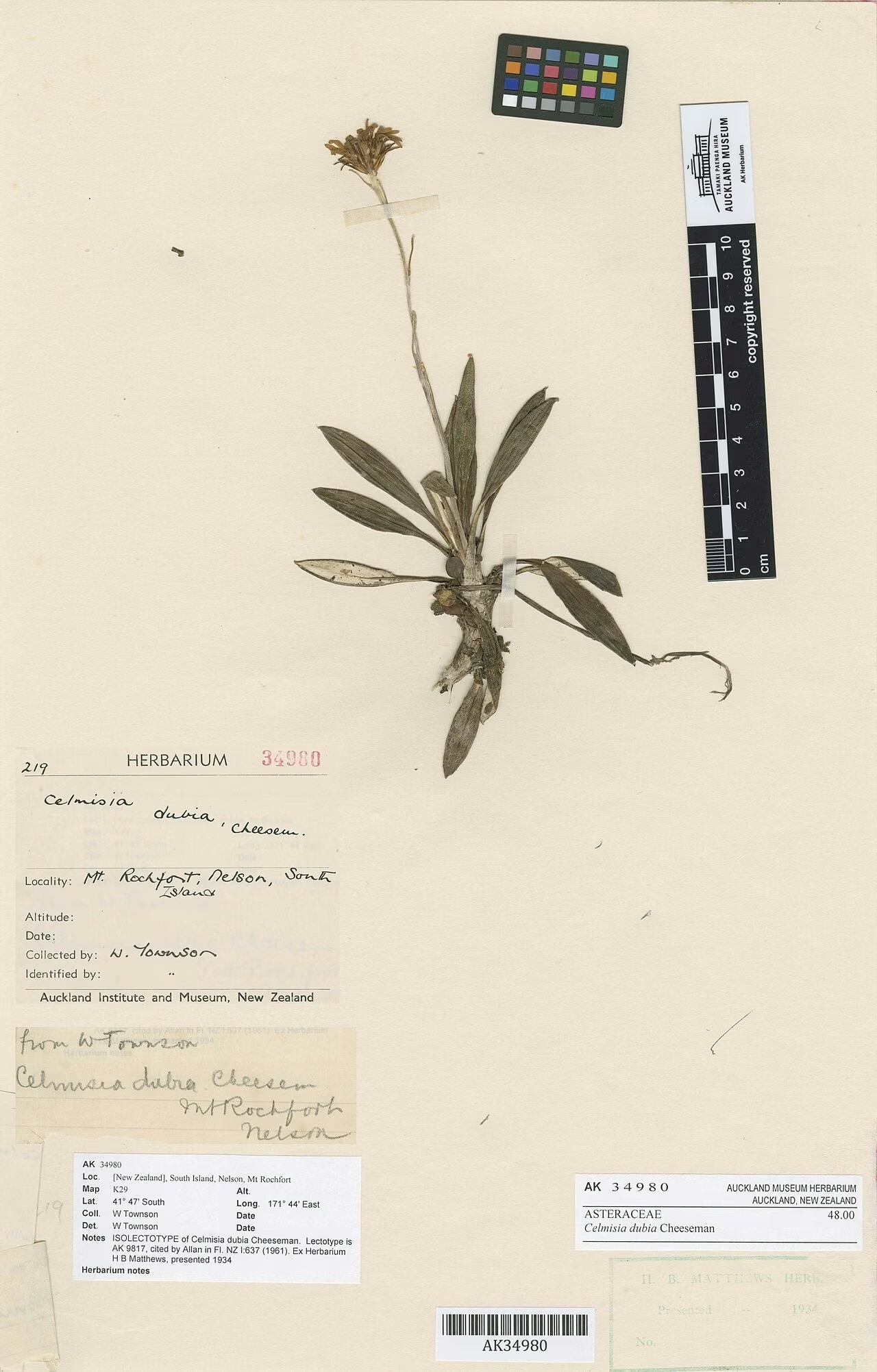
Celmisia dubia is a woody-based herb that forms irregular patches of rosettes from a simple or multi-headed stock. The leaves are somewhat leathery, usually about 8 cm long and 1.6 cm wide, but ranging from 2.3 to 15 cm long and 0.7 to 3 cm wide. The upper surface is usually grooved and covered with a dull, lead-coloured pellicle (a thin skin of fused hairs), while the underside is densely felted. The margins are entire or finely toothed, and there is a distinct leaf stalk up to 3 cm long.
The flowering stem is purple and up to 25 cm long, carrying a single head with 20 to 60 white ray florets and 20 to 80 yellow disc florets. The achenes are spindle-shaped to obovoid, 2.5 to 6 mm long. Flowering is from October to February and fruiting from November to April.
It is allied to Celmisia insignis, C. monroi, C. morganii and C. semicordata. It is distinguished by its flat leaves more than 20 mm wide, the dull leaden pellicle, a distinct petiole and a purple leaf sheath.
Quick Facts
| Scientific Name | Celmisia dubia |
|---|---|
| Height | Flowering stems up to 0.25 m |
| Spread | Forms irregular patches of rosettes; spread not documented |
| Water Needs | Permanently moist; tolerates wet ground |
| Light | Shade in lowland gardens; open sites in the wild |
| Frost Tolerance | High; montane to alpine |
| Salt Tolerance | Not documented |
| Growth Rate | Slow |
| Lifespan | Long-lived perennial |
Climate Best Suited to
Suits the very wet, cool and cloudy climate of the North-West Nelson uplands and the Buller plateaux, where rainfall is high throughout the year.
Regional Suitability
| City | Climate Suitability |
|---|---|
| Auckland | Low |
| Wellington | Low |
| Christchurch | Low |
| Dunedin | Medium |
Plant Habitat
Celmisia dubia is endemic to the South Island, in North-West Nelson from Boulder Lake through the Gouland Downs and south to Westport. Its range includes the Stockton and Denniston plateaux and the southern Paparoa Range.
It grows from the montane to the alpine zone on impoverished, skeletal soils in rock crevices, fellfield, thin infertile soils and sparse grassland. It is dominant in places on water-saturated soils over quartzite.
Growing Requirements
Soil Requirements
It is adapted to poor, acidic, often waterlogged soils. In cultivation NZPCN recommends a moist, free-draining acidic soil.
- Acidic, low-fertility gritty mix
- Constant moisture
- No added fertiliser or lime
Light Requirements
It is easily grown in a shaded site in cultivation, although wild plants grow in open, exposed fellfield and grassland.
- Light shade or cool aspect
- Shelter from hot sun in summer
Water Requirements
It grows on water-saturated ground in the wild and needs reliable moisture, but it dislikes humidity in cultivation.
- Never allow the root zone to dry
- Provide good airflow around the leaves
Planting and Establishing
Plant into a cool, shaded rock garden, peat bed or trough with an acidic gritty mix. Leave space for it to spread into a patch of rosettes over time.
It is not commercially available, so plants are usually raised from seed by specialist growers. Keep new plantings well watered through their first summer.
Ecological Role
Celmisia dubia can dominate the vegetation on wet quartzite soils, making it an important part of the low, open plant communities of the Buller coal plateaux and North-West Nelson uplands. Its insect pollinators are not documented in the sources consulted.
Its achenes are dispersed by wind, helping it colonise rock crevices and open ground in fellfield.
Uses & Significance
Garden Uses
A plant for alpine enthusiasts with a cool, moist, shaded site.
- Shaded peat or rock garden
- Alpine trough
- Collections of West Coast and Nelson mountain daisies
Ecological Value
It is a characteristic and sometimes dominant plant of infertile upland soils in the north-western South Island.
- Endemic to a limited region
- Dominant on some water-saturated quartzite soils
- Part of the distinctive Stockton and Denniston plateau flora
Landscaping Uses
The grey-leaden rosettes and purple stems give it a muted, unusual colouring that suits a stony, natural-looking planting.
Use it with small tussocks and cushion plants in a shaded scree or trough, letting it slowly form a patch.
Seasonal Care Calendar
Spring
Flowering begins in October, earlier than many mountain daisies.
- Keep evenly moist
- Protect new growth from slugs
Summer
Flowering continues into February and seed begins to ripen from November.
- Shade plants during hot spells
- Collect seed as heads ripen
Autumn
Fruiting continues until April.
- Sow fresh seed
- Remove spent stems
Winter
Rosettes remain evergreen and tolerate frost and snow.
- Keep drainage clear
- Remove decaying leaves
When to Prune and How Much
No pruning is needed beyond removing spent flowering stems and dead leaves.
Clear debris from between rosettes to reduce the chance of rot in damp weather.
How to Grow Mountain Daisy
NZPCN reports that Celmisia dubia is easily grown and is best raised from fresh seed, sown immediately or stratified for 1 to 3 months. Its long flowering season means seed may be available from November through to April. Because it forms patches of rosettes from a multi-headed stock, established plants can also be divided, a standard technique for patch-forming Celmisia, although the sources consulted do not specifically describe division of this species. Young plants need an acidic, moist, free-draining mix and a cool, shaded, airy position. Avoid humid, still conditions under glass, which encourage damping off and rot. Label seed with its collection site, because this species is restricted to a small region and local provenance matters if plants are ever used in restoration plantings on the Buller plateaux.
From Seed
Gather heads when the pappus has fluffed and the achenes are brown. Fresh seed gives the best germination.
- Collect seed from November to April
- Sow on the surface of an acidic, gritty mix
- Keep the tray cool, shaded and moist
- Stratify in a fridge for 1 to 3 months if sowing is delayed
- Pot on seedlings once they have several leaves
By Division
Rosettes with their own roots can be separated from a patch in cool weather.
- Lift or expose the edge of a patch in autumn or spring
- Detach rooted rosettes with a sharp knife
- Pot into gritty acidic mix and keep moist and shaded
Pests & Diseases
No pests specific to Celmisia dubia are recorded. Slugs may graze seedlings and soft growth.
Rot in humid, warm or poorly drained conditions is the main risk in cultivation.
Cultural Significance
No traditional Māori name or use specific to Celmisia dubia is recorded in the sources consulted.
Thomas Cheeseman described the species in 1906, and he later treated it as Celmisia coriacea var. lancifolia. David Given's 1980 revision of the Celmisia coriacea complex recognised it again as a separate species.
Bonus Tip
Unlike many mountain daisies that rot in wet soil, Celmisia dubia naturally dominates waterlogged quartzite ground. In a garden it is worth trying in a constantly damp, acidic, shaded spot such as the edge of a peat bed, provided the air around the leaves stays fresh.
Related Plants
Explore other native plants that share similar characteristics or habitats with Mountain Daisy (Celmisia dubia), offering further insights into New Zealand's diverse flora. These related species provide context and opportunities for complementary planting in your garden.
Common Shrub Mountain Daisy
Celmisia brevifolia
Celmisia clavata
Celmisia clavata
Dall's Mountain Daisy
Celmisia dallii
Celmisia densiflora
Celmisia densiflora
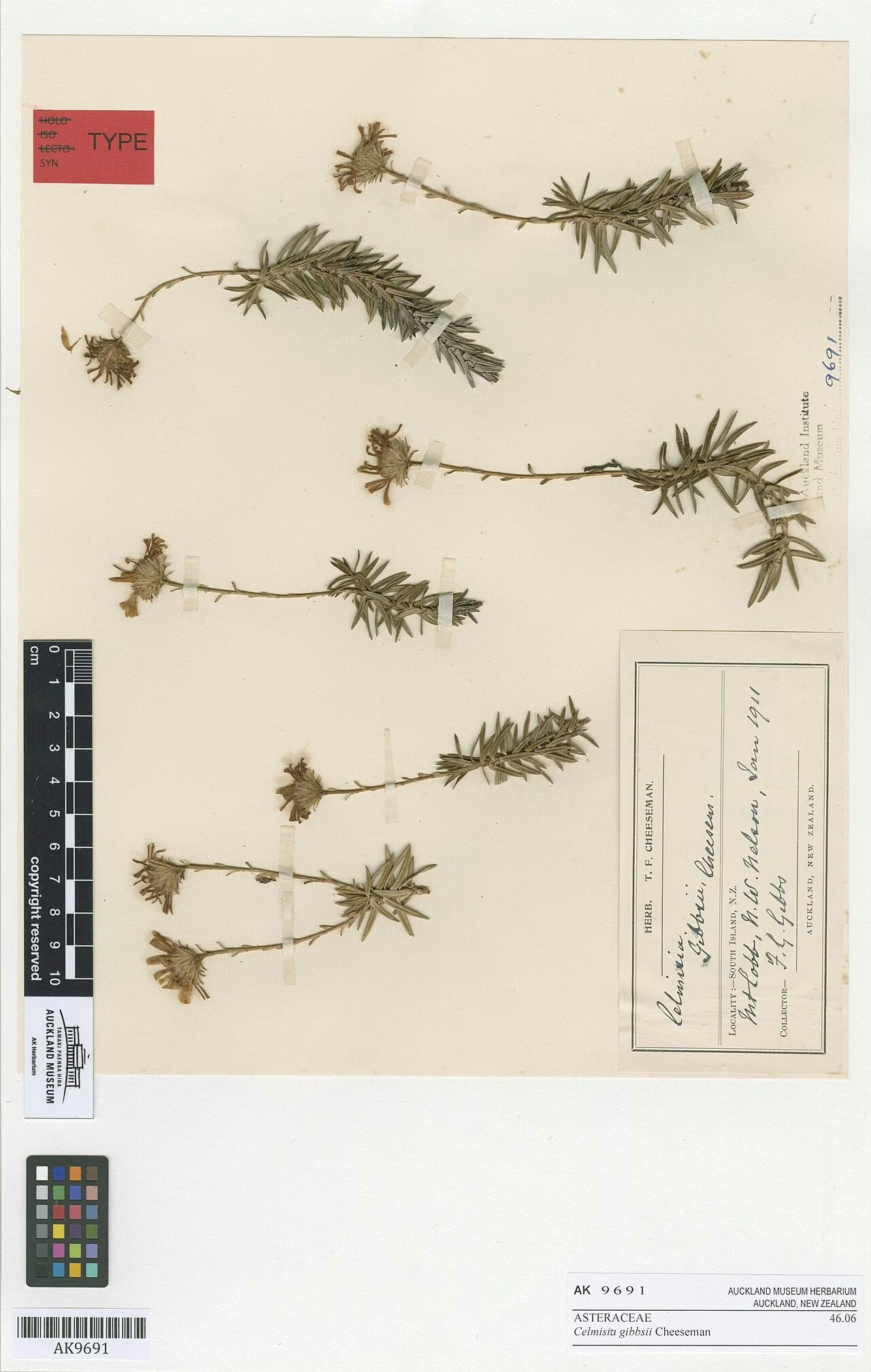
Gibbs's Mountain Daisy
Celmisia gibbsii
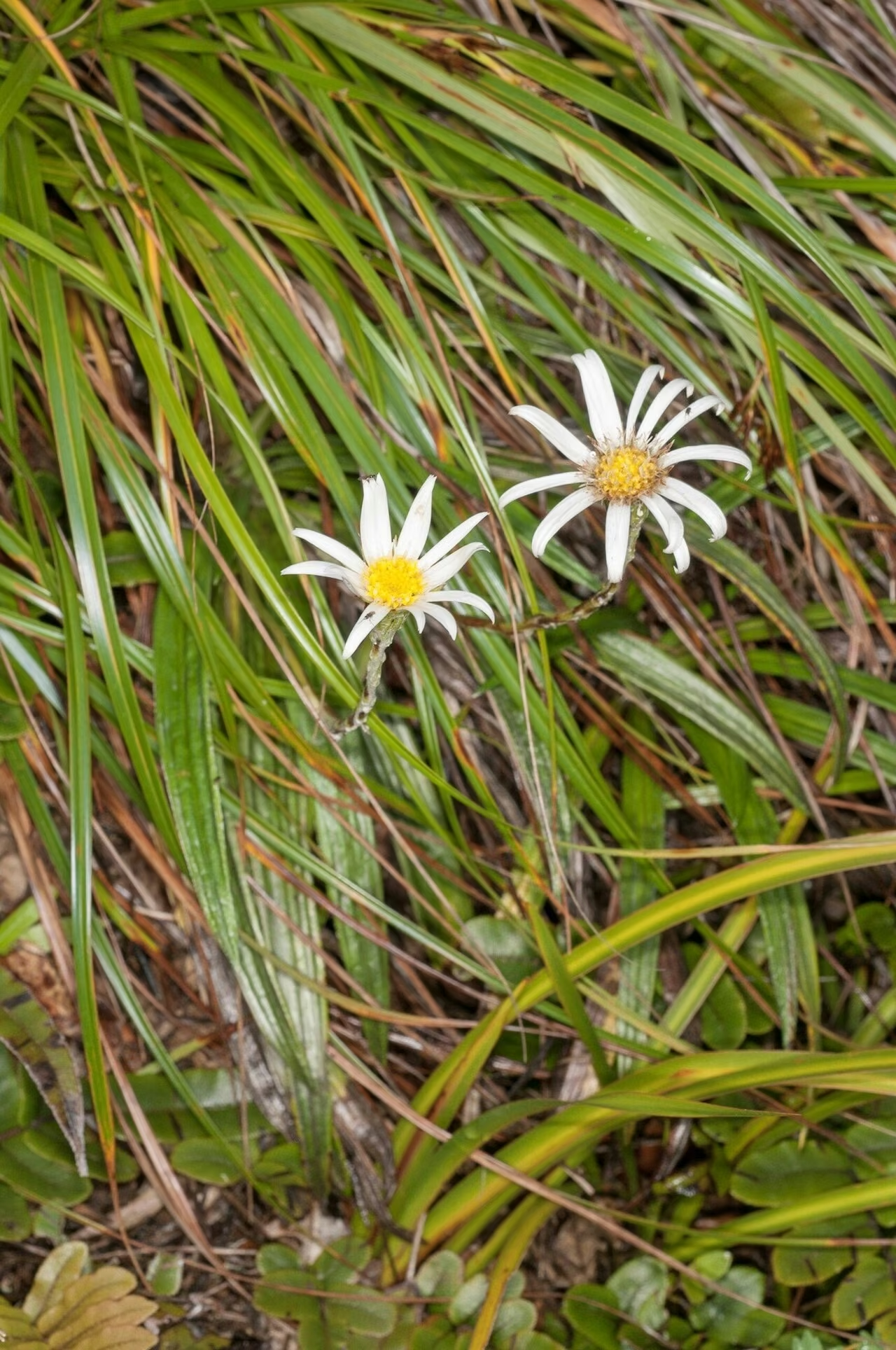
Celmisia graminifolia
Celmisia graminifolia
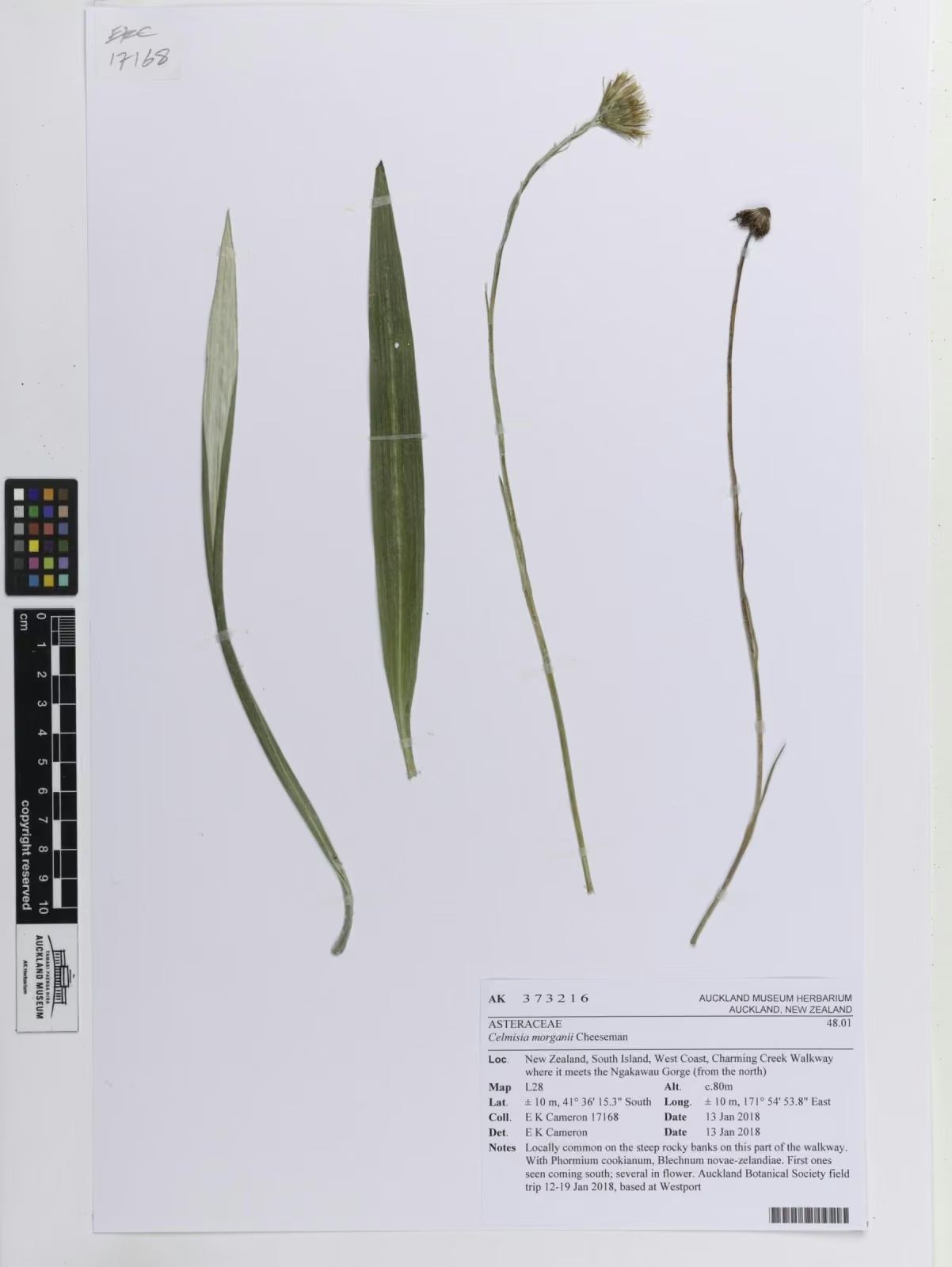
Ngakawau Gorge Daisy
Celmisia morganii
Celmisia parva
Celmisia parva
Plant Conservation
Celmisia dubia is ranked Not Threatened (2023) with the qualifiers DPS (data poor, size) and DPT (data poor, trend), meaning its population size and trend are not well known.
Part of its range is on the Stockton and Denniston plateaux, where opencast coal mining has altered native vegetation. Retaining and restoring plateau vegetation helps secure this and other local endemics.
Frequently Asked Questions
Where does Celmisia dubia grow?
It is endemic to North-West Nelson and the northern West Coast, from Boulder Lake through Gouland Downs south to Westport, including Stockton, Denniston and the southern Paparoa Range.
How do you identify Celmisia dubia?
Look for flat leaves over 20 mm wide with a dull leaden skin on the upper surface, a distinct leaf stalk, a purple leaf sheath and a purple flowering stem.
What soils does Celmisia dubia grow on?
It grows on impoverished, skeletal soils in rock crevices, fellfield and sparse grassland, and is dominant on water-saturated quartzite soils such as those on the Buller coal plateaux.
Why is it called dubia?
Dubia means doubtful in Latin, but the sources consulted do not record why Cheeseman chose this name when he described the species in 1906.
Sources and Further Reading
The botanical, growing, and conservation details for Mountain Daisy (Celmisia dubia) on this page draw on the New Zealand plant references below. Consult them for full technical records and the latest distribution data.