Dwarf Broom
Carmichaelia uniflora
Last updated:
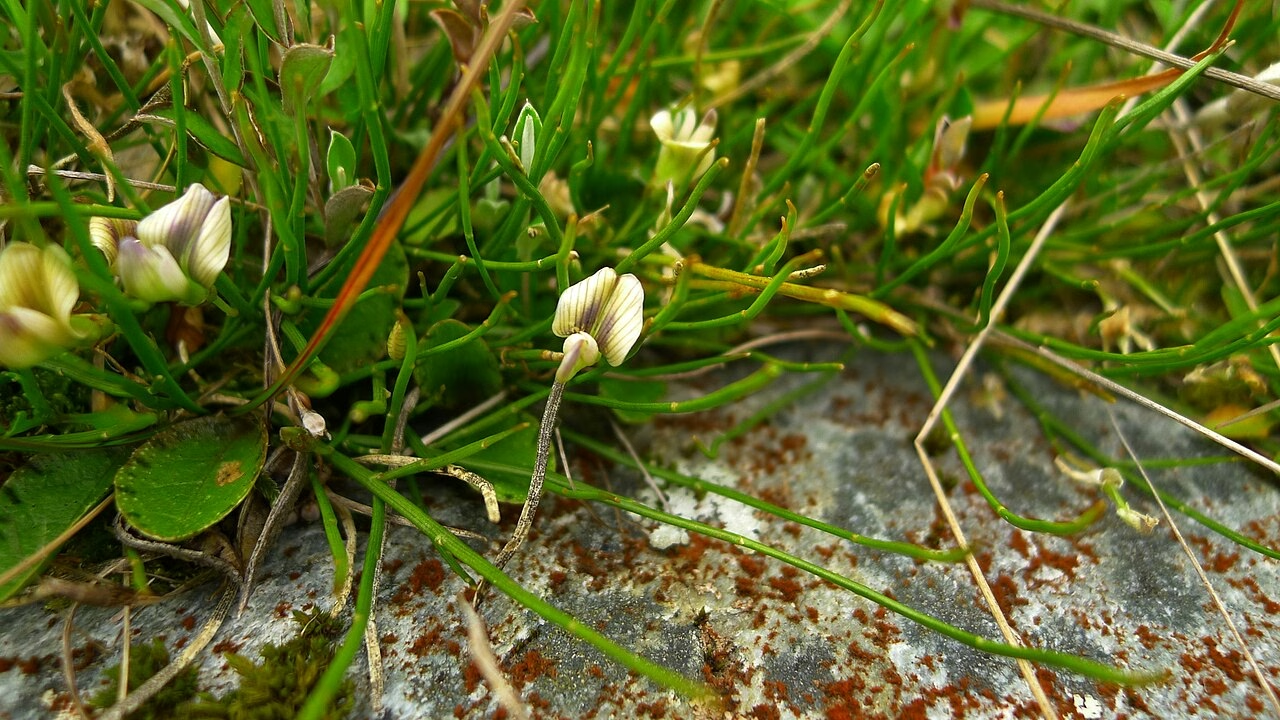
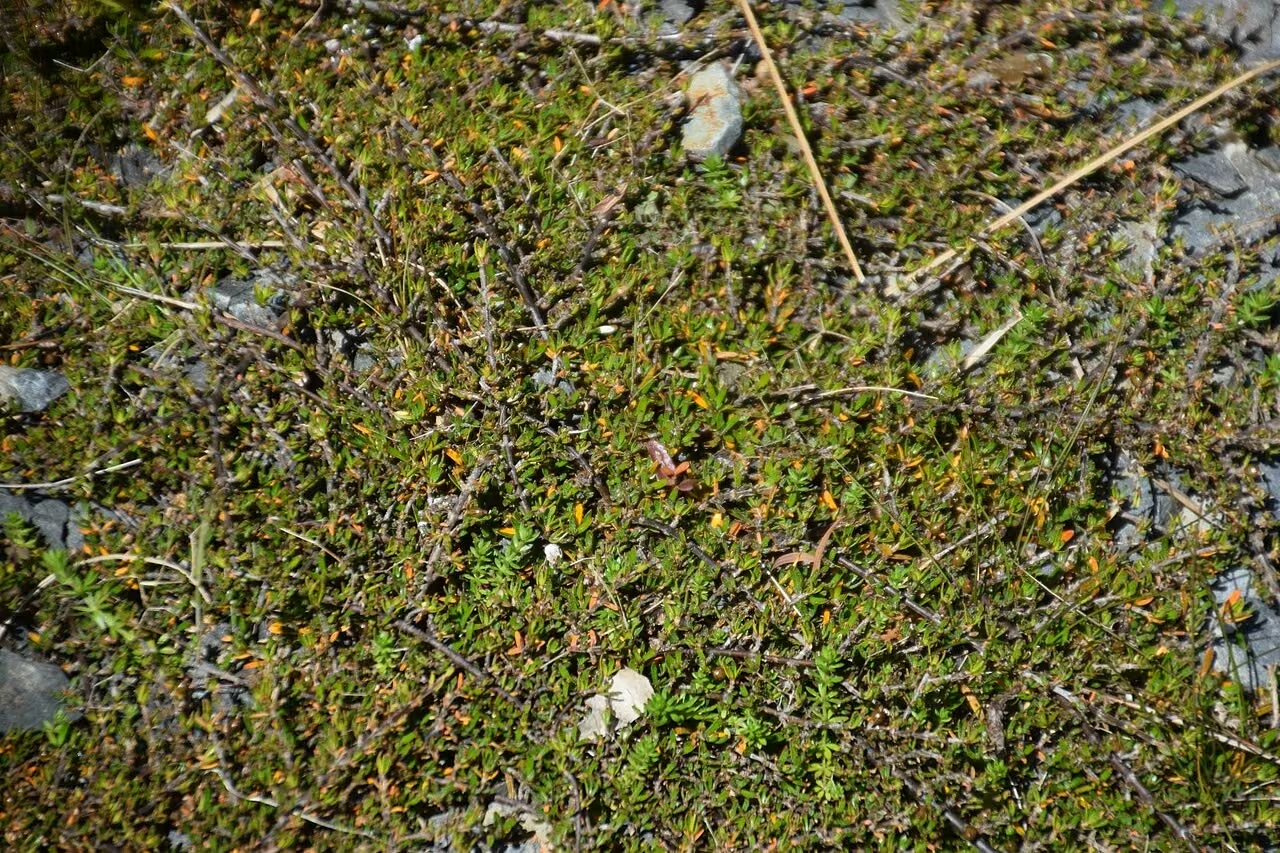
Dwarf broom (Carmichaelia uniflora) is one of the smallest native brooms, a rhizomatous shrub that forms dense mats or tufts only 20 to 60 mm tall but up to 1 m wide. Its thread-like green branchlets carry small pea flowers with purple stripes, usually borne singly, which gives the species its name. It is endemic to the South Island, from Nelson to Southland, where it grows on stable but sparsely vegetated riverbed gravels, outwash fans, terraces and stony ground. It is ranked At Risk - Declining because browsing animals and invading pasture grasses are reducing its populations. Explore more native ground covers in our native plant guide.
Plant Description
Carmichaelia uniflora is a dwarf, rhizomatous shrub that forms a dense mat or tufts of branchlets. The rhizomes become stout and woody with age, reaching 50 to 200 mm long. The branchlets (cladodes) are thread-like, flattened and grooved, green to green-yellow, hairless and 20 to 40 mm long, occasionally to 60 mm, and only 0.75 to 2 mm wide, with yellowish tips.
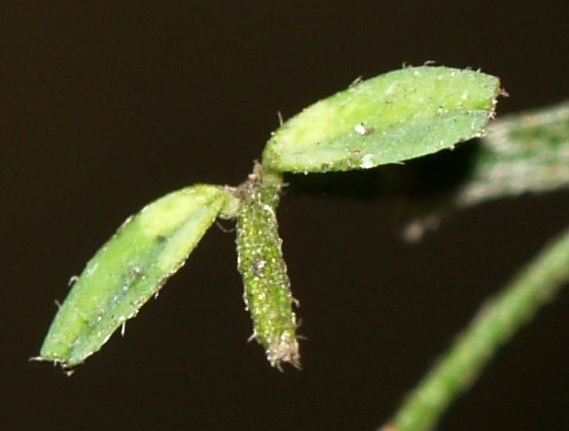
The pea-like flowers have purple stripes and are typically solitary. The pod is elliptic-oblong, flattened, slightly curved, black, brown or grey, 7.5 to 13 mm long, with a stout, sharp beak 1.5 to 2 mm long. One valve splits open from the base to release four to six seeds, sometimes as few as two or as many as nine. The seeds are small, kidney-shaped and black, brown, tan or olive green.
It is most likely to be confused with Carmichaelia corrugata. Carmichaelia uniflora has narrower rhizomes, pods that split open strongly, narrower thread-like branchlets and inflorescences that usually carry a single flower.
Quick Facts
| Scientific Name | Carmichaelia uniflora |
|---|---|
| Height | 0.02-0.06 m |
| Spread | Up to 1 m |
| Water Needs | Low to moderate; free-draining gravels |
| Light | Full sun |
| Frost Tolerance | High; grows on cold inland riverbeds and terraces |
| Salt Tolerance | No information available |
| Growth Rate | Slow |
| Lifespan | Perennial |
Climate Best Suited to
Suits the cold-winter, dry-summer climates of inland South Island riverbeds and terraces, where it tolerates hard frosts and drought on open gravels.
Regional Suitability
| City | Climate Suitability |
|---|---|
| Auckland | Low |
| Wellington | Low |
| Christchurch | Medium |
| Dunedin | Medium |
Plant Habitat
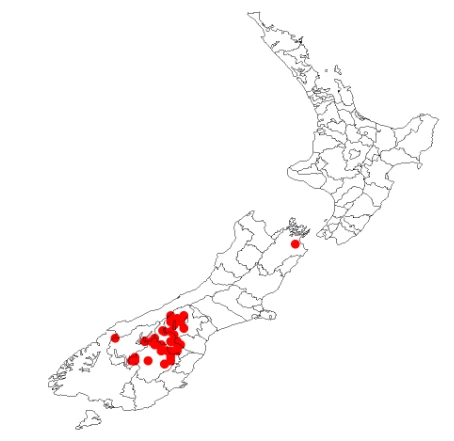
Dwarf broom is endemic to the South Island, recorded from Nelson, Canterbury, Otago and Southland.
It inhabits stable but unconsolidated, sparsely vegetated riverbed gravels, outwash fans, terraces and stony ground. These open, low-fertility sites have little competition from taller plants, which allows such a tiny shrub to persist. Where pasture grasses or weeds invade these gravels, it is quickly overwhelmed.
Growing Requirements
Soil Requirements
It grows on loose, stony gravels with little soil development, and like other legumes it can fix nitrogen.
- Gravelly, very free-draining soil
- Low fertility to limit competing grasses
- Room for rhizomes to spread through loose gravel
Light Requirements
Its sparsely vegetated habitats are fully open, and it cannot tolerate being shaded by grasses or taller plants.
- Full sun
- Keep surrounding vegetation low
Water Requirements
Riverbed gravels drain quickly, and the plant is adapted to dry surface conditions with deeper moisture below.
- Water occasionally during establishment
- Avoid wet, poorly drained soils
Planting and Establishing
Grow dwarf broom in a scree garden, gravel bed or alpine trough where it can spread through loose stones without competition. A deep, gritty mix allows the rhizomes to run.
In restoration of braided river terraces within its range, plant into bare gravel patches and keep pasture grasses and weeds controlled around the plants. Protection from rabbits and hares is also worthwhile.
Ecological Role
Flowering takes place from October to March, with fruit from November to May. The pods split open on one side to release their seeds, and the sharp beak on each pod is a distinctive feature.
As a nitrogen-fixing plant of open braided riverbeds and terraces, it is part of a specialised gravel flora that depends on low competition. Invasion of these habitats by pasture grasses and other weeds reduces the open ground it needs.
Uses & Significance
Garden Uses
It is a curiosity for alpine and scree gardeners, valued as one of the tiniest woody plants in the native flora.
- Scree gardens and gravel beds
- Alpine troughs
- Restoration of riverbed and terrace gravels within its range
Ecological Value
It contributes to the distinctive plant communities of South Island braided rivers and outwash surfaces.
- Fixes nitrogen in poor gravel soils
- Flowers provide food for small insects
- Part of a threatened riverbed and terrace flora
Landscaping Uses
Its very low, mat-forming habit makes it suitable for knitting between stones in a dry garden, where the thread-like green branchlets create a fine texture.
Combine it with other small dryland natives such as low Raoulia mats and small tussocks, giving each plant enough open gravel that nothing smothers it.
Seasonal Care Calendar
Spring
Flowering begins in October, with single purple-striped flowers among the branchlets.
- Weed around mats carefully
- Plant out young plants
Summer
Flowering continues, and pods start forming from November.
- Water new plants occasionally in drought
- Check for invading grasses
Autumn
Flowering ends in March and pods ripen through to May.
- Collect ripe pods before they split
- Take hardwood cuttings
Winter
The mats sit through cold frosts on open gravels with little growth.
- Keep drainage free
- Minimal care needed
When to Prune and How Much
No pruning is needed. The mat stays naturally low.
Remove any grass or weed seedlings that grow up through the mat, since competition is a key threat.
How to Grow Dwarf Broom
NZPCN records that Carmichaelia uniflora is easily grown from seed and hardwood cuttings. As an At Risk - Declining species, propagation for restoration should use locally sourced material collected with permission, and cultivated plants are the best source for home gardeners. The pods split open readily, so they need to be gathered just as they ripen. Its rhizomatous habit also means that established cultivated mats produce new shoots at a distance from the parent, and rooted pieces can sometimes be separated, though seed and cuttings are the documented methods.
From Seed
Each pod contains about four to six small, hard seeds. Pods split from the base on one side, so watch them closely as they ripen between November and May.
- Collect pods as they turn brown or black, before they split
- Nick or hot-water soak the hard seeds to aid germination
- Sow in a gritty seed mix and cover lightly
- Keep moist in a bright, airy position
- Transplant seedlings carefully into deep pots to allow root development
From Cuttings
Hardwood cuttings of the thin branchlets are small and delicate, so use a fine, gritty medium. Take more cuttings than you need, as some losses are likely with such slender material.
- Take short cuttings of firm, mature branchlets in late autumn or winter
- Insert in a mix of fine pumice and sand
- Keep lightly moist in a sheltered, bright place
- Pot on once roots have formed
Pests & Diseases
Browsing animals, including rabbits and hares, damage wild plants, and in cultivation small plants can disappear quickly if browsed.
Weeds, particularly pasture grasses, are the most serious competitive threat in the wild. No specific insect pests or diseases are recorded in the sources consulted.
Cultural Significance
No Māori name or traditional Māori use specific to Carmichaelia uniflora was found in the sources consulted.
Thomas Kirk described the species. The epithet uniflora is Latin for single-flowered, referring to its typically solitary flowers, and the genus honours the Scottish botanist Dugald Carmichael.
Bonus Tip
Look for this tiny broom on stable gravel terraces beside braided rivers rather than in the active channel. It is easily overlooked, so search for low green tufts of thread-like branchlets among the stones, especially in late spring when the purple-striped flowers appear.
Related Plants
Explore other native plants that share similar characteristics or habitats with Dwarf Broom (Carmichaelia uniflora), offering further insights into New Zealand's diverse flora. These related species provide context and opportunities for complementary planting in your garden.
Plant Conservation
Carmichaelia uniflora is ranked At Risk - Declining (2023) with the qualifiers Data Poor: Size, Data Poor: Trend and Recruitment Failure. Browsing animals and weed competition, especially from pasture grasses, are the main threats identified by NZPCN.
Weed control on river terraces and outwash surfaces, management of browsing animals and protecting gravel habitats from conversion to pasture are the main actions that help.
Frequently Asked Questions
How big does Carmichaelia uniflora grow?
It forms dense mats or tufts usually 20 to 40 mm tall, occasionally to 60 mm, spreading by underground rhizomes to about 1 m across.
Why is it called uniflora?
Uniflora means single-flowered. Its purple-striped pea flowers are usually borne one at a time rather than in clusters, which helps separate it from related dwarf brooms.
Where does dwarf broom grow?
It grows in the South Island in Nelson, Canterbury, Otago and Southland, on stable but loose, sparsely vegetated riverbed gravels, outwash fans, terraces and stony ground.
What threatens Carmichaelia uniflora?
NZPCN lists browsing animals and competition from weeds, particularly pasture grasses, as the main threats. It is ranked At Risk - Declining.
Sources and Further Reading
The botanical, growing, and conservation details for Dwarf Broom (Carmichaelia uniflora) on this page draw on the New Zealand plant references below. Consult them for full technical records and the latest distribution data.