South Island Broom
Carmichaelia arborea
Last updated:
South Island broom (Carmichaelia arborea), also called tree broom or swamp broom, is an endemic native broom that grows into a shrub up to 2 m tall and wide. Like other New Zealand brooms it photosynthesises mainly through flattened green branchlets, carrying only small leaves of one to five leaflets. In summer it bears clusters of small white pea flowers, sometimes with a purplish centre. It grows mostly west of the Main Divide in the South Island, on moraine, river terraces, forest margins and subalpine scrub, and is uncommon east of the Divide. It is ranked Not Threatened nationally. Explore more native shrubs in our native plant guide.
Plant Description
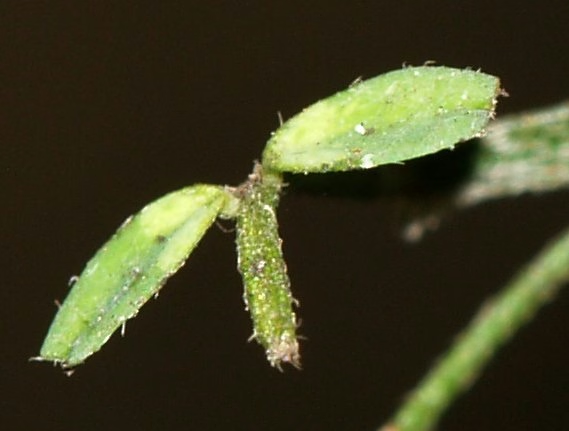
Carmichaelia arborea is a shrub up to 2 m tall and 2 m wide. It sometimes suckers to form broad patches up to 1 m tall. Its branches are stout, ascending and spreading, up to 80 mm in diameter at the base. The flattened green branchlets (cladodes) are 70 to 150 mm long and 1.5 to 3 mm wide, grooved, oval in cross-section, green to dark green, sometimes hairy when young and hairless when mature, usually held erect to spreading and sometimes drooping.
Small leaves with one to three, occasionally five, fleshy leaflets are scattered along the branches. The pea-like flowers are carried in racemes of five to ten, clustered on the upper third of the raceme. They are predominantly white, sometimes with a pale central blotch and faintly red-purple veins. The fruit is a small dry pod 7 to 15 mm long and 2.7 to 4.5 mm wide containing one to three flattened seeds.
Carmichaelia odorata is the most similar species. It has a longer flower stalk and rachis, more numerous and smaller flowers with keels of only 3.5 to 4 mm, and smaller pods. Carmichaelia arborea's flowers have keels of 5 to 6 mm.
Quick Facts
| Scientific Name | Carmichaelia arborea |
|---|---|
| Height | Up to 2 m; suckering forms to 1 m |
| Spread | Up to 2 m |
| Water Needs | Moderate to high; suits the wet western South Island |
| Light | Full sun to light shade |
| Frost Tolerance | Good; grows to montane and subalpine altitudes |
| Salt Tolerance | No information available |
| Growth Rate | Moderate |
| Lifespan | Perennial shrub |
Climate Best Suited to
Suits cool, high-rainfall climates such as Westland and the wetter South Island mountains, where it tolerates frost and snow. It is less suited to dry eastern climates.
Regional Suitability
| City | Climate Suitability |
|---|---|
| Auckland | Low |
| Wellington | Medium |
| Christchurch | Medium |
| Dunedin | High |
Plant Habitat
South Island broom is endemic to the South Island. It is found west of the Main Divide in Westland, Canterbury, Otago and Southland, and is uncommon to the east of the Main Divide in Canterbury.
It ranges from lowland to montane altitudes, growing on glacial moraine, river terraces, in subalpine scrub, on rock outcrops and cliffs, along forest margins and on recently disturbed ground. Its ability to colonise moraine and disturbed sites makes it an early coloniser in the wet western South Island.
Growing Requirements
Soil Requirements
In the wild it grows on young, often stony soils such as moraine, river terrace gravels and recently disturbed ground. Like other legumes, Carmichaelia can fix nitrogen, which helps it establish on raw ground.
- Free-draining, stony or gravelly soils
- Tolerates low fertility
- Avoid compacted, permanently waterlogged clay
Light Requirements
It grows in open, disturbed sites and along forest margins, so it does best with plenty of light.
- Full sun for the densest growth and best flowering
- Tolerates light shade at forest edges
Water Requirements
Its home range west of the Main Divide is very wet, so it is adapted to high rainfall, while its preference for gravelly sites means it is not normally waterlogged.
- Keep young plants watered through dry spells
- Established plants in wetter districts need little watering
Planting and Establishing
Plant South Island broom in autumn or spring in a sunny, well-drained position. Dig a hole larger than the root ball, plant at the same depth it grew in the pot and water in well.
It is a good choice for revegetating gravelly or disturbed ground in the western and southern South Island. Protect young plants from rabbits and hares, which browse broom stems.
Ecological Role
Carmichaelia arborea flowers from December to March, and its small pea flowers are visited by insects. NZPCN notes that its seeds are possibly dispersed by wind and granivory, though the details are not well studied.
As a nitrogen-fixing legume that colonises moraine, river terraces and disturbed ground, it plays a role in early succession, helping build soil fertility before forest returns. It forms part of the scrub along forest margins and in the subalpine zone.
Uses & Significance
Garden Uses
It makes an unusual architectural shrub with a fine-textured, broom-like outline, and is useful for restoration in its natural range.
- Revegetation of gravel, moraine and disturbed sites
- Native shrub borders in cool, wet gardens
- Contrast plant among broad-leaved shrubs
Ecological Value
It is an early coloniser of raw ground and contributes nitrogen to developing soils.
- Nitrogen fixation improves soil for later species
- Flowers provide nectar and pollen for insects
- Stabilises gravelly terraces and moraine
Landscaping Uses
The green, grooved, upright branches give a soft, wispy outline that contrasts well with large-leaved shrubs and flaxes. In summer the white flower clusters add a fine haze of colour along the stems.
Use it singly as a feature in a native garden or in groups to cover a gravel bank. Its suckering habit in some forms can help knit together loose slopes.
Seasonal Care Calendar
Spring
New branchlet growth begins, and young stems may be slightly hairy.
- Plant out new specimens
- Protect fresh growth from rabbits and hares
Summer
Flowering runs from December to March, with clusters of small white pea flowers.
- Water young plants in dry spells
- Watch for pollinating insects
Autumn
Pods ripen, and fruit can be found on the plant at almost any time of year.
- Collect ripe pods for seed
- Take hardwood cuttings later in the season
Winter
The green stems remain photosynthetic through the cold months, tolerating frost and snow in its mountain range.
- Take hardwood cuttings
- Little maintenance needed
When to Prune and How Much
Little pruning is needed. Light trimming after flowering can keep the shrub compact, but avoid cutting hard into old wood, which is slow to reshoot.
Remove any dead or broken branches in late winter.
How to Grow South Island Broom
NZPCN records that South Island broom is easily grown from seed and from hardwood cuttings. Seed is the usual method for restoration projects because it maintains genetic diversity and lets growers source plants from the local district. Like many legumes, Carmichaelia seed has a hard coat, so germination is faster and more even if the coat is nicked or softened before sowing. Hardwood cuttings are useful for reproducing a particular plant, such as a compact form. Pods can be found on the plant across much of the year, so seed is relatively easy to collect.
From Seed
Collect dry pods when they have darkened and the seeds inside are hard. Each pod holds one to three flattened seeds.
- Gather ripe pods and extract the seeds
- Nick the seed coat gently or soak the seed in hot water and leave it overnight
- Sow into a free-draining seed mix and cover lightly
- Keep moist in a bright, sheltered spot
- Pot seedlings individually once they have several shoots
From Cuttings
Hardwood cuttings of firm, mature branchlets taken in late autumn or winter are the recommended vegetative method for this species, and are slow but dependable.
- Cut 10 to 15 cm lengths of firm, mature green branchlets
- Insert them into a free-draining mix of bark and pumice or sand
- Keep in a sheltered, bright place and do not let the mix dry out
- Pot on when roots appear, usually after several months
Pests & Diseases
Rabbits, hares and other browsing animals eat the green stems of native brooms, particularly young plants, so guards are worthwhile when planting.
No specific insect pests or diseases are recorded for this species in the sources consulted. Root rot can occur in poorly drained soils.
Cultural Significance
No Māori name or traditional Māori use specific to Carmichaelia arborea was found in the sources consulted.
The species was first described by Georg Forster, naturalist on Cook's second voyage, and later transferred to Carmichaelia by George Claridge Druce. The genus honours Captain Dugald Carmichael, a Scottish army officer and botanist, and arborea means tree-like, referring to its relatively large size among the native brooms.
Bonus Tip
When planting South Island broom for restoration, source seed from plants in the same catchment. Its natural range is concentrated west of the Main Divide, and local seed gives plants best adapted to the rainfall and soils of the planting site.
Related Plants
Explore other native plants that share similar characteristics or habitats with South Island Broom (Carmichaelia arborea), offering further insights into New Zealand's diverse flora. These related species provide context and opportunities for complementary planting in your garden.
Plant Conservation
Carmichaelia arborea is ranked Not Threatened (2023) and has held that ranking in every national assessment since 2004. In Otago, however, it is listed as Regionally At Risk - Regionally Declining (2025).
Browsing by introduced mammals and weed invasion of disturbed habitats are pressures on native brooms generally. Planting it in restoration projects within its natural range and controlling browsers help maintain regional populations.
Frequently Asked Questions
Where does South Island broom grow?
It grows in the South Island, mainly west of the Main Divide in Westland, Canterbury, Otago and Southland, from lowland to montane altitudes, and is uncommon east of the Divide in Canterbury.
Does Carmichaelia arborea have leaves?
Adult plants carry small leaves of one to five leaflets on the branches, but most photosynthesis is done by the flattened green branchlets, called cladodes, which give the plant its leafless look.
How do you tell Carmichaelia arborea from Carmichaelia odorata?
NZPCN notes that C. arborea has a shorter flower stalk and rachis, fewer but larger mostly white flowers with longer keels of 5 to 6 mm, and larger pods than C. odorata.
Is South Island broom easy to grow?
Yes. NZPCN describes it as easily grown from seed and hardwood cuttings, and it naturally colonises disturbed ground, moraine and river terraces.
Sources and Further Reading
The botanical, growing, and conservation details for South Island Broom (Carmichaelia arborea) on this page draw on the New Zealand plant references below. Consult them for full technical records and the latest distribution data.