Cromwell Broom
Carmichaelia compacta
Last updated:
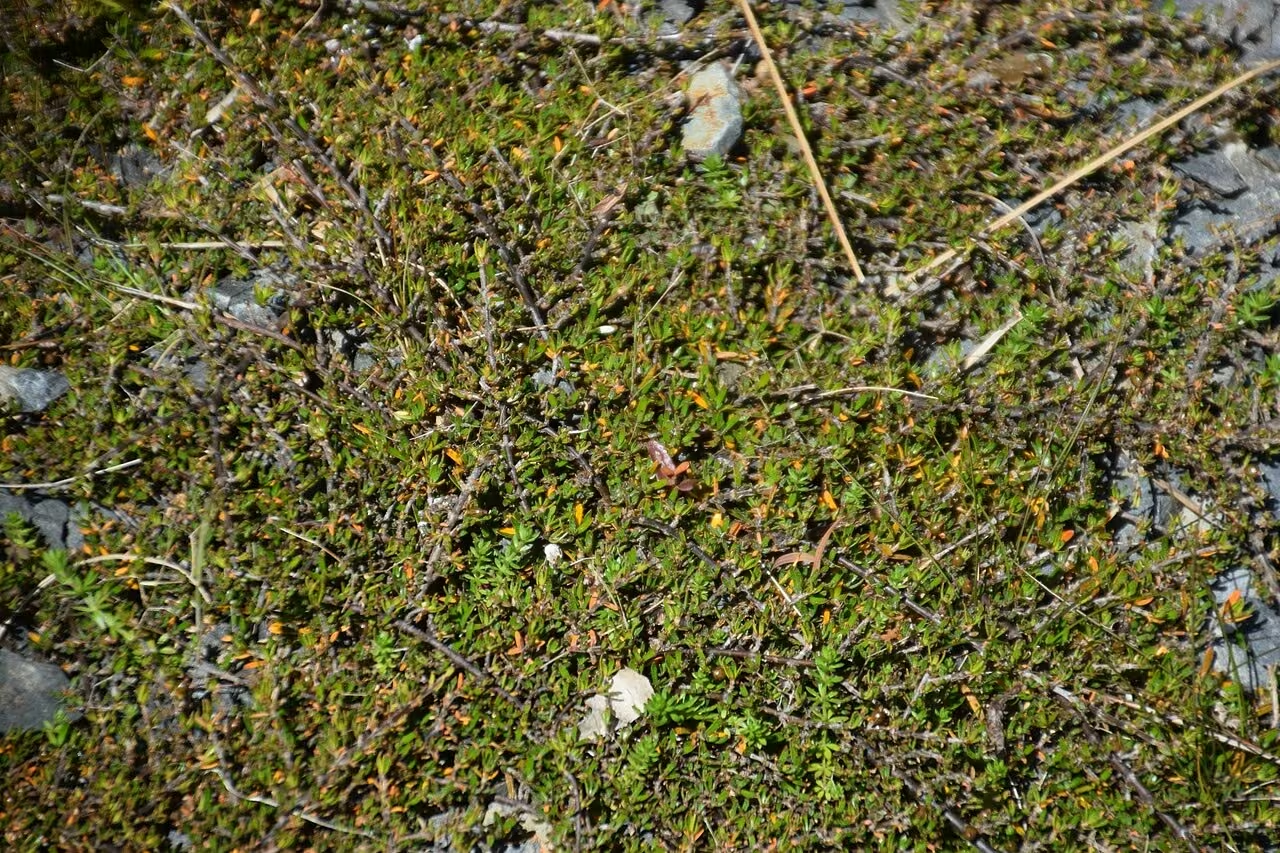
Cromwell broom (Carmichaelia compacta) is a small, yellow-green native broom endemic to Central Otago. It forms an erect or spreading shrub with densely packed, leafless-looking twigs, growing up to about 1 to 2 m tall and wide, and carries clusters of small pink to purple pea flowers in late spring and summer. It is a schist specialist, colonising rock and debris slopes, outcrops and steep tussock grassland in the Kawarau and Cromwell Gorges and nearby around Alexandra and Omakau. It is ranked At Risk - Naturally Uncommon because of its narrow range, and browsing animals appear to be preventing young plants from establishing. Explore more native shrubs in our native plant guide.
Plant Description
Carmichaelia compacta is an erect or spreading shrub with densely placed, yellow-green branches. Its twigs (cladodes) are grooved and oval in cross-section, and for most of the year the plant appears leafless. Leaves are rare, appearing sometimes on shaded parts of the plant, and have one to nine leaflets.
The small pea-like flowers are carried in erect clusters. NZPCN describes them as pink with slightly darker stripes, and the Flora records the upper surface of the standard petal as purple, about 3 to 4 mm long. The fruit is a small, dry, flattened pod, broadest towards the tip, containing one or two hard seeds.
It differs from Carmichaelia curta and Carmichaelia juncea by its more upright shrubby habit, its green, densely placed cladodes, its large obovate pods, larger seeds, and stamens whose lower filaments are joined for about half their length.
Quick Facts
| Scientific Name | Carmichaelia compacta |
|---|---|
| Height | Up to about 1-2 m |
| Spread | Up to about 1-2 m |
| Water Needs | Low; adapted to the dry Central Otago climate |
| Light | Full sun |
| Frost Tolerance | High; tolerates hard Central Otago frosts |
| Salt Tolerance | No information available; an inland species |
| Growth Rate | Slow to moderate |
| Lifespan | Perennial shrub |
Climate Best Suited to
Suits the semi-arid, continental climate of Central Otago, with hot dry summers, very cold frosty winters and low humidity. It dislikes humid climates.
Regional Suitability
| City | Climate Suitability |
|---|---|
| Auckland | Low |
| Wellington | Low |
| Christchurch | Medium |
| Dunedin | Medium |
Plant Habitat
Cromwell broom is endemic to Central Otago in the South Island. Its range centres on the Kawarau and Cromwell Gorges and the immediately surrounding area, with further sites near Alexandra, Omakau and Cromwell.
It is a schist endemic, colonising rock and debris slopes, rock outcrops, the steep tussock grassland associated with them and river gorges. These are some of the driest and most extreme habitats in New Zealand, with hot summers and severe winter frosts.
Growing Requirements
Soil Requirements
In the wild it grows on thin, stony schist soils, rock debris and outcrops. NZPCN recommends a well-drained site in cultivation.
- Very free-draining, stony or gravelly soil
- Schist chip or coarse grit suits it well
- Low fertility; avoid rich, moist soils
Light Requirements
It grows on exposed, sunny gorge slopes and needs a hot, open position to thrive.
- Full sun
- Avoid shaded or enclosed sites where air is humid
Water Requirements
Central Otago is one of the driest parts of New Zealand, and this broom is adapted to long dry spells with little rain.
- Water only to establish young plants
- Overwatering and humidity are more harmful than drought
Planting and Establishing
Plant Cromwell broom in spring in the sunniest, best-drained spot available, such as a dry bank, rock garden or gravel garden. In wetter regions, raise the planting site with gravel and keep it away from humid, sheltered corners.
Within its natural range it is a good candidate for restoration plantings on schist slopes, but young plants must be protected from rabbits, hares, goats and sheep, which are the main reason wild plants fail to regenerate.
Ecological Role
The flowers appear from October to February and are visited by insects. Pods ripen from December to July. NZPCN does not describe a specific dispersal mechanism for this species; the related brooms are thought to be dispersed by wind and seed-eating animals.
As a nitrogen-fixing legume, it adds fertility to the thin schist soils of the gorges. It forms part of a distinctive Central Otago dryland flora that has been greatly reduced by grazing, fire and introduced plants.
Uses & Significance
Garden Uses
It is a tough, sculptural shrub for dry gardens, particularly in Central Otago and other low-humidity districts.
- Dry rock and gravel gardens
- Schist landscapes and dryland restoration
- A native alternative to exotic brooms in hot, dry sites
Ecological Value
It is one of a small group of plants restricted to the Central Otago schist gorges, and its flowers support local insects.
- Found nowhere else in the world
- Fixes nitrogen on poor schist soils
- Provides nectar and pollen for native insects
Landscaping Uses
The dense, yellow-green twiggy form looks striking against grey schist rock and golden tussocks. Use it as a feature among rocks or in a small group on a dry bank.
It suits low-water landscapes where its compact, upright twigs give year-round structure and the pink flowers add colour in late spring and early summer.
Seasonal Care Calendar
Spring
Flowering begins in October as the gorges warm.
- Plant new specimens
- Check rabbit guards
Summer
Flowering continues to February, and pods begin to form from December.
- Water newly planted shrubs sparingly
- Enjoy the pink pea flowers
Autumn
Pods ripen through autumn and can be collected for seed.
- Collect ripe pods
- Prepare hardwood cuttings
Winter
Plants endure hard frosts in their native gorges, and the last pods ripen as late as July.
- Take hardwood cuttings
- Ensure the site does not stay waterlogged
When to Prune and How Much
Pruning is rarely needed. Its compact form develops naturally in full sun.
Remove dead or damaged twigs in late winter, and avoid heavy cutting, which this slow-growing shrub recovers from poorly.
How to Grow Cromwell Broom
NZPCN records that Cromwell broom is easily grown from seed and from hardwood cuttings. Because recruitment in the wild is poor and accessible plants are heavily browsed, nursery propagation from locally sourced material is valuable for restoration within Central Otago. Seed should be collected from several plants to capture genetic variety, and only with landowner or Department of Conservation permission where required. The plant dislikes humidity, so seedlings and cuttings should be grown on in an airy, sunny place with free-draining media rather than in a closed, humid propagating case for longer than necessary.
From Seed
Pods ripen from December to July and contain one or two hard seeds. The hard seed coat benefits from treatment before sowing to allow water in.
- Collect pods once they are dry and brown
- Remove the seeds and nick the coat or soak in hot water overnight
- Sow in a gritty, free-draining seed mix
- Keep in full light with good airflow and water moderately
- Pot on seedlings into a very free-draining mix
From Cuttings
Hardwood cuttings taken from firm, mature twigs are an easy way to produce plants of known origin, and they keep the characteristics of a good local parent plant.
- Take 10 cm lengths of mature twigs in late autumn or winter
- Insert into pumice or coarse sand
- Keep lightly moist and avoid humid, enclosed conditions once rooting starts
- Pot on when roots form and harden off in full sun
Pests & Diseases
In the wild, browsing by sheep, goats, hares and rabbits is the main threat, and NZPCN considers it the probable reason for the lack of young plants.
In cultivation, rot in humid or wet conditions is the main problem. No specific insect pests are recorded in the sources consulted.
Cultural Significance
No Māori name or traditional Māori use specific to Cromwell broom was found in the sources consulted.
Donald Petrie described the species in the 1880s. Thomas Kirk later placed it in the genus Huttonella as Huttonella compacta before it was returned to Carmichaelia. The epithet compacta refers to its small, compact growth, and its common name comes from the town of Cromwell at the heart of its range.
Bonus Tip
If you garden in Central Otago, grow Cromwell broom inside a rabbit-proof enclosure or wire cage for its first few years. Browsing animals are the main reason wild plants are not regenerating, and a protected garden plant can become a useful local seed source.
Related Plants
Explore other native plants that share similar characteristics or habitats with Cromwell Broom (Carmichaelia compacta), offering further insights into New Zealand's diverse flora. These related species provide context and opportunities for complementary planting in your garden.
Plant Conservation
Carmichaelia compacta is ranked At Risk - Naturally Uncommon (2023) with the qualifier Range Restricted. In Otago it is listed as Regionally At Risk - Regionally Declining (2025). It is known from many sites, but the combined population is small, seedlings and juveniles are scarce and there appears to be little recruitment.
Controlling rabbits, hares, goats and sheep around populations, together with weed control and planting of nursery-raised stock on suitable schist sites, would help secure its future.
Frequently Asked Questions
Where is Cromwell broom found?
It is endemic to Central Otago, centred on the Kawarau and Cromwell Gorges and the surrounding area, with populations also near Alexandra, Omakau and Cromwell.
Why is Cromwell broom at risk?
It has a narrow range and a small overall population, and NZPCN reports that seedlings and juveniles are scarce because sheep, goats, hares and rabbits heavily browse accessible plants.
How do you grow Carmichaelia compacta?
It is easily grown from seed and hardwood cuttings. NZPCN notes it dislikes humidity and does best in a well-drained, sunny position, much like its dry schist home.
Sources and Further Reading
The botanical, growing, and conservation details for Cromwell Broom (Carmichaelia compacta) on this page draw on the New Zealand plant references below. Consult them for full technical records and the latest distribution data.