Three Kings Sedge
Carex elingamita
Last updated:
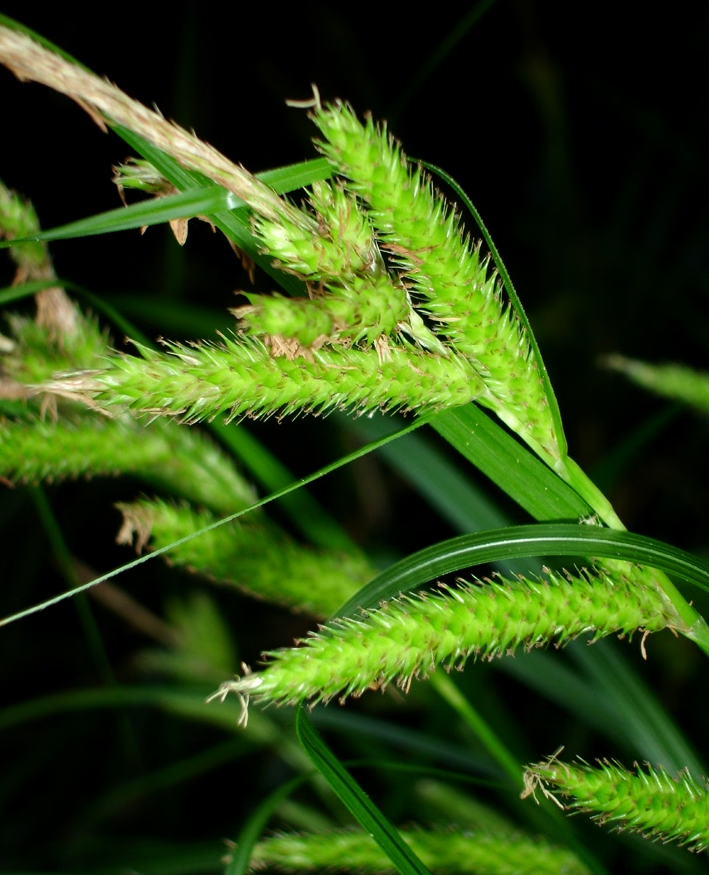
Three Kings sedge (Carex elingamita) is a leafy, light to dark green tussock sedge endemic to the Three Kings Islands, about 55 km north-west of Cape Reinga. Its flowering stems reach about 1 m, and its leaves are 5 to 10 mm wide, making it the only wide-leaved sedge on the islands. In the wild it grows in shade under dense forest, around petrel burrows, boulder falls and rubble. It is ranked At Risk - Naturally Uncommon because it occurs naturally only on this small island group. In gardens it is easy from fresh seed but can seed itself freely, and it has naturalised in Auckland. Explore more native grasses and flaxes in our native plant guide.
Plant Description
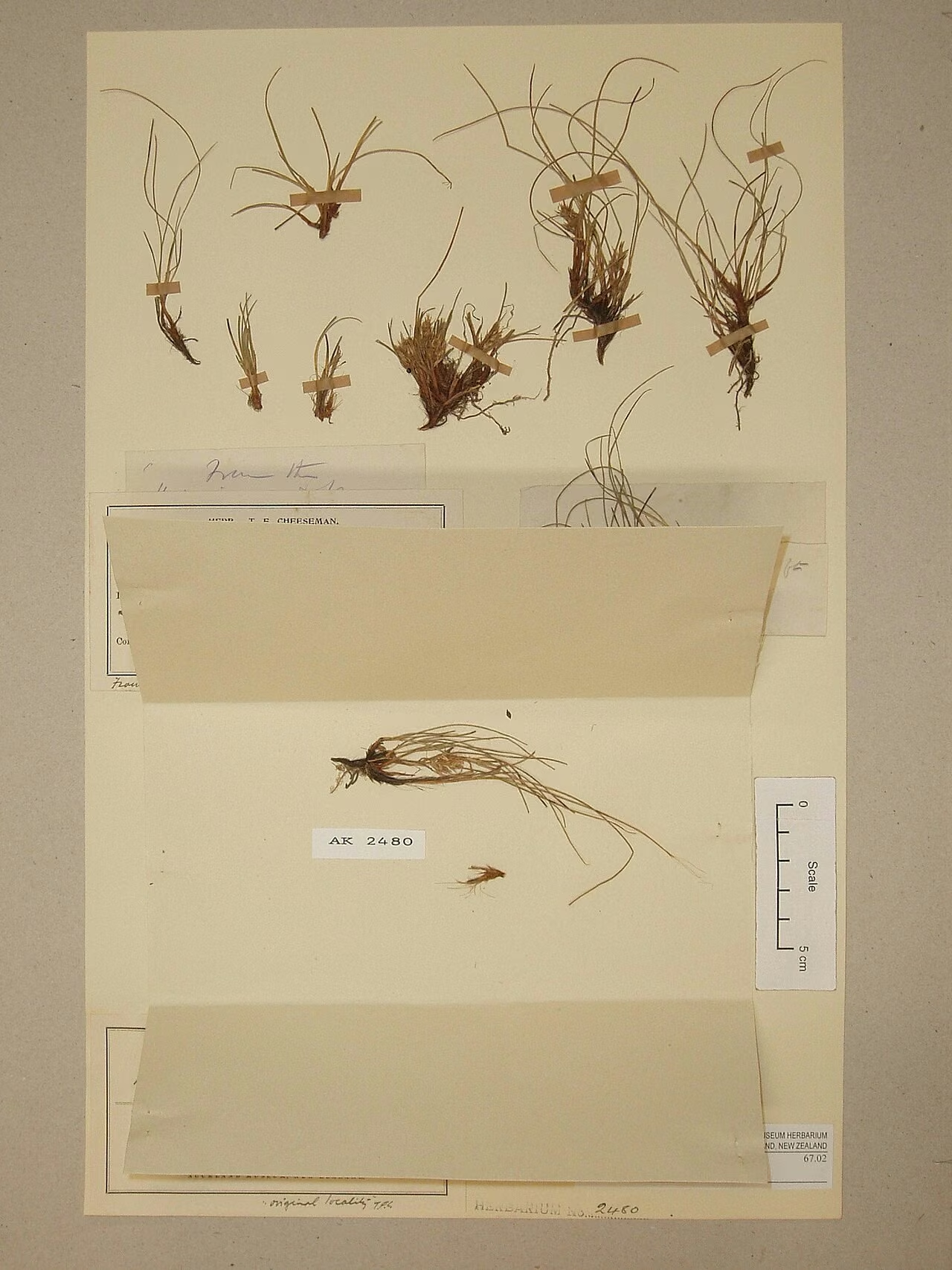
Carex elingamita forms leafy tussocks that are light to dark green. Its flowering stems (culms) reach about 1 m tall and 1.5 mm wide; they are three-angled and smooth, with light brown bracts at the base. The leaves are 5 to 10 mm wide, double-folded and finely rough on the margins, and are shorter than the flowering stems.
The inflorescence is large and open, with 10 to 12 green to grey-green spikes that may be simple or compound, each 60 to 80 mm long and about 5 mm wide. The terminal spike is male, while the remaining spikes are female in their lower part with male flowers towards the top. The glumes are narrow, membranous and flecked red-brown. The utricles (seed sacs) are 4 to 4.5 mm long, three-angled, narrowly elliptic and strongly nerved, and the nut is about 2 mm long and red-brown. Each flower has three stigmas.
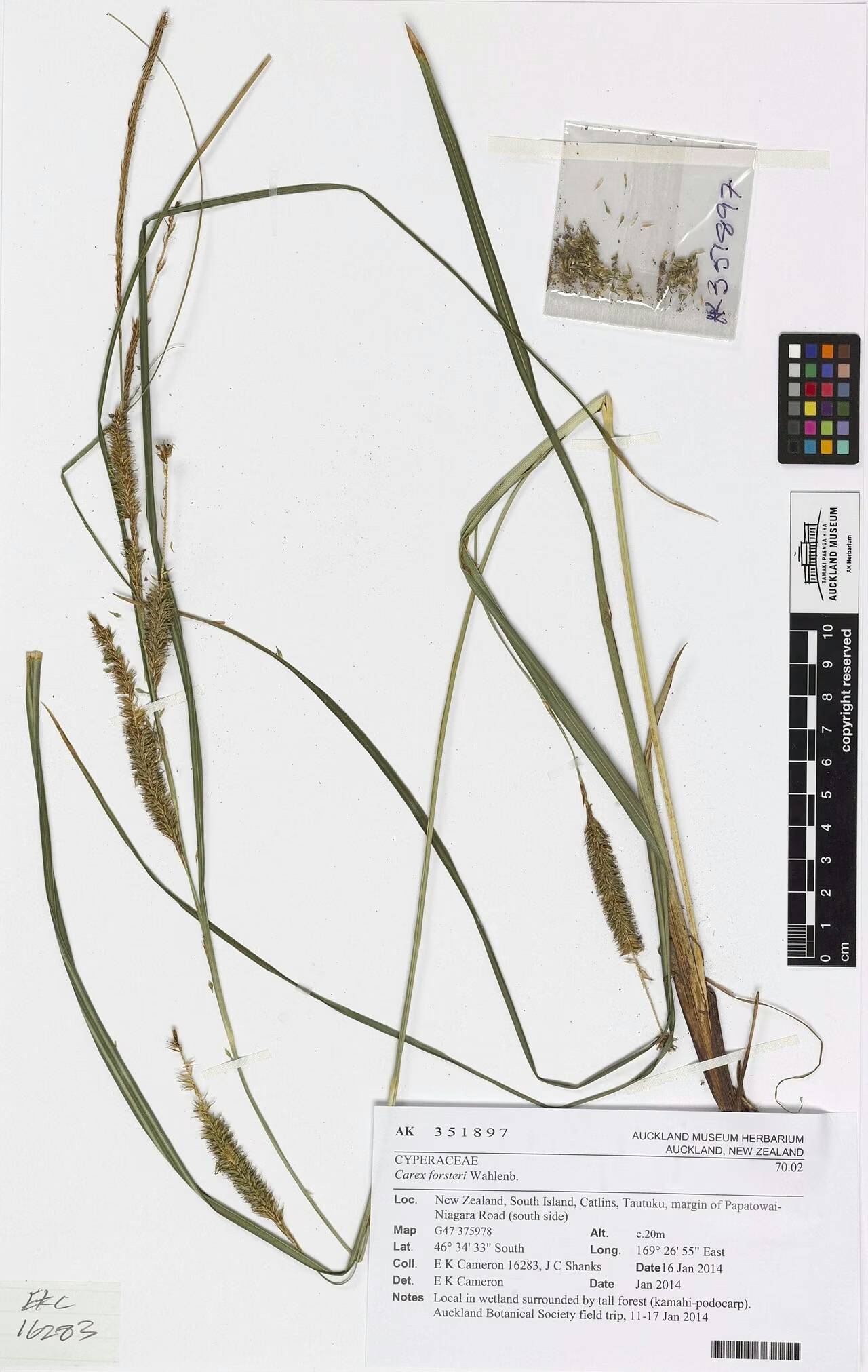
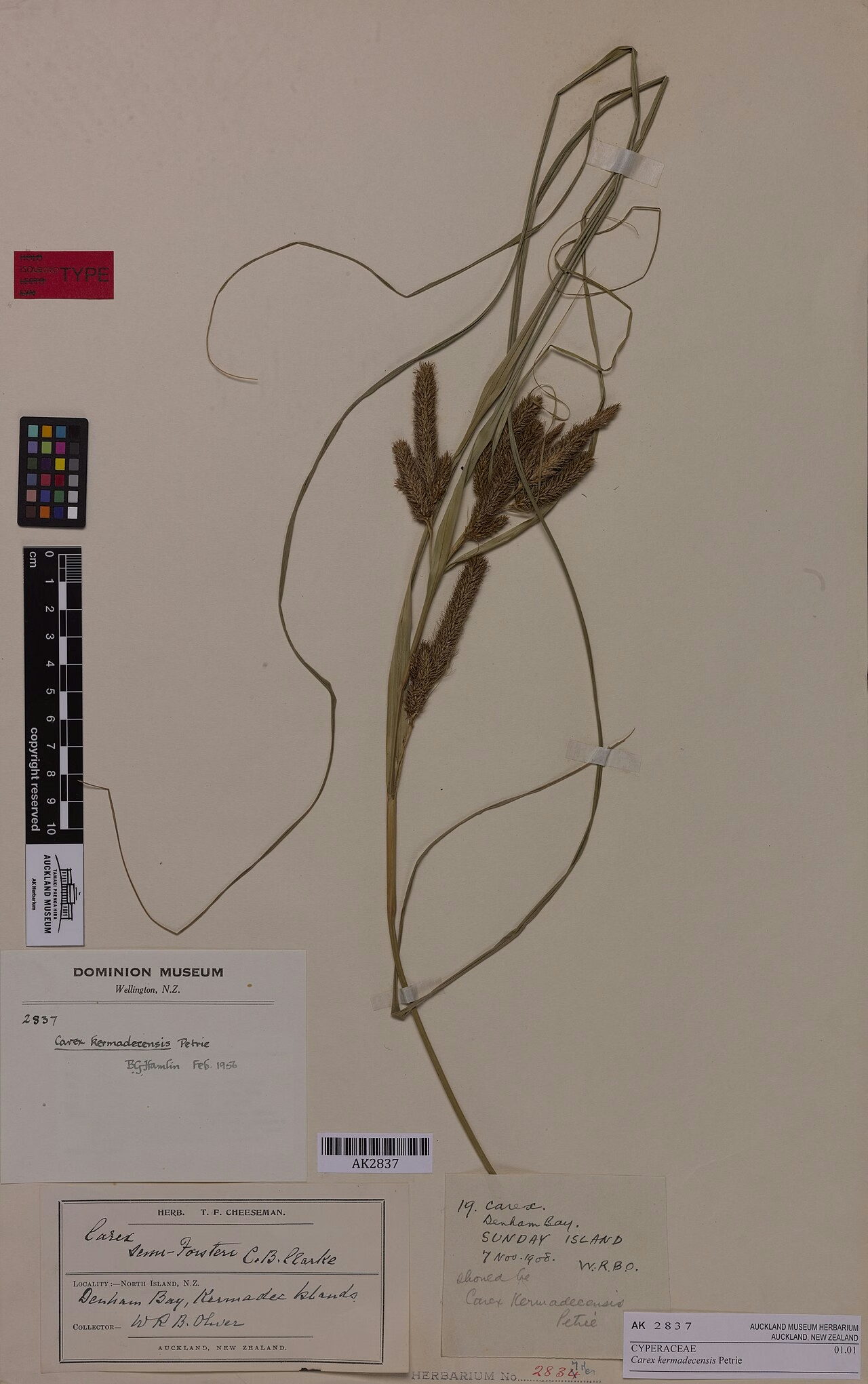
On the Three Kings it is easy to identify because it is the only wide-leaved sedge there. In cultivation or herbarium material it can be confused with Carex kermadecensis, Carex forsteri and Carex spinirostris, and is separated by its long spikes, larger utricles and red-brown nut. Carex kermadecensis, for example, has smaller utricles of 3 to 4 mm and a darker nut.
Quick Facts
| Scientific Name | Carex elingamita |
|---|---|
| Height | Up to about 1 m in flower |
| Spread | About 0.6-1 m |
| Water Needs | Moderate |
| Light | Semi-shade preferred; tolerates full sun |
| Frost Tolerance | Not recorded; from a frost-free subtropical island group, so protect from hard frost |
| Salt Tolerance | Moderate; grows on small exposed offshore islands, though usually under forest |
| Growth Rate | Fast |
| Lifespan | Perennial |
Climate Best Suited to
Suits a mild, frost-free, humid oceanic climate like that of the Three Kings Islands. It grows readily in warm northern districts and should be sheltered from heavy frost further south.
Regional Suitability
| City | Climate Suitability |
|---|---|
| Auckland | High |
| Wellington | Medium |
| Christchurch | Low |
| Dunedin | Low |
Plant Habitat
Three Kings sedge is endemic to the Three Kings Islands (Manawatāwhi) off the northern tip of New Zealand. NZPCN records it from Great Island, North East Island, South West Island, West Island and Hinemoa Rock in the Princes group. Outside the islands it has naturalised in Auckland City, where it has spread from garden plantings.
Its natural habitat is shaded ground under dense forest, often around ground burrowed by petrels, and on boulder falls and rubble. The seabird burrowing keeps soils loose and fertile, and this sedge is a characteristic plant of these disturbed forest floors.
Growing Requirements
Soil Requirements
In the wild it grows on loose, burrowed, often seabird-enriched forest soils and rubble. In gardens it grows in most reasonable soils that do not dry out completely.
- Moderately fertile, humus-rich soil
- Good drainage among rocks or rubble suits it
- Tolerates a range of soil textures
Light Requirements
It is a plant of shaded forest floors. NZPCN recommends semi-shade but notes it will tolerate full sun.
- Best foliage in dappled or partial shade
- Full sun is tolerated if the soil stays moist
Water Requirements
It prefers soil that stays reasonably moist, reflecting its sheltered forest habitat.
- Water during dry summers, especially in sun
- Mulch to keep roots cool and moist
Planting and Establishing
Plant in autumn or spring in a semi-shaded spot, such as beneath trees or on the shady side of a building. Allow about 0.6 to 1 m between plants, as mature tussocks are broad and arching.
Because it seeds freely and has naturalised in Auckland, avoid planting it next to native bush remnants or natural areas where self-sown seedlings could compete with local species.
Ecological Role
Carex elingamita is wind pollinated. On the Three Kings it is closely associated with petrel-burrowed ground under forest, where the disturbance and nutrients from seabirds suit a fast-growing tussock sedge. Its abundant seed is likely taken by birds and moved about on the forest floor, but its specific dispersers have not been documented.
Its ability to establish readily from seed is shown by its naturalisation in Auckland City, well outside its natural range.
Uses & Significance
Garden Uses
A lush, robust sedge for shaded gardens in warm districts, valued for its broad green foliage and tall, arching flower spikes.
- Underplanting beneath trees
- Shady borders and courtyards
- Collections of offshore island plants
Ecological Value
It is a characteristic plant of the Three Kings forest floor, part of a small island flora with many endemics.
- Provides ground cover on burrowed and rubbly forest soils
- Produces plentiful seed for birds and invertebrates
- Part of the distinctive endemic flora of Manawatāwhi
Landscaping Uses
Use Three Kings sedge as a bold foliage plant in shade, either singly as a specimen or in groups to fill the ground under tall trees. Its broad leaves give a lush, subtropical look that complements ferns and other Three Kings natives.
Because it can self-seed heavily, it works best in contained garden beds or urban settings where seedlings can be weeded out easily.
Seasonal Care Calendar
Spring
Tall flowering stems appear from September, carrying long green to grey-green spikes.
- Flowering September to December
- Good time to plant
Summer
Seed develops through summer; water plants in sunnier sites during dry spells.
- Fruiting from October
- Mulch to conserve moisture
Autumn
Ripe seed can be collected for sowing, and spent stems removed to limit self-seeding.
- Fruiting continues to May
- Remove seed heads if seedlings are unwanted
Winter
The tussock stays green. In cooler districts, shelter it from frost.
- Protect from hard frost
- Tidy dead leaves in late winter
When to Prune and How Much
Pull out dead leaves by hand in late winter, wearing gloves as the leaf margins are rough. Cut old flowering stems at the base once they finish.
Removing seed heads before they shed is the simplest way to prevent self-seeding, which NZPCN warns can make this sedge invasive.
How to Grow Three Kings Sedge
NZPCN describes Three Kings sedge as easy to grow from fresh seed. Large clumps can also be divided, as with other tussock-forming sedges. Because it can become invasive, raise only as many plants as you need and keep seedlings away from natural areas. Seed collected in late spring through autumn and sown immediately usually germinates well, and young plants grow quickly in a warm, sheltered nursery. In cooler regions, raise seedlings under cover over their first winter and plant them out in spring once the risk of frost has passed.
From Seed
Seed ripens from October through to May. Collect spikes when the utricles turn brown and the nuts come away easily, and sow them fresh for the best results.
- Cut ripe spikes and shake or rub the seed into a paper bag.
- Sow thinly onto a moist seed-raising mix.
- Cover with a light layer of fine mix or grit.
- Keep in a warm, semi-shaded place and water regularly.
- Pot seedlings individually once they are large enough to handle.
By Division
Large tussocks can be split in spring, when warming temperatures help the divisions establish. Each piece should carry healthy roots and several leafy shoots.
- Dig up the clump and shake off loose soil.
- Cut through the crown with a sharp spade or knife.
- Trim leaves back by about half.
- Replant at once into prepared soil or large pots.
- Keep moist and shaded until new growth starts.
Pests & Diseases
No specific pests or diseases are recorded for Carex elingamita. Like other sedges it may suffer root rot in soil that is constantly waterlogged, and it can be checked by hard frost.
Its own tendency to self-seed is the main management issue in cultivation.
Cultural Significance
No Māori name or traditional use specific to Carex elingamita has been recorded in the sources consulted. The Three Kings Islands themselves are known to Māori as Manawatāwhi.
The species was described by Hamlin in 1958 in the Transactions of the Royal Society of New Zealand. It is one of a number of plants found only on the Three Kings, an island group whose flora recovered after goats were removed in 1946.
Bonus Tip
If you grow Three Kings sedge in Auckland or Northland, cut the flower stems off before the seed ripens each autumn. This keeps the clump looking tidy and prevents it from spreading into nearby bush, where it has already naturalised.
Related Plants
Explore other native plants that share similar characteristics or habitats with Three Kings Sedge (Carex elingamita), offering further insights into New Zealand's diverse flora. These related species provide context and opportunities for complementary planting in your garden.
Plant Conservation
Three Kings sedge is ranked At Risk - Naturally Uncommon (2023) with the qualifiers Conservation Dependent and Island Endemic. Its whole natural range is a small island group, so it is vulnerable to any new threat such as introduced weeds, browsing animals or fire.
The Three Kings Islands are a nature reserve with strict biosecurity. Keeping them free of pests and weeds is the key to the species' survival in the wild, and cultivated plants also provide a safety net.
Frequently Asked Questions
Where does Three Kings sedge come from?
It is endemic to the Three Kings Islands, recorded from Great, North East, South West and West Islands and Hinemoa Rock in the Princes group. It has also naturalised in Auckland City from cultivated plants.
Is Carex elingamita invasive?
NZPCN notes that it is easy to grow from fresh seed and can become invasive in cultivation, so deadhead it if you do not want seedlings appearing around the garden.
Does Three Kings sedge grow in shade?
Yes. In the wild it grows in shaded sites under dense forest, and NZPCN recommends a semi-shaded position in gardens, although it will tolerate full sun.
Sources and Further Reading
The botanical, growing, and conservation details for Three Kings Sedge (Carex elingamita) on this page draw on the New Zealand plant references below. Consult them for full technical records and the latest distribution data.