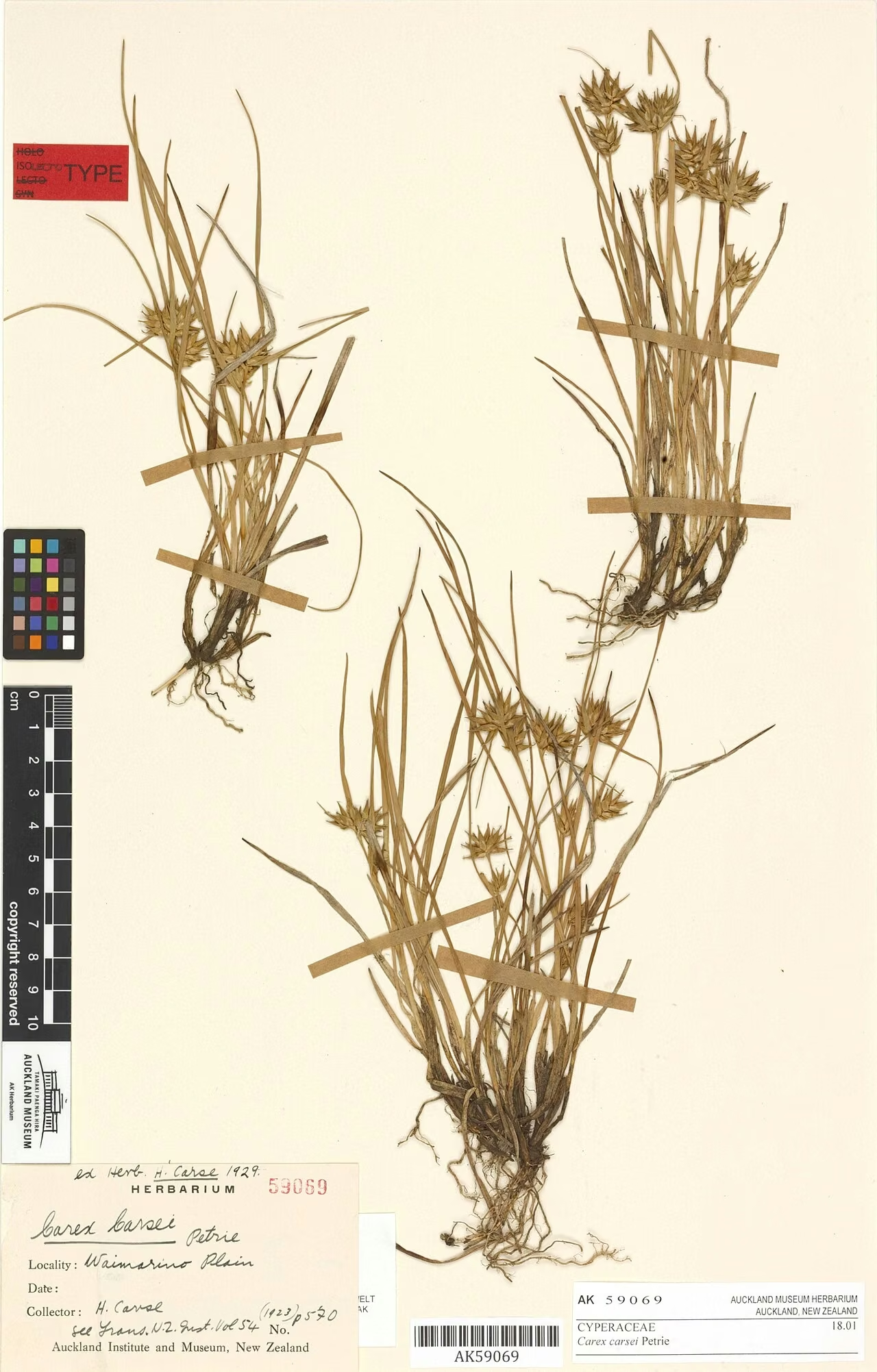
Carse's Sedge
Carex carsei
Last updated:
Carse's sedge (Carex carsei) is an endemic New Zealand sedge that spreads by far-reaching rhizomes to form continuous, grassy, yellow-green swards, usually 7 to 15 cm high. Its stiff, erect stems carry a compact greenish head of 3 to 5 spikes, with unusually long utricles of 7 to 8.5 mm that taper to a long, two-pronged beak. It grows in boggy ground, mires and wet forest clearings from subalpine to alpine elevations, near Lake Taupō and Tongariro National Park in the North Island and through suitable South Island habitats, especially Westland. It is ranked At Risk - Naturally Uncommon and is easily grown from division or fresh seed. Explore more native grasses and flaxes in our native plant guide.
Plant Description
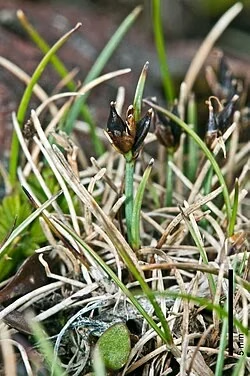
Carex carsei is a rhizomatous sedge whose far-extending rhizomes produce a continuous, grassy sward, usually 7 to 15 cm high. The stems range from 2.5 to 25 cm tall and are stiff and erect. The leaves are grass-like, yellow-green, 1 to 2.5 mm wide and longer than the culms.
The inflorescence is a compact greenish head about 1.5 cm long made up of 3 to 5 spikes, with a small male spike at the top and the female spikes extending above it. The utricles are strikingly long, 7 to 8.5 mm, much longer than the glumes and tapering to a long beak split into two points at the tip. Each flower has three stigmas.
NZPCN calls it a very distinctive species unlikely to be confused with any other indigenous or naturalised sedge. Its sward-forming habit combined with the compact head of long-beaked utricles is unlike the tufted bog sedges it grows with.
Quick Facts
| Scientific Name | Carex carsei |
|---|---|
| Height | 0.025-0.25 m, usually 0.07-0.15 m |
| Spread | Spreads widely by rhizomes to form swards |
| Water Needs | Wet; bog conditions |
| Light | Full sun to light shade |
| Frost Tolerance | High; subalpine to alpine |
| Salt Tolerance | No information available |
| Growth Rate | Moderate; spreads steadily by rhizomes |
| Lifespan | Perennial |
Climate Best Suited to
Suited to cool, wet climates with frequent rain, frost and snow, such as the volcanic plateau and the wet West Coast. It needs constantly moist conditions and cool summers.
Regional Suitability
| City | Climate Suitability |
|---|---|
| Auckland | Low |
| Wellington | Medium |
| Christchurch | Low |
| Dunedin | Medium |
Plant Habitat
Carse's sedge is endemic to New Zealand. In the North Island it is known from near Lake Taupō and from wetlands around Tongariro National Park, including the Waimarino Plain where the type was collected. In the South Island it occurs throughout suitable habitats and is commonest in Westland, with scattered records in Nelson, North Canterbury, Fiordland and Southland, and it is scarce in Canterbury and Otago.
It is a subalpine to alpine sedge of boggy ground, mires and wet forest clearings, where its rhizomes knit through wet peat and moss to form open, grassy swards.
Growing Requirements
Soil Requirements
It grows in wet, acidic, peaty bog soils and in waterlogged ground in forest clearings.
- Permanently wet peat or boggy soil
- Low fertility
- Acidic conditions typical of mires
Light Requirements
Its open bogs and clearings are mostly sunny, though forest clearings give some shelter and part shade.
- Full sun to light shade
- Open, uncrowded sites
Water Requirements
As a mire and bog plant it needs ground that stays wet all year.
- Keep constantly wet
- Suits bog gardens and pond margins
Planting and Establishing
Plant into a bog garden, wet peaty hollow or the shallow margin of a pond, where its rhizomes can spread to form a low sward. A container stood in water also works for a small collection.
Use a low-fertility, peaty mix and do not fertilise. Give it room, since it spreads by rhizomes rather than staying as a single tuft.
Ecological Role
Carse's sedge is wind pollinated, like other Carex. Its rhizomes allow it to spread vegetatively and form extensive patches in suitable bogs, which can persist even where seed set is limited.
It is part of the subalpine and alpine mire communities of the volcanic plateau and South Island mountains, growing with mosses, small herbs and other sedges. These bogs are sensitive to drainage, trampling and changes in water level.
Uses & Significance
Garden Uses
A specialist sedge for cool, wet gardens and conservation collections, valued for its unusual long-beaked seed heads.
- Bog garden ground cover
- Pond margin planting
- Conservation and botanic collections
Ecological Value
Its rhizomatous swards help knit and stabilise peat in mires and wet clearings.
- Binds wet peat surfaces
- Contributes to subalpine mire diversity
- Indicator of intact, undrained bogs
Landscaping Uses
Allowed to spread, it forms a fine, yellow-green carpet through a bog garden, with the green seed heads standing just above the leaves. It works as a low wetland ground cover in cool, wet regions.
Combine it with other bog natives such as small sundews and mosses, keeping taller wetland plants back so the sward is not shaded out.
Seasonal Care Calendar
Spring
New shoots emerge from the rhizomes as the ground warms.
- Divide and replant
- Keep bog moist
Summer
Compact green heads of long-beaked utricles develop; the type specimen was collected in mid January.
- Do not let the bog dry out
Autumn
Utricles ripen and can be collected for sowing.
- Collect fresh seed
Winter
Plants are dormant under frost and snow in their subalpine habitats.
- No protection needed in cool gardens
When to Prune and How Much
No pruning is needed. If the sward spreads beyond where it is wanted, cut around the edge with a spade and lift the excess rhizomes.
Old dead foliage can be raked out lightly in early spring.
How to Grow Carse's Sedge
NZPCN states that Carex carsei is easily grown by division and from fresh seed. Its far-spreading rhizomes make division the quickest method, as each piece of rhizome with shoots can establish as a new plant. Specific flowering and fruiting months are not recorded in the sources consulted. Because it is At Risk and few recent collections exist, wild material should be collected only with permission, for example from the Department of Conservation within national parks.
By Division
Cut sections from the edge of an established sward, including a length of rhizome and several shoots. These establish readily in wet, peaty conditions. Larger sections give a faster cover in a bog garden.
- In spring, cut a section from the edge of the sward with rhizomes attached.
- Pot into a peaty, low-fertility mix or plant straight into a bog garden.
- Stand pots in a tray of water to keep them saturated.
- Plant out once new shoots appear from the rhizome.
From Seed
Collect utricles once they have turned brown and come away easily from the spikes. The long-beaked utricles are large for a sedge, which makes them easy to handle. Sow fresh, as sedge seed generally loses viability in storage.
- Collect ripe utricles from the seed heads.
- Sow on the surface of a moist, peaty seed mix.
- Cover lightly with fine grit or sphagnum.
- Keep wet and cool in bright light.
- Pot up seedlings once they have several leaves.
Pests & Diseases
No specific pests or diseases are recorded for Carse's sedge. Drying out is the main risk in cultivation, quickly browning the foliage.
In the wild, drainage of mires and invasion by taller exotic plants are general threats to its bog habitats.
Cultural Significance
No Māori name or traditional use is recorded for Carex carsei.
Donald Petrie described the species in the Transactions of the New Zealand Institute in 1923. He named it after H. Carse, who, with H. B. Matthews, collected the type from swampy ground on the Waimarino Plain near Tongariro in January 1921.
Bonus Tip
If you find a low, yellow-green grassy carpet in a subalpine bog, look closely at the seed heads: Carse's sedge has utricles 7 to 8.5 mm long with a forked beak, far longer than those of most bog sedges. A photograph of the head posted to iNaturalist can add a valuable record, since few collections have been made since 1980.
Related Plants
Explore other native plants that share similar characteristics or habitats with Carse's Sedge (Carex carsei), offering further insights into New Zealand's diverse flora. These related species provide context and opportunities for complementary planting in your garden.
Plant Conservation
Carex carsei is ranked At Risk - Naturally Uncommon (2023), with qualifiers indicating data are poor for both population size and trend. It was ranked At Risk - Declining in 2018. NZPCN notes there are very few collections since 1980.
Protecting subalpine bogs and mires from drainage, trampling and weed invasion is the best way to help it. More survey work and records are needed to understand its true distribution and trend.
Frequently Asked Questions
Where does Carex carsei grow?
In the North Island it is known from near Lake Taupō and wetlands around Tongariro National Park. In the South Island it occurs throughout suitable habitat, commonest in Westland and scarce in Canterbury, Otago and Fiordland.
How do you identify Carse's sedge?
It forms a continuous, grassy yellow-green turf from long rhizomes, with a compact green head of 3 to 5 spikes. Its long utricles, 7 to 8.5 mm with a forked beak, make it very distinctive.
Who is Carex carsei named after?
It honours H. Carse, who with H. B. Matthews collected the type specimen from swampy ground on the Waimarino Plain in January 1921. Donald Petrie described the species in 1923.
Is Carse's sedge threatened?
It is ranked At Risk - Naturally Uncommon (2023), having been ranked Declining in 2018. NZPCN notes there are very few collections made since 1980.
Sources and Further Reading
The botanical, growing, and conservation details for Carse's Sedge (Carex carsei) on this page draw on the New Zealand plant references below. Consult them for full technical records and the latest distribution data.