Sedge
Carex devia
Last updated:
Carex devia is a loosely tufted, reddish-green to yellow-green sedge endemic to New Zealand and found only on ultramafic (serpentine) rock in the Nelson region of the South Island, including Dun Mountain, the Red Hills and the upper Takaka River. Its stiff, channelled leaves reach about 30 cm, and its slender flowering stems carry two to four short, dark red-purple female spikes. It is closely related to the widely planted Carex flagellifera but has more leathery leaves and fully coloured seed sacs. Because it is restricted to one unusual rock type it is ranked At Risk - Naturally Uncommon, although it is common where it does occur. Explore more native grasses and flaxes in our native plant guide.
Plant Description
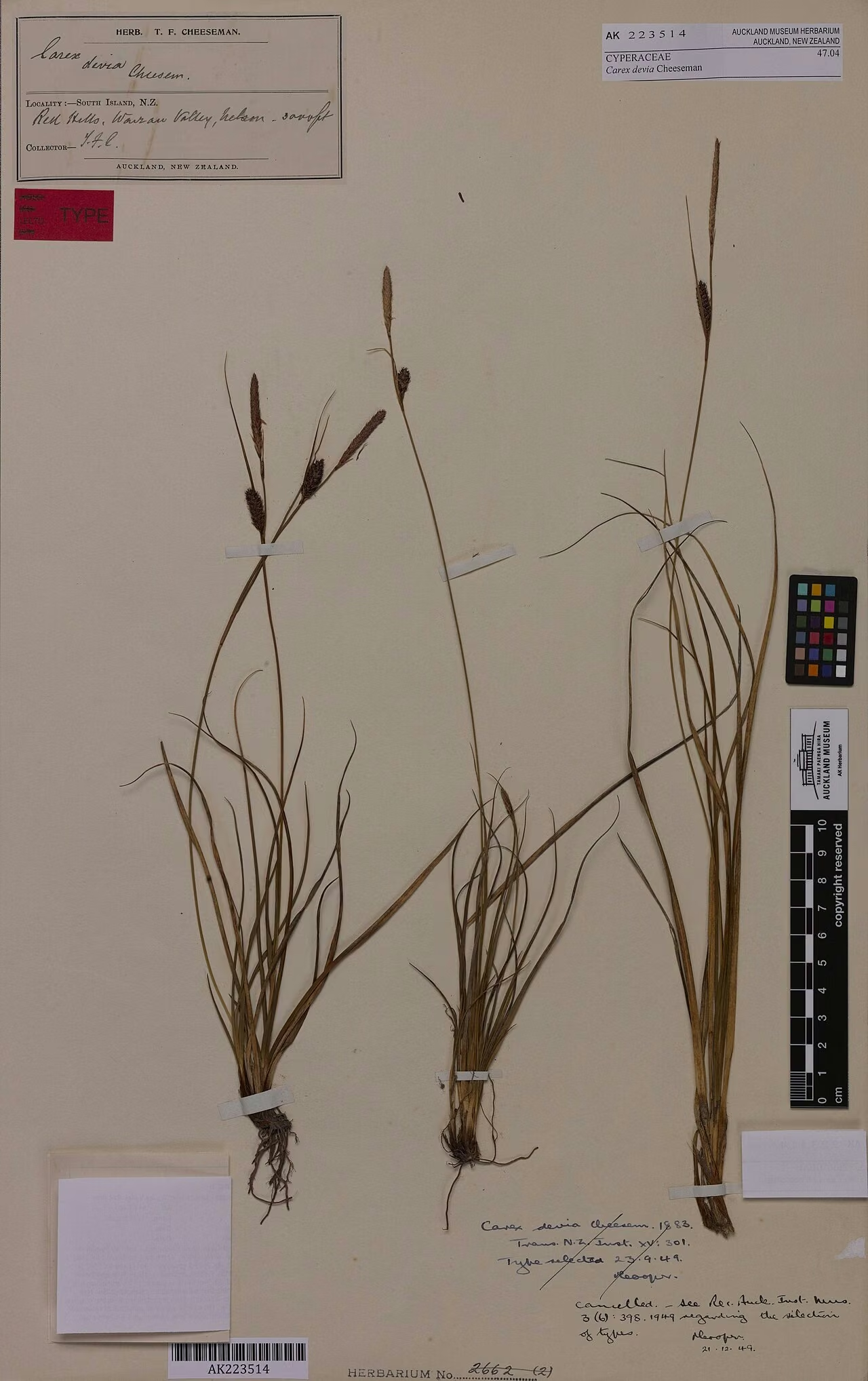
Carex devia forms loose tufts of reddish-green to yellow-green foliage. The leaves are 70 to 300 mm long and 1.5 to 2.5 mm wide, crowded at the base of the plant, channelled and often rolled inwards, with stiff margins and a leathery feel. The basal sheaths are brown to charcoal black. The flowering stems (culms) are very slender, about 1 mm thick, roughly three-angled and smooth or finely rough, and range from 70 mm to 750 mm long, occasionally reaching 900 mm.
Each stem carries two to four spikes that are spaced apart and stalkless or shortly stalked. The terminal spike is male and narrow, 1.5 to 3 mm wide, while the lower female spikes are up to 30 mm long and about 5 mm wide and are a striking dark red-purple. The utricles (the sacs that enclose each seed) are about 3 mm long, flattened on both faces, light to dark brown with distinct nerves, and abruptly narrowed to a cleft beak. Each flower has two stigmas, and the nut is oblong and about 1.8 mm long.
Its closest relative is Carex flagellifera, which grows widely through New Zealand. Carex devia can be told apart by its stiffer, leathery reddish-green leaves, its shorter spikes set closer together, and its utricles that are red-purple all over rather than bicoloured. Its strict association with ultramafic rock is also a strong field clue.
Quick Facts
| Scientific Name | Carex devia |
|---|---|
| Height | Tufts about 0.3 m; flowering stems 0.07-0.75 m, rarely 0.9 m |
| Spread | About 0.3-0.5 m; a loose tuft |
| Water Needs | Low to moderate; prefers free-draining ground |
| Light | Full sun |
| Frost Tolerance | Good; grows on exposed montane ultramafic country |
| Salt Tolerance | No information available; an inland species |
| Growth Rate | Moderate |
| Lifespan | Perennial |
Climate Best Suited to
Suits the cool, exposed montane climate of the Nelson mineral belt, with cold winters, frosts and periods of summer drought on thin stony soils. In cultivation it is tolerant of most New Zealand climates given sun and drainage.
Regional Suitability
| City | Climate Suitability |
|---|---|
| Auckland | Medium |
| Wellington | High |
| Christchurch | High |
| Dunedin | Medium |
Plant Habitat
Carex devia is endemic to the Nelson region of the South Island, where it is confined to ultramafic rocks. NZPCN records it from Dun Mountain, the Red Hills and the upper Takaka River. These ultramafic outcrops are part of the Dun Mountain ophiolite belt, a band of magnesium-rich, nutrient-poor rock that supports a distinctive, sparse vegetation.
Within that narrow range it is common on scree, boulder fields, in tussock grassland and among scrub. It is reported to be particularly abundant on old mine workings, showing that it readily colonises disturbed, bare ultramafic ground.
Growing Requirements
Soil Requirements
In the wild it grows on stony, skeletal soils derived from ultramafic rock, which are low in calcium and high in magnesium and heavy metals. In cultivation NZPCN reports it is easily grown in most soils as long as drainage is good.
- Free-draining, gritty or stony soil
- Low fertility is acceptable; rich soils are not needed
- Avoid heavy ground that stays waterlogged
Light Requirements
Its natural habitat on open scree and tussock grassland is sunny and exposed, and NZPCN recommends full sun in gardens.
- Full sun brings out the reddish leaf colour
- Keep it clear of taller plants that would shade it
Water Requirements
It copes with the dry spells typical of open ultramafic scree, and prefers sites that drain quickly after rain.
- Water young plants until established
- Established plants need little extra watering
- Poor drainage is a greater risk than dryness
Planting and Establishing
Plant in autumn or spring into an open, sunny position with well-drained soil. A rock garden, gravel bed or sloping bank suits it well. Space plants about 30 to 40 cm apart so the loose tufts can develop their natural shape.
Work some grit or fine gravel into heavy soils and avoid adding rich compost, which is unnecessary for a plant adapted to poor ultramafic ground. Water in well and keep moist for the first few weeks.
Ecological Role
Like other sedges, Carex devia is wind pollinated. Its seeds are held in small utricles that are shed from the female spikes; the specific dispersers of this species have not been documented, but sedge seed in general is eaten by birds and moved by wind, water and gravity on scree slopes.
On the Nelson mineral belt it is one of a group of plants able to tolerate the toxic, nutrient-poor ultramafic soils. Its abundance on old mine workings shows it acts as an early coloniser of bare ground, helping to stabilise disturbed scree and boulder fields.
Uses & Significance
Garden Uses
NZPCN suggests it as an alternative to the commonly sold Carex flagellifera and Carex testacea, for gardeners wanting a sedge with reddish-green foliage for a dry, sunny spot.
- Rock gardens and gravel beds
- Sunny banks and dry borders
- Specialist collections of ultramafic or threatened plants
Ecological Value
It is part of the distinctive flora of the Nelson ultramafic belt, one of the most unusual plant habitats in New Zealand.
- Colonises and stabilises bare ultramafic scree and mine workings
- Contributes to the endemic plant diversity of Dun Mountain and the Red Hills
- Produces seed eaten by small birds and insects
Landscaping Uses
Use Carex devia in groups among rocks or gravel where its reddish-green tufts and dark red-purple spikes contrast with pale stone. It pairs well with other low, sun-loving natives such as small tussocks and cushion plants.
Because it is not commercially available, it is best treated as a specialist plant for collectors and restoration projects working with locally sourced material, rather than as a mass-planted landscape sedge.
Seasonal Care Calendar
Spring
Flowering begins in September, with slender stems carrying a narrow male spike above the dark red-purple female spikes.
- Flowering September to December
- Good time to plant or divide
Summer
Seed develops in the female spikes and the foliage takes on its strongest colour in full sun.
- Fruiting continues from September to June
- Water new plantings in dry spells
Autumn
Ripe seed can be collected from the spikes and sown fresh.
- Collect and sow fresh seed
- Autumn planting suits most districts
Winter
Plants remain evergreen and tolerate cold and frost.
- Check drainage after heavy rain
- Little maintenance needed
When to Prune and How Much
No regular pruning is needed. Comb out dead leaves by hand, wearing gloves, in late winter or early spring to keep tufts tidy.
Avoid cutting the whole plant to the ground; removing old, spent flowering stems is enough to keep it looking fresh.
How to Grow Sedge
NZPCN reports that Carex devia is easily grown and can be propagated by division or from fresh seed. Because the species is range restricted and not commercially available, propagation material should come from existing cultivated stock or be collected with the landowner's permission and appropriate authority, and never in quantity from the small wild populations. Seed sown fresh gives the most reliable results, while division is the quickest way to multiply a garden plant.
From Seed
Seed is produced in the dark red-purple female spikes over a long period, from spring into the following winter. Collect spikes when the utricles have turned brown and the nuts are firm, and sow straight away for the best germination.
- Collect ripe spikes and rub out the utricles.
- Sow on the surface of a free-draining seed mix with added grit.
- Cover lightly with fine grit and keep evenly moist.
- Place in a bright, sheltered spot outdoors.
- Prick out seedlings into individual pots once they have several leaves.
By Division
Established tufts can be lifted and split into smaller clumps, each with healthy roots and leaves. Division is best done in autumn or early spring when the plant is not under heat stress.
- Lift the clump with a fork, keeping the root ball intact.
- Pull or cut it into pieces that each have several shoots and roots.
- Trim the leaves back by about half to reduce moisture loss.
- Pot up or replant in gritty, free-draining soil.
- Keep in light shade and water until new growth appears.
Pests & Diseases
No specific pests or diseases are recorded for Carex devia. As with other tufted sedges, the main cultivation problem is root rot in heavy, waterlogged soil.
In the wild, weeds that invade ultramafic scree and grassland, and further disturbance of its habitat, are more relevant concerns than insect pests.
Cultural Significance
No Māori name or traditional Māori use specific to Carex devia has been recorded in the sources consulted.
The species was described by Thomas Cheeseman in the early 1880s. Its home on Dun Mountain is also the type locality of the rock dunite, named after the mountain, and the area has a history of copper and chromite mining, which created the old workings this sedge now colonises.
Bonus Tip
If you want a reddish sedge for a hot, dry gravel garden, Carex devia is worth seeking from specialist growers: it is adapted to some of the harshest, most infertile soils in New Zealand, so resist feeding it, as rich soil tends to make it soft and less colourful.
Related Plants
Explore other native plants that share similar characteristics or habitats with Sedge (Carex devia), offering further insights into New Zealand's diverse flora. These related species provide context and opportunities for complementary planting in your garden.
Plant Conservation
Carex devia is ranked At Risk - Naturally Uncommon (2023) with the qualifier Range Restricted. It is not declining but its natural range is limited to the Nelson ultramafic belt, so any large-scale disturbance or weed invasion there could affect a significant share of the species.
Protecting the Dun Mountain and Red Hills ultramafic landscapes from weeds and inappropriate development, and growing the plant in cultivation from responsibly sourced material, both help secure its future.
Frequently Asked Questions
Where does Carex devia grow?
It grows only on ultramafic rock in Nelson, on Dun Mountain, the Red Hills and near the upper Takaka River, where it is common on scree, boulder fields, tussock grassland, scrub and old mine workings.
How is Carex devia different from Carex flagellifera?
NZPCN describes it as the sister species of Carex flagellifera. Carex devia has leathery reddish-green leaves, shorter and more closely set spikes, and utricles that are entirely red-purple rather than two-toned.
Can I buy Carex devia for my garden?
NZPCN lists it as not commercially available, although it is easily grown and suggested as an alternative to Carex flagellifera and Carex testacea for sunny, free-draining sites.
Is Carex devia threatened?
It is ranked At Risk - Naturally Uncommon with the qualifier Range Restricted, because it naturally occurs only on the Nelson ultramafic belt.
Sources and Further Reading
The botanical, growing, and conservation details for Sedge (Carex devia) on this page draw on the New Zealand plant references below. Consult them for full technical records and the latest distribution data.