Beach Bean
Canavalia rosea
Last updated:
Beach bean (Canavalia rosea) is a creeping, salt-tolerant member of the pea family that trails across sand and boulder beaches throughout the warmer Pacific and Indian Oceans. In the New Zealand Botanical Region it grows only on the Kermadec Islands, where it is uncommon and reaches the southern limit of its world range. Its stems run up to 3 m or more, carrying leaves of three rounded leaflets, upright spikes of dark pink pea flowers and large woody pods with floating seeds. It is ranked At Risk - Naturally Uncommon. It is easy to raise from seed but very cold sensitive, and attempts to grow it on the New Zealand mainland have failed. Explore more native vines in our native plant guide.
Plant Description
Canavalia rosea is a perennial herb with procumbent, creeping stems that can also scramble over other plants. The trailing stems reach 3 m or more and are covered in flattened, silky hairs when young. Each leaf has three leaflets 40 to 120 mm long and 35 to 80 mm wide, broadly obovate to almost round, often notched at the tip, dark green above and paler beneath. The leaflets are hairy when young and become almost hairless with age.
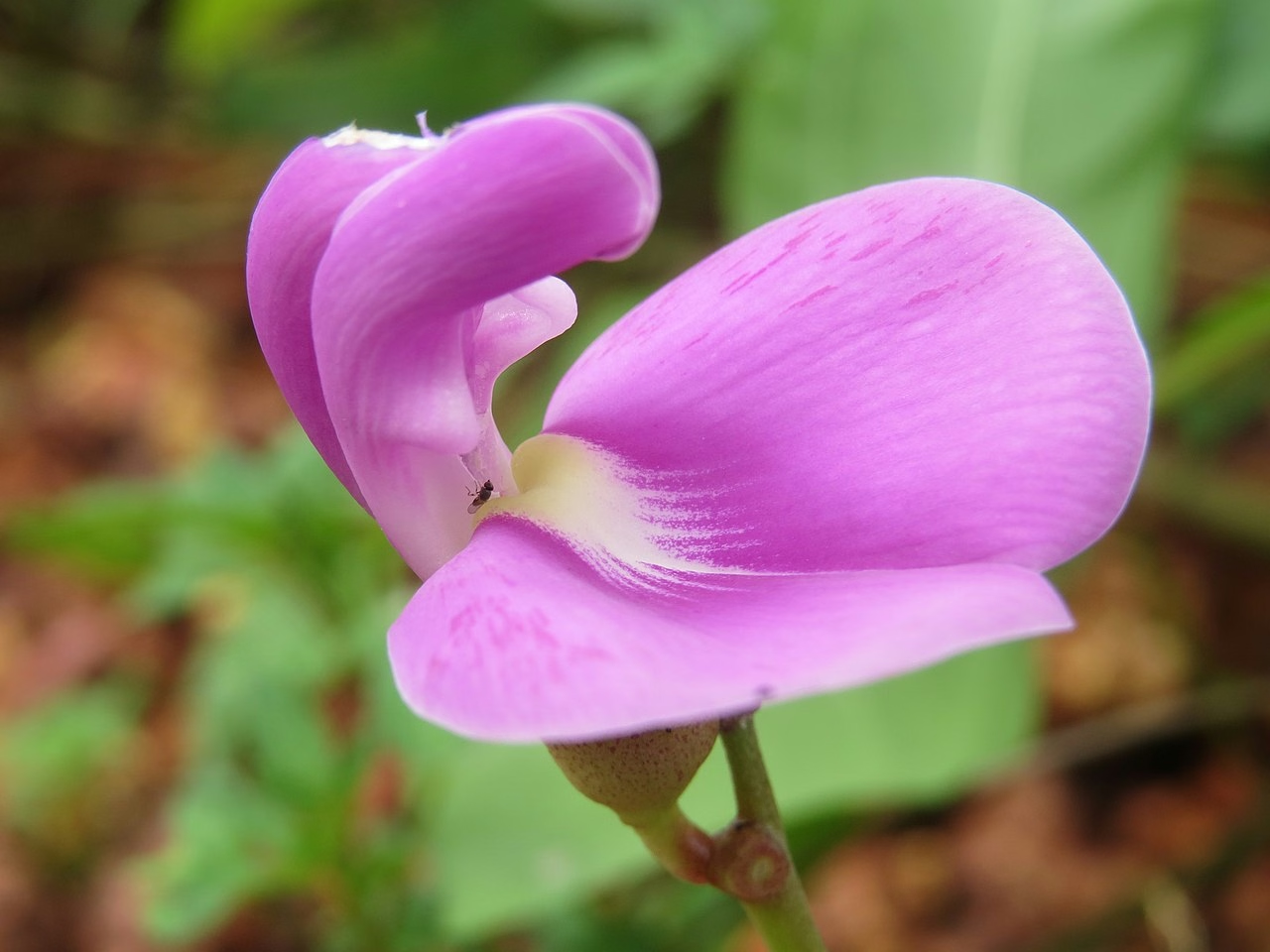
The flowers sit near the top of stout, erect stalks 50 to 300 mm long, a few to each raceme. They are typical pea flowers about 30 mm across, with a rounded dark pink standard petal, and are sweetly scented. The pods are linear-oblong, 70 to 140 mm long and 25 to 30 mm wide, dark green at first and drying brownish black, with a double rib along the back and a single rib along the front. Inside are brown, often dark-marked, flattened ellipsoid seeds 15 to 20 mm long.
On the Kermadec Islands it cannot be confused with any other plant of the same habitat. Its large trifoliate leaves, pink pea flowers and thick bean pods separate it from the other strand creepers it grows with, such as Ipomoea pes-caprae subsp. brasiliensis, which has single lobed leaves and funnel-shaped flowers.
Quick Facts
| Scientific Name | Canavalia rosea |
|---|---|
| Height | Low trailing vine, usually under 0.3 m |
| Spread | Stems 3 m or more |
| Water Needs | Low once established; drought tolerant on sand |
| Light | Full sun |
| Frost Tolerance | None; killed by cold winters |
| Salt Tolerance | Very high; a beach strand plant |
| Growth Rate | Fast in warm conditions |
| Lifespan | Perennial |
Climate Best Suited to
A plant of tropical and subtropical coasts that needs frost-free, warm conditions all year. Even the warmest parts of mainland New Zealand have proved too cold in winter for it to survive.
Regional Suitability
| City | Climate Suitability |
|---|---|
| Auckland | Low |
| Wellington | Low |
| Christchurch | Low |
| Dunedin | Low |
Plant Habitat
Canavalia rosea is a common beach strand plant across the tropical and subtropical Pacific and Indian Oceans. In the New Zealand Botanical Region it is confined to the Kermadec Islands, about 1000 km north-east of the North Island, and is not very common there. The Kermadecs mark the southern limit of its global distribution.
It grows on boulder beaches and sand dunes just above the high tide line. Elsewhere in the Pacific it typically shares this strand zone with Lepturus repens, Ipomoea pes-caprae subsp. brasiliensis and Vigna marina, forming a low mat of salt-tolerant creepers that helps bind loose sand.
Growing Requirements
Soil Requirements
In the wild it roots into coarse beach sand and among boulders, where soils are very free draining and low in organic matter. As a legume it can fix nitrogen and copes with poor substrates.
- Sand or gravel with sharp drainage
- Tolerates salty, low-nutrient beach soils
- Avoid heavy, wet or cold soils
Light Requirements
It is a plant of open, unshaded beaches and needs full sun and warmth to grow and flower.
- Full sun all day
- Shade from taller vegetation weakens it
Water Requirements
Deep roots and a beach habitat mean it tolerates dry spells well, relying on moisture held deep in the sand.
- Water seedlings until established
- Established plants need little extra water in warm climates
Planting and Establishing
Because it dies in mainland New Zealand winters, beach bean is not a realistic outdoor plant here. Anyone growing it for interest should treat it as a heated greenhouse or conservatory plant, giving it a deep pot of sandy mix, full light and minimum temperatures well above freezing.
Plants on the Kermadec Islands are part of a protected nature reserve and should not be disturbed or collected. Seed for experimental growing should come from legitimate cultivated or overseas sources, observing biosecurity rules.
Ecological Role
Its scented pink pea flowers are visited by bees and other insects in its wider tropical range. Flowers and fruit can appear at any time of year, so pods in all stages are often present together.
The buoyant seeds are dispersed by seawater, which is how the species has spread across so many islands and probably how it reached the Kermadecs. Its long runners help stabilise beach sand and dunes, and as a legume it adds nitrogen to otherwise poor strand soils.
Uses & Significance
Garden Uses
In New Zealand it is a collector's curiosity rather than a garden plant, suited only to protected, heated conditions.
- Heated glasshouse specimen for botanic or educational collections
- Demonstrating ocean-dispersed seeds and strand vegetation
Ecological Value
On the Kermadec Islands it contributes to the small subtropical beach flora that makes these islands botanically distinctive within New Zealand.
- Binds sand and boulder beach margins
- Fixes nitrogen in nutrient-poor strand soils
- Part of the southern edge of a pantropical plant community
Landscaping Uses
Where it can be grown in its tropical range, beach bean is used as a fast, salt-proof ground cover for stabilising coastal sand, sprawling over dunes with bold rounded leaves and pink flowers.
In New Zealand such use is not possible outdoors. Gardeners wanting a native sand binder on mainland beaches should look instead to species such as pingao or spinifex that are adapted to local conditions.
Seasonal Care Calendar
Spring
In warm conditions new runners extend quickly as temperatures rise.
- Sow fresh seed in heated conditions
Summer
Peak growth, with flowers and pods forming in heat and full sun.
- Water potted plants when the mix dries
Autumn
On the Kermadecs it continues flowering and fruiting, as it does year round across its range.
- Collect ripe brown-black pods
Winter
This is the critical season in New Zealand: cold kills plants grown outside the subtropics.
- Keep under heated glass
- Reduce watering in cool weather
When to Prune and How Much
No regular pruning is needed. In a glasshouse, trailing stems can be shortened or redirected when they outgrow their space, cutting just above a leaf node.
Remove any stems damaged by cold promptly so rot does not spread back into the crown.
How to Grow Beach Bean
NZPCN describes Canavalia rosea as easy from fresh seed. The problem is not germination but survival: the plants are extremely sensitive to cold, and attempts to grow them in New Zealand have failed because seedlings and young plants die during winter. Any propagation here should be done under heated glass, and seed should never be taken from the protected Kermadec Islands populations.
From Seed
The seeds are large and have a tough coat adapted to floating in the sea. Nicking or lightly sanding the coat, then soaking the seed in warm water until it swells, speeds germination. Sow singly in deep pots of sandy, free-draining mix and keep warm and bright.
- Use fresh, plump brown seed from a legitimate source.
- Nick the seed coat away from the scar and soak for several hours in warm water.
- Sow 2 to 3 cm deep in a deep pot of sandy mix.
- Keep at warm tropical temperatures with bottom heat.
- Grow on in full light and never let plants experience cold.
From Cuttings
No reliable record of propagation from cuttings in New Zealand was found. Trailing legumes of this type often root where stems touch the ground, so pegging a runner into a pot of sand while it is still attached is a low-risk way to try.
- Peg a healthy runner into a pot of moist sand alongside the parent.
- Keep warm and wait for roots to form at the node.
- Sever from the parent once new growth appears.
Pests & Diseases
No specific pest or disease problems have been recorded for this species in New Zealand, largely because it has not survived in cultivation here. Under glass, legumes like this can attract aphids, mealybugs and spider mites, which should be checked for regularly.
Cold and wet roots are the main killers. Grow it hot, bright and in very free-draining mix.
Cultural Significance
No Māori name or traditional Māori use is recorded for Canavalia rosea, which is not surprising given that in New Zealand it grows only on the remote Kermadec Islands.
Elsewhere in its range people have eaten the young seeds and pods after boiling, and the flowers have been used as a flavouring. The floating seeds are one of the classic drift seeds or sea beans washed up on tropical shores.
Bonus Tip
If you find a large, flattened brown bean washed up on a northern New Zealand beach, it may be a drift seed of a Canavalia or similar tropical legume carried south by currents. It is a nice example of how species like beach bean reached the Kermadecs, but it will not survive a mainland winter if sown outside.
Related Plants
Explore other native plants that share similar characteristics or habitats with Beach Bean (Canavalia rosea), offering further insights into New Zealand's diverse flora. These related species provide context and opportunities for complementary planting in your garden.
Grassland Daisy
Brachyscome sinclairii
Callitriche aucklandica
Callitriche aucklandica
Mueller's Starwort
Callitriche muelleri
Pink Bindweed
Convolvulus sepium subsp. roseata
Panapana
Cardamine dolichostyla

Campbell Island Bittercress
Cardamine subcarnosa
Aston's Sedge
Carex astonii
Climbing Convolvulus
Climbing Convolvulus
Plant Conservation
Canavalia rosea is ranked At Risk - Naturally Uncommon in New Zealand (2023), with the qualifiers Secure Overseas and Sparse. NZPCN notes it is not threatened as such, but is very uncommon here because the Kermadecs sit at the southern edge of its world range. The IUCN lists the species as Least Concern globally.
The Kermadec Islands are a nature reserve, and keeping them free of introduced weeds and animals is the main protection for this and the other strand plants. Visitors must follow Department of Conservation biosecurity procedures.
Frequently Asked Questions
Where does beach bean grow in New Zealand?
Within the New Zealand Botanical Region it is known only from the subtropical Kermadec Islands, where it grows on boulder beaches and sand dunes and is not very common.
Can you grow Canavalia rosea in mainland New Zealand?
NZPCN reports that it germinates easily from fresh seed, but every attempt to cultivate it in New Zealand has so far failed because the plants die over winter.
How are beach bean seeds spread?
The brown seeds float and survive long periods in seawater, so ocean currents carry them between islands and coasts. This explains its very wide tropical range.
Are beach bean seeds edible?
Wikipedia notes that young seeds and pods have been eaten after boiling elsewhere in its range, but mature seeds of Canavalia species can be toxic raw, so it should not be treated as a food plant.
Sources and Further Reading
The botanical, growing, and conservation details for Beach Bean (Canavalia rosea) on this page draw on the New Zealand plant references below. Consult them for full technical records and the latest distribution data.