Castlepoint Daisy
Brachyglottis compacta
Last updated:
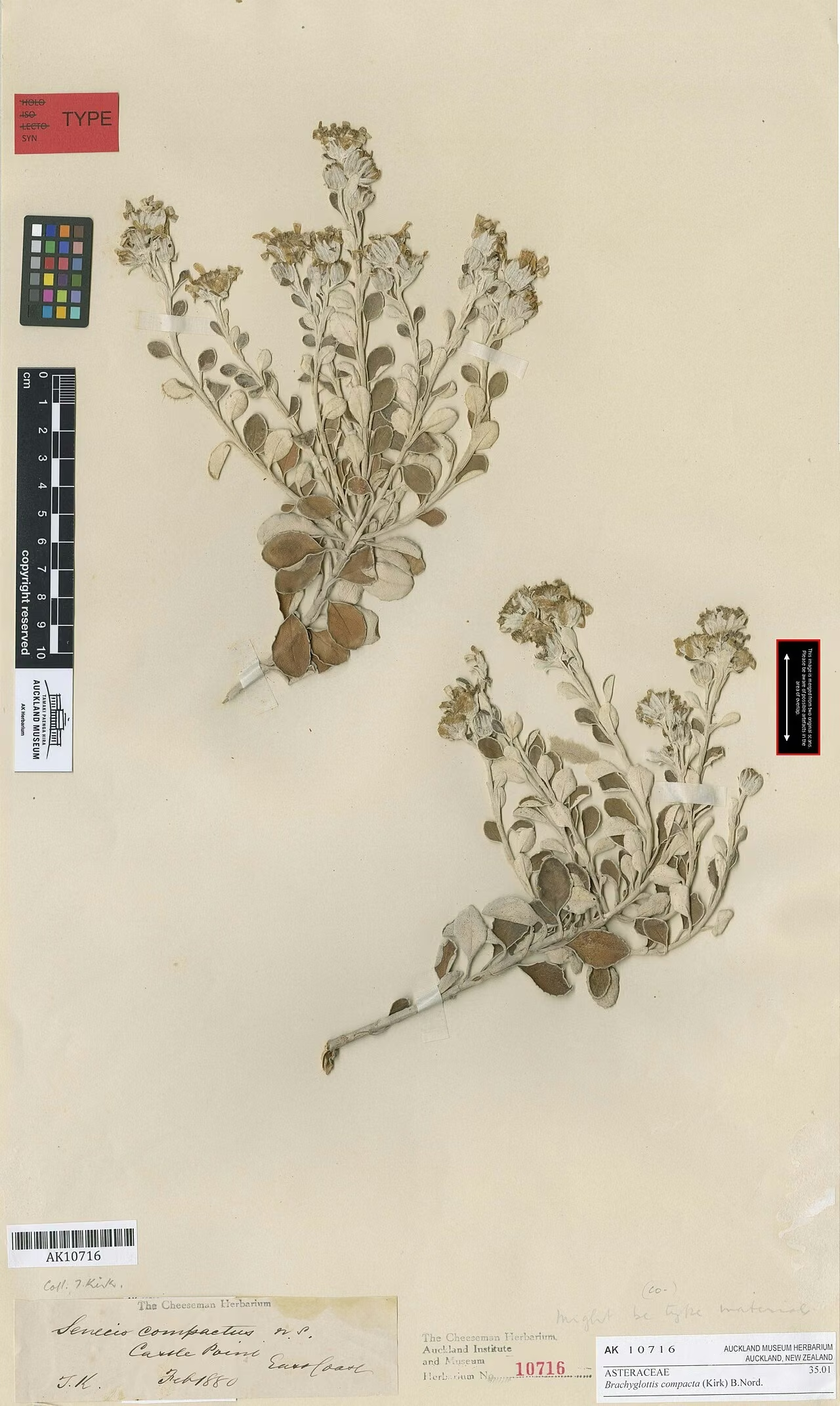
Castlepoint daisy (Brachyglottis compacta) is a compact, stoutly branched shrub up to 1 m tall with leathery, wavy-edged leaves that are dark green above and densely white-felted beneath. In summer it carries bright yellow daisy flowers up to 30 mm across. In the wild it grows only on the limestone cliffs at Castlepoint on the Wairarapa coast, which makes it one of the most narrowly distributed shrubs in the North Island. It is ranked Threatened - Nationally Endangered (2023). Nursery-grown plants are tough in gardens, coping with drying, salt-laden wind, dry sites and limestone soils. Explore more native shrubs in our native plant guide.
Plant Description
Brachyglottis compacta is a compactly branched shrub up to about 1 m tall, with stout branches. The branchlets and leaf stalks are densely clothed in soft white tomentum, giving young growth a pale, felted look.
The leaves are obovate to oblong, 20 to 40 mm long and 10 to 20 mm wide, with margins that are distinctly to faintly crenulate and wavy. Young leaves are white-felted on both surfaces, but the upper surface becomes smooth, dull and dark green with age, keeping a white rim. The underside stays densely covered in soft white felt with a clear midrib.
The flower heads are up to 30 mm in diameter and borne singly or in short, few-flowered racemes with leafy bracts. Each head has ten or more bright yellow ray florets around a yellow disc. The seeds (achenes) are about 3 mm long, linear-oblong, grooved and finely rough. It closely resembles Brachyglottis greyi, but the two species have separate natural ranges.
Quick Facts
| Scientific Name | Brachyglottis compacta |
|---|---|
| Height | Up to 1 m |
| Spread | About 1 m, a dense rounded bush |
| Water Needs | Low once established; drought tolerant |
| Light | Full sun |
| Frost Tolerance | Moderate; a lowland coastal species |
| Salt Tolerance | High; withstands salt-laden coastal wind |
| Growth Rate | Moderate |
| Lifespan | Long-lived perennial shrub |
Climate Best Suited to
Suited to a mild, windy, coastal climate with dry summers like that of the eastern Wairarapa coast. It handles salt and wind far better than heavy, humid shade or very hard inland frosts.
Regional Suitability
| City | Climate Suitability |
|---|---|
| Auckland | Medium |
| Wellington | High |
| Christchurch | High |
| Dunedin | Medium |
Plant Habitat
The only known wild population is at Castle Point on the Wairarapa coast in the southeastern North Island. Here the shrub clings to limestone cliffs exposed to the open Pacific.
The cliffs are a harsh habitat of thin, alkaline soil, strong onshore wind and salt spray, which helps explain the plant's dense form, thick leaves and felted undersides.
Growing Requirements
Soil Requirements
In nature it roots into crevices and ledges on limestone, so it needs sharp drainage and tolerates alkaline conditions.
- Free-draining, gritty or stony soil
- Tolerates limestone and other alkaline soils
- Avoid heavy, wet clay that stays waterlogged in winter
Light Requirements
A plant of open, sunny cliffs, it keeps its tight shape and best leaf colour in full sun.
- Full sun for compact growth and good flowering
- Shade makes it leggy and less floriferous
Water Requirements
It is adapted to dry, wind-swept cliffs and needs little watering once its roots are established.
- Water regularly through the first summer after planting
- Established plants tolerate dry sites
- Overwatering and poor drainage are greater risks than drought
Planting and Establishing
Plant nursery-grown stock in autumn or early spring in a sunny, well-drained position. Dig a hole about twice the width of the pot, add grit or gravel if the soil is heavy, and set the plant at the same depth it grew in the pot.
Because it tolerates salt wind and limestone soil, it is well suited to first-line coastal plantings, banks and rock gardens. Space plants about 1 m apart for a low informal hedge.
Ecological Role
The bright yellow flower heads are visited by bees, and the nursery trade lists it as a bee-attracting shrub. The small achenes are typical of Brachyglottis, which disperse their seed on the wind.
On the Castlepoint cliffs it is part of a specialised limestone coastal plant community. Detailed studies of the insects that feed on or pollinate this particular species were not found in the sources consulted.
Uses & Significance
Garden Uses
It is an attractive, hardy grey-green shrub for difficult, exposed and dry gardens, especially near the coast.
- Coastal gardens exposed to salt wind
- Rock gardens and limestone or alkaline soils
- Low informal hedging and mass planting on dry banks
- Silver and grey foliage borders
Ecological Value
As a Nationally Endangered endemic with a single wild site, each cultivated plant from legitimate nursery stock is a small insurance against loss of the species.
- Summer flowers provide nectar and pollen for bees
- A signature plant of the Castlepoint limestone cliffs
- Garden populations help keep the species in cultivation
Landscaping Uses
Use Castlepoint daisy as a structural grey shrub in coastal and Mediterranean-style plantings, where its white-edged leaves contrast with darker greens such as coprosma and flax. Its compact habit suits the front of shrub borders or the edge of paths.
It pairs well with other silver-leaved natives and with rocks and gravel, echoing its limestone cliff home. Plant in groups of three or more for a strong summer display of yellow flowers.
Seasonal Care Calendar
Spring
New felted shoots appear and growth is most active.
- Plant out new shrubs
- Light tidy if needed
Summer
The main flowering period is December to February, when bright yellow daisies cover the bush.
- Water young plants during dry spells
- Watch for bees on the flowers
Autumn
Seed ripens from January to March, and plants may be lightly trimmed after flowering.
- Remove spent flower stalks for neatness
- Take semi-hardwood cuttings
Winter
Growth slows. Plants occasionally produce a few flowers or seed out of season around August.
- Avoid waterlogged soil
- No feeding required
When to Prune and How Much
Trim lightly after flowering by cutting back spent flower stems and shortening any long shoots. This keeps the bush dense and rounded.
Avoid hard pruning into old leafless wood, which may regrow slowly. Regular light trims from a young age are better than an occasional heavy cut.
How to Grow Castlepoint Daisy
NZPCN gives no specific propagation notes for Brachyglottis compacta, but the species is grown and sold by New Zealand nurseries, and shrubby Brachyglottis are generally propagated from semi-hardwood cuttings, with seed as an alternative. Because the only wild population is at Castlepoint and the species is Nationally Endangered, never collect cuttings or seed from the cliffs. Take material only from your own garden plants or nursery stock, and keep track of what you grow so that garden plants do not confuse the record of the wild population. Note that Brachyglottis species hybridise freely, so seed from a garden containing several species may not come true.
From Cuttings
Semi-hardwood cuttings taken in late summer or autumn from healthy, non-flowering shoots are the most reliable way to produce plants identical to the parent.
- Cut 8 to 10 cm shoots from non-flowering side branches of a garden plant
- Strip the lower leaves and trim just below a node
- Insert into a free-draining mix of pumice or perlite and peat substitute
- Keep in bright light out of direct sun, with moderate humidity but not wet
- Pot on once a good root system has formed
From Seed
Seed ripens from January to March. The small grooved achenes are carried away on the wind, so collect the seed heads as soon as they turn fluffy.
- Collect ripe seed heads from a plant growing away from other Brachyglottis
- Sow fresh seed thinly on the surface of a seed-raising mix
- Cover very lightly with fine grit and keep evenly moist
- Prick out seedlings once they can be handled
Pests & Diseases
Few pest problems are recorded. The main cause of losses in gardens is root rot in poorly drained, heavy soils, especially in wet winters.
As with other daisy shrubs, aphids may occasionally gather on soft new shoots, and dense, humid plantings can encourage leaf fungal problems.
Cultural Significance
No traditional Māori name or use is recorded for Brachyglottis compacta in the sources consulted.
The species was described by Thomas Kirk as Senecio compactus and later transferred to Brachyglottis by Bertil Nordenstam. The epithet compacta refers to its small, compact growth habit, and its common name ties it to Castlepoint, a well-known Wairarapa landmark.
Bonus Tip
If you garden on limestone, chalky or other alkaline soil near the coast, Castlepoint daisy is one of the few native shrubs that comes from exactly those conditions. Give it the sunniest, windiest spot you have and it will stay far tighter and more silver than in a sheltered, rich bed.
Related Plants
Explore other native plants that share similar characteristics or habitats with Castlepoint Daisy (Brachyglottis compacta), offering further insights into New Zealand's diverse flora. These related species provide context and opportunities for complementary planting in your garden.
Caldwell's Clubrush
Bolboschoenus caldwellii
Purua Grass
Bolboschoenus medianus
Fine-Leaved Parsley Fern
Botrychium biforme
Brachyglottis bifistulosa
Brachyglottis bifistulosa
Brachyglottis revoluta
Brachyglottis revoluta
Brachyscome montana
Brachyscome montana
Lees Valley Daisy
Brachyscome pinnata
Grassland Daisy
Brachyscome sinclairii
Plant Conservation
Brachyglottis compacta is ranked Threatened - Nationally Endangered (2023) with the qualifiers DPS (Data Poor: Size), DPT (Data Poor: Trend) and RR (Range Restricted). Earlier assessments from 2009 to 2017 listed it as At Risk - Naturally Uncommon. In the Wellington region it is ranked Regionally Endangered.
With one wild population, the species is vulnerable to any event affecting the Castlepoint cliffs, such as weed invasion, slips or damage from visitors. Keeping to formed tracks at Castlepoint and growing only nursery-raised plants help protect it.
Frequently Asked Questions
Where does the Castlepoint daisy grow naturally?
Only at Castle Point on the Wairarapa coast of the North Island, where it grows on limestone cliffs. It is not known from anywhere else in the wild.
Why is Brachyglottis compacta Nationally Endangered?
Its entire wild population is confined to one small coastal site, so a single event could affect the whole species. The 2023 assessment also flagged that data on its population size and trend are poor.
Is Castlepoint daisy a good coastal garden shrub?
Yes. Nursery stock is sold as a shrub that tolerates strong, drying, salt-laden winds, dry sites and limestone soils, making it useful for exposed seaside gardens.
How do you tell Brachyglottis compacta from Brachyglottis greyi?
The two look similar, but NZPCN notes that their wild ranges do not overlap. Brachyglottis compacta is a smaller, more compact shrub with leaves only 20 to 40 mm long.
Sources and Further Reading
The botanical, growing, and conservation details for Castlepoint Daisy (Brachyglottis compacta) on this page draw on the New Zealand plant references below. Consult them for full technical records and the latest distribution data.