Fine-Leaved Parsley Fern
Botrychium biforme
Last updated:
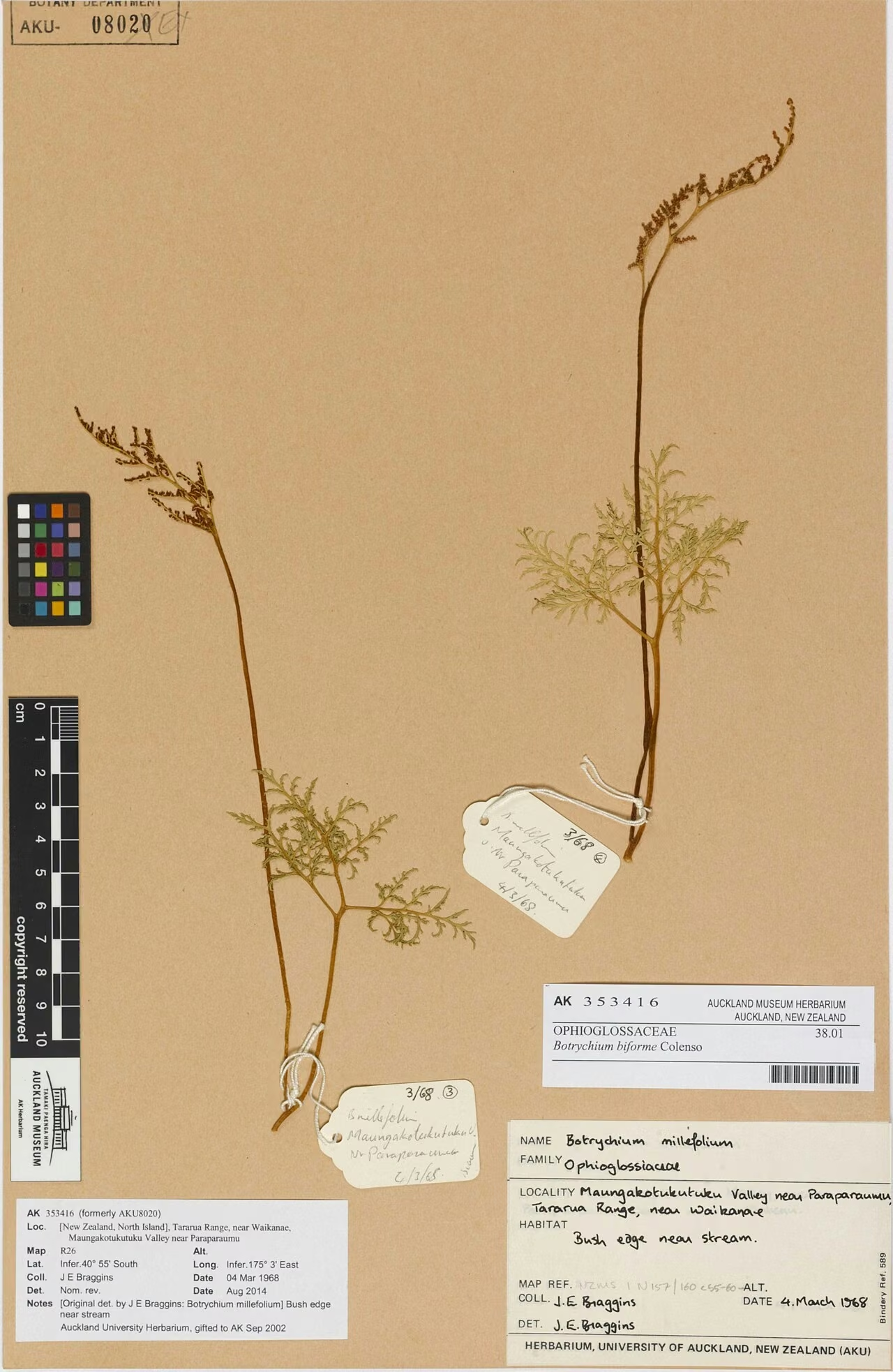
Fine-leaved parsley fern (Botrychium biforme) is an endemic New Zealand fern related to adder's-tongue ferns. Each plant sends up a fleshy frond split into two parts: a broad, very finely divided sterile blade, green or bronze, and a taller stalked spike carrying clusters of round sporangia like tiny bunches of grapes. Fronds are 7 to 44 cm long, and plants die down completely in winter. It grows from about Hamilton and East Cape south through both main islands to Stewart Island and the Chatham Islands, in forest, scrub, grassland and damp open ground. It is Not Threatened but often local and sporadic, and should not be taken from the wild. Explore more native ferns in our native plant guide.
Plant Description
Botrychium biforme has a short, erect underground rhizome and thick, fleshy roots up to 3 mm in diameter that contain starch but are not ridged or contractile. Each frond, 7 to 44 cm long, has a short common stalk that divides into a sterile lamina and a fertile sporophore. The sterile lamina is borne on its own stalk and is broadly ovate to five-angled, often broader than long, up to about 17 cm long and 18.5 cm wide, and divided five to seven times. Its ultimate segments are narrow and long-pointed, 0.2 to 1 mm wide. Plants occur in green and bronze colour forms.
The sporophore stands above the sterile blade on a longer stalk and is divided three to five times, bearing clusters of sessile, round sporangia 0.6 to 1.1 mm across. The overall effect is of a lacy green or bronze frond with a separate grape-like spike above it.
It closely resembles Botrychium australe, and the two sometimes grow together. B. biforme is told apart by its more finely divided blade, narrower and more sharply pointed segments, and smooth, non-contractile roots.
Quick Facts
| Scientific Name | Botrychium biforme |
|---|---|
| Height | 0.07-0.44 m (frond length) |
| Spread | Single plants about 0.1-0.2 m; sometimes in large patches |
| Water Needs | Moist; tolerates seasonally flooded ground |
| Light | Open sun to deep shade |
| Frost Tolerance | High; occurs on frost flats and dies down in winter |
| Salt Tolerance | No information available |
| Growth Rate | Slow |
| Lifespan | Perennial (deciduous) |
Climate Best Suited to
Grows in a wide range of temperate climates from lowland to montane and subalpine areas, including cold frost flats. Its winter dormancy lets it survive hard frosts.
Regional Suitability
| City | Climate Suitability |
|---|---|
| Auckland | Low |
| Wellington | Medium |
| Christchurch | Medium |
| Dunedin | Medium |
Plant Habitat
In the North Island it occurs in lowland and montane areas from about Hamilton and East Cape south to Cook Strait, with an unconfirmed nineteenth-century record from the Bay of Islands. It is widespread but uncommon in the South Island, and reaches Stewart Island and the Chatham Islands. The Flora of New Zealand records it from about 20 m in Wellington to 900 m in the central North Island, and to 750 m in the Eyre Mountains of Southland.
It grows in podocarp, beech and broadleaved forest, under mānuka and kānuka, and in open places such as track sides, river flats, stream banks, silty streambeds, lake margins, swampy ground, clay banks, bush margins, tussock grassland, reverting pasture, frost flats and sandy or stony soils. It is more shade tolerant and more southern in distribution than B. australe. Plants grow singly or in large patches, but populations are often widely separated.
Growing Requirements
Soil Requirements
It grows on a wide range of soils, from silty streambeds and swampy ground to clay banks and sandy or stony ground.
- Moist soils, including seasonally flooded ground
- Sandy, stony, silty or clay soils
- Undisturbed soil, as the fleshy roots are easily damaged
Light Requirements
Unusually for a fern, it occurs in both open grassland and deeply shaded forest.
- Open sites in grassland and on river flats
- Dappled light at bush margins
- Deep shade under tall forest or scrub
Water Requirements
Many of its habitats are damp or seasonally wet, such as river flats, lake margins and swampy ground.
- Moist conditions during the growing season
- Tolerates seasonal flooding
- Dormant underground over winter
Planting and Establishing
Fine-leaved parsley fern is not a practical garden plant. NZPCN states it is difficult to propagate and should not be removed from the wild, and its fleshy roots and underground life cycle make it very hard to transplant successfully.
If it appears naturally on your property, the best approach is to protect the site: avoid digging, spraying or heavy trampling, and mark the location so it is not disturbed while dormant in winter.
Ecological Role
Its minute spores are dispersed by wind. Like other members of the family Ophioglossaceae, its life cycle depends on underground stages, and the plant stores starch in its fleshy roots to regrow each spring after dying down completely in winter.
It often colonises open, disturbed or reverting ground such as track edges and old pasture, as well as forest floors. Particular animal associations are not documented in the sources consulted.
Uses & Significance
Garden Uses
It has no real role in ordinary gardening but is valued by botanists and fern enthusiasts as an interesting native to find in the wild.
- Protect existing wild populations on private land
- Leave grassy or reverting areas unmown where it occurs
- Not suitable for nursery production
Ecological Value
An endemic fern of an ancient lineage, found across a wide range of habitats.
- Endemic to New Zealand
- Part of the Ophioglossaceae, an unusual family of ferns
- Occurs in grassland, scrub and forest, from open river flats to deep shade
Landscaping Uses
Fine-leaved parsley fern is not used in landscaping. Where it occurs naturally in lawns, paddocks or track edges, adjust mowing so it can complete its season in summer.
Its finely cut bronze or green fronds are most attractive when seen in a natural setting of tussock or open forest floor.
Seasonal Care Calendar
Spring
Fronds emerge again from the underground rhizome.
- Avoid mowing or spraying known sites
- Watch for the new fronds
Summer
The fertile spike ripens its round sporangia.
- Photograph rather than pick
- Keep stock and vehicles off small populations
Autumn
Spores are released by the wind and the fronds begin to fade.
- Leave fronds to die back naturally
- Note locations for next season
Winter
Plants die down completely and survive underground.
- Do not dig where plants are known
- No care required
When to Prune and How Much
No pruning is needed. Allow the fronds to die back naturally in autumn so that the plant can withdraw resources into its fleshy roots.
Cutting or mowing fronds while green weakens the plant, so delay mowing where it grows until the fronds have withered.
How to Grow Fine-Leaved Parsley Fern
NZPCN describes propagation of Botrychium biforme as difficult and states that it should not be removed from the wild. Ferns in the family Ophioglossaceae are known for spores that germinate underground and develop slowly, which makes them very hard to raise artificially, and no reliable published method for this species was found in the sources consulted. The notes below describe the general approaches botanists use with this group, offered for interest and for legally held material only, not as a tested protocol. In practice, protecting wild populations is far more effective than trying to propagate it.
From Spores
The round sporangia ripen on the fertile spike in summer and release very fine spores. Raising plants from spores in this family is rarely successful outside specialist laboratories, because germination takes place underground and is slow.
- Collect a ripe fertile spike only from cultivated plants or with permission
- Dry on paper to release the spores
- Sow onto a sterile, moist medium and keep in darkness and constant moisture
- Expect very slow progress over a year or more, with low success
By Division
Plants in large patches may occasionally be separable, but the fleshy roots are easily damaged and the plants resent disturbance. Division is only worth attempting on plants already in cultivation.
- Lift while dormant with a large block of soil
- Separate only where plants are clearly distinct
- Replant immediately at the same depth
- Keep the soil moist and undisturbed the following spring
Pests & Diseases
No specific pests are recorded. The main threats in the wild are physical disturbance such as ploughing, spraying, mowing at the wrong time and trampling, plus competition from rank exotic grasses and weeds.
Because plants vanish in winter, they are easily damaged by earthworks when no fronds are visible.
Cultural Significance
No traditional Māori name or use is recorded for this fern in the sources consulted.
William Colenso described the species as Botrychium biforme. The genus name comes from the Greek botrus, a bunch of grapes, after the grape-like clusters of sporangia, and biforme from the Latin for two forms, after its distinct sterile and fertile parts.
Bonus Tip
When searching for this fern, look in late spring and summer on river flats, track edges and tussock grassland as well as in forest. Its lacy bronze fronds blend into dry grass, so look for the upright, grape-like fertile spike standing above them.
Related Plants
Explore other native plants that share similar characteristics or habitats with Fine-Leaved Parsley Fern (Botrychium biforme), offering further insights into New Zealand's diverse flora. These related species provide context and opportunities for complementary planting in your garden.
Black Hard Fern
Cranfillia nigra
Austroblechnum norfolkianum
Austroblechnum norfolkianum
Caldwell's Clubrush
Bolboschoenus caldwellii
Purua Grass
Bolboschoenus medianus
Brachyglottis bifistulosa
Brachyglottis bifistulosa
Castlepoint Daisy
Brachyglottis compacta
Brachyglottis revoluta
Brachyglottis revoluta
Brachyscome montana
Brachyscome montana
Plant Conservation
Botrychium biforme is ranked Not Threatened (2023). NZPCN notes that it is often local and sporadic, but there is no suggestion of decline in any part of its range.
Protecting sites from cultivation, herbicide spraying and inappropriate mowing helps keep local populations healthy. Never dig plants from the wild.
Frequently Asked Questions
Why is Botrychium biforme called a parsley fern?
Its sterile blade is divided five to seven times into very narrow, pointed segments, giving a finely cut, parsley-like look. The epithet biforme means having two forms, referring to the separate sterile and fertile parts of the frond.
How do you tell Botrychium biforme from Botrychium australe?
B. biforme has more finely divided fronds whose final segments are only 0.2 to 1 mm wide and long-pointed, and its fleshy roots are not ridged or contractile. B. australe has broader segments 1.3 to 5 mm wide and ridged, contractile roots.
Why does my parsley fern disappear in winter?
Botrychium biforme dies down completely each winter and re-emerges in spring from its underground rhizome, so a missing plant in winter is normal and not a sign it has died.
Can you grow fine-leaved parsley fern in a garden?
NZPCN describes it as difficult to propagate and says it should not be removed from the wild. It relies on soil conditions that are hard to replicate, so it is rarely cultivated.
Sources and Further Reading
The botanical, growing, and conservation details for Fine-Leaved Parsley Fern (Botrychium biforme) on this page draw on the New Zealand plant references below. Consult them for full technical records and the latest distribution data.