Shiny-Leaved Spleenwort
Asplenium lamprophyllum
Last updated:
Shiny-leaved spleenwort (Asplenium lamprophyllum) is an endemic New Zealand ground fern with creeping, stolon-like rhizomes and thin, glossy, light green fronds that are one to two times divided. It spreads to form carpets over the forest floor and, as a characteristic field feature, the crushed fresh fronds smell of oil of wintergreen. It grows in shaded podocarp and broadleaved forest, especially alluvial forest, from Te Paki in the far north to around Whanganui and northern Hawke's Bay, at 10 to 600 m. It is Not Threatened and is an attractive, if slow, fern for shady gardens. Explore more native ferns in our native plant guide.
Plant Description
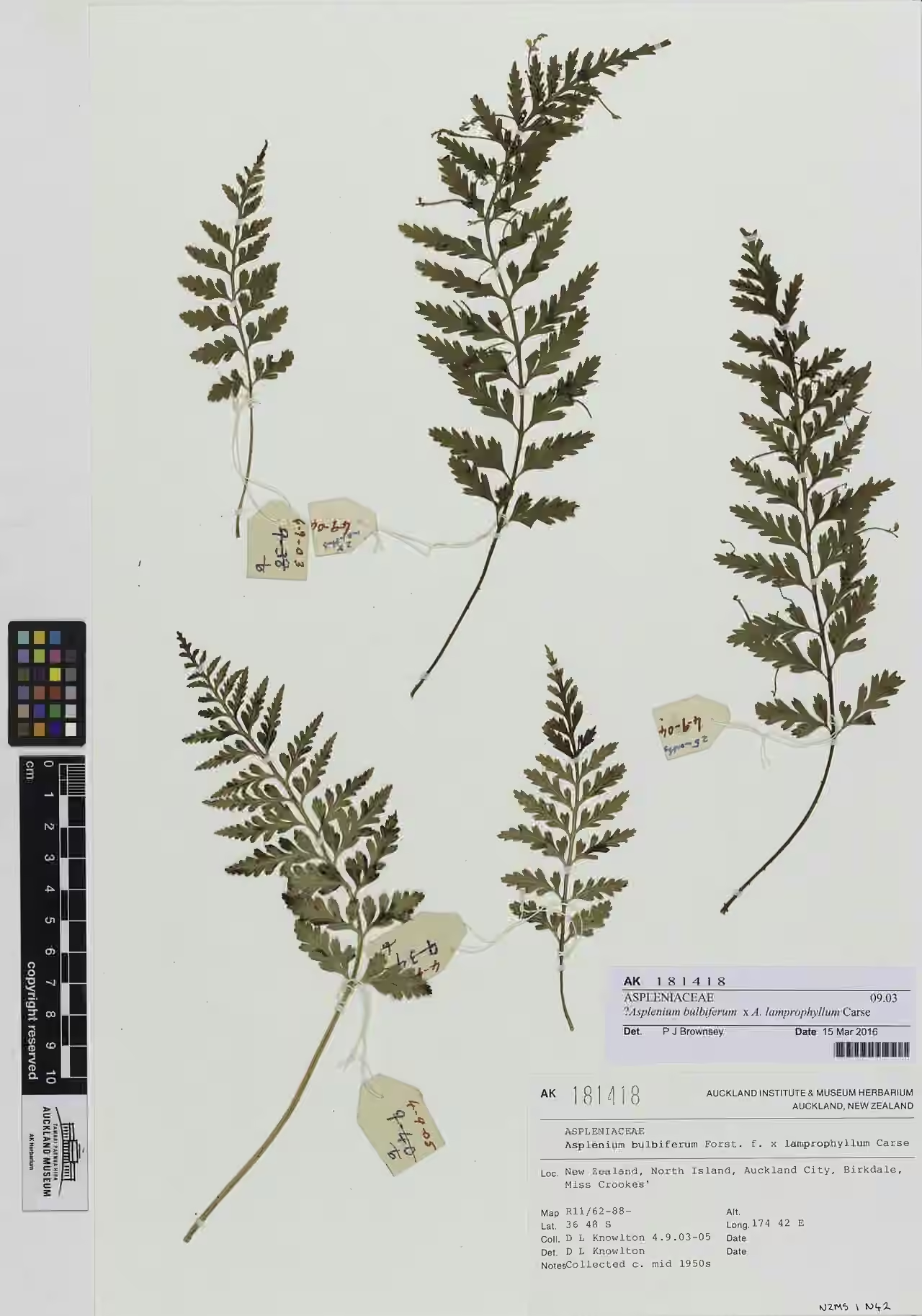
Asplenium lamprophyllum is a terrestrial or occasionally low epiphytic fern with a creeping, stoloniferous rhizome bearing thick-walled scales. The fronds are 21 to 82 cm long overall. The stipes are 6 to 20 cm long, pale green above and brown towards the base. The blade is lanceolate to elliptic, light green and glossy on the upper surface and dull and paler beneath, thin in texture, and one to two times pinnate with lobed segments.
There are about 8 to 25 pairs of stalked, lanceolate primary pinnae, and the secondary pinnae or pinnules are elliptic and often deeply toothed. The sori are long and narrow, 2 to 10 mm, lying closer to the midvein than the margin, with curved indusia and orange-brown sporangia. When crushed, fresh fronds give off a distinct smell of oil of wintergreen.
It is most often confused with hen and chicken fern (Asplenium bulbiferum) and its relatives. Shiny-leaved spleenwort is distinguished by its widely creeping stoloniferous habit, glossy and less finely divided fronds, longer sori and the complete absence of bulbils.
Quick Facts
| Scientific Name | Asplenium lamprophyllum |
|---|---|
| Height | Fronds 0.2 to 0.8 m long |
| Spread | Creeping rhizomes form patches and carpets |
| Water Needs | Moderate; moist but free-draining |
| Light | Shade to semi-shade |
| Frost Tolerance | Low to moderate; a northern lowland forest fern |
| Salt Tolerance | Low; a forest-floor fern with no coastal exposure data |
| Growth Rate | Slow |
| Lifespan | Perennial |
Climate Best Suited to
Suits warm-temperate, humid lowland climates of the northern and central North Island, with mild winters and reliable rainfall. It does best where frosts are light.
Regional Suitability
| City | Climate Suitability |
|---|---|
| Auckland | High |
| Wellington | Medium |
| Christchurch | Low |
| Dunedin | Low |
Plant Habitat
Shiny-leaved spleenwort is endemic to New Zealand. It occurs in the North Island from Te Paki southwards through Northland, Auckland, the Volcanic Plateau and Taranaki to about Whanganui and northern Hawke's Bay, but is only common north of Mokau and Gisborne. The Flora of New Zealand also records it from Arapawa Island in the Marlborough Sounds. It grows from 10 to 600 m above sea level.
It is a fern of shaded forest, mostly within alluvial forest and open podocarp and broadleaved forest. It grows on well-drained soils on steep slopes, clay banks, rock outcrops, logs and the buttresses of swamp trees, on substrates including lava and limestone, and often forms carpets over extensive areas.
Growing Requirements
Soil Requirements
In the wild it grows on well-drained forest soils and organic litter, often on slopes, banks and tree buttresses.
- Deep, rich, humus-laden soil
- Free drainage; avoid sodden ground
- Leaf mould or bark mulch to keep the rhizomes cool
Light Requirements
It always grows in shade in the wild, and NZPCN recommends a semi-shaded site in cultivation.
- Semi-shade to full shade
- Avoid direct afternoon sun, which scorches the thin fronds
Water Requirements
It needs a consistently moist, humid forest environment with good drainage.
- Keep the soil evenly moist
- Water during dry summer spells
- Shelter from drying winds
Planting and Establishing
Plant in autumn or spring into a sheltered, semi-shaded position with deep, rich, free-draining soil, such as under established trees or beside a shaded bank. Work in plenty of compost or leaf mould before planting.
Set the creeping rhizome just at the surface and mulch around it with leaf litter. Give it room to wander, as over time it will creep outwards to form a patch.
Ecological Role
Like all ferns it reproduces by wind-borne spores rather than flowers or seed. Its creeping, stoloniferous rhizomes let it spread vegetatively, which is why it can carpet large areas of forest floor and swamp-tree buttresses.
The dense patches it forms help to hold soil and litter on steep slopes and banks, and provide moist cover for forest-floor invertebrates and seedlings in alluvial and podocarp forest.
Uses & Significance
Garden Uses
It is a handsome, glossy ground fern for shady gardens in warmer parts of New Zealand.
- Shade ground cover under trees
- Covering shaded banks and rockeries
- Fern gardens and woodland plantings
- Large containers in sheltered courtyards
Ecological Value
It is a characteristic ground fern of northern alluvial and podocarp forest.
- Stabilises soil and litter on slopes and banks
- Carpets the buttresses of swamp forest trees
- Part of the endemic fern diversity of northern forests
Landscaping Uses
Use it as a glossy, light green carpet in the shade of trees or along a damp but free-draining woodland path. Its brightness lifts dark corners, and it contrasts well with the dark, leathery fronds of crown ferns and the broad leaves of kawakawa.
Because it spreads slowly, plant several pieces close together if quick cover is wanted, and allow it to merge into a continuous patch over a few years.
Seasonal Care Calendar
Spring
New fronds unfurl from the creeping rhizome as the soil warms.
- Top up leaf mulch
- Divide or plant new pieces
Summer
Fronds mature and the long orange-brown sori develop on the undersides.
- Water in dry spells
- Collect spores when sori are ripe
Autumn
Fronds remain green and glossy; a good season for planting in mild districts.
- Plant out new divisions
- Keep moist
Winter
Growth slows; the fronds persist through mild winters.
- Protect from hard frost in cooler areas
When to Prune and How Much
No regular pruning is needed. Remove old, brown or damaged fronds at the base in early spring to keep the patch tidy.
If the patch spreads too far, sever and lift the outer rhizomes and pot them up for planting elsewhere.
How to Grow Shiny-Leaved Spleenwort
NZPCN describes shiny-leaved spleenwort as easily grown but rather slow. It does not form bulbils on its fronds, unlike hen and chicken fern, so it is propagated from spores or by dividing its creeping rhizomes. Division gives larger plants quickly, while spores can produce many plants but take longer. Use material from garden plants or collect only small amounts with landowner permission.
From Spores
Spores are produced in the long sori on the underside of the fronds. Collect a fertile frond when the sporangia turn orange-brown but before they have released their spores, and sow onto a sterile surface. The first green prothalli appear after a few weeks, and young ferns with recognisable fronds follow over several months.
- Pick a fertile frond with ripe orange-brown sori
- Lay it on clean paper in a dry room for a few days to release spores
- Sterilise a fine, moist seed mix with boiling water and let it cool
- Dust the spores thinly over the surface
- Cover with clear plastic or glass and keep in warm, indirect light
- Keep the surface constantly moist by misting with boiled water
- Prick out clumps of young ferns once fronds develop and grow on in pots in shade
By Division of Rhizomes
The creeping, stoloniferous rhizome readily produces new fronds and roots along its length, so established patches can be divided. Make sure each piece has a growing tip and some roots.
- In spring or autumn, lift a section of rhizome with fronds and roots
- Cut into pieces each with at least one growing tip
- Pot into rich, free-draining mix or replant directly
- Keep shaded and moist until new fronds appear
Pests & Diseases
No serious pests are recorded for this fern. Slugs and snails can damage young fronds, and in dry, sheltered conditions scale insects may appear on the fronds.
Drying out and hot sun are the main causes of poor growth in gardens. In the wild, clearance and drainage of alluvial forest, and browsing by pigs, goats and deer in some forests, reduce its habitat.
Cultural Significance
No Māori name or traditional use specific to Asplenium lamprophyllum is recorded in the sources consulted.
The name lamprophyllum comes from the Greek lampro, shining, and phyllus, leaved, referring to its glossy fronds. The genus name Asplenium means without spleen, recalling the old European belief that spleenworts could treat ailments of the spleen.
Bonus Tip
If you are unsure whether a fern is this species or hen and chicken fern, gently crush a fresh frond and smell it. A clear scent of wintergreen confirms shiny-leaved spleenwort, and you will also find no bulbils on the frond.
Related Plants
Explore other native plants that share similar characteristics or habitats with Shiny-Leaved Spleenwort (Asplenium lamprophyllum), offering further insights into New Zealand's diverse flora. These related species provide context and opportunities for complementary planting in your garden.
Anisotome lanuginosa
Anisotome lanuginosa
Odd-Leaved Orchid
Aporostylis bifolia
Glossy Fern
Arachniodes aristata
Argyrotegium mackayi
Argyrotegium mackayi
Asplenium shuttleworthianum
Asplenium shuttleworthianum
Native Orache
Atriplex australasica
Limestone Wheatgrass
Australopyrum calcis subsp. calcis
Canterbury Limestone Wheat Grass
Australopyrum calcis subsp. optatum
Plant Conservation
Asplenium lamprophyllum is ranked Not Threatened (2023). Regionally it is Not Threatened in Northland (2026) and Auckland (2025, data-poor qualifiers), but in the Wellington region, near the southern edge of its range, it is assessed as Regionally Threatened - Regionally Critical (2025).
Its main threat is loss and degradation of lowland alluvial and swamp forest, much of which has been cleared. Protecting remaining forest remnants, fencing out stock and controlling browsing animals help this fern persist.
Frequently Asked Questions
Why does Asplenium lamprophyllum smell of wintergreen?
NZPCN and the Flora of New Zealand both note that fresh fronds smell of oil of wintergreen when crushed, a useful field character that separates it from other New Zealand spleenworts.
How is shiny-leaved spleenwort different from hen and chicken fern?
Unlike hen and chicken fern (Asplenium bulbiferum), it has a widely creeping, stoloniferous rhizome, glossy and less divided fronds, longer sori of 2 to 10 mm, thick-walled scales, and it never produces bulbils on its fronds.
Where does Asplenium lamprophyllum grow?
It is found in the North Island from Te Paki south to near Whanganui and northern Hawke's Bay, and is most common north of Mokau and Gisborne, in shaded lowland to montane forest.
Is shiny-leaved spleenwort easy to grow?
NZPCN describes it as easily grown but rather slow, doing best in semi-shade in deep, rich, free-draining soil, and calls it a beautiful plant that deserves wider cultivation.
Sources and Further Reading
The botanical, growing, and conservation details for Shiny-Leaved Spleenwort (Asplenium lamprophyllum) on this page draw on the New Zealand plant references below. Consult them for full technical records and the latest distribution data.