Odd-Leaved Orchid
Aporostylis bifolia
Last updated:
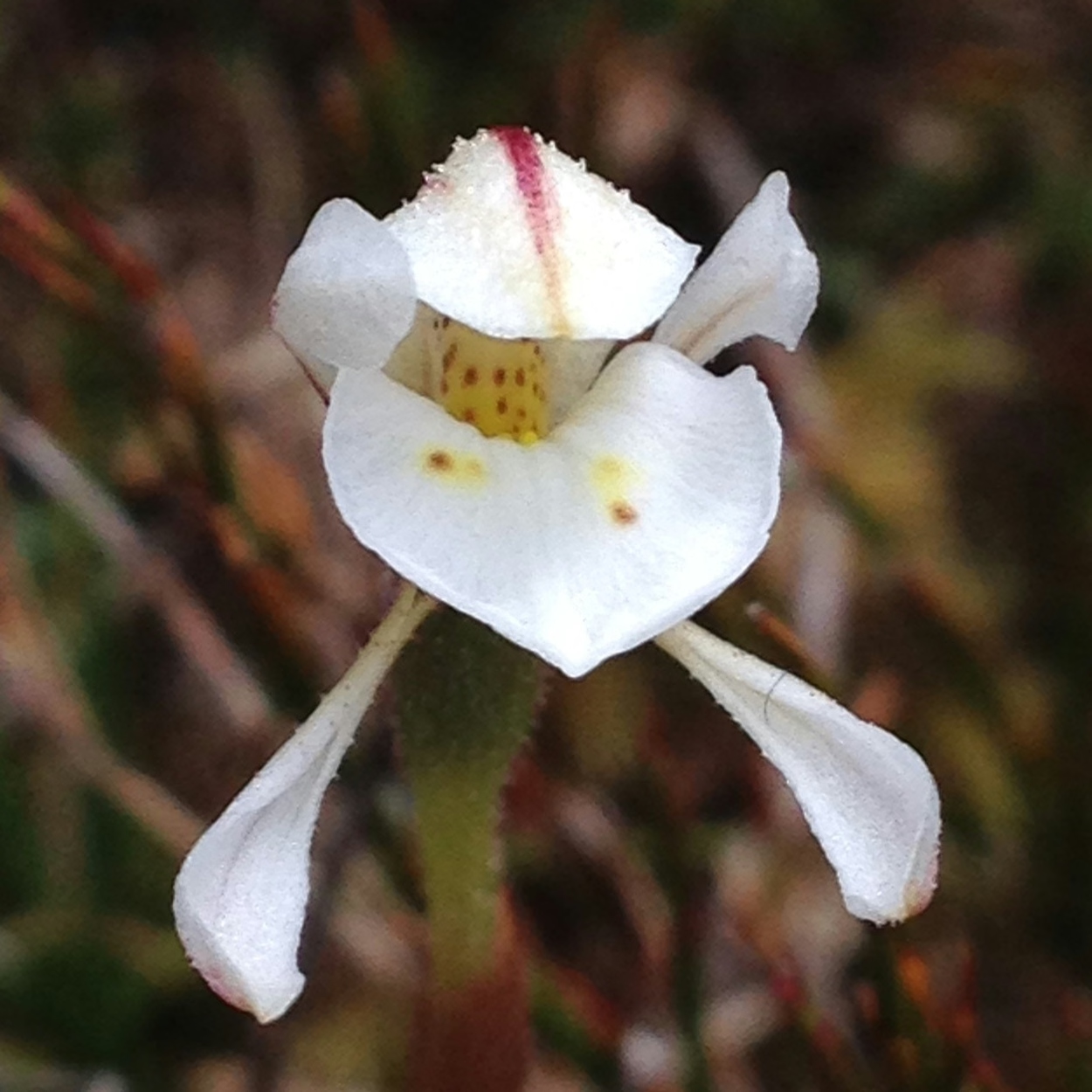
The odd-leaved orchid (Aporostylis bifolia) is a small terrestrial orchid and the only member of a genus found nowhere but New Zealand. Up to 20 cm tall in flower, it has two broad leaves near the base of the stem and a single glandular-hairy white or pink flower about 2.5 cm across, with rows of yellow calli on the lip. It ranges from Te Moehau on the Coromandel south through the South Island and Stewart Island to the Chatham, Antipodes, Auckland and Campbell Islands, growing in bogs, seepages, tussock grassland, shrubland and forest. It is Not Threatened but should not be dug from the wild. Explore more native flowering plants in our native plant guide.
Plant Description
Aporostylis bifolia is a stocky, glandular-hairy terrestrial orchid that grows from a rounded to cone-shaped underground tuber. It is green from spring to summer and then dies back to the tuber. At flowering it stands up to 20 cm tall on an erect, slender stem. The two leaves sit near the base of the stem; they are linear-lanceolate to broadly ovate-oblong, up to about 15 cm long, short-stalked and often blotched with brown.
The single flower is about 2.5 cm across, white or pink, and glandular-hairy on the outside. The lip (labellum) is simple, broadly expanded and rounded to obovate with a narrow base, carrying two central rows of yellow calli near its base. After flowering, the ovary swells into a capsule containing many dust-like seeds.
It is most likely to be confused with species of Caladenia and Chiloglottis because of its broad, shortly stalked leaves, and it was once placed in both genera. The broader ovate-oblong leaves, glandular-hairy flower, white or pink sepals and petals and the two rows of yellow calli on the lip identify it.
Quick Facts
| Scientific Name | Aporostylis bifolia |
|---|---|
| Height | 0.05 to 0.2 m in flower |
| Spread | A single small plant; leaves up to 15 cm long |
| Water Needs | Moist to wet; bogs and seepages |
| Light | Full sun to partial shade |
| Frost Tolerance | High; reaches the subalpine zone and subantarctic islands |
| Salt Tolerance | Some; descends to coastal sites in the far south, but no tolerance data published |
| Growth Rate | Slow; seasonal growth from a tuber |
| Lifespan | Perennial (tuberous, dies back each year) |
Climate Best Suited to
Suits cool, moist temperate to subantarctic climates, from the North Island mountains to the cold, wet islands south of New Zealand. It is not adapted to warm, dry lowland conditions.
Regional Suitability
| City | Climate Suitability |
|---|---|
| Auckland | Low |
| Wellington | Medium |
| Christchurch | Medium |
| Dunedin | High |
Plant Habitat
The odd-leaved orchid occurs in the North Island from Te Moehau at the tip of the Coromandel Peninsula southward, throughout the South Island, and on Stewart Island/Rakiura, the Chatham Islands, Antipodes Islands, Auckland Islands and Campbell Island/Motu Ihupuku. Wikipedia notes records from alpine tussock in Kahurangi National Park and the Silverpeaks near Dunedin.
In the northern part of its range it is subalpine to high montane, but in the southern half it descends to lowland and coastal habitats. It grows in bogs, seepages and damp open ground, shrubland, tussock grassland and forest margins, and NZPCN notes it can also turn up in plantation forest.
Growing Requirements
Soil Requirements
It grows in damp, often peaty or acidic soils where the orchid's tuber and its fungal partners can persist from year to year.
- Moist, organic or peaty soil
- Low fertility; no fertiliser
- Relies on soil fungi for germination and growth
Light Requirements
Most populations grow in open bog, tussock and seepage sites, though it also occurs in shrubland and forest.
- Full sun in cool, moist sites
- Tolerates light shade under shrubs or forest
Water Requirements
It favours wet ground such as bogs and seepages, and is active during the moist spring and summer before dying back.
- Needs reliable moisture in the growing season
- Avoid drying out while in leaf and flower
- The dormant tuber tolerates seasonal change below ground
Planting and Establishing
The odd-leaved orchid is not a garden plant and is not commercially available. Like most New Zealand ground orchids it depends on specific soil fungi, and plants dug from the wild almost always die, so it should be left where it grows.
The best way to have it near you is to protect and restore the habitats where it already occurs, such as wet tussock, bog margins and seepages, and to avoid draining, spraying or mowing those areas during spring and summer.
Ecological Role
The pollinators of Aporostylis bifolia are not documented in the sources consulted. Its relatives in subtribe Caladeniinae are typically insect pollinated, but no specific study of this species was found.
Like other orchids it produces huge numbers of tiny dust-like seeds that are carried on the wind and need to land where a compatible mycorrhizal fungus is present in order to germinate. Each year the plant grows from a tuber, flowers, replaces its tuber and dies back, which lets it survive cold winters and dry periods underground.
Uses & Significance
Garden Uses
Garden use is not realistic for this orchid; its value is in the wild.
- Enjoy and photograph it in subalpine bogs and tussock
- Protect it where it appears on private land
- Not suitable for transplanting or container culture
Ecological Value
It is a characteristic plant of damp open habitats throughout southern New Zealand.
- The sole species of an endemic orchid genus
- Part of the bog and tussock flora of the subantarctic islands
- Supports and depends on native soil fungi
Landscaping Uses
Aporostylis bifolia has no landscaping use. Where it already grows in a rural property, wetland restoration project or reserve, keeping the area free of drainage, heavy grazing and weed invasion is the best way to retain it.
In restoration of bogs and wet tussock it may reappear naturally once suitable conditions return, as its wind-borne seed can travel some distance.
Seasonal Care Calendar
Spring
Leaves emerge from the tuber, and the earliest flowers can open from October.
- Avoid mowing or spraying known sites
- Look for the paired, often blotched leaves
Summer
Main flowering season, especially December and January, with white or pink flowers on short stems.
- Best time to see it in subalpine bogs and tussock
- Capsules begin forming from December
Autumn
Capsules ripen and release dust-like seed through to about May, and the leaves wither.
- Leave seed capsules undisturbed
Winter
The plant is dormant below ground as a tuber.
- Avoid soil disturbance at known sites
When to Prune and How Much
No pruning is needed or appropriate. The leaves and flower stem die back naturally after fruiting, returning their resources to the new tuber.
Do not cut leaves or flowers, as the plant relies on its two leaves to build up the tuber for the following year.
How to Grow Odd-Leaved Orchid
NZPCN describes the odd-leaved orchid as difficult to propagate and says it should not be removed from the wild. Like other terrestrial orchids, its tiny seeds have almost no food reserve and germinate only with the help of a compatible mycorrhizal fungus. The plant also renews itself each year from an underground tuber, and some ground orchids produce extra daughter tubers, but no record of tuber increase was found for this species. Propagation is therefore a specialist laboratory or research activity rather than something for home gardeners.
From Seed (laboratory)
Orchid seed of this kind is normally raised by symbiotic germination, in which seed is sown on a sterile agar medium together with a fungus isolated from the roots of wild plants. Researchers working with native ground orchids use this method under permit, and success varies between species. No published protocol specific to Aporostylis bifolia was found.
- Obtain any necessary permits and landowner permission before collecting
- Collect a mature capsule just before it splits open
- Surface-sterilise the seed in the laboratory
- Sow onto sterile oat-based agar inoculated with a compatible mycorrhizal fungus
- Incubate in darkness until protocorms form, then move to light
- Deflask young plants into a sterile, open mix and keep cool and moist
From Tubers
Because the plant survives each year as a tuber, moving dormant tubers is sometimes suggested for ground orchids. For this species it is not recommended: wild plants should not be dug up, and tubers separated from their fungal partners usually decline within a few seasons.
- Leave wild tubers in place
- Protect the soil and moisture regime at existing sites instead
Pests & Diseases
Slugs and snails graze the leaves and flower buds of many native ground orchids, and browsing by introduced mammals such as deer, hares and rabbits can remove flowering stems before seed is set.
Habitat loss is a greater issue than pests. Drainage of bogs and seepages, weed invasion and intensive grazing all reduce suitable damp open ground.
Cultural Significance
No Māori name or traditional use specific to the odd-leaved orchid is recorded in the sources consulted.
The genus name Aporostylis means perplexing style, reflecting the puzzle its column structure posed to early botanists. The species has passed through several genera, including Caladenia and Chiloglottis, before being placed in its own genus by Rupp and Hatch.
Bonus Tip
Look for the odd-leaved orchid in summer on boardwalks across subalpine bogs and wet tussock in the South Island and on Stewart Island. The paired leaves at ground level are often noticed first, and in the far south it can even be found close to sea level.
Related Plants
Explore other native plants that share similar characteristics or habitats with Odd-Leaved Orchid (Aporostylis bifolia), offering further insights into New Zealand's diverse flora. These related species provide context and opportunities for complementary planting in your garden.
Anisotome capillifolia
Anisotome capillifolia
Anisotome deltoidea
Anisotome deltoidea
Haast's Carrot
Anisotome haastii
Anisotome lanuginosa
Anisotome lanuginosa
Glossy Fern
Arachniodes aristata
Argyrotegium mackayi
Argyrotegium mackayi
Shiny-Leaved Spleenwort
Asplenium lamprophyllum
Asplenium shuttleworthianum
Asplenium shuttleworthianum
Plant Conservation
Aporostylis bifolia is ranked Not Threatened (2023) and has been assessed as Not Threatened in every national assessment since 2004. It is widespread and often common, especially in the southern South Island, Stewart Island and the subantarctic islands.
Its main pressures are loss of wetlands and damp open ground through drainage and land development. Protecting bogs, seepages and tussock grassland, and controlling browsing animals in high country, keeps it secure.
Frequently Asked Questions
Why is Aporostylis bifolia called the odd-leaved orchid?
Its name refers to the leaves: bifolia means two-leaved, and the plant bears a pair of broad, short-stalked leaves near the base, often of unequal size and sometimes blotched with brown.
When does the odd-leaved orchid flower?
NZPCN gives flowering from October to March, with the main season in December and January according to the Flora of New Zealand. Seed capsules develop from December to May.
Where can I see Aporostylis bifolia?
It is common in subalpine and montane bogs, seepages and tussock grassland from the Coromandel southward, and in the south it also grows at low altitude and near the coast, including on Stewart Island and the subantarctic islands.
Can you grow odd-leaved orchids at home?
NZPCN describes it as difficult to cultivate, says it is not commercially available and advises that it should not be removed from the wild.
Sources and Further Reading
The botanical, growing, and conservation details for Odd-Leaved Orchid (Aporostylis bifolia) on this page draw on the New Zealand plant references below. Consult them for full technical records and the latest distribution data.