Haast's Carrot
Anisotome haastii
Last updated:
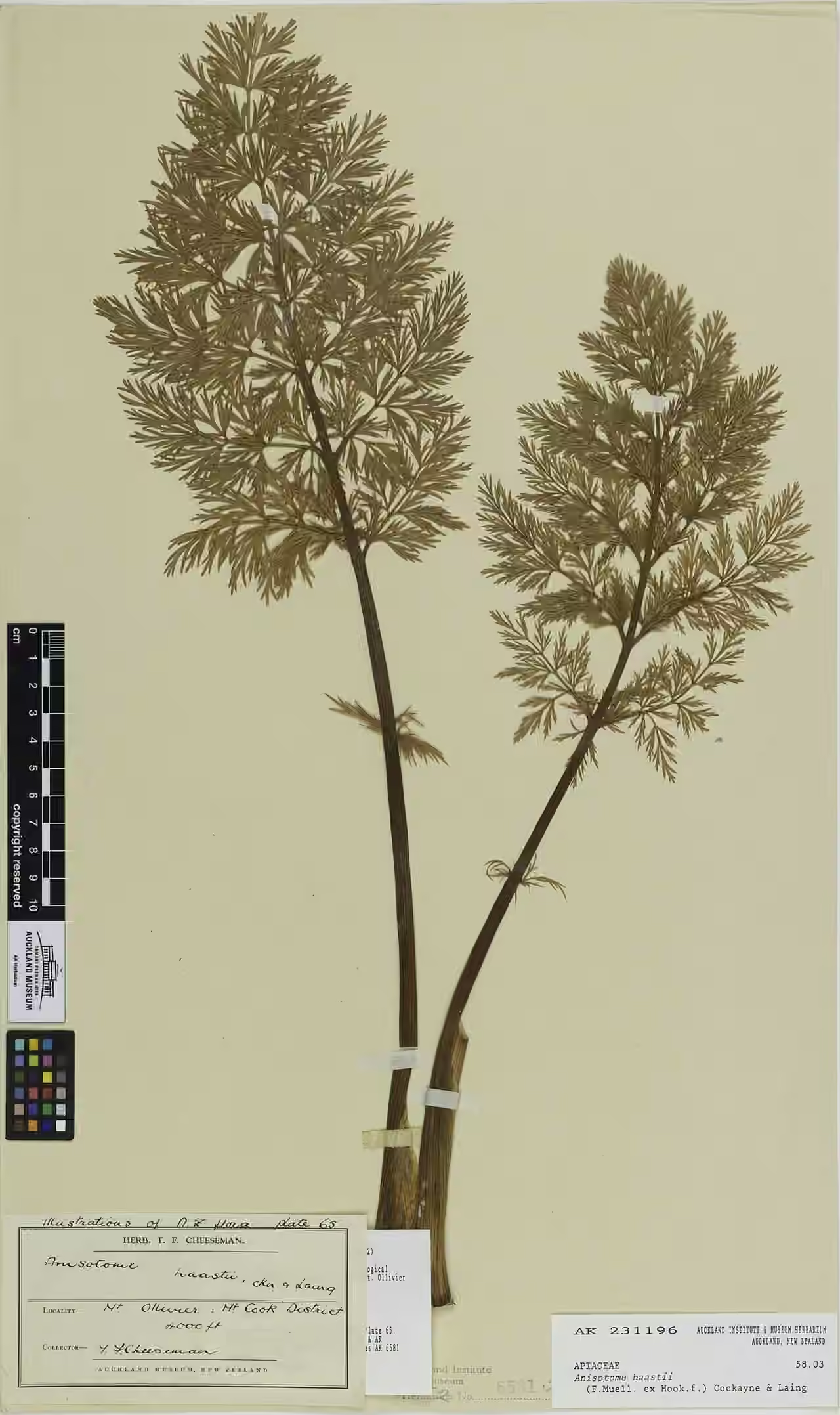
Haast's carrot (Anisotome haastii) is an endemic New Zealand member of the carrot family that grows in the mountains of the South Island. It forms a tuft of finely divided, fern-like leaves up to about 25 cm long, from which stout, grooved flowering stems rise 30 to 60 cm carrying many umbels of small white flowers between October and February. It grows in montane to subalpine rocky places, shingly ground, fellfield and herbfield, mainly along and west of the Main Divide. It is ranked Not Threatened and is one of the more attractive Anisotome species for a cool alpine or rock garden. Explore more native flowering plants in our native plant guide.
Plant Description
Anisotome haastii is a tufted, aromatic perennial herb arising from a stout stock about 2 to 3 cm across. The leaves sit on stout stalks and have an ovate-oblong blade 15 to 25 cm long and 6 to 12 cm wide that is two to three, occasionally four, times pinnate. There are 8 to 12 pairs of primary leaflets, and the secondary leaflets are deeply cut into narrow linear lobes tipped with fine hair-like points, giving the foliage a lacy, fern-like look.
The flowering stems are rather stout, grooved and 30 to 60 cm tall. They carry many umbels arranged in a loose, branching cluster, each made up of small white flowers with petals about 3 mm long. The fruits are narrow-ovoid, 4 to 6 mm long, and split into two winged halves (mericarps) that are carried away by the wind.
Among the Anisotome species of the southern mountains, Haast's carrot is recognised by the combination of its large, very finely dissected leaves with hair-pointed lobes and its tall, many-umbelled white flower heads. Species such as Anisotome aromatica are much smaller with simpler, once-pinnate leaves, while the large megaherb Anisotome latifolia of the subantarctic islands has broad, coarsely toothed leaflets and pink flowers.
Quick Facts
| Scientific Name | Anisotome haastii |
|---|---|
| Height | Foliage to about 0.25 m; flowering stems 0.3 to 0.6 m |
| Spread | 0.3 to 0.5 m |
| Water Needs | Moderate; moist but sharply drained |
| Light | Full sun |
| Frost Tolerance | High; a montane to subalpine species |
| Salt Tolerance | Low; an inland mountain plant with no coastal occurrence |
| Growth Rate | Slow to moderate |
| Lifespan | Perennial |
Climate Best Suited to
Suits a cool to cold, moist mountain climate with cold winters, reliable rainfall and cool summers. It performs poorly in warm, humid lowland conditions.
Regional Suitability
| City | Climate Suitability |
|---|---|
| Auckland | Low |
| Wellington | Low |
| Christchurch | Medium |
| Dunedin | Medium |
Plant Habitat
Haast's carrot is endemic to the South Island. The Flora of New Zealand describes it as occurring mainly along and west of the Main Divide and as rather local in the northern part of its range. It is most familiar from the wetter western mountains, including western Otago and Fiordland, and is uncommon on the drier eastern side of the Alps.
Its habitats are montane to subalpine rocky places, shingly ground, fellfield and occasionally herbfield, where it grows among snow tussocks, rocks and other alpine herbs. These sites are cold in winter, often snow-covered, and well watered but quick-draining.
Growing Requirements
Soil Requirements
In the wild it roots into stony, shingly or rocky mountain soils that hold moisture yet drain freely. In gardens the key is sharp drainage around the crown.
- Gritty, free-draining mix with plenty of crushed rock or scoria
- Moderate fertility; avoid rich, heavily fertilised beds
- Avoid heavy clay and any site where water lies in winter
Light Requirements
It grows in open fellfield and herbfield above or at the bushline, fully exposed to sun and wind.
- Full sun in cool districts
- Light afternoon shade can help in warmer gardens
- Good air movement reduces fungal problems
Water Requirements
Its home mountains have high rainfall and snow melt, so it expects steady moisture during the growing season but never stagnant water.
- Keep evenly moist in spring and summer
- Water deeply during dry spells rather than little and often
- Keep drier and well drained over winter
Planting and Establishing
Plant young, pot-grown seedlings in autumn or early spring into a raised rock garden bed, scree or a large container filled with a gritty alpine mix. Because established plants resent root disturbance, choose the final position early and handle the root ball gently.
Set the crown level with the surface and top-dress with fine gravel so that water runs away from the base of the leaves. Give each plant about half a metre of space so that the foliage and later the flowering stems are not crowded by neighbours.
Ecological Role
The open umbels of small white flowers are typical of the carrot family and are accessible to a wide range of short-tongued insects. Native flies, small bees and beetles are the likely visitors in subalpine herbfield, though no species-specific pollination study was found.
The fruits split into two flattened, winged mericarps that are dispersed by wind across fellfield and shingle. As a long-lived perennial herb it forms part of the mixed herbfield community that stabilises rocky ground above the treeline.
Uses & Significance
Garden Uses
In cool southern gardens Haast's carrot is a striking foliage and flowering plant for alpine collections.
- Rock gardens and scree beds
- Alpine house or large trough plantings
- Feature plant in native alpine collections for its lacy foliage
- Contrast plant beside tussocks and cushion plants
Ecological Value
In the wild it contributes nectar and pollen to the short subalpine flowering season.
- Umbels offer an open food source for small native insects
- Wind-dispersed seed helps colonise shingle and rocky ground
- Part of the endemic herbfield flora of the South Island mountains
Landscaping Uses
Use it as a mid-height accent in an alpine scree, where the finely cut foliage contrasts with the strap leaves of snow tussocks (Chionochloa) and the rosettes of mountain daisies (Celmisia). The white umbels stand above the foliage in summer and look best against a dark rock backdrop.
It is not a plant for warm northern gardens. In Canterbury, Otago and Southland it can be grown in a raised, gravel-mulched bed or a deep trough, grouped with other subalpine natives that share its need for cool roots and good drainage.
Seasonal Care Calendar
Spring
New leaves unfurl from the crown and the first flowering stems begin to appear from October.
- Remove dead foliage from the crown
- Begin watering if spring is dry
Summer
Main flowering season, with white umbels held well above the foliage, followed by developing fruit from December.
- Keep evenly moist
- Mark seed heads you want to collect
Autumn
Fruits ripen until about March and split into winged halves; leaves begin to fade.
- Collect ripe seed and sow fresh
- Cut spent flowering stems if seed is not wanted
Winter
The plant dies back towards its stout stock and rests, as it would under snow in the mountains.
- Keep the crown free of lying water
- Avoid disturbing the roots
When to Prune and How Much
Haast's carrot needs no structural pruning. Remove spent flowering stems once seed has been collected or has dispersed, cutting them back to the base.
In late winter or early spring tidy away dead and yellowed leaves around the crown so that new growth can emerge freely and fungal rots have less to feed on.
How to Grow Haast's Carrot
Haast's carrot is propagated from seed. Like many members of the carrot family it forms a deep, fleshy root system and dislikes being disturbed, so division of established plants is not recommended. Seed is the practical method and should be collected from cultivated plants or, with permission, in small amounts from large wild populations. Fresh seed gives the best results because umbellifer seed often loses viability or becomes more dormant with storage.
From Seed
Collect fruits in late summer or early autumn when they have turned brown and are starting to split into their two winged halves. Sow immediately in a cool place. Germination can be slow and irregular, and seed sown in autumn often waits until after the winter cold before seedlings appear in spring, mirroring what happens under snow in the mountains.
- Collect ripe, dry fruits from the umbels in late summer or early autumn
- Fill trays with a gritty seed mix of fine bark and pumice or grit
- Sow seed on the surface and cover lightly with fine grit
- Place the tray outdoors in a cool, sheltered position over winter
- Keep the mix just moist and do not discard trays if nothing appears for several months
- Prick seedlings out into deep individual pots while still small to protect the developing root
- Grow on in a cool, bright spot and plant out when the pots are well rooted
Seedling Transplanting
Because established plants resent root disturbance, move young plants only once, from their pot to their final position, keeping the root ball intact. Deep pots such as tree tubes suit the fleshy root better than shallow punnets.
- Water the pot well the day before planting
- Slide the plant out without breaking the root ball
- Plant at the same depth into gritty, free-draining soil
- Water in and top-dress with gravel around the crown
Pests & Diseases
In cultivation the main risk is crown and root rot in warm, humid conditions or in soils that stay wet in winter. Good drainage, a gravel collar around the crown and an open, airy position are the best defence.
Slugs and snails will graze emerging leaves in spring, and aphids sometimes cluster on flowering stems. In the wild, introduced browsing animals such as deer and hares can eat palatable alpine herbs, though Haast's carrot remains widespread.
Cultural Significance
Several Anisotome species are aromatic, and the genus is related to the native carrots and Aciphylla, but no traditional Māori name or use specific to Anisotome haastii is recorded in the sources consulted.
The species is named after Sir Julius von Haast, the German-born geologist and explorer who became the first director of the Canterbury Museum and whose collections in the 1860s added many alpine plants to the New Zealand flora.
Bonus Tip
Sow Haast's carrot seed straight into deep tubes rather than shallow trays and leave the seedlings there until planting out. This avoids the root disturbance the species dislikes and gives the fleshy taproot room to develop before it goes into the garden.
Related Plants
Explore other native plants that share similar characteristics or habitats with Haast's Carrot (Anisotome haastii), offering further insights into New Zealand's diverse flora. These related species provide context and opportunities for complementary planting in your garden.
Anisotome antipoda
Anisotome antipoda
Native Carrot
Anisotome brevistylis
Anisotome capillifolia
Anisotome capillifolia
Anisotome deltoidea
Anisotome deltoidea
Anisotome lanuginosa
Anisotome lanuginosa
Odd-Leaved Orchid
Aporostylis bifolia
Glossy Fern
Arachniodes aristata
Argyrotegium mackayi
Argyrotegium mackayi
Plant Conservation
Anisotome haastii is ranked Not Threatened (2023) in the New Zealand Threat Classification System, and Otago's 2025 regional assessment also lists it as Regionally Not Threatened. It is common through much of the wetter South Island mountains.
Like other palatable alpine herbs it benefits from control of deer, chamois, tahr and hares in high country, and from keeping weeds such as heather and lupins out of fellfield and herbfield.
Frequently Asked Questions
Where does Haast's carrot grow in the wild?
It grows in the South Island mountains from the montane to the subalpine zone, mainly along and west of the Main Divide, on rocky places, shingle, fellfield and herbfield. It is local in the northern part of its range.
When does Anisotome haastii flower?
The Flora of New Zealand records flowering from October to February and fruiting from December to March, so plants are usually in bloom through late spring and summer.
Who is Anisotome haastii named after?
The epithet honours Sir Julius von Haast (1822 to 1887), the New Zealand geologist and botanist who explored much of the South Island high country.
Can I grow Haast's carrot in a garden?
Yes, in a cool climate. It needs full sun, sharply free-draining gritty soil and low humidity, and is usually raised from fresh seed. It struggles in warm, humid, sheltered gardens and heavy wet soils.
Sources and Further Reading
The botanical, growing, and conservation details for Haast's Carrot (Anisotome haastii) on this page draw on the New Zealand plant references below. Consult them for full technical records and the latest distribution data.