Anisotome
Anisotome antipoda
Last updated:
Anisotome antipoda is a stout subantarctic herb in the carrot family, endemic to New Zealand's Auckland Islands, Campbell Island/Motu Ihupuku and Antipodes Islands. It grows up to about 1 to 1.2 m tall from a very stout stock and deep taproot, with large, rigid, finely divided leaves and umbels of dark pink to magenta flowers, sometimes paler or white. It is one of the colourful megaherbs of the subantarctic, growing from sea level to about 570 m on cliffs, rock ledges, wet peat and herbfield. Once heavily browsed on Campbell Island, it has recovered since farm animals were removed and is ranked At Risk - Naturally Uncommon. Explore more native flowering plants in our native plant guide.
Plant Description
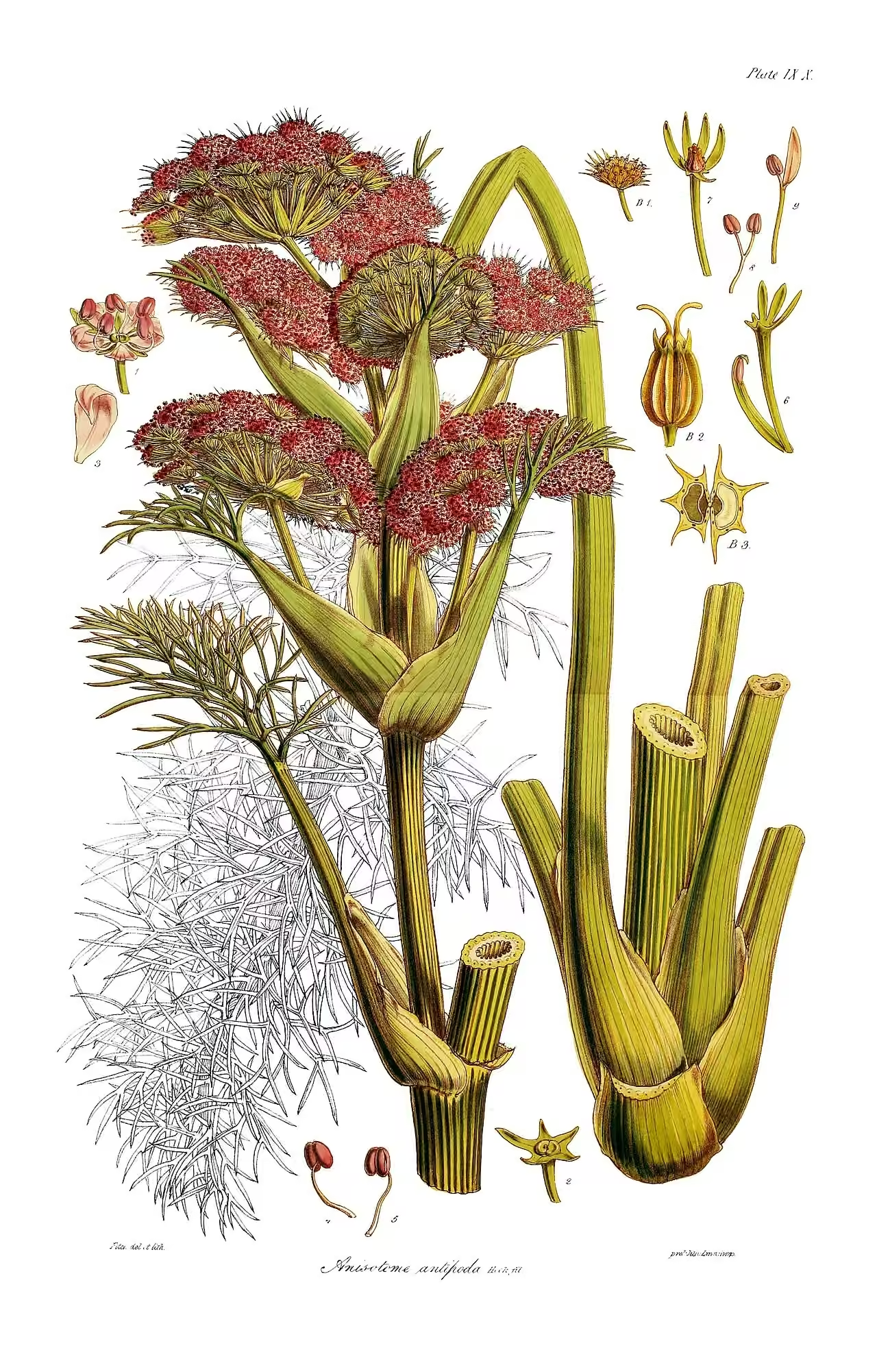
Anisotome antipoda is a very robust perennial herb up to about 1 to 1.2 m tall. It arises from a very stout stock with a deeply descending taproot, and its flowering stems are deeply furrowed. The basal leaves are large, 0.1 to 0.6 m long and 6 to 15 cm wide, rigid and deeply divided, with five to ten pairs of primary leaflets cut into narrow, linear segments with sharp, pungent tips.
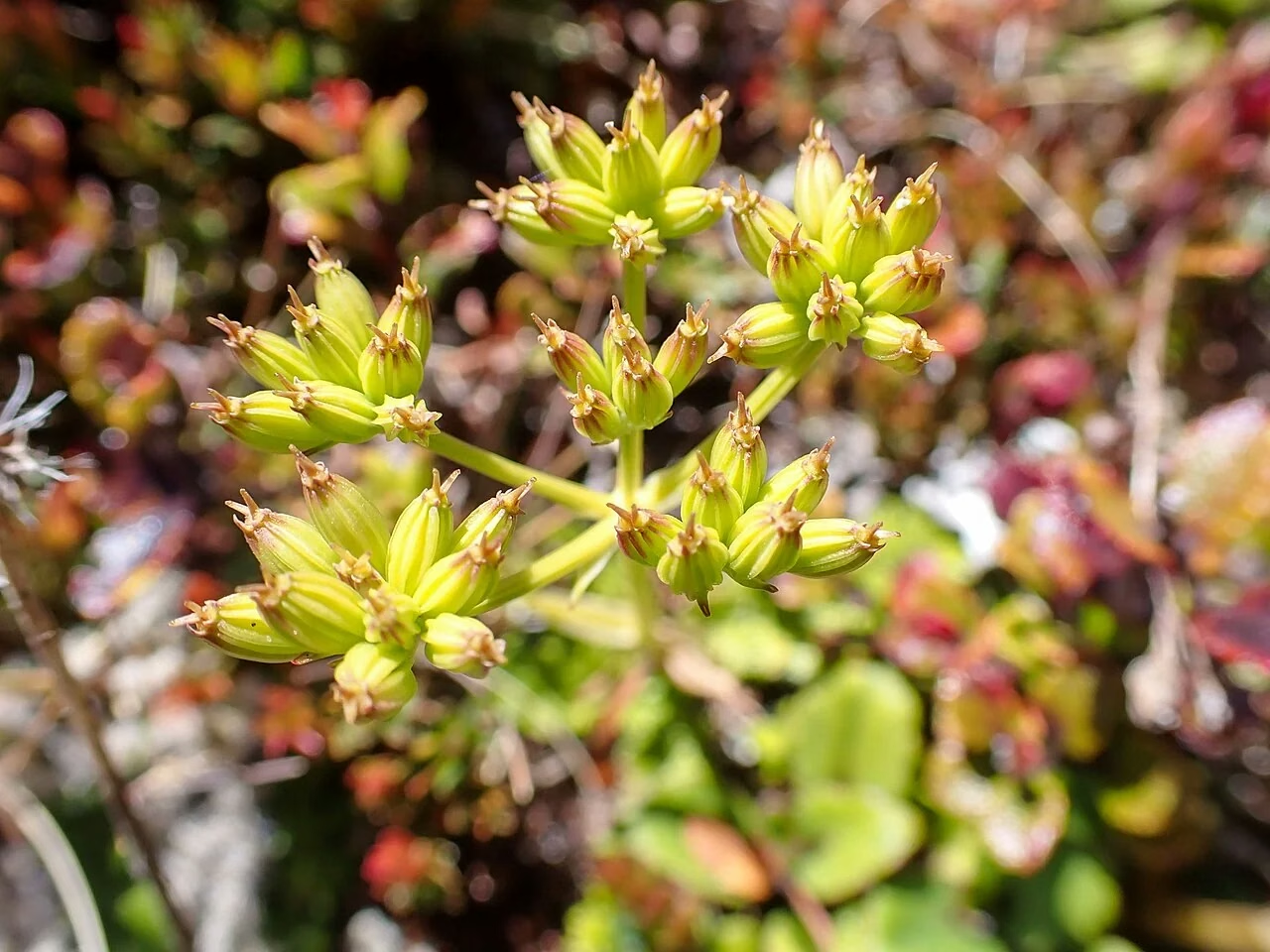
The flowers are carried in compound umbels. NZPCN describes them as dark pink to magenta, and the Flora of New Zealand records the petals as reddish mauve to white. The fruits are narrowly elliptic to oblong mericarps, 5 to 7 mm long.
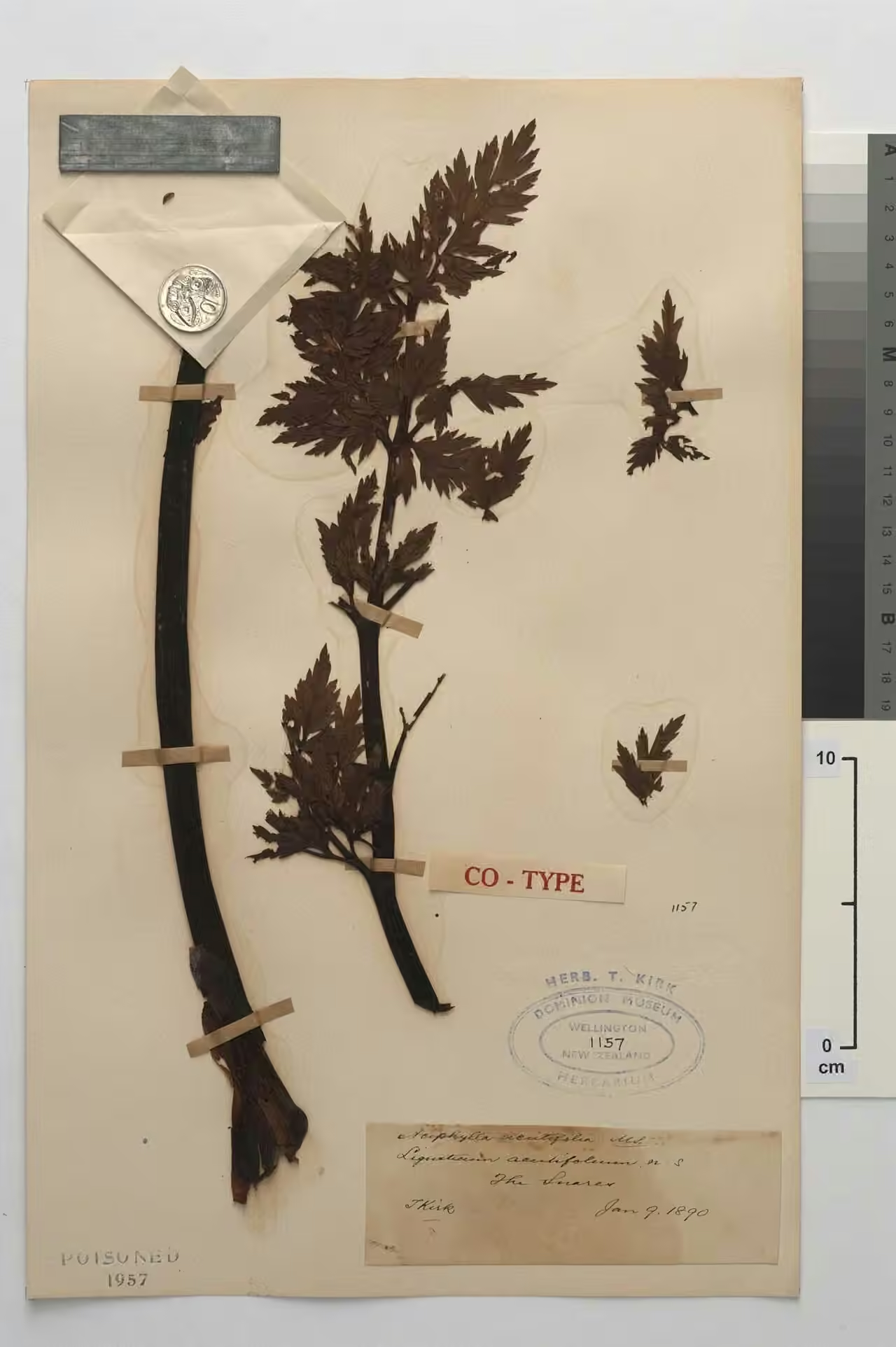
It is distinguished from its subantarctic relative Anisotome latifolia by its much finer, narrowly segmented, sharp-tipped leaves, whereas A. latifolia has broad, soft leaflets. On the Snares, the related A. acutifolia has whitish flowers and much larger, softer leaves.
Quick Facts
| Scientific Name | Anisotome antipoda |
|---|---|
| Height | Up to 1-1.2 m |
| Spread | Basal leaves up to 0.6 m long |
| Water Needs | High; wet peat and seepage |
| Light | Full sun to light shade |
| Frost Tolerance | Cold tolerant, but dislikes warmth and humidity |
| Salt Tolerance | Grows on coastal cliffs exposed to salt spray |
| Growth Rate | Moderate |
| Lifespan | Perennial |
Climate Best Suited to
Adapted to the cold, windy, wet and cloudy oceanic climate of New Zealand's subantarctic islands. It struggles in warm or humid climates, and only the coolest southern mainland gardens come close to suiting it.
Regional Suitability
| City | Climate Suitability |
|---|---|
| Auckland | Low |
| Wellington | Low |
| Christchurch | Low |
| Dunedin | Medium |
Plant Habitat
Anisotome antipoda is endemic to New Zealand's subantarctic region, occurring on the Auckland Islands, Campbell Island/Motu Ihupuku and the Antipodes Islands.
It grows from the coast to montane altitudes, about 0 to 570 m, on cliffs and rock ledges, in sodden areas of exposed peat and in herbfield. On Campbell Island it is now locally abundant in these habitats.
Growing Requirements
Soil Requirements
In the wild it grows in wet peat and among rocks on cliffs and ledges, where its deep taproot anchors it.
- Deep, moist, humus-rich or peaty soil
- Enough depth for a long taproot
- Good drainage around the crown despite constant moisture
Light Requirements
It grows in open herbfield and on exposed cliffs under the persistent cloud cover of the subantarctic.
- Full sun in cool, cloudy climates
- Afternoon shade in any warmer garden
Water Requirements
Its home islands are wet almost all year, and it grows in sodden peat as well as on cliffs.
- Keep the root zone moist at all times
- Avoid warm, stagnant conditions
Planting and Establishing
NZPCN notes it is easily raised from fresh seed but fickle in cultivation, disliking humidity and warm climates and prone to sudden collapse. It should be attempted only by specialist growers in cool southern districts, using seed from cultivated plants.
Choose an open, airy site with cool, moist, deep soil, and plant young seedlings early to avoid damaging the developing taproot. Container plants should go into deep pots for the same reason.
Ecological Role
With other megaherbs such as Pleurophyllum and Bulbinella, Anisotome antipoda forms part of the colourful subantarctic herbfields. Its fruits are winged mericarps of the type that, in this genus, are dispersed by wind.
On Campbell Island it was formerly kept in check by introduced browsing animals, and its recovery to local abundance shows how strongly grazing had suppressed the island's herbfields. Its pollinators are not documented in the sources consulted.
Uses & Significance
Garden Uses
It is a specialist plant for cool-climate growers interested in subantarctic flora.
- Cool southern alpine or bog gardens
- Botanic garden subantarctic collections
- Deep containers in a cool, airy position
Ecological Value
It is a characteristic megaherb of three of New Zealand's subantarctic island groups.
- Endemic to the Auckland, Campbell and Antipodes Islands
- Part of the colourful subantarctic herbfield
- Its recovery on Campbell Island demonstrates the value of removing browsing animals
Landscaping Uses
Where it can be grown, its finely cut rigid foliage and magenta umbels make a striking feature in a cool woodland edge or bog garden. Plant it singly so its rosette and flowering stems can be seen clearly.
It associates well with other cool-climate natives such as Celmisia and small tussocks, but should be kept away from warm, humid corners.
Seasonal Care Calendar
Spring
Flowering starts in October in the wild as new leaves expand.
- Keep cultivated plants cool and moist
- Check for slug damage on new growth
Summer
Flowering continues through summer, with the main display of pink to magenta umbels.
- Provide shade and airflow in warm weather
- Water deeply during dry spells
Autumn
Flowering finishes by March, and fruit ripens from March to May.
- Collect fresh seed as soon as it ripens
- Sow immediately for best results
Winter
The plant rests through the cold months.
- Ensure the crown does not sit in stagnant water
- Little care required
When to Prune and How Much
No regular pruning is needed. Remove spent flowering stems once seed has been collected, cutting them back to the base.
Trim off old, dead leaves at the base to improve air movement, which helps reduce rot in cultivation.
How to Grow Anisotome
Anisotome antipoda is one of the easier subantarctic megaherbs to raise. NZPCN states that it is easily grown from fresh seed, although plants are fickle once established and are prone to sudden collapse in humid or warm conditions. It flowers from October to March and fruits from March to May, so seed is available in autumn. Because the plant has a very stout stock and a deeply descending taproot, it does not lend itself to division, and seed is the practical method. Seed should come from cultivated plants or be collected under permit; wild subantarctic plants must not be disturbed.
From Seed
Fresh seed is the key to success, since freshness is specifically noted by NZPCN. Sow as soon as the mericarps ripen in autumn and keep seedlings cool.
- Collect ripe mericarps between March and May
- Sow immediately into a deep tray or tube of moist, free-draining seed mix
- Cover lightly and keep in a cool, shaded, well-ventilated spot
- Transplant seedlings while small into deep pots to protect the taproot
- Grow on in cool conditions and plant out before the roots circle the pot
Division (Not Recommended)
The deep taproot and single stout stock mean division is unlikely to succeed. If a plant has produced more than one crown, separating them carries a high risk of losing both.
- Rely on seed rather than division wherever possible
- If attempted, divide only multi-crowned plants in early spring
- Keep divisions cool and moist until re-established
Pests & Diseases
No specific insect pests are recorded. In cultivation the main problem is sudden collapse associated with warmth and humidity, which NZPCN highlights, and slugs may damage young leaves.
In the wild, introduced browsing animals were formerly a threat on Campbell Island, but the species has since recovered and become locally abundant there.
Cultural Significance
No traditional Māori name or use is recorded for Anisotome antipoda in the sources consulted.
It was first described by Joseph Dalton Hooker in 1844 from material gathered during the Ross expedition to the southern islands, and has also been known as Ligusticum antipodum and Calosciadium antipodum. NZPCN explains the epithet antipoda as referring to the Antipodes in the sense of lands on the opposite side of the world from Europe.
Bonus Tip
If you raise this plant from seed, sow in deep root trainers or long tubes rather than shallow trays. The taproot descends quickly, and seedlings that are left too long in shallow containers often fail after planting out, adding to the species' reputation for sudden collapse.
Related Plants
Explore other native plants that share similar characteristics or habitats with Anisotome (Anisotome antipoda), offering further insights into New Zealand's diverse flora. These related species provide context and opportunities for complementary planting in your garden.
Anaphalioides subrigida
Anaphalioides subrigida
New Zealand Anemone
Anemonastrum tenuicaule
Snares Islands Anisotome
Anisotome acutifolia
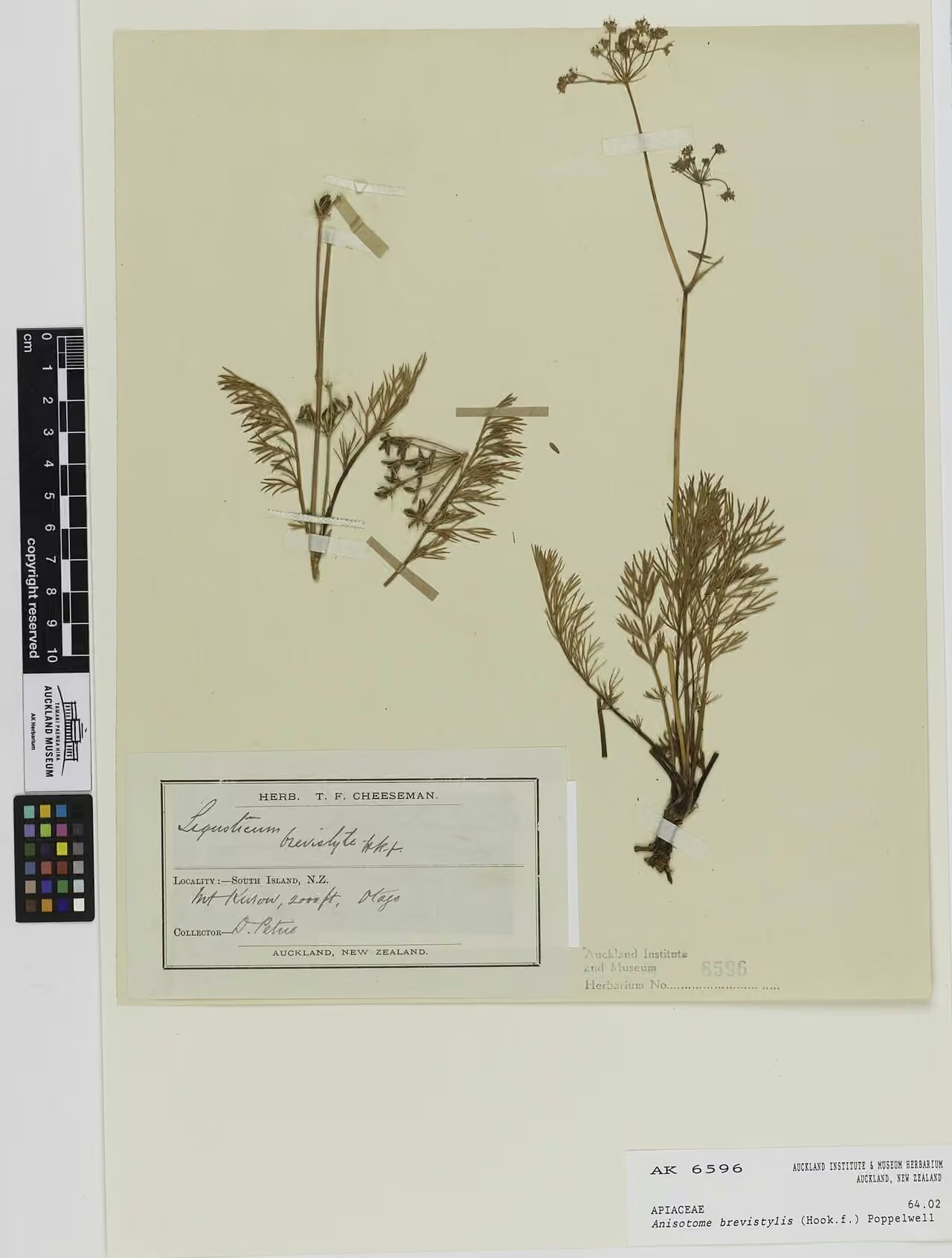
Native Carrot
Anisotome brevistylis
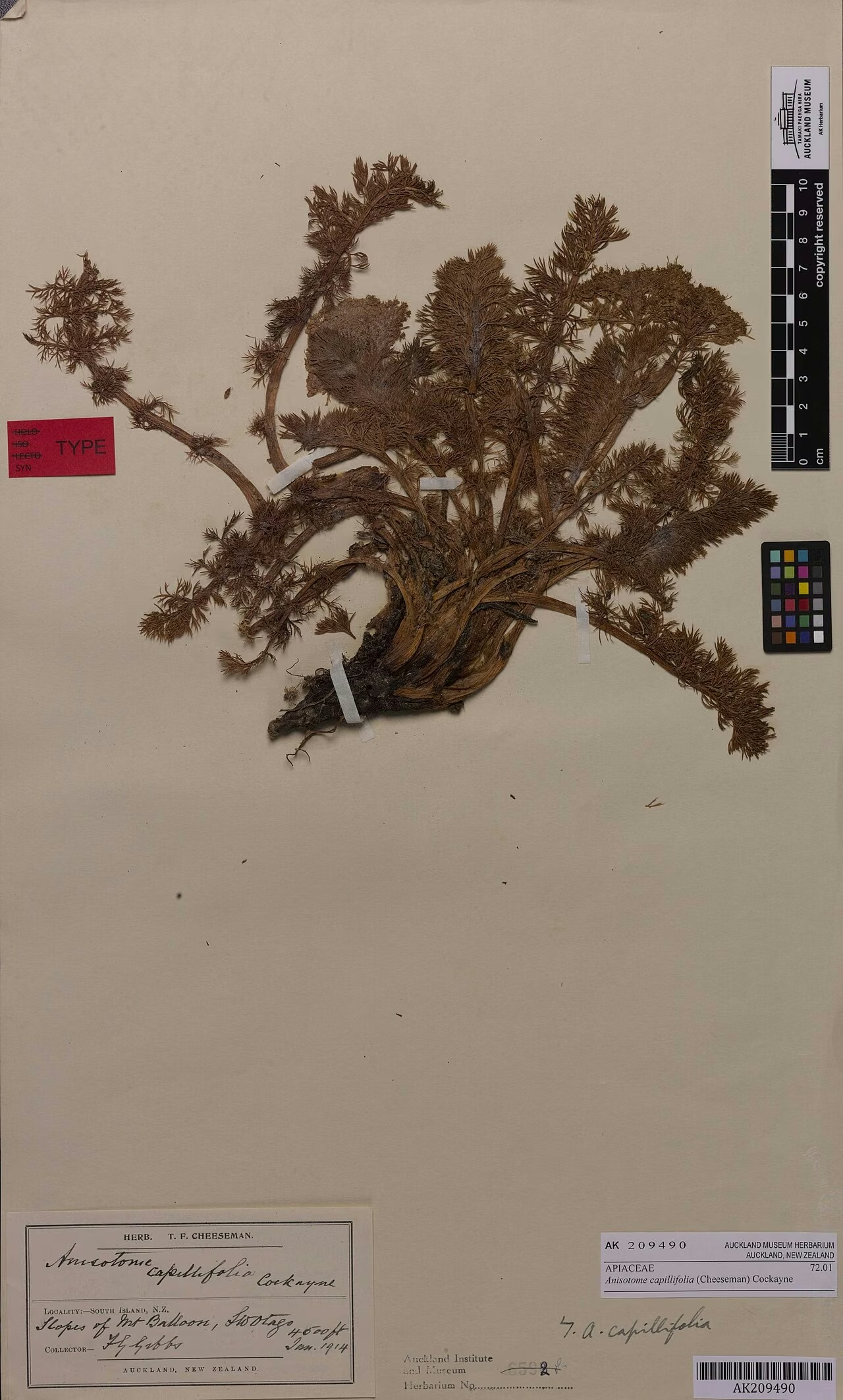
Anisotome capillifolia
Anisotome capillifolia
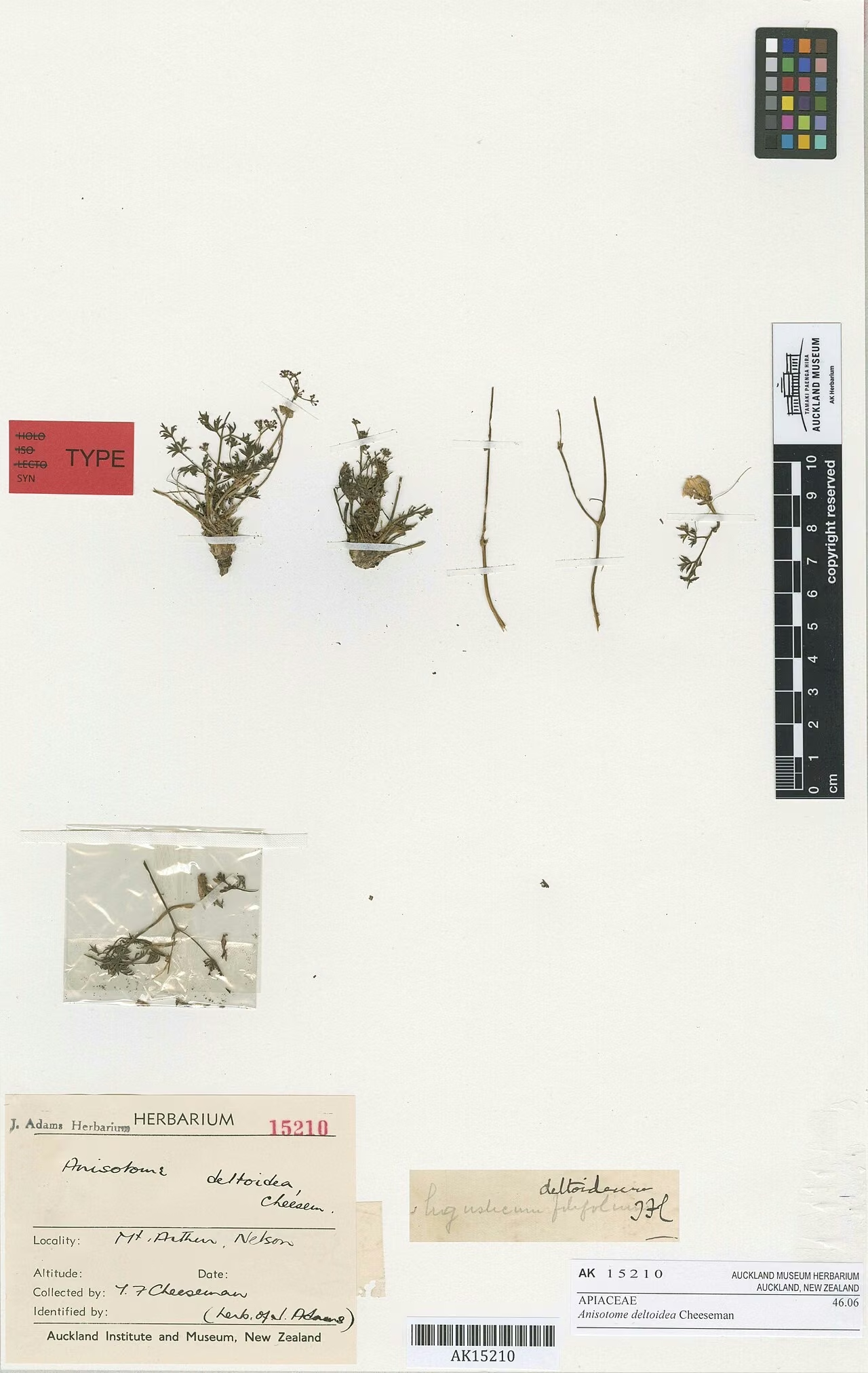
Anisotome deltoidea
Anisotome deltoidea
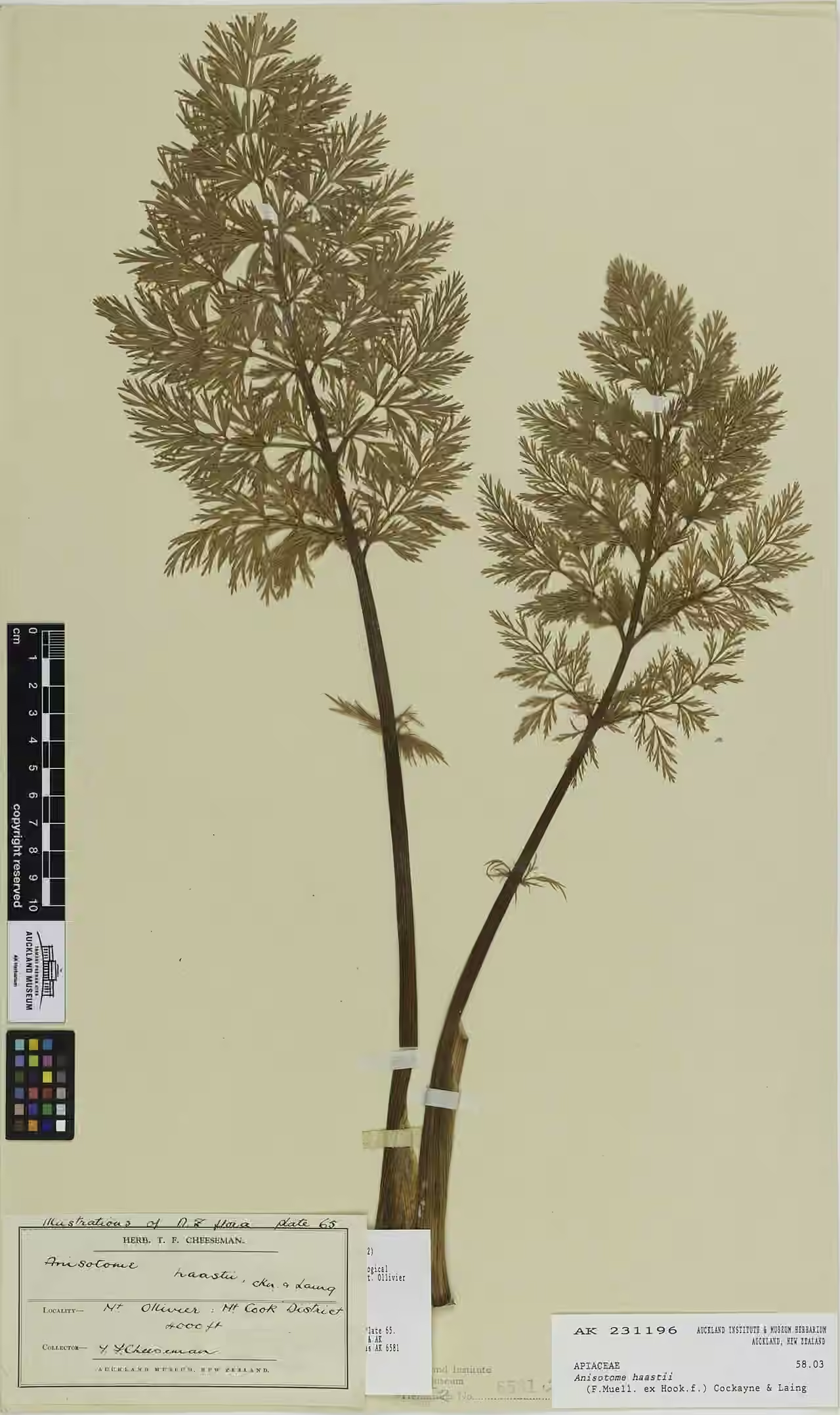
Haast's Carrot
Anisotome haastii
Kopoti
Kopoti
Plant Conservation
Anisotome antipoda is ranked At Risk - Naturally Uncommon (2023) with the qualifiers Conservation Dependent, Partial Decline and Range Restricted. Its listing reflects its confinement to a few remote island groups.
The subantarctic islands are protected reserves and a World Heritage Area, and the removal of browsing animals from Campbell Island has allowed the species to recover. Continued biosecurity to prevent new introductions is the main safeguard.
Frequently Asked Questions
Where is Anisotome antipoda found?
It grows only on New Zealand's subantarctic Auckland Islands, Campbell Island/Motu Ihupuku and Antipodes Islands, from the coast to about 570 m altitude.
What colour are the flowers of Anisotome antipoda?
NZPCN describes the flowers as dark pink to magenta, while the Flora of New Zealand gives the petals as reddish mauve to white, borne in compound umbels from October to March.
Can Anisotome antipoda be grown on the mainland?
NZPCN says it is easily grown from fresh seed but fickle in cultivation, disliking humidity and warm climates and being prone to sudden collapse.
Why did Anisotome antipoda recover on Campbell Island?
It was formerly threatened by browsing animals on Campbell Island, and NZPCN notes it is now locally abundant there after those animals were removed.
Sources and Further Reading
The botanical, growing, and conservation details for Anisotome (Anisotome antipoda) on this page draw on the New Zealand plant references below. Consult them for full technical records and the latest distribution data.