Alseuosmia
Alseuosmia turneri
Last updated:
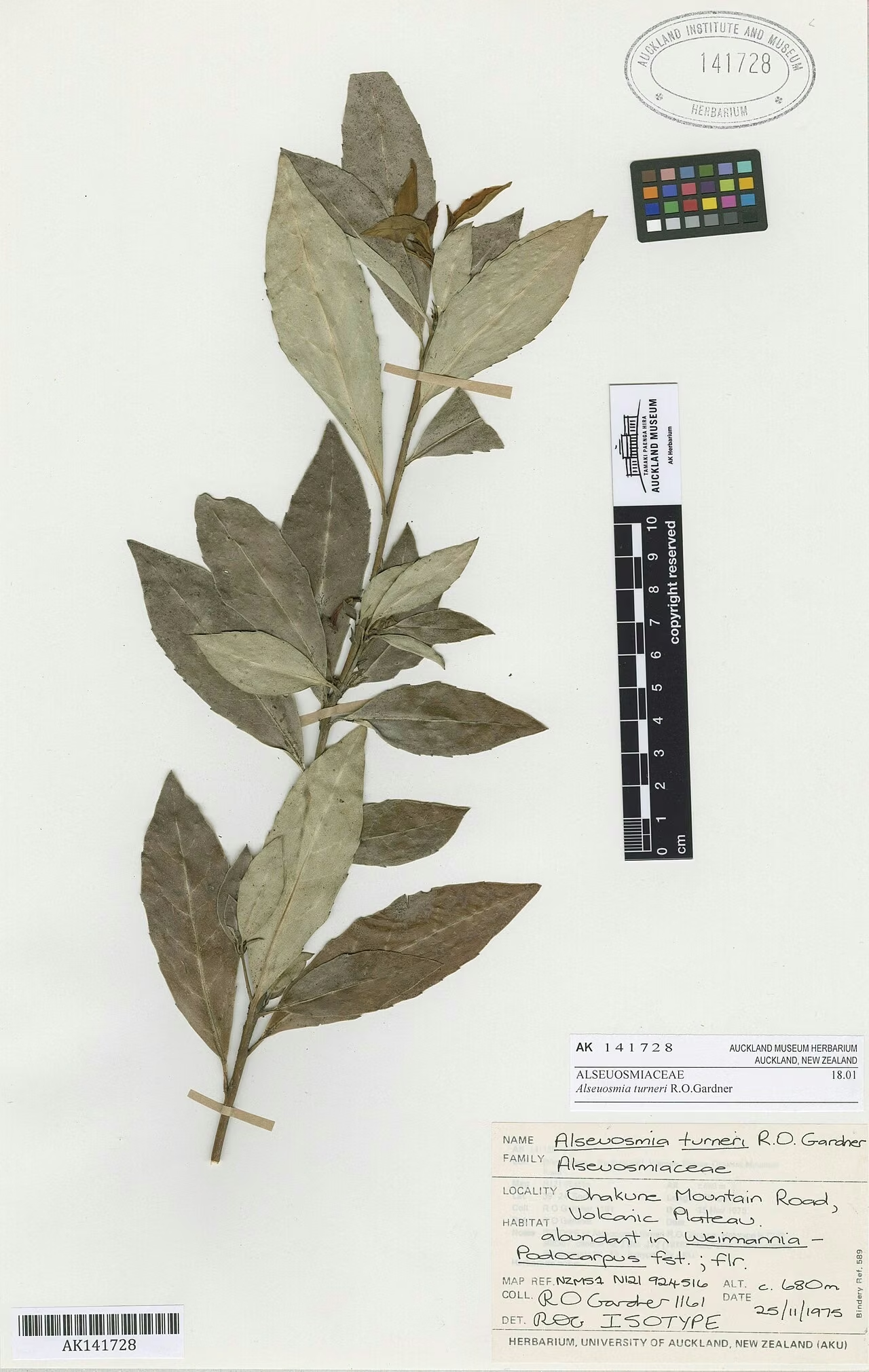
Alseuosmia turneri is a glossy-leaved shrub endemic to the western part of the Central Volcanic Plateau in the North Island. Its leaves are noticeably longer than wide with irregular teeth on the margins, and it carries small clusters of drooping, tubular pink or red flowers at the bases of the leaves, followed by fleshy red berries on long stalks. It is intermediate in appearance between the large-leaved Alseuosmia macrophylla and the small Alseuosmia pusilla. In 2023 it was ranked At Risk - Declining, and it needs cool, moist, semi-shaded conditions to thrive. Explore more native shrubs in our native plant guide.
Plant Description
Alseuosmia turneri is a glossy evergreen shrub. Its leaves are glossy green and noticeably longer than they are wide, with irregular teeth along the margins. The flowers are tubular, pink or red (NZPCN also records cream among its flower colours), and hang down in small clusters at the bases of the leaves. They are followed by fleshy red berries held on long stalks.
The Flora of New Zealand describes it as intermediate in appearance between Alseuosmia macrophylla and Alseuosmia pusilla. Compared with A. macrophylla it has smaller flowers and leaves, is smaller overall and less elaborately branched. Compared with A. pusilla it has larger flowers and leaves that lack blotching, grows taller, branches more, and its new growth lacks the crimson-purple colouring typical of A. pusilla.
Alseuosmia species are known for their strongly scented flowers, which is reflected in the genus name meaning perfume grove. Because Alseuosmia species are variable and can be hard to separate, identification is best confirmed by comparing leaf size, leaf colour and the colour of young shoots with the features above.
Quick Facts
| Scientific Name | Alseuosmia turneri |
|---|---|
| Height | No published figure found; a small shrub, shorter than A. macrophylla |
| Spread | No published figure found |
| Water Needs | High; needs consistently moist soil |
| Light | Semi-shade |
| Frost Tolerance | Moderate to good; grows on the cold volcanic plateau |
| Salt Tolerance | Low; an inland forest shrub |
| Growth Rate | Slow |
| Lifespan | Long-lived perennial shrub |
Climate Best Suited to
Suits the cool, moist, frosty climate of the central North Island volcanic plateau; it is intolerant of drought and hot, dry exposure.
Regional Suitability
| City | Climate Suitability |
|---|---|
| Auckland | Low |
| Wellington | Medium |
| Christchurch | Low |
| Dunedin | Medium |
Plant Habitat
Alseuosmia turneri is endemic to the North Island, where it is restricted to the western part of the Central Volcanic Plateau. Its range-restricted (RR) qualifier in the 2023 threat assessment reflects this small natural distribution.
It grows as a shrub of the forest understorey. NZPCN's cultivation notes, which call for a semi-shaded, cool site with consistently moist soil, match the cool, wet forests of the western volcanic plateau. More detailed habitat information was not found in the sources consulted.
Growing Requirements
Soil Requirements
It needs soil that stays consistently moist, like the deep, humus-rich forest soils of the volcanic plateau.
- Humus-rich, friable forest soil
- Consistently moist but not waterlogged
- Mulch with leaf litter to keep roots cool
Light Requirements
As an understorey shrub it prefers dappled light and protection from hot sun.
- Semi-shade beneath trees or on a shaded side of the house
- Avoid full afternoon sun
Water Requirements
NZPCN notes that it is susceptible to collapse during drought, so steady moisture is the single most important factor in cultivation.
- Water deeply during dry spells
- Never let the root ball dry out, especially in the first years
Planting and Establishing
Plant Alseuosmia turneri in a sheltered, cool, semi-shaded position, such as beneath established trees, with moist, humus-rich soil. Autumn or early spring planting gives roots time to establish before summer.
Mulch well with leaf litter or bark and water regularly through the first summers. Because it is slow growing and declining in the wild, use only nursery-propagated plants, never plants dug from the forest.
Ecological Role
Its fleshy red berries on long stalks are the kind of fruit typically eaten and spread by native forest birds, and its tubular, scented flowers are suited to visiting pollinators. The specific pollinators and seed dispersers of A. turneri have not been documented in the sources consulted.
It forms part of the shrub layer of central North Island forest. The causes of its decline are not detailed in the sources consulted, although the conservation dependent qualifier indicates that management is needed to secure it.
Uses & Significance
Garden Uses
In suitable cool, moist gardens it is an attractive, glossy shrub for woodland plantings, valued for its scented hanging flowers and red fruit.
- Shaded woodland gardens
- Native understorey restoration on the volcanic plateau
- Collections of New Zealand Alseuosmiaceae
Ecological Value
It belongs to Alseuosmia, a small genus of shrubs endemic to New Zealand, and is a range-restricted endemic of North Island forest.
- Fleshy fruit offers food for forest wildlife
- Tubular flowers provide nectar
- Contributes to the distinctive understorey of central North Island forests
Landscaping Uses
Use Alseuosmia turneri as a feature shrub in a shady corner or along a woodland path where its drooping flowers can be seen and smelled at close range. Its glossy toothed leaves contrast well with ferns and soft groundcovers.
Plant it among taller native trees that provide shelter and shade, and keep surrounding ground covered with leaf mulch to imitate a forest floor.
Seasonal Care Calendar
Spring
New growth appears as temperatures rise. Exact flowering months for this species were not found in the sources consulted, so note when your own plant flowers.
- Top up leaf mulch
- Begin regular watering as soils warm
Summer
Fruits develop into fleshy red berries on long stalks. This is the season of greatest drought risk.
- Water deeply in dry spells
- Check for wilting, an early warning of collapse
Autumn
Red berries may still be present, and autumn is a good time to plant or layer.
- Plant new shrubs while soils are moist
- Peg down low branches to layer
Winter
Growth slows through the cold months; plants on the volcanic plateau naturally experience regular frosts.
- Protect young plants from hard frost
- Avoid waterlogging around the roots
When to Prune and How Much
Very little pruning is needed for this slow-growing shrub. Remove dead or damaged branches in late spring after flowering.
Light tip pruning can encourage a bushier shape, but avoid heavy cutting, since slow-growing plants take a long time to replace lost foliage.
How to Grow Alseuosmia
NZPCN notes that Alseuosmia turneri can be propagated from semi-hardwood cuttings, although these strike with varying degrees of success, that seed germinates only with difficulty, and that the plant layers readily. Layering is therefore the most reliable way to produce a few new plants from an established shrub. All young plants grow slowly and need a semi-shaded, cool site with consistently moist soil, as they are prone to collapse in drought. Because the species is At Risk - Declining and confined to a small part of the central North Island, propagation material should come from cultivated plants or be collected with permission as part of a conservation project.
By Layering
Layering uses the plant's own readiness to root where stems touch moist soil, and gives a well-rooted new plant with little risk.
- Choose a low, flexible branch in spring or autumn
- Wound the underside lightly where it will touch the soil
- Peg it into a shallow trench of moist, humus-rich soil and cover
- Keep the area moist and leave it for about a year
- Sever the rooted layer and pot it up or replant it in a shaded spot
From Cuttings
Semi-hardwood cuttings can strike, but results vary, so take more cuttings than you need.
- Take semi-hardwood cuttings in late summer or autumn
- Remove lower leaves and dip the base in rooting hormone
- Insert into a free-draining propagation mix
- Keep in a humid, shaded propagation frame without letting it dry out
- Pot on gently once roots have formed
From Seed
Seed can be sown from ripe red berries but germinates with difficulty, so expect low and slow results.
- Clean the seed from ripe fruit
- Sow fresh in a moist, fine mix in a shaded spot
- Be patient and keep the tray moist for many months
Pests & Diseases
No specific pests or diseases are recorded for Alseuosmia turneri in the sources consulted. In cultivation the main risk is drought, which can cause sudden collapse.
In the wild, the reasons for its decline are not detailed in the sources consulted. Browsing animals affect many forest understorey shrubs, and controlling them benefits the understorey generally.
Cultural Significance
No Māori name or traditional use specific to Alseuosmia turneri is recorded in the sources consulted. The name toropapa is applied to other Alseuosmia species, particularly Alseuosmia macrophylla.
The species was described by the New Zealand botanist Rhys Gardner in 1978 in his revision of the genus. The person honoured by the epithet turneri could not be confirmed from the sources consulted. The genus name means perfume grove, a reference to the fragrance of its flowers.
Bonus Tip
If your Alseuosmia turneri starts wilting in summer, act immediately with a deep soaking and extra mulch. NZPCN warns that it is prone to collapse in drought, and slow-growing shrubs rarely recover from a severe dry spell.
Related Plants
Explore other native plants that share similar characteristics or habitats with Alseuosmia (Alseuosmia turneri), offering further insights into New Zealand's diverse flora. These related species provide context and opportunities for complementary planting in your garden.
Feeble Bent
Agrostis imbecilla
Agrostis pallescens
Agrostis pallescens
Agrostis personata
Agrostis personata
Agrostis petriei
Agrostis petriei
Lesser Joyweed
Alternanthera denticulata
Anaphalioides alpina
Anaphalioides alpina
Anaphalioides hookeri
Anaphalioides hookeri
Anaphalioides subrigida
Anaphalioides subrigida
Plant Conservation
Alseuosmia turneri was Not Threatened in assessments from 2004 to 2012, At Risk - Naturally Uncommon in 2017, and was moved to At Risk - Declining in 2023 with the qualifiers Conservation Dependent, Data Poor (size and trend) and Range Restricted.
Protecting the remaining forests of the western volcanic plateau, controlling browsing animals and improving survey data are the main steps that help. Growing it in gardens from propagated stock also builds a safety net for this declining species.
Frequently Asked Questions
How is Alseuosmia turneri different from other Alseuosmia species?
The Flora of New Zealand describes it as intermediate between A. macrophylla and A. pusilla. It has smaller flowers and leaves and a smaller, less branched habit than A. macrophylla, but larger, unblotched leaves, taller and more branched growth, and new shoots without crimson-purple colouring compared with A. pusilla.
Where does Alseuosmia turneri grow?
It is endemic to the North Island and confined to the western Central Volcanic Plateau, where it grows as an understorey shrub in cool, moist forest.
Is Alseuosmia turneri endangered?
It was ranked At Risk - Declining in the 2023 assessment, having previously been Not Threatened and then Naturally Uncommon. It is range restricted and its population size and trend are poorly known.
Is Alseuosmia turneri easy to grow?
NZPCN says it is slow growing, needs a semi-shaded, cool site with consistently moist soil, and can collapse in drought. Semi-hardwood cuttings strike with variable success, seed is difficult, but it layers readily.
Sources and Further Reading
The botanical, growing, and conservation details for Alseuosmia (Alseuosmia turneri) on this page draw on the New Zealand plant references below. Consult them for full technical records and the latest distribution data.