Bent Grass
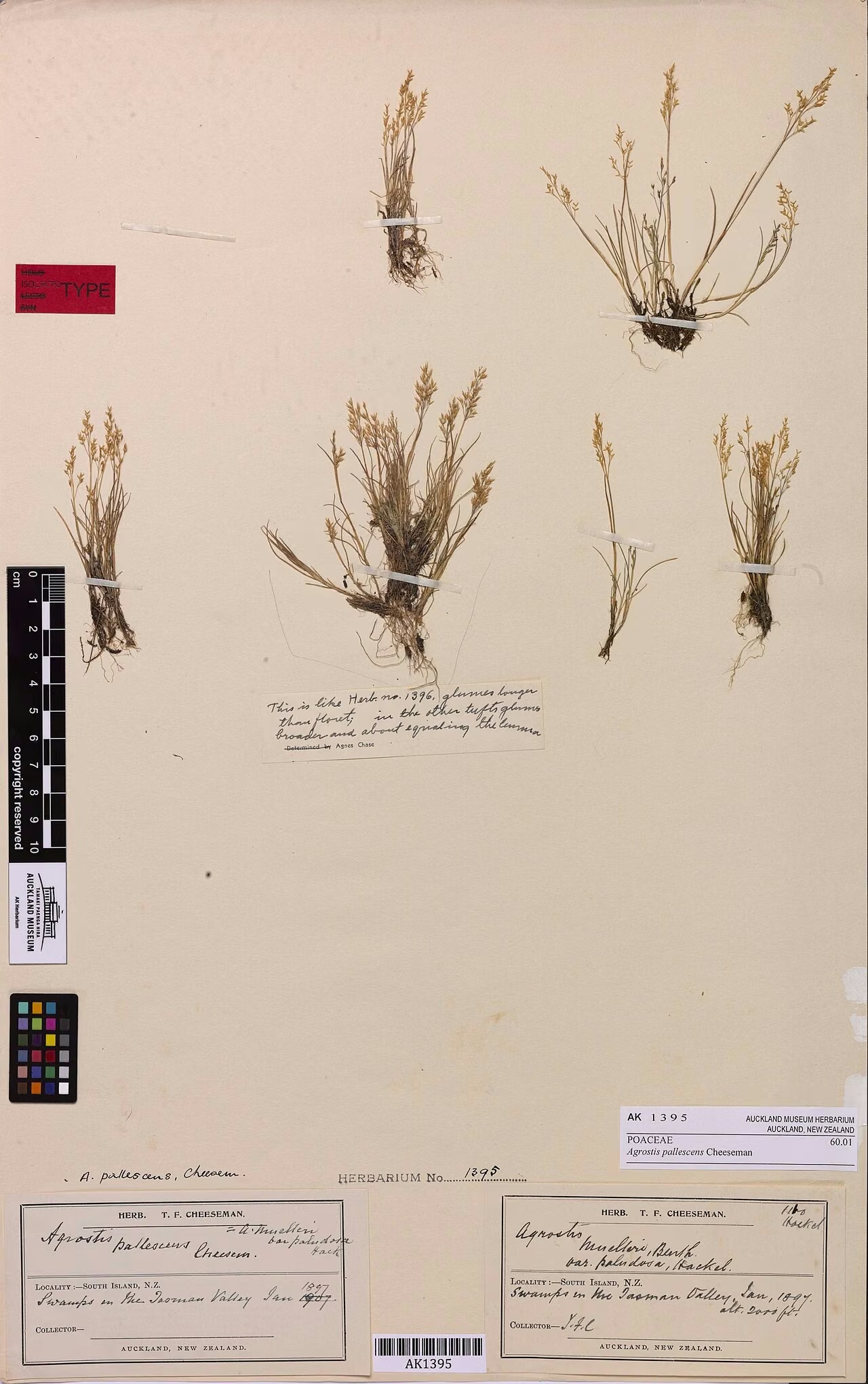
Agrostis pallescens
Last updated:
Agrostis pallescens is a tiny, finely rhizomatous bent grass endemic to New Zealand, usually only 3 to 5 cm tall, with fine pale to blue-green or light brown leaves and small, open seed heads that barely rise above the foliage. It grows mainly in cushion bogs and peat bogs, from montane to alpine levels in the central North Island mountains and along the Main Divide of the South Island to Fiordland, coming down to the lowlands in the far south and on Stewart Island/Rakiura. It is ranked At Risk - Naturally Uncommon. Explore more native grasses and flaxes in our native plant guide.
Plant Description
Agrostis pallescens forms small, finely rhizomatous tufts usually 3 to 5 cm tall, occasionally up to 20 cm. The leaves are fine and pale to blue-green or light brown, with blades only 0.8 to 2.5 cm long and 0.2 to 0.4 mm in diameter, narrow-linear and rolled inward. The ligule is short, 0.1 to 0.6 mm, squared off and minutely fringed.
The panicle is open, ovate to pyramidal and only 0.6 to 2 cm long (rarely 3 cm), with few branches, each carrying a single spikelet. The panicles usually do not stand much above the leaves. Spikelets are 1.5 to 2 mm long and pale green to creamy brown. The glumes are about as long as the lemma, ovate-lanceolate and rather blunt, and the lemma is 1.2 to 1.8 mm, smooth, faintly five-nerved and without an awn. The palea is tiny, 0.4 to 0.6 mm, and the anthers are 0.4 to 0.7 mm.
Its very small size, pale fine foliage, awnless lemmas and few-flowered open panicle tucked into the leaves separate it from most other native bents. It was once treated as a variety of Agrostis muelleri, another small mountain bent, and careful examination of the spikelets is needed to tell such small Agrostis apart.
Quick Facts
| Scientific Name | Agrostis pallescens |
|---|---|
| Height | 0.03-0.05 m, rarely to 0.2 m |
| Spread | Small rhizomatous patches, about 0.1 m |
| Water Needs | Wet; a bog species |
| Light | Full sun in open bogs |
| Frost Tolerance | High; montane to alpine |
| Salt Tolerance | No information available |
| Growth Rate | Slow |
| Lifespan | Perennial |
Climate Best Suited to
Suits cool, wet, cloudy climates with cold winters, from the central North Island mountains to Stewart Island; NZPCN notes it dislikes humidity in cultivation and needs cold to flower.
Regional Suitability
| City | Climate Suitability |
|---|---|
| Auckland | Low |
| Wellington | Low |
| Christchurch | Low |
| Dunedin | Medium |
Plant Habitat
Agrostis pallescens is endemic to New Zealand. In the North Island it occurs only in the central mountains. In the South Island it is found from Nelson along the Main Divide to Fiordland and is rare in the east, and it also grows on Stewart Island/Rakiura.
It is a montane to alpine grass, but in the southern part of its range it descends into the lowlands. Its usual habitat is cushion bogs and peat bogs, where it grows among cushion plants, sedges and mosses in permanently wet, low-fertility peat.
Growing Requirements
Soil Requirements
It grows in wet, acidic, low-nutrient peat in bogs, often within or between cushion plants.
- Permanently moist peaty soil
- Low fertility; avoid fertiliser
- Acidic conditions similar to a sphagnum bog
Light Requirements
Open bogs are treeless and exposed, so this tiny grass relies on full light and little competition.
- Full sun or very bright conditions
- Shading by shrubs or tall sedges will weaken it
Water Requirements
As a bog grass it should never dry out, but it still needs fresh air around the foliage rather than humid stagnation.
- Keep constantly wet, ideally with rainwater
- Avoid enclosed, humid glasshouse conditions
Planting and Establishing
This is not a garden plant and is not commercially available. It is relevant to wetland restoration and to specialist growers of bog plants in cool southern or upland gardens.
If grown, plant it in a peat-based bog garden or a shallow container standing in a saucer of rainwater, in an open, cool position where it can experience winter cold.
Ecological Role
Agrostis pallescens is part of the low, mixed vegetation of cushion and peat bogs. Like other grasses it is wind pollinated, and its small florets are likely spread by wind and water across the wet bog surface, as NZPCN records for related native Agrostis.
No information on insects that feed on it or on its specific role in bog succession was found in the sources consulted.
Uses & Significance
Garden Uses
Its value is botanical rather than ornamental; it is easily overlooked even in the wild.
- Bog garden or peat trough collections in cool climates
- Wetland restoration within its natural range
- Teaching collections of native grasses
Ecological Value
It is a characteristic, if inconspicuous, member of New Zealand's cushion and peat bog flora.
- Endemic grass of a specialised and vulnerable wetland habitat
- Adds to the plant diversity of upland and southern bogs
- A useful indicator that bog conditions remain intact
Landscaping Uses
Agrostis pallescens has no real landscaping role. Its tufts are only a few centimetres tall and its seed heads are hidden among the leaves.
In a dedicated bog display it could be grown among cushion plants and small sedges to recreate a natural peat bog community, but it would be a detail for the keen observer rather than a feature.
Seasonal Care Calendar
Spring
New shoots appear from the fine rhizomes as bogs warm up.
- Keep bog containers topped up with rainwater
- Remove any weed seedlings invading the peat
Summer
The small open panicles develop among the leaves. The sources consulted do not give exact flowering months.
- Do not let plants dry out on hot days
- Photograph wild plants with a scale to help identification
Autumn
Seed ripens on the tiny panicles and is shed onto the bog surface.
- Collect seed from cultivated plants for fresh sowing
- Leave wild bogs undisturbed
Winter
Plants are dormant through frosts and snow; this cold period is needed for flowering.
- Keep cultivated plants outdoors
- Protect pots from being frozen solid in a dry state
When to Prune and How Much
No pruning is needed. The plant is so small that any trimming would remove most of its foliage.
If a patch becomes congested in a container, divide it rather than cutting it back.
How to Grow Bent Grass
NZPCN describes Agrostis pallescens as very easy to propagate from fresh seed and by division of whole plants, but notes that it dislikes humidity and will not flower without cold treatment. The difficulty is therefore in keeping plants healthy and flowering, not in producing them. Because the species is At Risk - Naturally Uncommon and its bog habitats are easily damaged, wild collection should be minimal, done with permission and best linked to a restoration project near the source population. Use peaty, low-nutrient mixes and rainwater, and grow plants outdoors in a cool, open place.
From Seed
Fresh seed germinates well. The panicles are tiny and close to the foliage, so collect them carefully by hand when the spikelets turn creamy brown.
- Collect ripe panicles and dry them in a paper envelope for a few days
- Sow fresh seed onto the surface of a moist peat and sand mix
- Stand the tray in a shallow dish of rainwater to keep it wet
- Keep outdoors in a cool, bright spot with good air movement
- Pot seedlings on in small clumps once they are large enough to handle
By Division
Because it spreads by fine rhizomes, established plants can be divided into small rooted portions.
- Lift the clump in early spring
- Separate small pieces that each have rhizome, roots and shoots
- Replant into wet peat-based mix at the same depth
- Keep shaded and moist until new growth starts
Pests & Diseases
No pests or diseases specific to this grass are recorded. In cultivation, humid, still air leads to decline, and drying out is quickly fatal for a bog plant.
In the wild, the main risks to bog plants generally include drainage, trampling, vehicle damage and invasion by weeds, although no species-specific threats are documented for Agrostis pallescens.
Cultural Significance
No Māori name or traditional use is recorded for Agrostis pallescens in the sources consulted.
The species was described by Thomas Cheeseman. It has also been known as Agrostis muelleri var. paludosa, a varietal name referring to marshy places, which reflects its long-recognised association with bogs.
Bonus Tip
When exploring an upland cushion bog, kneel down and look between the cushions for a grass only a few centimetres tall with pale, thread-like leaves and tiny seed heads barely clearing the foliage. Step only on firm ground or boardwalks, since bog surfaces recover very slowly from footprints.
Related Plants
Explore other native plants that share similar characteristics or habitats with Bent Grass (Agrostis pallescens), offering further insights into New Zealand's diverse flora. These related species provide context and opportunities for complementary planting in your garden.
Plant Conservation
Agrostis pallescens is ranked At Risk - Naturally Uncommon (2023). Its qualifiers DPR, DPS and DPT indicate that its range, population size and trend are all poorly known. It was assessed as Not Threatened in 2004 and 2009 and Data Deficient in 2012. Otago's 2025 regional list treats it as Regionally Naturally Uncommon.
Protecting cushion and peat bogs from drainage, fire, grazing and trampling is the key to its survival. Further survey of bogs along the Main Divide and in Southland would clarify how common it really is.
Frequently Asked Questions
What does Agrostis pallescens look like?
It forms very small tufts, typically 3 to 5 cm tall and rarely to 20 cm, spreading by fine rhizomes. Its leaves are thread-like and pale, and its small open panicle carries only a few pale green to creamy brown spikelets.
Where can you find Agrostis pallescens?
Look in cushion bogs and peat bogs in the central North Island mountains, along the Main Divide from Nelson to Fiordland, and in lowland bogs in the far south, including Stewart Island/Rakiura. It is rare east of the Main Divide.
What does pallescens mean?
The Latin epithet pallescens means rather pale, a reference to the pale green, bluish or light brown colour of its fine foliage and spikelets.
Sources and Further Reading
The botanical, growing, and conservation details for Bent Grass (Agrostis pallescens) on this page draw on the New Zealand plant references below. Consult them for full technical records and the latest distribution data.