Bent Grass
Agrostis personata
Last updated:
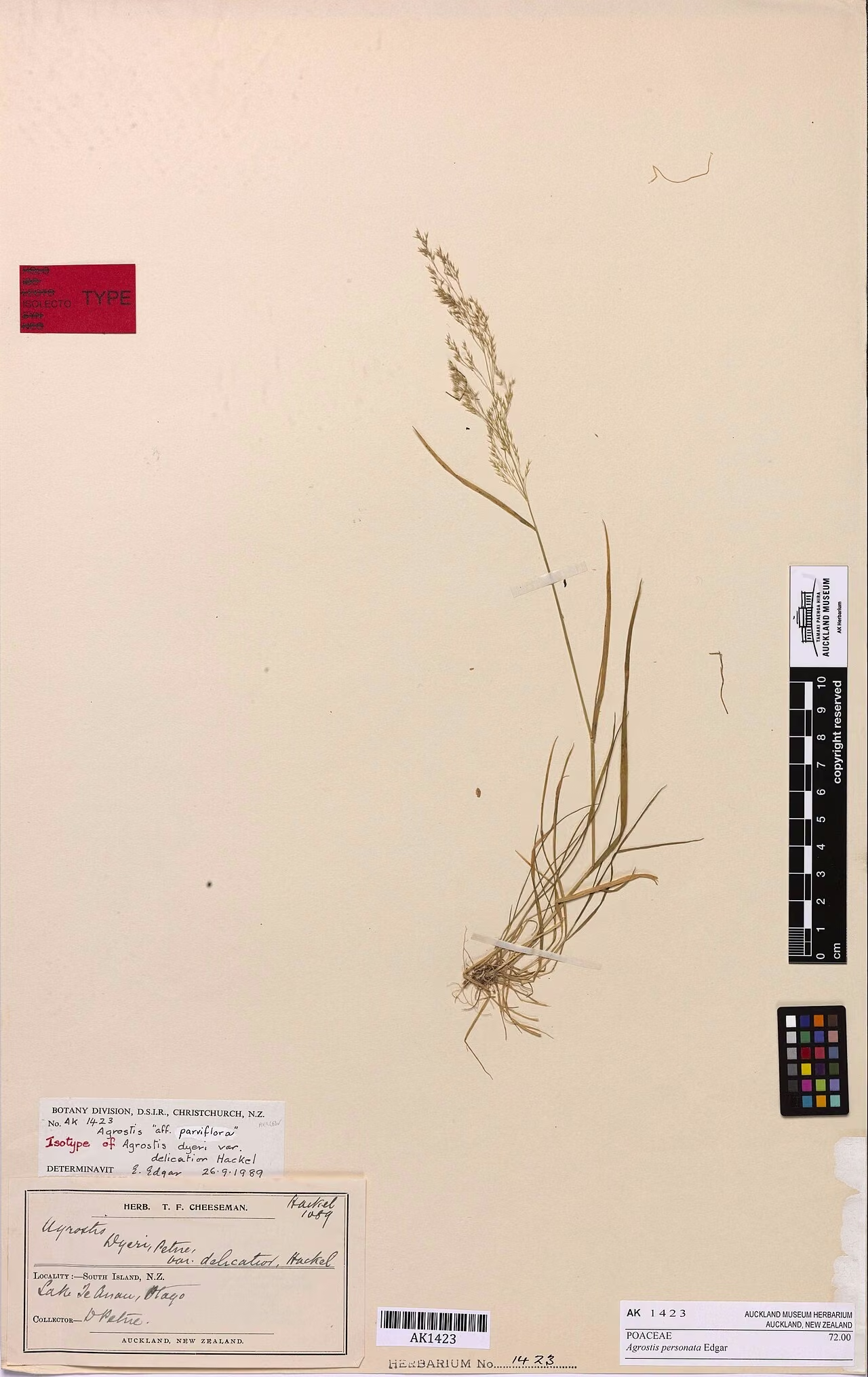
Agrostis personata is a delicate endemic bent grass that forms lax, slender tufts usually up to about 30 cm tall, occasionally 60 cm, with soft leaves and fine, wide-spreading panicles of purplish-green spikelets. It grows from the lowlands to the alpine zone in forest, forest margins, scrub and tussock grassland, from East Cape south through the North Island and across the South Island, where it is commonest in the west and Fiordland. It is Not Threatened nationally, and NZPCN notes it can spread readily in cultivation. Explore more native grasses and flaxes in our native plant guide.
Plant Description
Agrostis personata forms lax, slender tufts 6.5 to 30 cm tall, rarely to 60 cm. The leaf sheaths are membranous and pale, and the ligule is 0.8 to 2 mm long, truncate to rounded and slightly ragged. The leaf blades are soft, 2 to 8 cm long and 0.5 to 1.5 mm wide (occasionally 3 mm), flat or with inrolled margins, and finely rough (scabrid).
The panicle is (2) 4.5 to 8.5 cm long, occasionally to 16 cm, ovate-lanceolate to pyramidal, with very fine branches that spread widely at maturity. It equals or overtops the leaves. Spikelets are about 2 to 2.5 mm long and purplish green. The lemma is 1.4 to 2.2 mm and smooth, either awnless or with a delicate awn 1 to 3 mm long arising from the middle of the lemma or above. Anthers are 0.4 to 0.9 mm long.
It was first named as a variety of Agrostis dyeri, and the Flora of New Zealand notes that it is distinguished by its particularly delicate build and slender, spreading panicle. Its tolerance of forest and scrub shade also helps separate it from the many bent grasses confined to open grassland.
Quick Facts
| Scientific Name | Agrostis personata |
|---|---|
| Height | 0.07-0.3 m, occasionally to 0.6 m |
| Spread | Loose tufts about 0.1-0.25 m |
| Water Needs | Moderate; dry or damp sites |
| Light | Full sun to partial shade |
| Frost Tolerance | High; reaches the alpine zone |
| Salt Tolerance | No information available |
| Growth Rate | Moderate to fast |
| Lifespan | Perennial |
Climate Best Suited to
Adaptable to a wide range of cool temperate climates from lowland to alpine, including wetter western districts; it grows near sea level in the Wairarapa.
Regional Suitability
| City | Climate Suitability |
|---|---|
| Auckland | Low |
| Wellington | Medium |
| Christchurch | Medium |
| Dunedin | High |
Plant Habitat
Agrostis personata is endemic to New Zealand. In the North Island it is found south from East Cape, mainly in the mountains but reaching close to sea level in the Wairarapa. In the South Island it is common mainly in the west and in Fiordland, and scattered throughout the east.
It ranges from lowland to alpine elevations and grows in forest, along forest margins, under scrub and within tussock grassland, on both dry and damp sites. It is occasionally found in peat bogs.
Growing Requirements
Soil Requirements
It is not fussy about soil and occurs on forest litter, grassland soils and occasionally peat.
- Moderately fertile, humus-rich soil
- Tolerates both free-draining and damp soils
- Avoid heavy, compacted clay
Light Requirements
Its occurrence in forest and under scrub as well as in open grassland makes it one of the more shade-tolerant native bents.
- Full sun to dappled or partial shade
- Useful for woodland edges
Water Requirements
It grows in both dry and damp sites, so moderate, even moisture suits it best in cultivation.
- Water during long dry spells
- Good drainage prevents winter rot
Planting and Establishing
Agrostis personata is rarely offered by nurseries, but it is easy to raise from seed for restoration plantings within its natural range. Plant it in groups along forest margins, in clearings or among tussocks where its fine panicles add a soft, airy texture.
Space plants 15 to 20 cm apart. Because it can become invasive in suitable conditions, avoid planting it next to small, slow-growing alpine plants that it might smother.
Ecological Role
As a grass it is wind pollinated, and NZPCN records that its florets are dispersed by wind and water. Its fine, spreading panicles release seed easily, which helps it colonise forest margins and openings.
Its relationships with particular insects or other animals are not documented in the sources consulted. It forms part of the ground layer of forest margins, scrub and tussock grassland over a wide altitudinal range.
Uses & Significance
Garden Uses
It can be used as a soft, fine-textured native grass in naturalistic plantings, with care because it self-seeds.
- Woodland edge and clearing plantings
- Restoration of tussock grassland and scrub margins in its range
- Native grass collections
Ecological Value
It is a widespread endemic grass that contributes to the ground cover of a broad range of native habitats.
- Grows in forest, scrub, tussock grassland and occasionally bogs
- Helps fill gaps in disturbed or regenerating forest margins
- Part of New Zealand's diverse endemic Agrostis flora
Landscaping Uses
The fine, open panicles of Agrostis personata catch the light and give a hazy purple tint in mass plantings, making it suitable for informal, meadow-like drifts in cool gardens.
Combine it with small tussocks, native herbs and ferns at a forest edge. Its delicate look contrasts well with bolder foliage, but plan for some self-seeding into nearby gaps.
Seasonal Care Calendar
Spring
New soft leaves emerge from the tufts.
- Remove old dead leaves by hand
- Weed around young plants
Summer
The slender panicles develop and spread open as they mature, giving a purplish haze. Exact flowering months are not recorded in the sources consulted.
- Water during drought
- Collect panicles for seed as they ripen
Autumn
Seed is shed and seedlings may appear around established plants.
- Pull unwanted seedlings
- Divide congested clumps
Winter
The tufts persist through cold weather with little growth.
- No action needed
- Avoid waterlogging in heavy soils
When to Prune and How Much
Little pruning is needed. Cut off spent panicles after seed has been shed if you want to limit self-seeding.
Comb out dead foliage in late winter or early spring rather than shearing the tufts, which can damage new growth.
How to Grow Bent Grass
NZPCN states that Agrostis personata is easy to propagate from fresh seed and by dividing whole plants, and warns that in suitable conditions it can become invasive. This makes it one of the more straightforward native bents to grow, but it also means you should think about where it will be planted before raising large numbers. For restoration work, collect seed from local populations so that plants are adapted to the site, whether that is a lowland Wairarapa remnant or a montane forest margin. Grow seedlings in a moderately fertile, free-draining mix in a sheltered outdoor position.
From Seed
Seed from the delicate panicles germinates readily when fresh. Collect panicles when the spikelets turn straw coloured and shed easily.
- Collect ripe panicles into a paper bag
- Sow fresh seed thinly on a fine, moist seed-raising mix
- Cover lightly with sieved mix or fine grit
- Keep the tray moist in a sheltered, bright place
- Prick out seedlings into cell trays or small pots when they reach a few centimetres
By Division
Clumps of established plants can be lifted and split, giving plantable pieces quickly.
Divisions are also the quickest way to supply a restoration site with plants of known local origin, as each piece is a clone of a plant already growing well.
- Lift a healthy clump in autumn or early spring
- Divide it into pieces with several shoots and good roots
- Replant or pot up immediately and water in well
- Keep moist until the divisions re-establish
Pests & Diseases
No serious pests or diseases are recorded for this species. In cultivation, crowded, poorly ventilated plantings are best avoided, and the main management issue is its tendency to self-seed.
In the wild, browsing animals and competition from exotic pasture grasses may affect grassland populations, but no specific threats are documented and the species is Not Threatened.
Cultural Significance
No Māori name or traditional use is recorded for Agrostis personata in the sources consulted.
It was originally described by Eduard Hackel as Agrostis dyeri var. delicatior, a name meaning more delicate. Elizabeth Edgar later recognised it as a distinct species under the new name Agrostis personata.
Bonus Tip
When you need a fine native grass for a shady forest margin, Agrostis personata is a better choice than open-country bents, because it naturally grows under scrub and along forest edges. Deadhead it after seed fall if you do not want it spreading through the garden.
Related Plants
Explore other native plants that share similar characteristics or habitats with Bent Grass (Agrostis personata), offering further insights into New Zealand's diverse flora. These related species provide context and opportunities for complementary planting in your garden.
Plant Conservation
Agrostis personata has been assessed as Not Threatened in every national assessment from 2004 to 2023. Regionally, Otago lists it as Not Threatened, while the Wellington region (2025) ranks it Regionally At Risk - Regionally Naturally Uncommon.
No active conservation is required nationally. Protecting forest margins and tussock grassland from weeds and heavy grazing will help maintain local populations, particularly in the Wellington region where it is uncommon.
Frequently Asked Questions
How do you recognise Agrostis personata?
It is a soft, slender tufted grass whose fine panicles equal or exceed the leaves and spread widely when mature, carrying small purplish-green spikelets 2 to 3 mm long. Its leaves are flat or inrolled at the margins and rough to the touch.
Does Agrostis personata grow in shade?
Yes. Unlike many native bents it grows in forest, along forest margins and under scrub, as well as in open tussock grassland, so it tolerates partial shade.
Is Agrostis personata invasive in gardens?
NZPCN notes that it is easy to grow from fresh seed and division and that in suitable conditions it can become invasive, so it may self-seed freely in a moist garden.
Where is Agrostis personata found?
It occurs in the North Island south from East Cape, mainly in the mountains but down to near sea level in the Wairarapa, and throughout the South Island, especially in the west and Fiordland.
Sources and Further Reading
The botanical, growing, and conservation details for Bent Grass (Agrostis personata) on this page draw on the New Zealand plant references below. Consult them for full technical records and the latest distribution data.