Maidenhair
Adiantum fulvum
Last updated:
Adiantum fulvum is an endemic maidenhair fern of New Zealand forests, forming spreading clumps of dark green, triangular to ovate fronds up to about 85 cm long on dark brown, hairy stalks. It grows on the forest floor, clay banks, streamsides and rocky slopes under kauri, podocarp, broadleaf and coastal forest and mānuka scrub, from the Kermadec Islands and Te Paki south to Wellington, with outliers in the northern South Island. It is most common from Northland to the Bay of Plenty. Ranked Not Threatened, it makes a handsome shade fern once established, though it is slow to start. Explore more native ferns in our native plant guide.
Plant Description
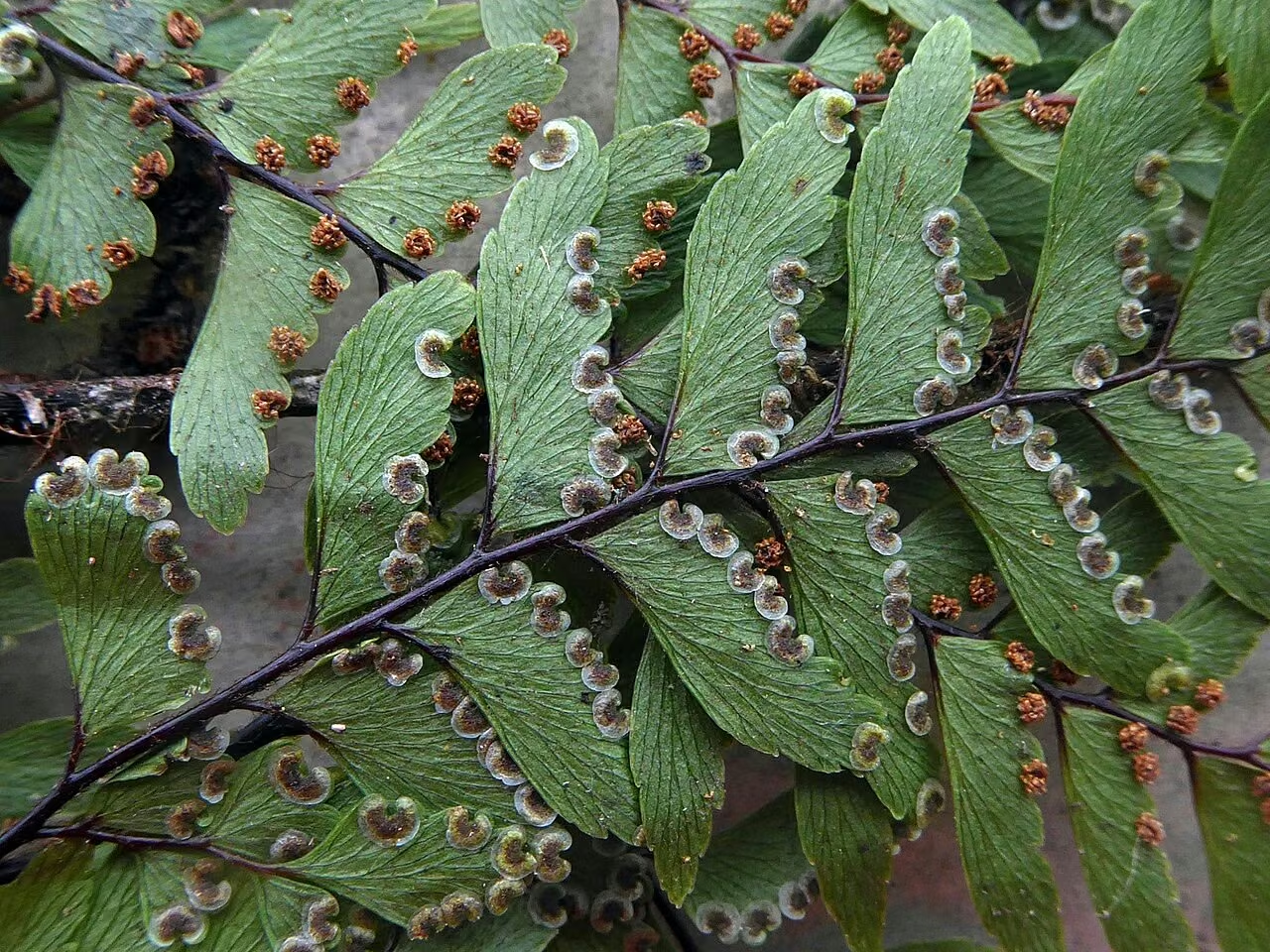
Adiantum fulvum is a terrestrial fern with creeping rhizomes 1.5 to 3 mm in diameter covered in narrow red-brown scales, producing fronds 5 to 40 mm apart that build into spreading clumps. The fronds are 170 to 850 mm long. The stipes are dark brown, up to 530 mm long, with spreading red-brown scales near the base and shorter forward-pointing hairs above; the grooved rachises also carry red-brown hairs.
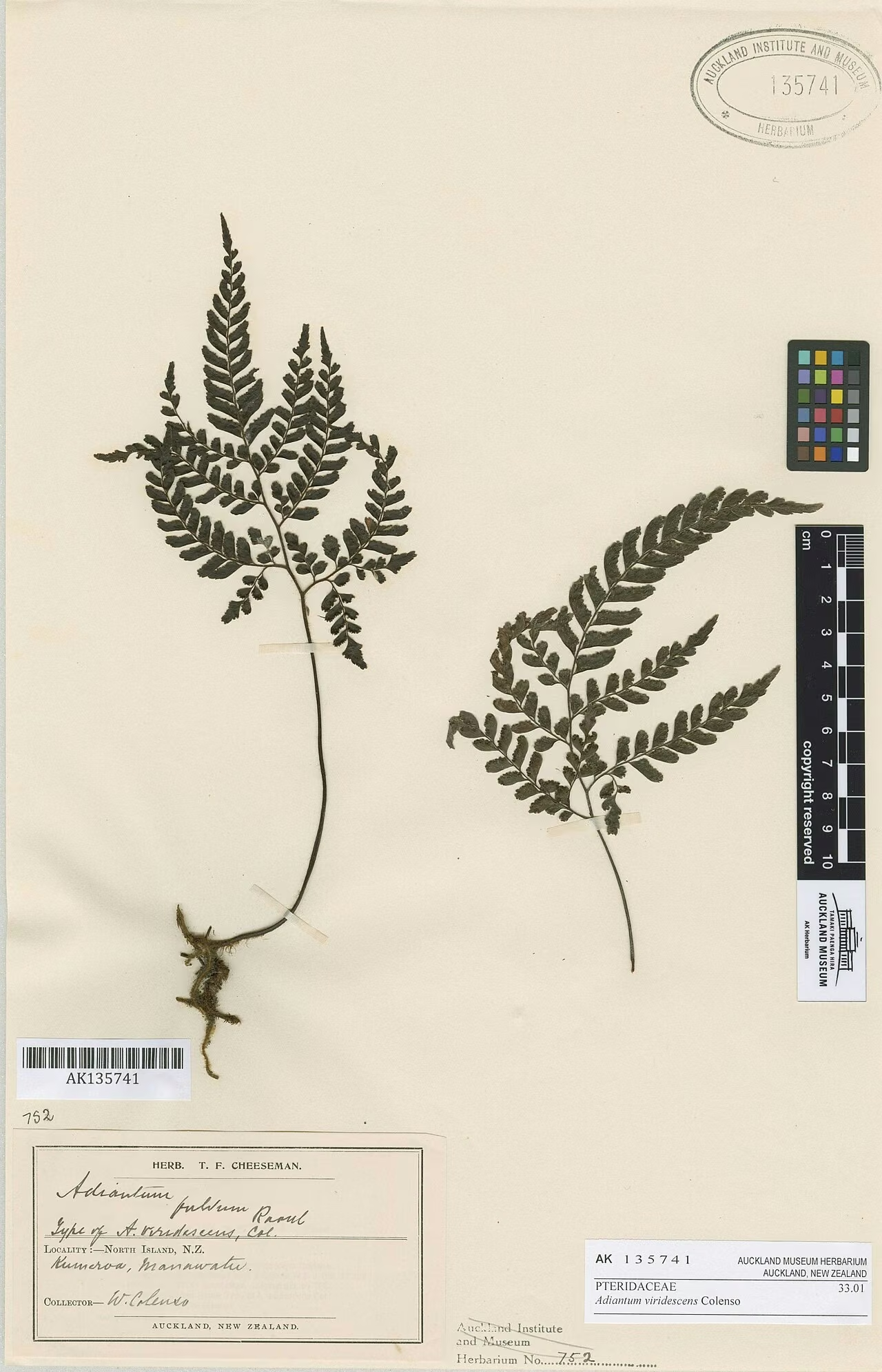
The blade is broadly ovate, 90 to 360 mm long and 60 to 275 mm wide, usually three-pinnate (two-pinnate in small fronds, occasionally four-pinnate in large ones) and dark green on both surfaces. The ultimate segments are oblong, curve towards the frond tip and attach by one corner. Sori sit under reflexed flaps on the segment margins, with glabrous, kidney-shaped indusia. The undersides of the segments may be hairy or smooth; the smooth form was formerly called Adiantum viridescens.
It differs from Adiantum cunninghamii in its dark rather than glaucous fronds and hairy stipes and rachises, and from Adiantum formosum in having hairy stalks and longer segments (8 to 26 mm rather than 9 to 16 mm). It may occasionally hybridise with A. cunninghamii.
Quick Facts
| Scientific Name | Adiantum fulvum |
|---|---|
| Height | Fronds 0.17-0.85 m long |
| Spread | Spreading clumps from creeping rhizomes |
| Water Needs | Moist but well drained |
| Light | Deep to moderate shade |
| Frost Tolerance | Low to moderate; a lowland to lower montane northern fern |
| Salt Tolerance | Some; grows in coastal forest and on coastal cliffs |
| Growth Rate | Slow to establish |
| Lifespan | Long-lived perennial |
Climate Best Suited to
Suits mild, humid, frost-light climates; it is most common in the warm north of the North Island and becomes scarce south of the Bay of Plenty.
Regional Suitability
| City | Climate Suitability |
|---|---|
| Auckland | High |
| Wellington | Medium |
| Christchurch | Low |
| Dunedin | Low |
Plant Habitat
Adiantum fulvum is endemic to New Zealand. The Flora of New Zealand records it on the Kermadec Islands and in lowland to montane areas of the North Island from Te Paki to Wellington, common only from Northland to the Bay of Plenty. In the South Island it is confined to the Marlborough Sounds and north-west Nelson; older records from Canterbury and Banks Peninsula have not been repeated since the 19th century. NZPCN also lists it from the Chatham Islands. It reaches about 450 m in the Tutamoe Range, Northland.
It grows on the ground under kauri, podocarp, broadleaf and coastal forest and in mānuka and kānuka scrub, on streambanks, clay banks, gullies, rocky slopes, tracksides and coastal cliffs, over greywacke, limestone and mudstone.
Growing Requirements
Soil Requirements
In the wild it grows on clay banks, among boulders and on forest floors over several rock types. In gardens NZPCN recommends moist, well-drained, fertile soil.
- Humus-rich, fertile soil
- Moist but freely draining
- Tolerates clay banks and rocky ground
Light Requirements
NZPCN says it flourishes in deep shade, and in the wild it grows under closed forest as well as in moderately open forest-floor sites.
- Deep to dappled shade
- Avoid direct sun, which scorches the fronds
Water Requirements
It favours streamsides and damp banks but not waterlogged ground.
- Water during dry spells, especially while establishing
- Mulch to keep roots cool and moist
Planting and Establishing
Plant in a sheltered, shaded spot in moist, well-drained, fertile soil enriched with leaf mould. Set the rhizome just below the surface rather than burying it deeply, and keep the soil evenly moist through the first summer.
Expect slow growth at first. NZPCN notes that once established it becomes easy to grow and will spread into a clump.
Ecological Role
As a fern it reproduces by minute spores released from sori along the margins of its segments, and spreads locally by its creeping rhizome. It is part of the ground layer of northern forests, often on banks and streamsides where competition from other ground plants is lower.
Specific invertebrates that depend on it are not documented in the sources consulted. Its fronds help bind clay banks and track edges in forest.
Uses & Significance
Garden Uses
It is an attractive, fine-textured ground fern for shaded gardens, especially in the north.
- Shady borders and woodland gardens
- Clay banks and streamside plantings under trees
- Large containers in shaded courtyards
- Native forest restoration understoreys
Ecological Value
It is a characteristic ground fern of northern North Island forests and part of New Zealand's endemic fern flora.
- Endemic to New Zealand
- Helps stabilise banks and streamsides
- Contributes to forest floor diversity
Landscaping Uses
Use it in drifts under trees or along shaded paths, where its dark, lacy fronds contrast with broad-leaved plants such as rengarenga or kawakawa. It looks particularly good spilling over a shaded bank or rock edge.
In southern gardens it is safest in a sheltered, frost-free spot or in a pot that can be moved under cover.
Seasonal Care Calendar
Spring
New fronds unfurl from the creeping rhizome.
- Remove last year's tattered fronds before new growth
- Top-dress with leaf mould
Summer
Fronds are fully expanded and sori develop on the segment margins.
- Water in dry spells
- Keep out of direct sun
Autumn
Spores ripen on mature fronds and can be collected for sowing.
- Collect fertile fronds for fresh spore sowing
- Divide established clumps if needed
Winter
Growth slows; fronds may be damaged by frost in colder districts.
- Protect from frost in the south
- Avoid waterlogging
When to Prune and How Much
Cut off old, brown or damaged fronds at the base in late winter or early spring so new fronds can emerge cleanly.
No other pruning is needed. Avoid cutting green fronds, which feed the slow-growing rhizome.
How to Grow Maidenhair
NZPCN states that Adiantum fulvum is best grown from spores, which must be sown fresh and may take several years to produce plants, and that it is slow to establish but easy once settled. Division of established clumps is a quicker way to obtain a few plants, since the species spreads by creeping rhizomes. Spores are produced in sori under the reflexed margins of the frond segments. Because the fern is endemic and widespread, garden propagation is a good way to obtain plants without collecting from the wild, but any spore collection from wild plants should be done with landowner permission and only from a few fronds per plant.
From Spores
Fresh spores give the best results. Collect fronds when the sori darken and before the spores have been shed, and dry them on paper so the spores drop out.
- Place a fertile frond on clean paper in a dry, still room for a few days
- Sow the fine spores thinly on sterilised, moist, fine potting mix
- Cover with glass or plastic to keep humidity high and place in bright shade
- Mist when needed and wait for green prothalli to form
- Transplant small sporelings in clumps once fronds appear, then grow on in shade
By Division
Established clumps can be divided by separating sections of creeping rhizome with fronds and roots attached.
- Divide in spring as new growth begins
- Cut the rhizome into sections, each with several fronds and roots
- Replant at the same depth in moist, humus-rich soil
- Keep shaded and well watered until new fronds appear
Pests & Diseases
No serious pests are recorded for Adiantum fulvum in the sources consulted. In gardens, slugs and snails can damage emerging fronds.
Drying out, direct sun and frost cause more damage than pests, producing brown, crisp fronds.
Cultural Significance
No traditional Māori name or use specific to Adiantum fulvum is recorded in the sources consulted.
The genus name Adiantum comes from Greek for 'unwetted', because maidenhair fronds shed water. The epithet fulvum means tawny yellow, likely referring to the hairs on the stalks. The species is now understood to include the glabrous form described by William Colenso as Adiantum viridescens in 1895.
Bonus Tip
Run a finger along the frond stalk: if it feels rough with red-brown hairs and the fronds are dark green, it is Adiantum fulvum; a smooth-stalked maidenhair with paler, glaucous fronds is more likely Adiantum cunninghamii.
Related Plants
Explore other native plants that share similar characteristics or habitats with Maidenhair (Adiantum fulvum), offering further insights into New Zealand's diverse flora. These related species provide context and opportunities for complementary planting in your garden.
Chatham Island Speargrass
Aciphylla traversii
Aciphylla trifoliolata
Aciphylla trifoliolata
Turoa Onamata
Ackama nubicola
Adenochilus gracilis
Adenochilus gracilis
Adiantum viridescens
Adiantum viridescens
Feeble Bent
Agrostis imbecilla
Agrostis pallescens
Agrostis pallescens
Agrostis personata
Agrostis personata
Plant Conservation
Adiantum fulvum is ranked Not Threatened (2023), as it has been since 2004. NZPCN notes it is often rather uncommon over large parts of its range, and it is regionally At Risk - Regionally Naturally Uncommon in the Wellington region.
Protecting forest remnants from stock grazing and weed invasion helps maintain the shady, moist ground layer it needs.
Frequently Asked Questions
How do you identify Adiantum fulvum?
Look for dark green, usually three-pinnate fronds with oblong segments that curve towards the frond tip, on dark brown stipes and rachises covered in red-brown hairs and scales. The fronds are not bluish or glaucous.
What is the difference between Adiantum fulvum and Adiantum cunninghamii?
Adiantum cunninghamii has paler, glaucous fronds with smooth stalks, while A. fulvum has dark green fronds and hairy stipes and rachises.
Is Adiantum viridescens the same as Adiantum fulvum?
The current Flora of New Zealand treats them as one species. Plants with smooth undersides, once called A. viridescens, differ only in lacking hairs on the lower lamina surface.
How do you grow Adiantum fulvum?
NZPCN says it is slow but easy once established, flourishing in deep shade in moist, well-drained, fertile soil. It is best raised from fresh spores, which can take several years to produce plants.
Sources and Further Reading
The botanical, growing, and conservation details for Maidenhair (Adiantum fulvum) on this page draw on the New Zealand plant references below. Consult them for full technical records and the latest distribution data.