Maidenhair
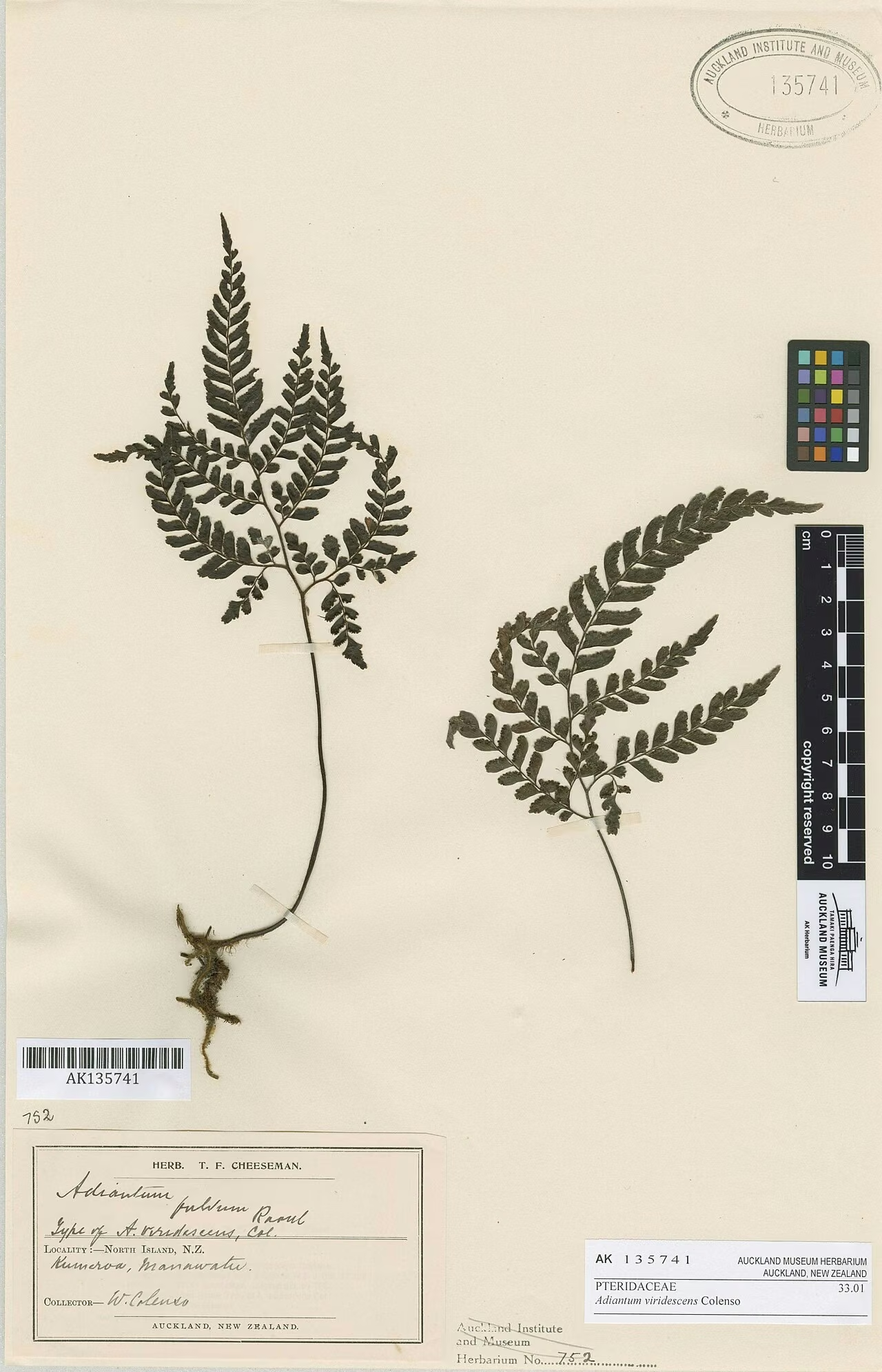
Adiantum viridescens
Last updated:
Adiantum viridescens is the name William Colenso gave in 1895 to a New Zealand maidenhair fern whose leaf segments lack hairs underneath. The current Flora of New Zealand no longer recognises it as a separate species: researchers found it differs from Adiantum fulvum only in that one character, so it is treated as the hairless form of that endemic fern. Plants sold or labelled under this name are therefore Adiantum fulvum, a ground fern with dark green, finely divided fronds up to about 85 cm long on dark, hairy stalks, found mainly in northern North Island forest and growing best in moist, shady sites. Explore more native ferns in our native plant guide.
Plant Description
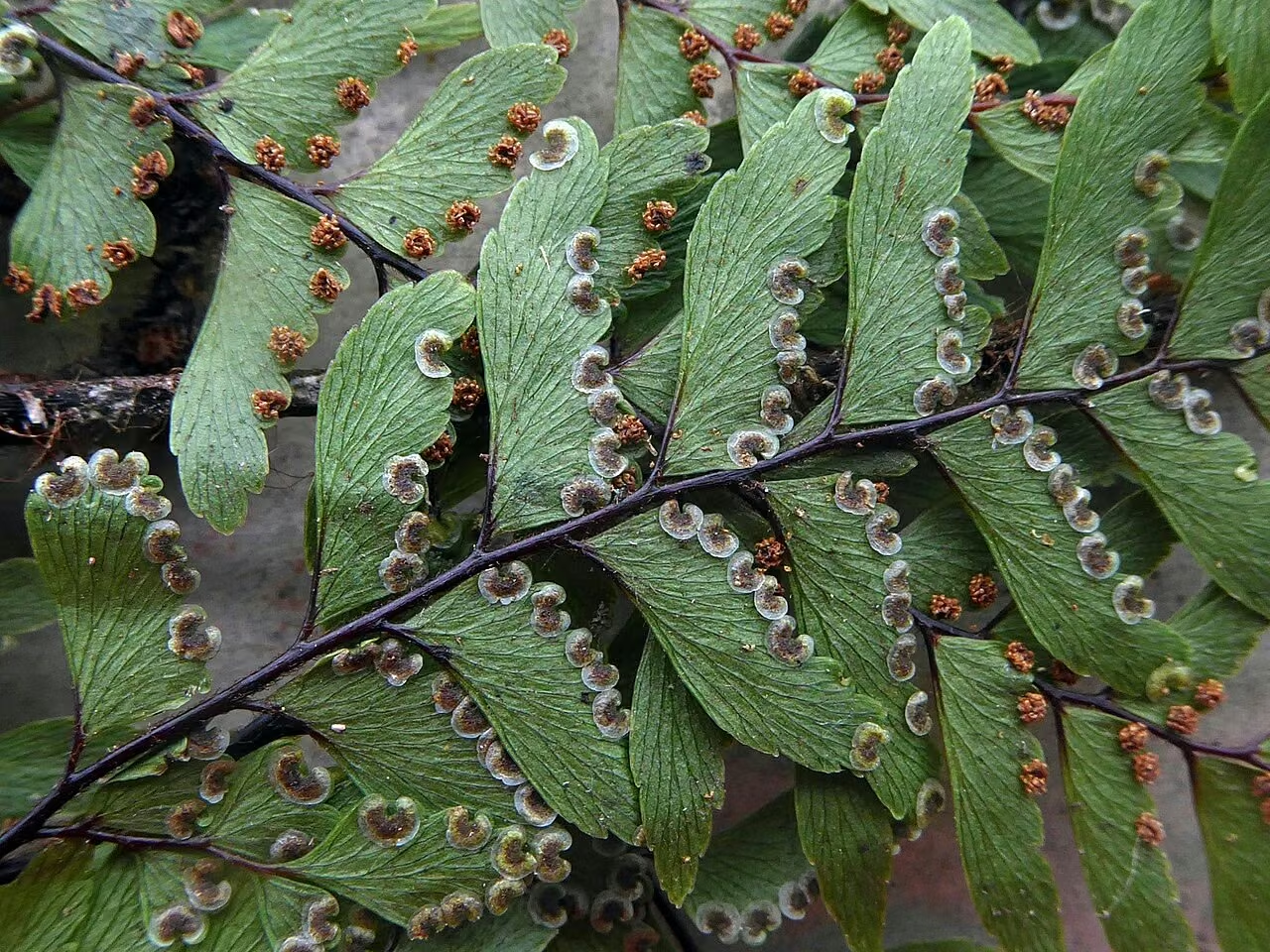
Plants once called Adiantum viridescens are maidenhair ferns with creeping rhizomes and dark green, broadly ovate fronds that are usually divided three times. The segments are oblong and curve towards the tip of the frond, attaching to their tiny stalks at one corner, and the spore-bearing sori lie under the turned-back margins of the segments. The stipes and rachises are dark brown with red-brown hairs, as in all Adiantum fulvum.
What set this form apart was a hairless lower surface to the leaf segments, which older accounts also described as narrower and more sickle-shaped. The Flora of New Zealand treatment explains that the hairy and glabrous forms could not be distinguished in any other way, so the two are now regarded as dimorphic states of one species rather than separate taxa.
Both forms differ from the common Adiantum cunninghamii, which has paler, glaucous fronds and smooth stalks. So when identifying a smooth-leaved maidenhair, check the stalk: hairs on the stipe and rachis point to Adiantum fulvum, including its former viridescens form.
Quick Facts
| Scientific Name | Adiantum viridescens |
|---|---|
| Height | Fronds 0.17-0.85 m long (as Adiantum fulvum) |
| Spread | Slowly spreading clumps from a creeping rhizome |
| Water Needs | Evenly moist, free-draining soil |
| Light | Shade |
| Frost Tolerance | Limited; a mainly northern lowland fern |
| Salt Tolerance | Low to moderate; occurs in coastal forest |
| Growth Rate | Slow until established |
| Lifespan | Long-lived perennial |
Climate Best Suited to
Like the rest of Adiantum fulvum, it suits warm, humid, sheltered climates and becomes uncommon in cooler southern districts.
Regional Suitability
| City | Climate Suitability |
|---|---|
| Auckland | High |
| Wellington | Medium |
| Christchurch | Low |
| Dunedin | Low |
Plant Habitat
As part of Adiantum fulvum, this form belongs to an endemic fern found on the Kermadec Islands and in the North Island from Te Paki to Wellington, most commonly from Northland to the Bay of Plenty, with South Island populations in the Marlborough Sounds and north-west Nelson. The sources consulted do not map the hairless form separately from the hairy one.
The species grows on the forest floor and on banks under kauri, podocarp, broadleaf and coastal forest and in mānuka and kānuka scrub, including streambanks, gullies, rocky slopes and coastal cliffs, from sea level to about 450 m.
Growing Requirements
Soil Requirements
It prefers the moist, fertile, well-drained soil that NZPCN recommends for Adiantum fulvum, and in the wild grows on clay, limestone, mudstone and greywacke slopes.
- Leaf-mould-rich, fertile soil
- Good drainage with steady moisture
- Copes with clay banks
Light Requirements
A forest-floor fern, it does best in deep or dappled shade and scorches in strong sun.
- Shade under trees or on the shady side of buildings
- Shelter from drying wind
Water Requirements
Keep the root zone consistently damp but not sodden; streamside and gully conditions suit it.
- Water through the first summers
- A leaf-litter mulch reduces drying
Planting and Establishing
Treat it exactly as Adiantum fulvum: plant in a sheltered, shaded site in humus-rich soil, with the rhizome close to the surface, and water regularly until established.
If you buy a plant labelled Adiantum viridescens, it is worth relabelling it as Adiantum fulvum so that records and garden lists reflect current naming.
Ecological Role
Spores released from the marginal sori are carried by air and grow into small prothalli on moist ground, from which new ferns develop. The creeping rhizome lets a plant spread slowly into a patch.
Why some plants of the species are hairy underneath and others are not is not explained in the sources consulted, and no separate ecological role is known for the hairless form.
Uses & Significance
Garden Uses
It has the same garden uses as Adiantum fulvum: a refined ground fern for shade.
- Shaded garden beds and woodland plantings
- Fernery collections showing variation within a species
- Containers in sheltered, shady spots
Ecological Value
It represents natural variation within an endemic New Zealand fern rather than a separate species.
- Part of the endemic Adiantum fulvum
- Ground cover on forest banks in the northern North Island
- Illustrates how taxonomy is refined as plants are restudied
Landscaping Uses
Group it in a shaded fern bed with other maidenhairs and small ground ferns, where the delicate, dark green fronds can be seen at close range near a path.
It also works on a shaded retaining wall or rocky bank, echoing the clay banks and boulders it occupies in the wild.
Seasonal Care Calendar
Spring
Fresh fronds emerge from the rhizome as the soil warms.
- Clear away old fronds beforehand
- Mulch with leaf litter
Summer
Fronds mature and sori form under the segment margins.
- Do not let the soil dry out
- Keep sun off the fronds
Autumn
Spores ripen and can be gathered for sowing.
- Collect spores while fresh
- Divide crowded clumps
Winter
Growth slows and fronds may brown in frost-prone gardens.
- Shelter from frost
- Keep soil free-draining
When to Prune and How Much
Remove dead or frost-damaged fronds at ground level in late winter, before the new season's fronds appear.
Leave healthy fronds in place; the plant grows slowly and relies on its existing foliage.
How to Grow Maidenhair
No propagation information is published under the name Adiantum viridescens, but as it is now part of Adiantum fulvum the same methods apply. NZPCN states that A. fulvum is best grown from spores sown fresh, which can take several years to produce plants, and that it is slow to establish but easy afterwards. Division of the creeping rhizome is a faster option for gardeners with an existing clump. Whether spores from a hairless plant always produce hairless offspring is not recorded in the sources consulted, so if you want to keep the smooth-leaved form, division is the more reliable method because it produces genetically identical plants.
From Spores
Spores ripen on fertile fronds through summer and autumn. Use them fresh, as NZPCN advises, because viability declines with storage.
- Pick a frond with dark, ripe sori and dry it on white paper for several days
- Tip the dust-like spores onto sterile, damp, fine seed-raising mix
- Seal the container in a clear bag and keep in bright shade at room temperature
- Keep the surface moist by misting, not watering from above
- Prick out small clumps of sporelings once the first fronds form, and grow on for a year or more
By Division
Dividing the rhizome keeps the exact character of the parent plant, including smooth leaf undersides.
- Lift the clump in early spring
- Separate rhizome sections that each have roots and two or three fronds
- Replant at the original depth in humus-rich soil
- Water well and keep in shade until new growth starts
Pests & Diseases
No pests specific to this form are recorded. Snails and slugs may chew emerging fronds in gardens.
Most problems come from dry soil, strong sun or frost, which brown the fronds.
Cultural Significance
No traditional Māori name or use is recorded for this fern in the sources consulted.
William Colenso, the missionary, printer and botanist, described Adiantum viridescens in the Transactions and Proceedings of the New Zealand Institute in 1895. Colenso named many New Zealand plants that later botanists merged with earlier species, and this is one of them.
Bonus Tip
Turn a frond over and look at the underside of the segments with a hand lens. Fine, stiff dark hairs mean the typical hairy form of Adiantum fulvum; a smooth surface means the form once called Adiantum viridescens. Both are the same species, so either can be recorded as Adiantum fulvum.
Related Plants
Explore other native plants that share similar characteristics or habitats with Maidenhair (Adiantum viridescens), offering further insights into New Zealand's diverse flora. These related species provide context and opportunities for complementary planting in your garden.
Plant Conservation
NZPCN ranks the name Adiantum viridescens as Taxonomically Indistinct (2023), reflecting its merger into Adiantum fulvum; it had been ranked Not Threatened from 2004 to 2017. Adiantum fulvum itself is Not Threatened.
Retaining shaded forest remnants and stream margins, and controlling weeds and stock, protects both the hairy and the hairless forms.
Frequently Asked Questions
Is Adiantum viridescens still a recognised species?
No. Brownsey and Perrie's Flora of New Zealand treatment includes it within Adiantum fulvum, and NZPCN now ranks the name Taxonomically Indistinct.
How was Adiantum viridescens told apart from Adiantum fulvum?
It was separated on its glabrous, rather narrower and sickle-shaped segments. Later study found the presence or absence of hairs on the lower leaf surface was the only consistent difference.
What does the name viridescens mean?
It comes from the Latin viridis, green, and means becoming green, presumably referring to the fronds.
Sources and Further Reading
The botanical, growing, and conservation details for Maidenhair (Adiantum viridescens) on this page draw on the New Zealand plant references below. Consult them for full technical records and the latest distribution data.