Grassland Wheatgrass
Stenostachys laevis
Last updated:
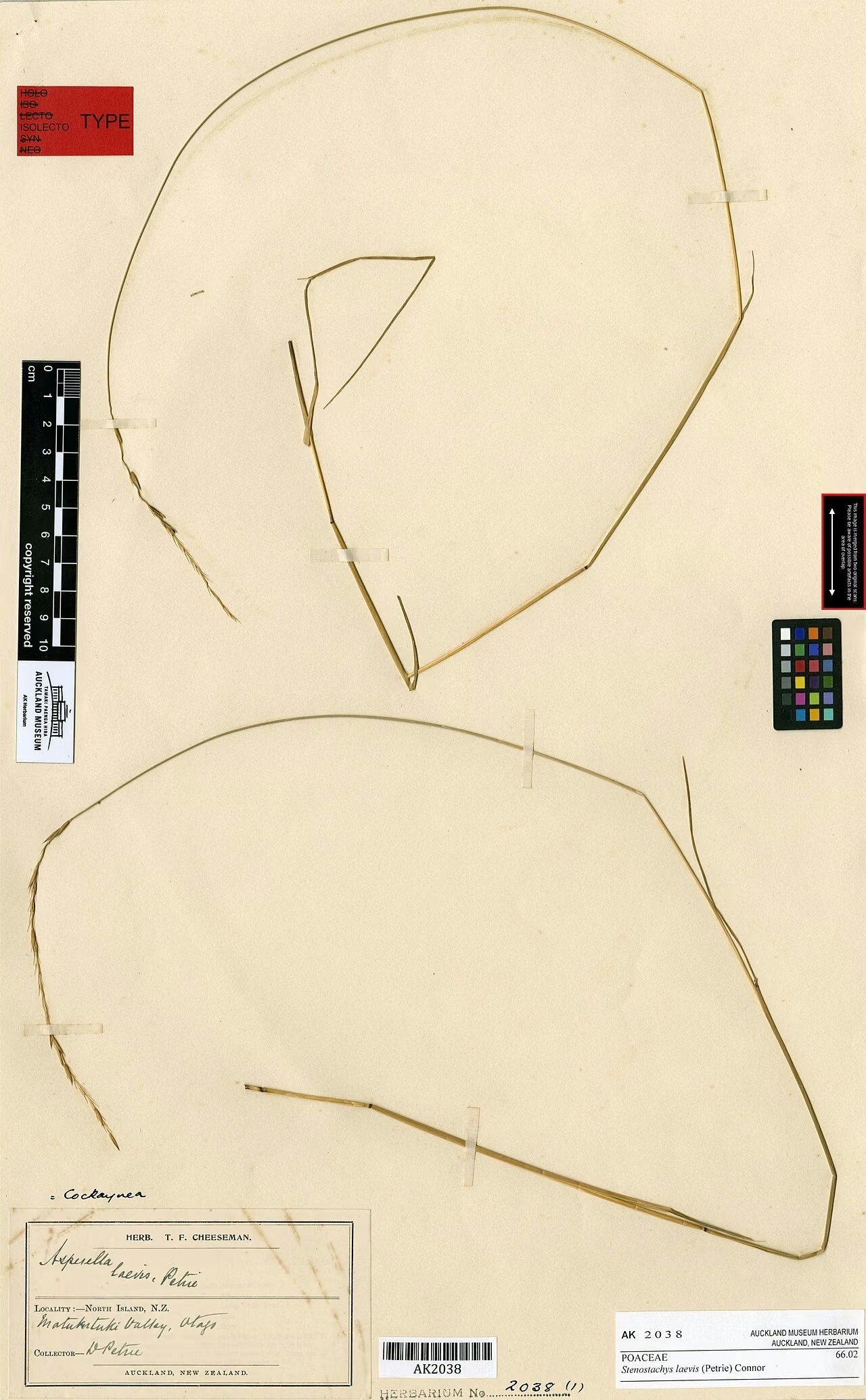
Grassland wheatgrass (Stenostachys laevis) is a small, uncommon grass endemic to New Zealand, in a genus found nowhere else. It forms loose patches from stolons that root at the nodes, with narrow leaves 15 to 25 cm long and slender culms 50 to 75 cm long carrying narrow, nodding spikes of 10 to 25 spikelets. It grows in tussock grassland, grey scrub, flushes, on shaded cliff faces and by lakes, from sea level to 1300 m, mostly in the South Island and on Stewart Island. It is ranked At Risk - Naturally Uncommon because it is sparse and easily overlooked, though it faces no obvious threats. Explore more native grasses and flaxes in our native plant guide.
Plant Description
Stenostachys laevis is a perennial grass with long stolons that root and shoot at the nodes, forming loose patches. The leaf sheaths are 5 to 10 cm long and the ligule 0.5 to 1 mm, with a ragged tip. The leaf blades are 15 to 25 cm long and 1.5 to 2 mm wide, flat, or inrolled in coastal forms.
The culms are slender and 50 to 75 cm long, ending in a narrow, nodding or drooping inflorescence 8 to 15 cm long with 10 to 25 spikelets. Each spikelet is 8 to 12 mm long, the glumes 2 to 6 mm, and the lemma 6.5 to 8 mm, tipped with a spine or short awn. The anthers are 1.6 to 2.6 mm long and the seed about 4 mm.
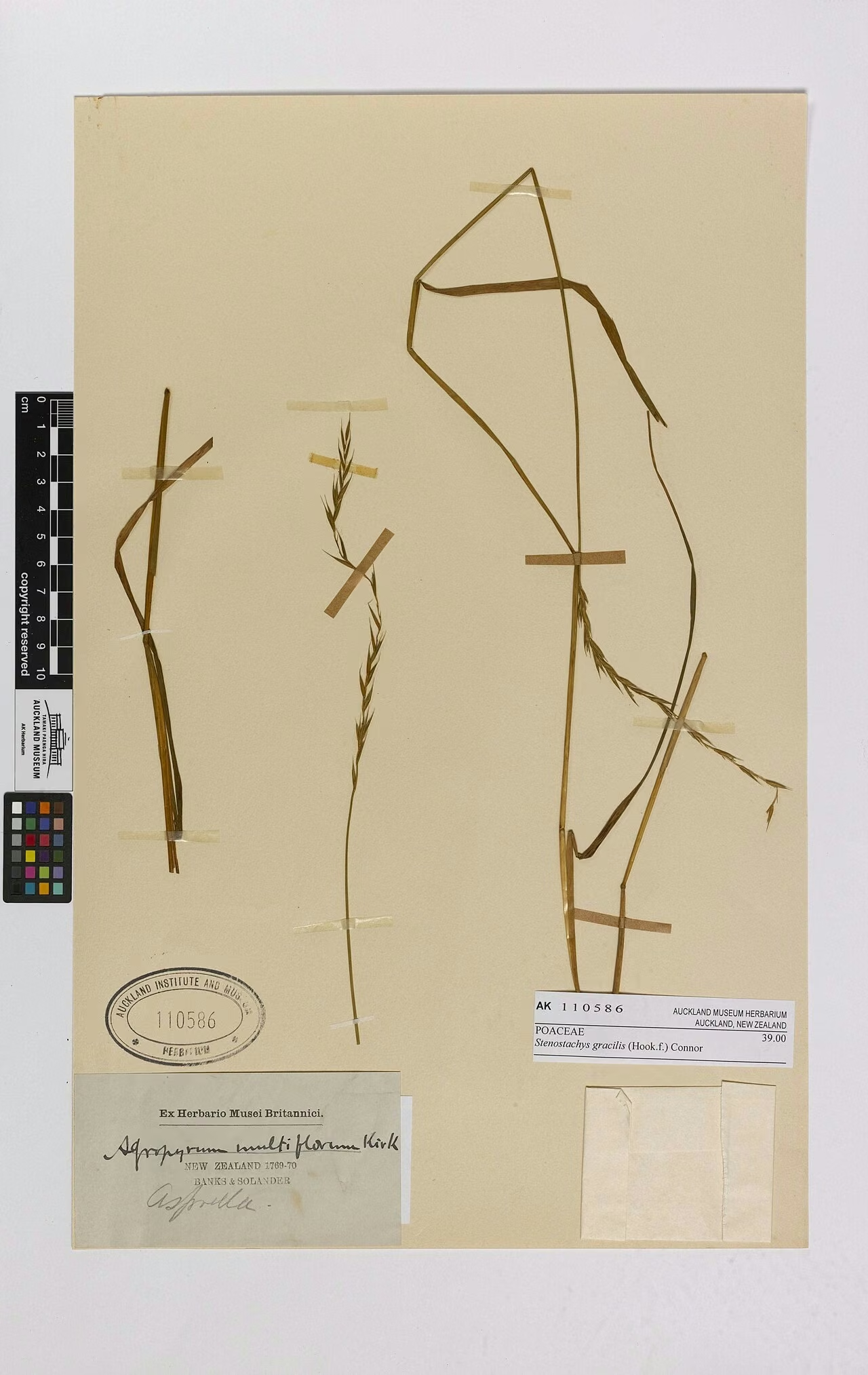
It differs from S. gracilis and S. deceptorix in the shape of the lemma tip, and from S. gracilis in having well-developed glumes rather than minute or absent ones. NZPCN notes that its glume structure and spikelet arrangement make it look most like the native wheatgrasses in Anthosachne, so careful examination of the spikelets is needed.
Quick Facts
| Scientific Name | Stenostachys laevis |
|---|---|
| Height | 0.5-0.75 m in flower |
| Spread | Loose patches via rooting stolons |
| Water Needs | Moist; often in flushes |
| Light | Light shade to sun |
| Frost Tolerance | High; grows to 1300 m |
| Salt Tolerance | Some coastal forms; tolerance not documented |
| Growth Rate | Moderate |
| Lifespan | Perennial |
Climate Best Suited to
Suits cool temperate climates, from mild coasts to cold montane grassland with hard frosts and snow. It is mostly a plant of the drier and cooler South Island.
Regional Suitability
| City | Climate Suitability |
|---|---|
| Auckland | Low |
| Wellington | Medium |
| Christchurch | High |
| Dunedin | High |
Plant Habitat
Stenostachys laevis is endemic to New Zealand. In the North Island it is known only from Reporoa Bog in the north-western Ruahine Range. It occurs throughout the South Island except Nelson and Westland, and is also present on Stewart Island/Rakiura.
It is a small grass of tussock grasslands, grey scrub, shaded cliff faces and lake sides, often growing in flushes and occasionally on the coast. It ranges from sea level to 1300 m.
Growing Requirements
Soil Requirements
It grows in moist soils in grassland and scrub, often where seepage keeps the ground damp.
- Damp flush and lakeside soils
- Tussock grassland soils of low to moderate fertility
- Crevices and ledges on shaded cliffs
Light Requirements
NZPCN advises that it grows best in light shade, consistent with its occurrence in grey scrub and on shaded cliffs.
- Light or dappled shade is ideal
- Tolerates open grassland with taller tussocks for shelter
- Avoid deep shade
Water Requirements
Flushes and lake margins are among its favoured sites, so it does best with steady moisture.
- Keep the soil moist, especially in summer
- A damp spot near a pond or seep suits it
Planting and Establishing
Plant in moist, lightly shaded ground, for example beneath open shrubs or beside a seep or pond margin. Space plants 30 to 40 cm apart so the stolons can knit together.
In restoration of South Island tussock or grey scrub sites, it can be added as a minor component using locally sourced material.
Ecological Role
Its pollination biology is not documented in the sources consulted; as a grass it is presumably wind-pollinated or self-pollinated like its relative S. gracilis, which has mainly cleistogamous flowers, but this is not confirmed for S. laevis.
It is part of the grass and herb layer in tussock grassland and grey scrub, where its rooting stolons let it spread into gaps. Because it is small and easily overlooked, its true abundance may be underestimated.
Uses & Significance
Garden Uses
It is a modest grass suited to native plant collections and restoration rather than showy borders.
- Lightly shaded native gardens in the south
- Damp margins of ponds and seeps
- South Island tussock and grey scrub restoration
Ecological Value
It is an uncommon member of an endemic genus and contributes to the diversity of South Island grasslands and shrublands.
- Endemic species in an endemic genus
- Grows in flush habitats that support specialised plant communities
- Isolated North Island population at Reporoa Bog
Landscaping Uses
Grow it as a loose, fine-leaved filler among taller tussocks and small-leaved shrubs, where its nodding seed spikes catch the light in late summer and autumn.
It suits naturalistic plantings that mimic grey scrub, combined with divaricating Coprosma and small Olearia species.
Seasonal Care Calendar
Spring
New leaves and stolons grow as soils warm.
- Divide and replant patches
- Weed around young plants
Summer
Flowering occurs from January to March, later than its relative S. gracilis.
- Water in dry spells
- Watch for the nodding flower spikes
Autumn
Fruiting runs from March to May.
- Collect fresh seed as the heads ripen
- Sow seed straight away
Winter
Growth slows through cold weather; it is hardy to the frosts of montane grassland.
- No feeding needed
- Cut back old culms in late winter
When to Prune and How Much
Pruning is not required. Spent culms can be cut back in late winter to tidy the patch before new growth.
Trim stolons at the edges if the plant spreads beyond its allotted space.
How to Grow Grassland Wheatgrass
NZPCN describes Stenostachys laevis as very easy to propagate from rooted pieces, divisions of whole plants and fresh seed, and notes that it grows best in light shade. Its long stolons root and shoot at the nodes, so a single patch soon yields many rooted pieces. Seed ripens from March to May and should be sown fresh. As this is an At Risk species, take material only from cultivated stock or with permission from the landowner and the Department of Conservation, and use local provenance for restoration so that regional forms, such as the inrolled-leaved coastal plants, are not mixed.
From Seed
Collect the narrow seed heads as they ripen in autumn and sow promptly for best germination.
- Gather ripe seed heads between March and May
- Separate seeds and sow on a moist seed-raising mix
- Cover lightly and keep in a sheltered, lightly shaded place
- Prick out seedlings into individual pots when large enough to handle
- Plant out the following spring
By Division and Rooted Pieces
Rooted stolon sections or divisions of whole plants establish quickly and are the fastest way to produce plants. Spring is a convenient time to divide, giving the new plants a full growing season to settle.
- Lift a patch or cut free stolon sections that have rooted at the nodes
- Pot each piece in a moist, free-draining mix
- Keep lightly shaded and damp until new shoots appear
- Plant out once a good root system has formed
Pests & Diseases
No pests or diseases are recorded for this species in the sources consulted, and NZPCN states that it faces no apparent threats.
In gardens, ensure vigorous exotic grasses do not overrun it, as its loose patches are easily swamped.
Cultural Significance
No Māori name or traditional use is recorded for Stenostachys laevis in the sources consulted.
It was first described in 1894 as Asprella laevis and later moved through Hystrix, Cockaynea and Elymus before being placed in the endemic genus Stenostachys. The epithet laevis means smooth.
Bonus Tip
If you find a slender wheatgrass-like grass growing in a seep or under grey scrub in the South Island, check the spikelets: well-formed glumes and a lemma with a spine tip or short awn point to this species, and reporting it to iNaturalist NZ helps map a plant that is easily overlooked.
Related Plants
Explore other native plants that share similar characteristics or habitats with Grassland Wheatgrass (Stenostachys laevis), offering further insights into New Zealand's diverse flora. These related species provide context and opportunities for complementary planting in your garden.

New Zealand Sea Spurrey
Spergularia tasmanica
Stackhousia minima
Stackhousia minima
Slender Chickweed
Stellaria gracilenta
Stenostachys gracilis
Stenostachys gracilis
Fennel-Leaved Pondweed
Stuckenia pectinata
Suaeda novae-zelandiae
Suaeda novae zelandiae
Petriei Grass
Achnatherum Petriei Grass
Speargrass
Speargrass
Plant Conservation
Stenostachys laevis is ranked At Risk - Naturally Uncommon (2023) with the qualifier Sparse. NZPCN notes it faces no apparent threats but is certainly uncommon and easily overlooked.
Its isolated North Island population at Reporoa Bog is of particular interest. Protecting flushes, lake margins and grey scrub from drainage and weed invasion helps safeguard this and associated species.
Frequently Asked Questions
What is grassland wheatgrass?
It is Stenostachys laevis, an endemic New Zealand grass related to the wheatgrasses, with slender nodding flower spikes. It forms loose patches in tussock grassland, grey scrub and flushes.
Where does Stenostachys laevis grow?
It grows throughout the South Island except Nelson and Westland, on Stewart Island/Rakiura, and in the North Island only at Reporoa Bog in the north-west Ruahine Range.
Is grassland wheatgrass rare?
It is ranked At Risk - Naturally Uncommon with the qualifier Sparse. NZPCN says it has no apparent threats but is certainly uncommon and easily overlooked.
How is Stenostachys laevis propagated?
NZPCN describes it as very easy to grow from rooted pieces, divisions of whole plants and fresh seed, and notes that it grows best in light shade.
Sources and Further Reading
The botanical, growing, and conservation details for Grassland Wheatgrass (Stenostachys laevis) on this page draw on the New Zealand plant references below. Consult them for full technical records and the latest distribution data.