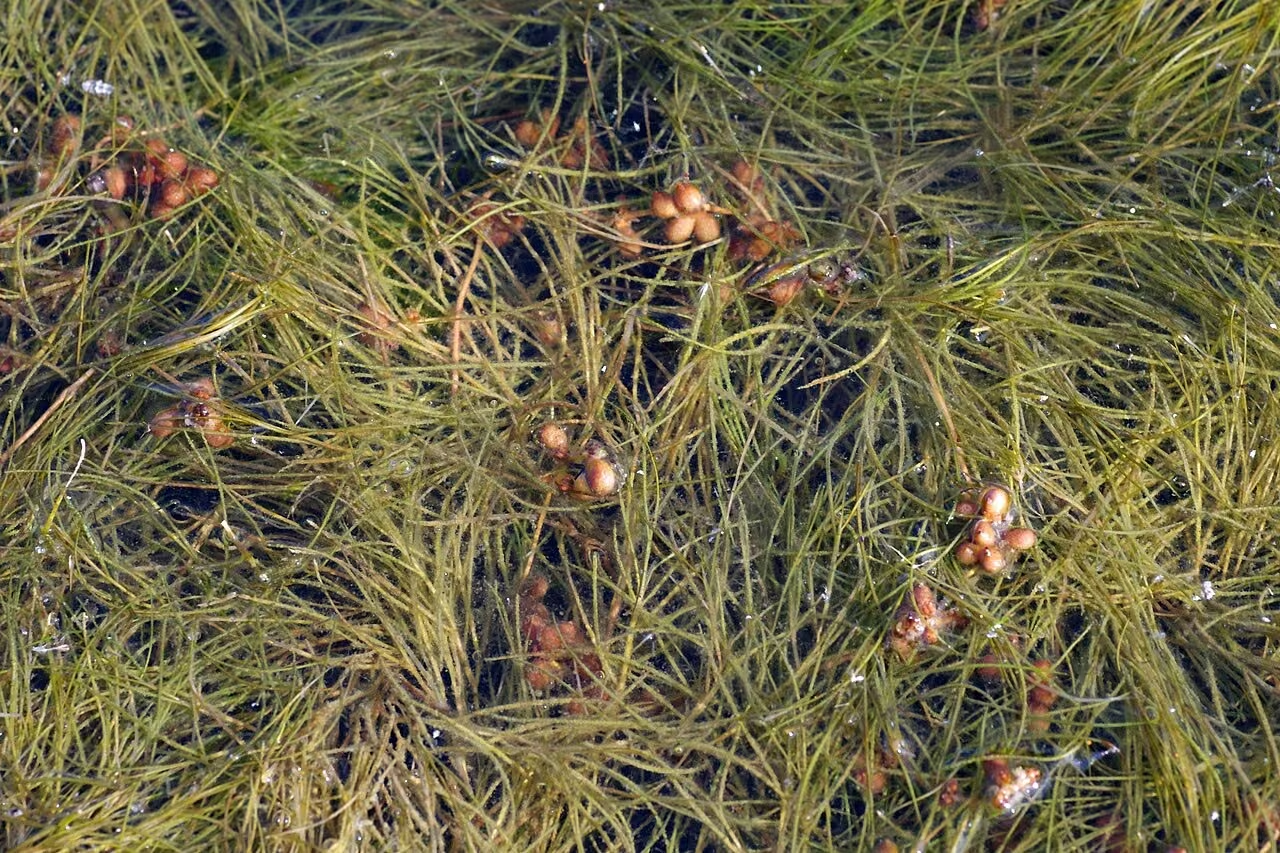
Fennel-Leaved Pondweed
Stuckenia pectinata
Last updated:
Fennel-leaved pondweed, also called sago pondweed (Stuckenia pectinata), is a fully submerged aquatic herb found in fresh and brackish water on every continent except Antarctica. In New Zealand it is indigenous but uncommon, recorded from the North, South and Chatham Islands, mostly in brackish lagoons and slow tidal streams, and sometimes in shallow lowland pools. Its slender, brittle stems can trail over 3 m long and carry fine, dark green, grass-like leaves about 1 mm wide, while its rhizomes form swollen tubers in autumn. It is ranked At Risk - Naturally Uncommon, and the drainage and modification of brackish wetlands is its main threat. Explore more native flowering plants in our native plant guide.
Plant Description
Stuckenia pectinata is an aquatic herb with an extensive network of rhizomes, which develop swollen, starchy tubers in autumn. From these arise slender, brittle, much-branched stems from 0.1 to more than 3 m long, which lie submerged in the water.
The submerged leaves are narrow-linear, 50 to 120 mm long and about 1 mm wide, dark green to brown-green, with entire margins and visible transverse veins; at the base each leaf has a sheath and ligule. The inflorescence is a brown spike 20 to 40 mm long, with whorls of small flowers separated by gaps so that it looks discontinuous. Flowering is in January and February and fruiting from January to March. The flowers are wind-pollinated and the seeds float.
It is most likely to be confused with Ruppia species, with which it often grows. Stuckenia pectinata is distinguished by its ligulate, acute-tipped leaves, its tuberous stems and its spicate inflorescences. Its fine, fennel-like leaves also separate it from the broader-leaved native Potamogeton pondweeds.
Quick Facts
| Scientific Name | Stuckenia pectinata |
|---|---|
| Height | Stems 0.1-3 m or more long, submerged |
| Spread | Extensive rhizome networks |
| Water Needs | Aquatic; permanently submerged |
| Light | Full sun through clear, shallow water |
| Frost Tolerance | Survives winter as rhizomes and tubers |
| Salt Tolerance | High; usually in brackish water |
| Growth Rate | Fast in nutrient-rich water |
| Lifespan | Perennial |
Climate Best Suited to
Occurs in temperate lowland climates across New Zealand, from the north to the Chatham Islands. The plant itself is protected by water, surviving cold periods as rhizomes and tubers.
Regional Suitability
| City | Climate Suitability |
|---|---|
| Auckland | Medium |
| Wellington | Medium |
| Christchurch | Medium |
| Dunedin | Medium |
Plant Habitat
Fennel-leaved pondweed is indigenous to New Zealand and has been collected from the North, South and Chatham Islands. It is a cosmopolitan species, known from fresh and brackish waters on all continents except Antarctica.
In New Zealand it is usually found in brackish water, such as slow-moving tidal streams and coastal lagoons, especially where streams and rivers enter the sea, but it also grows in shallow lowland pools. Regionally it is ranked Naturally Uncommon in Northland, Data Deficient in Auckland, Regionally Vulnerable in Otago and Regionally Endangered in Wellington.
Growing Requirements
Soil Requirements
It roots into soft sediments on the bed of lagoons, tidal streams and pools, where its rhizomes and tubers spread.
- Soft mud or silt substrates
- Brackish or fresh water
- Shallow, slow-moving or still water
Light Requirements
As a submerged plant it needs enough light to penetrate the water, so it grows best in clear, shallow water.
- Full sun on shallow water
- Declines where sediment or algae cloud the water
Water Requirements
It is a true aquatic and must remain submerged, typically in brackish water where salinity fluctuates with the tide.
- Permanently submerged habitat
- Tolerates brackish to fresh water
- Slow currents or still lagoons
Planting and Establishing
This species is not planted in gardens. NZPCN advises that it is difficult to propagate and should not be removed from the wild.
For brackish wetland restoration, the most effective approach is to protect and improve existing habitat by keeping tidal connections open, limiting sediment and nutrient inputs, and preventing drainage, rather than attempting to plant it.
Ecological Role
Fennel-leaved pondweed spreads vegetatively from tubers and stem fragments, and sexually by seeds, which float and are carried by water. Its flowers are wind-pollinated.
Internationally it is one of the most important waterfowl foods: diving ducks such as canvasbacks feed on the starchy tubers, while swans and dabbling ducks eat the leaves and seeds, and various insect larvae live on the plant. It tolerates nutrient-rich water and can become a nuisance weed in some countries, but in New Zealand it is uncommon.
Uses & Significance
Garden Uses
It has no practical garden use; its value lies in natural brackish wetlands.
- Not suitable for ornamental ponds
- Valued in estuarine and lagoon restoration through habitat protection
- Of interest to wetland ecologists and botanists
Ecological Value
It is a structural plant of brackish lagoons and tidal streams, providing food and cover in a habitat type that has been greatly reduced in New Zealand.
- Submerged beds shelter invertebrates and small fish
- Tubers, leaves and seeds are eaten by waterfowl
- Indicator of healthy brackish wetland habitat
Landscaping Uses
Fennel-leaved pondweed is not a landscaping plant. In wetland design, its presence is best encouraged by retaining tidal flow, clear water and soft sediments in coastal lagoons.
Where restoration of brackish margins is planned, ecologists should survey for existing beds before earthworks, as these are easily destroyed by dredging or drainage.
Seasonal Care Calendar
Spring
New shoots grow from overwintering rhizomes and tubers.
- Avoid disturbing lagoon beds
- Monitor water clarity
Summer
Flowering occurs in January and February, with spikes at or near the water surface.
- Look for brown flower spikes in brackish lagoons
- Avoid trampling beds
Autumn
Fruits mature from January to March, and the rhizomes form swollen tubers in autumn.
- Leave fruits and tubers undisturbed for wildlife
- Record populations for regional monitoring
Winter
The plant persists through winter mainly as rhizomes and tubers in the sediment.
- Prevent drainage or dredging of lagoons
- No other action needed
When to Prune and How Much
No pruning or cutting is needed in natural habitats.
Where overseas the species becomes a weed in nutrient-enriched waterways it is sometimes cut, but in New Zealand it is uncommon and should be left undisturbed.
How to Grow Fennel-Leaved Pondweed
NZPCN states that Stuckenia pectinata is difficult to propagate and should not be removed from the wild, and it is not available from nurseries. In nature it reproduces vegetatively, from the starchy tubers that form on its rhizomes in autumn and from broken stem fragments, and sexually from floating seeds produced between January and March. The notes below describe how the plant multiplies in its habitat and how specialists working under permit for conservation might use these methods. Anyone involved in such work should coordinate with the Department of Conservation or regional council, since the species is At Risk and regionally threatened in some areas.
From Tubers
The swollen tubers formed on the rhizomes in autumn are the plant's main means of surviving unfavourable periods and re-establishing in spring. Stem fragments that break off can also root where they settle on soft sediment, which is how beds spread naturally.
- Use only tubers obtained under permit for conservation purposes
- Plant tubers into soft sediment in containers of brackish or fresh water
- Keep in a sunny position with clear water
- Transfer established plants to the restoration site in spring
From Seed
Seed forms from January to March and floats, which allows it to spread along waterways. No germination data for New Zealand plants were found in the sources consulted.
- Collect ripe fruits only with permission
- Sow on fine sediment under shallow water
- Keep in good light and maintain water quality
- Be prepared for slow or patchy results
Pests & Diseases
No specific pests are recorded for this species in New Zealand in the sources consulted.
The main threats are wetland modification and drainage, particularly of brackish systems and river mouths. Sedimentation, nutrient pollution and turbid water, and competition from invasive aquatic weeds, can also reduce its beds.
Cultural Significance
No Māori name or traditional use is recorded for Stuckenia pectinata in the sources consulted.
It was long known as Potamogeton pectinatus before being placed in the genus Stuckenia. The epithet pectinata means comb-bearing, referring to the comb-like arrangement of its fine leaves. Its American name, sago pondweed, refers to its starchy tubers.
Bonus Tip
If you find fine, thread-like underwater leaves in a brackish lagoon, check for Ruppia as well: fennel-leaved pondweed has a sheath with a small ligule at each leaf base and a gappy spike of flowers, while Ruppia lacks the ligule and tubers. Reporting confirmed sightings to iNaturalist NZ helps track this uncommon plant.
Related Plants
Explore other native plants that share similar characteristics or habitats with Fennel-Leaved Pondweed (Stuckenia pectinata), offering further insights into New Zealand's diverse flora. These related species provide context and opportunities for complementary planting in your garden.
Plant Conservation
Stuckenia pectinata is ranked At Risk - Naturally Uncommon (2023), with the qualifier Secure Overseas because it is widespread internationally. Regionally it is ranked Regionally Endangered in Wellington and Regionally Vulnerable in Otago.
Its threats are mainly the modification and drainage of brackish wetlands and stream mouths. Maintaining tidal connections, reducing sediment and nutrient runoff, and protecting coastal lagoons from reclamation are the most effective conservation actions.
Frequently Asked Questions
Is fennel-leaved pondweed native to New Zealand?
Yes. Stuckenia pectinata is indigenous to New Zealand, recorded from the North, South and Chatham Islands, but it is not endemic because the species occurs worldwide.
How do you tell fennel-leaved pondweed from Ruppia?
It often grows with Ruppia, but differs in its ligulate leaves with pointed tips, its tuberous stems and its spike-like inflorescence of separated whorls of flowers.
Why is fennel-leaved pondweed important for wildlife?
Overseas it is a major waterfowl food: diving ducks eat the starch-rich tubers, while swans and dabbling ducks feed on the leaves and seeds. Its role for New Zealand waterbirds is less documented.
Can I grow Stuckenia pectinata in a pond?
NZPCN says it is difficult to propagate and should not be removed from the wild, so it is not a practical choice for garden ponds.
Sources and Further Reading
The botanical, growing, and conservation details for Fennel-Leaved Pondweed (Stuckenia pectinata) on this page draw on the New Zealand plant references below. Consult them for full technical records and the latest distribution data.