Slender Chickweed
Stellaria gracilenta
Last updated:
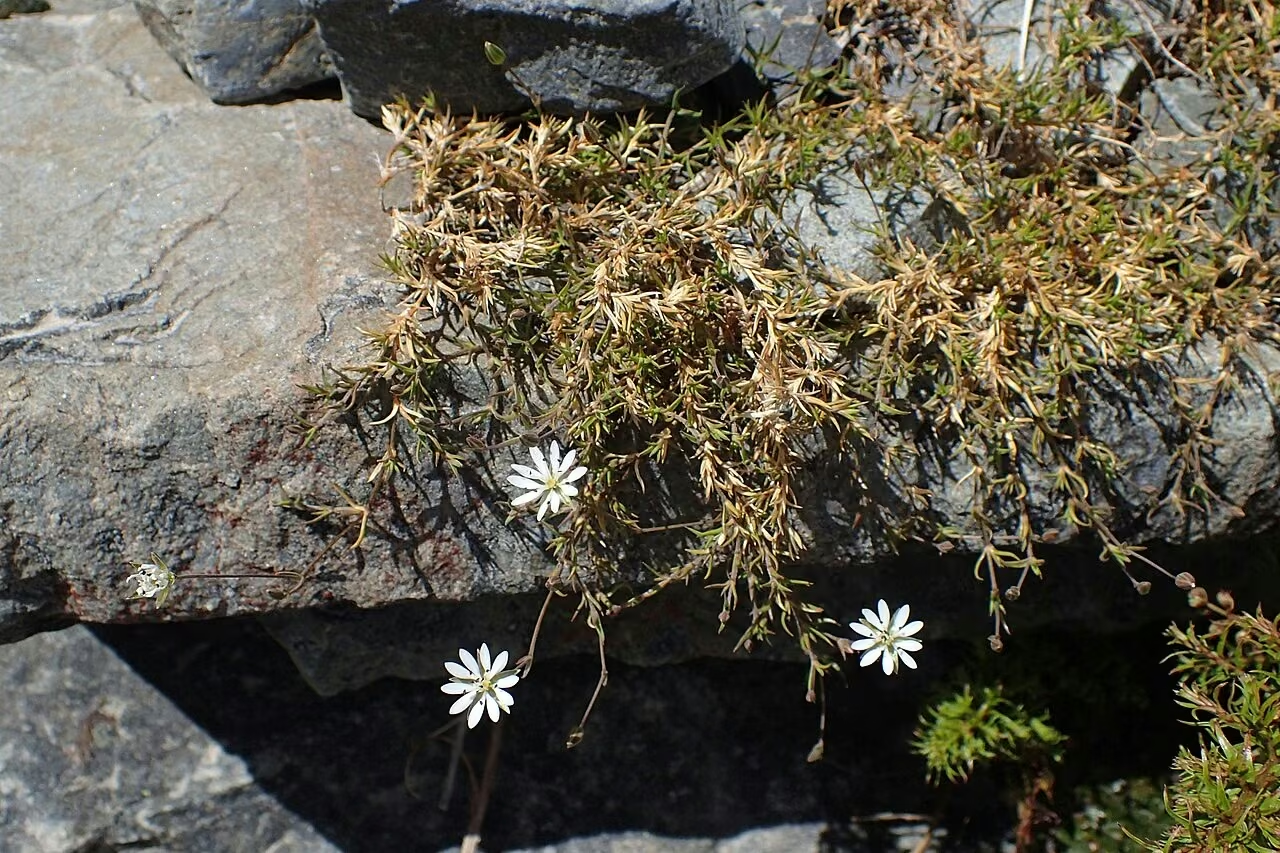
Slender chickweed (Stellaria gracilenta) is a small, wiry perennial herb endemic to New Zealand. Its fine, finely hairy stems sprawl or rise to 5 to 15 cm, clothed in pairs of tiny, needle-like, yellowish-green leaves, and from October to February it carries single white starry flowers on long, upright stalks. It grows in rocky, well-drained places on riverbeds and in tussock grassland, from sea level to about 1500 m, in the eastern ranges of the North Island and through much of the South Island. Unlike the familiar weedy chickweed, it is a native plant of open dry country and is ranked Not Threatened. Explore more native flowering plants in our native plant guide.
Plant Description
Stellaria gracilenta is a wiry perennial. Its stems lie along the ground or rise at the tips, are round in section, and usually carry a uniform coat of sparse to dense fine hairs, though they are occasionally hairless. Most stems are 5 to 15 cm long, ranging from 2 to 30 cm.
The leaves are yellowish green, stalkless, linear to awl-shaped and pointed, only 3 to 8 mm long and 0.5 to 0.7 mm wide. They are arranged in opposite pairs that are joined at the base, with a few hairs near the base. The flowers are borne singly on erect stalks usually 30 to 60 mm long, so they stand clear of the stems. Each flower has white petals in the starry pattern typical of the genus. The fruit is a capsule containing pale brown seeds about 0.8 to 1 mm long.
The combination of very narrow, needle-like leaves and long-stalked solitary flowers separates it from the introduced chickweeds, which have broader, softer leaves. Other native Stellaria species, such as the larger-leaved forest and alpine species, differ in leaf shape and habitat.
Quick Facts
| Scientific Name | Stellaria gracilenta |
|---|---|
| Height | 0.05-0.15 m (stems to 0.3 m) |
| Spread | Small sprawling patches |
| Water Needs | Low to moderate; well-drained sites |
| Light | Full sun, open sites |
| Frost Tolerance | High; grows to about 1500 m |
| Salt Tolerance | No information available |
| Growth Rate | Moderate |
| Lifespan | Perennial |
Climate Best Suited to
Suits cool, often dry, continental climates with cold winters and warm summers, typical of eastern ranges and inland basins. It copes with frost and drought on free-draining ground.
Regional Suitability
| City | Climate Suitability |
|---|---|
| Auckland | Low |
| Wellington | Medium |
| Christchurch | High |
| Dunedin | Medium |
Plant Habitat
Slender chickweed is endemic to New Zealand. In the North Island it is recorded from the Hikurangi, Kaweka, Kaimanawa and Ruahine Ranges. In the South Island it occurs in Nelson, Marlborough, Canterbury, Westland and Otago.
It grows on riverbeds and in open places in tussock grassland, favouring rocky, well-drained sites, from sea level up to about 1500 m. Shingle terraces, stony slopes and gaps between tussocks are typical places to find it.
Growing Requirements
Soil Requirements
It prefers stony, free-draining soils and gravels where competition from taller plants is low.
- Riverbed gravels and shingle
- Rocky, well-drained tussock grassland soils
- Low-fertility ground
Light Requirements
It is a plant of open country and needs full light to flower well.
- Full sun
- Open gaps between tussocks and rocks
- Declines when shaded by rank grass or shrubs
Water Requirements
Its riverbed and dry grassland habitats drain quickly, and the plant tolerates dry spells once established.
- Water occasionally in very dry spells when grown in pots
- Avoid wet, poorly drained mixes
Planting and Establishing
Slender chickweed is not commonly offered by nurseries. If legally sourced plants are available, grow them in a scree bed, rock garden or trough with a very gritty mix, in full sun.
Plant in spring so roots can establish before summer dry, and set the plant among stones where its wiry stems can scramble and its flowers can be seen against the rock.
Ecological Role
Its white, open flowers are of a type usually visited by small flies and native bees, but specific pollinators of this species are not documented in the sources consulted. The seeds are shed from small capsules.
As a low plant of riverbeds and tussock grassland, it is part of the diverse small-herb flora that fills gaps between tussocks and stones. Braided riverbeds where it grows are increasingly invaded by weeds such as lupins, broom and gorse, which shade out such small natives.
Uses & Significance
Garden Uses
Its small size and fine texture make it a plant for collectors of native alpine and rock plants rather than for general gardens.
- Scree and gravel gardens
- Alpine troughs and rock crevices
- Dryland native plantings in eastern regions
Ecological Value
It contributes to the native herb diversity of braided riverbeds and tussock grassland, two habitats heavily modified by weeds and land development.
- Endemic member of the riverbed and grassland flora
- Provides nectar and pollen for small insects in spring and summer
- Occupies stony gaps that would otherwise be colonised by weeds
Landscaping Uses
In a dryland or riverbed-themed planting, slender chickweed can be tucked between greywacke stones alongside small tussocks, scabweeds and other low natives, where its white flowers add a fine sprinkle of colour from spring into summer.
Because it is small and open, it needs companions that stay low; vigorous grasses will quickly smother it.
Seasonal Care Calendar
Spring
Flowering begins in October as new growth extends the wiry stems.
- Weed around plants to keep them in full light
- Top up gravel mulch
Summer
Flowering continues into February and capsules ripen from January.
- Collect seed from cultivated plants as capsules open
- Water potted plants in prolonged drought
Autumn
Fruiting continues to March, occasionally into June.
- Leave some seed to self-sow in gravel
- Tidy straggly stems if needed
Winter
The plant sits quietly through frosts and snow in its native ranges.
- Ensure drainage so roots are not waterlogged
- No feeding required
When to Prune and How Much
Pruning is not needed. If the stems become straggly in cultivation, they can be trimmed lightly after flowering to encourage a more compact patch.
Remove any weeds growing through the plant by hand rather than cutting the native stems.
How to Grow Slender Chickweed
No propagation information for Stellaria gracilenta is given by NZPCN, and it is rarely grown, so the methods below follow standard practice for small native Stellaria species rather than a published protocol for this one. The plant fruits from January to March, producing capsules of small pale brown seeds, and its sprawling stems offer material for cuttings. Use only seed or cuttings from cultivated plants or collected with permission. A gritty, free-draining mix and an open, cool position suit both methods, and young plants should be kept out of hot afternoon sun until established.
From Seed
Capsules ripen mainly between January and March. Collect them as they begin to open and sow promptly, as the seeds are small and easily lost. Seedlings are tiny at first and should not be allowed to dry out.
- Collect ripe capsules in late summer
- Sow seed thinly on a gritty seed-raising mix and cover very lightly
- Keep the tray moist in a bright, sheltered spot outdoors
- Pot seedlings individually once they have several pairs of leaves
From Cuttings
Short non-flowering stem tips can be rooted in spring or early summer, which is a common way to propagate small perennial chickweeds.
- Take 3 to 5 cm tips from non-flowering stems
- Insert into a mix of pumice or coarse sand and a little peat-free compost
- Keep humid and lightly shaded until roots form
- Harden off gradually before planting into a scree bed
Pests & Diseases
No specific pests or diseases of this species are recorded in the sources consulted.
Its main threat in the wild is competition from invasive plants on riverbeds and in grassland. In cultivation, slugs and snails can damage the fine stems, and overly rich or wet soil causes rot.
Cultural Significance
No Māori name or traditional use is recorded for Stellaria gracilenta in the sources consulted.
The genus name Stellaria means star flower, describing the starry white petals, and gracilenta means slender. Joseph Dalton Hooker described the species in 1855 from New Zealand material.
Bonus Tip
When surveying braided riverbeds, check stable shingle terraces between tussocks in early summer: slender chickweed is easy to overlook until its white flowers appear on long stalks, and spotting it there indicates a terrace still holding native herb diversity rather than being overrun by weeds.
Related Plants
Explore other native plants that share similar characteristics or habitats with Slender Chickweed (Stellaria gracilenta), offering further insights into New Zealand's diverse flora. These related species provide context and opportunities for complementary planting in your garden.
Cook Strait Kōwhai
Sophora molloyi
Sparganium subglobosum
Sparganium subglobosum

New Zealand Sea Spurrey
Spergularia tasmanica
Stackhousia minima
Stackhousia minima
Stenostachys gracilis
Stenostachys gracilis
Grassland Wheatgrass
Stenostachys laevis
Cushion Daisy
Cushion Daisy
Fertilis Plant
Fertilis Plant
Plant Conservation
Stellaria gracilenta has been ranked Not Threatened at each national assessment since 2004. Regionally, Otago ranks it Not Threatened while Wellington (2025) ranks it Data Deficient, reflecting limited records there.
Weed invasion of braided riverbeds and the conversion of tussock grassland to pasture are the main pressures on its habitat. Controlling weeds such as lupins, broom and gorse on riverbeds benefits this species along with many other small natives.
Frequently Asked Questions
Is slender chickweed a weed?
No. Stellaria gracilenta is an endemic New Zealand native. The weedy garden chickweed is Stellaria media, an introduced annual with broad, soft leaves rather than the narrow, needle-like leaves of slender chickweed.
Where does Stellaria gracilenta grow?
In the North Island it is found in the Hikurangi, Kaweka, Kaimanawa and Ruahine Ranges, and in the South Island in Nelson, Marlborough, Canterbury, Westland and Otago, on riverbeds and in tussock grassland.
When does slender chickweed flower?
It flowers from October to February, producing single white flowers on erect stalks 2 to 6 cm long, and fruits mainly from January to March.
How do you identify slender chickweed?
Look for wiry, sprawling stems with fine hairs, pairs of stiff, narrow leaves only 3 to 8 mm long joined at the base, and solitary white flowers held well above the foliage on long stalks.
Sources and Further Reading
The botanical, growing, and conservation details for Slender Chickweed (Stellaria gracilenta) on this page draw on the New Zealand plant references below. Consult them for full technical records and the latest distribution data.