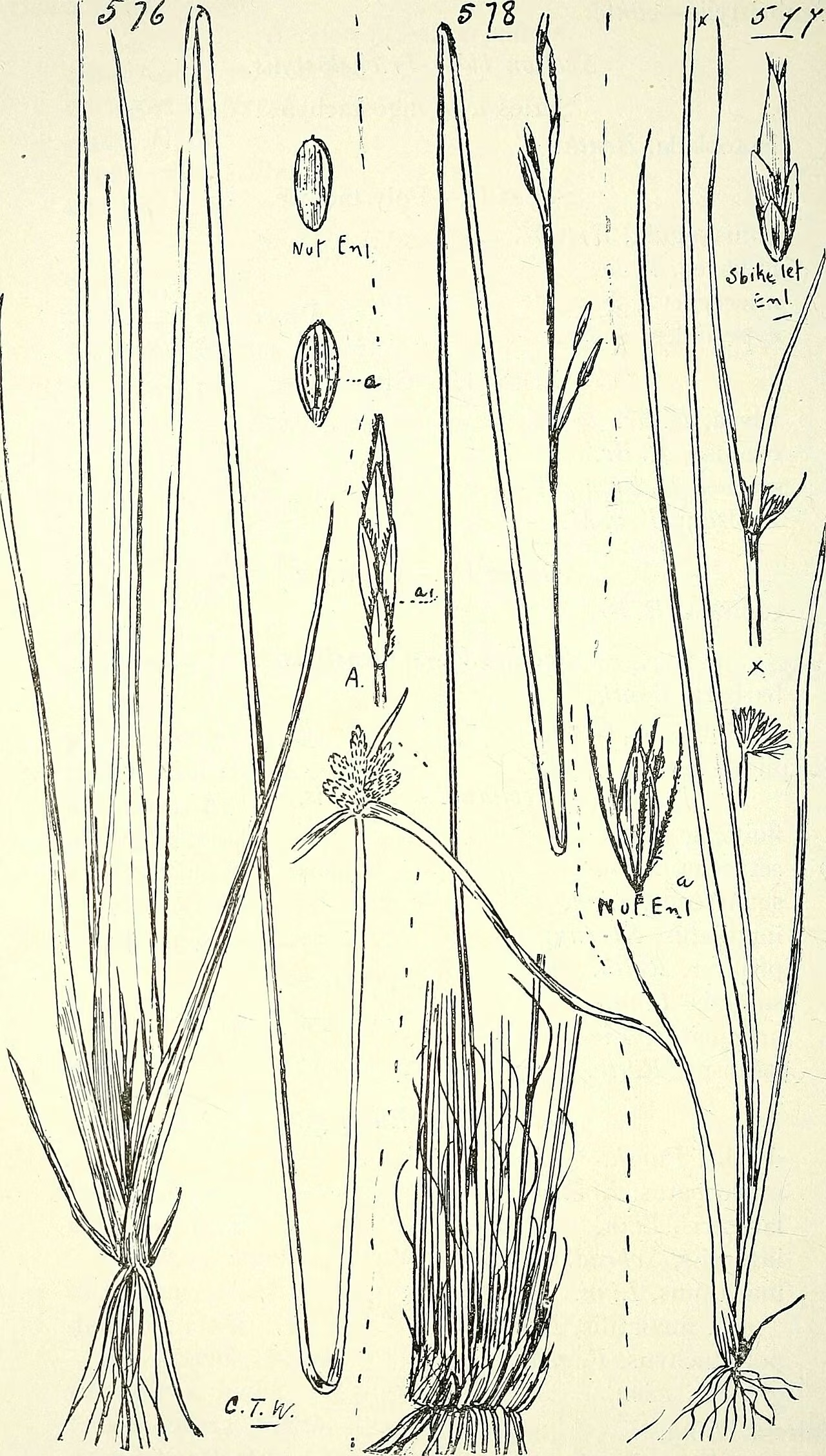
Scirpus
Scirpus polystachyus
Last updated:
Scirpus polystachyus is a robust, leafy sedge that forms clumps up to 1.8 m tall in open wetlands, and a recent natural arrival in New Zealand. Its three-angled stems carry evenly spaced, keeled leaves and end in a large, fan-shaped umbel of many small spikelets, which become fluffy as their long bristles twist at maturity. Here it is known only from the West Coast of the South Island, mainly in wetlands from south of Hokitika to about Okarito, where its range is expanding. Once treated as an introduced Australian weed, it is now regarded as a native coloniser that probably crossed the Tasman with waterbirds such as grey teal. Explore more native grasses and flaxes in our native plant guide.
Plant Description
Scirpus polystachyus is a semi-aquatic to terrestrial summer-green sedge forming robust leafy clumps up to 1.8 m tall. The stems are three-angled and very leafy at the base, with three to five (occasionally eight) evenly spaced leaves along the stem. The leaves are numerous, much shorter than the stems, 0.4 to 0.8 m long and 5 to 8 mm wide, channelled at the base and flattened above, strongly keeled, with finely rough margins and keel. The leaf sheaths are light reddish-brown and glossy.
The inflorescence is a large terminal, compound, irregular fan-shaped umbel with many unequal erect rays and slender secondary rays that droop at maturity. About three leaf-like bracts overtop it. The ovate spikelets are about 4 mm long, clustered two to five at the ray tips, with membranous, light brown glumes about 1.5 mm long that darken toward the tip. Many thread-like bristles, longer than the nut and folded, twisted or spiralled, become conspicuous as the fruit ripens. The nut is tiny, about 0.7 mm long, three-angled and cream.
Without flowers it can be confused with sea clubrushes (Bolboschoenus), but those have a bulbous rootstock and few or no umbel rays. In flower, the dense, many-flowered, fan-shaped umbel of Scirpus polystachyus is unmistakable.
Quick Facts
| Scientific Name | Scirpus polystachyus |
|---|---|
| Height | Up to 1.8 m |
| Spread | Forms robust clumps from rhizomes |
| Water Needs | Wet; base and rhizomes usually in water |
| Light | Full sun |
| Frost Tolerance | Moderate; a lowland coastal species |
| Salt Tolerance | No information available; grows in freshwater wetlands |
| Growth Rate | Fast in fertile wetlands |
| Lifespan | Perennial (summer-green) |
Climate Best Suited to
In New Zealand it grows in the mild, very wet lowland climate of the central West Coast. It would likely grow in other mild, wet lowland districts, though it is not naturally found there.
Regional Suitability
| City | Climate Suitability |
|---|---|
| Auckland | Medium |
| Wellington | Medium |
| Christchurch | Low |
| Dunedin | Low |
Plant Habitat
In New Zealand, Scirpus polystachyus is known from the West Coast of the South Island, mainly in wetlands from south of Hokitika to about Okarito. Its range is continuing to expand. It is common in Australia, the presumed source of the New Zealand population.
It grows from the coast to low-lying country in fertile to moderately acidic open wetlands and on the margins of lakes, ponds and slow-flowing streams. It usually occupies well-lit sites with its stem bases and rhizomes immersed in water. It is classed as a facultative wetland plant.
Growing Requirements
Soil Requirements
It roots into fertile to moderately acidic wetland soils, mud and silt along lake and stream margins.
- Wet, fertile to moderately acidic mud
- Silt and organic sediment at water margins
- Will not tolerate drying out
Light Requirements
NZPCN notes that it requires full sun to flourish, and it occupies open, well-lit wetlands in the wild.
- Full sun
- Poor growth under shade
Water Requirements
It grows with its stem bases and rhizomes immersed in water, at the edges of lakes, ponds and slow streams.
- Shallow standing or slow-moving water
- Permanently saturated margins
- Fresh water
Planting and Establishing
Scirpus polystachyus is not commercially available. Where it is grown, plant it in spring into the shallow margins of a sunny pond or wetland, setting rooted pieces into soft mud with their bases just below the water.
Given its very limited natural range in New Zealand, planting it outside the West Coast is not appropriate for restoration; reserve it for pond plantings or collections where it is not near natural wetlands it could spread into.
Ecological Role
Like other sedges it is wind-pollinated. NZPCN suggests it reached New Zealand through bird dispersal, particularly by grey teal, a duck that crosses between Australia and New Zealand. The long twisted bristles on the nuts may help them catch on feathers or float on water, although this has not been studied.
On the West Coast it forms robust clumps in open wetlands and along water margins, adding a tall, leafy sedge layer that provides cover for wetland birds and invertebrates. As a recent colonist its ecological interactions in New Zealand are not well studied.
Uses & Significance
Garden Uses
NZPCN notes it has some potential as a pond ornamental, valued for its large, fan-shaped flower heads.
- Margins of large, sunny ponds
- Water gardens with room for robust clumps
- Botanical collections of native sedges
Ecological Value
It is of particular interest as a natural trans-Tasman colonist, showing how wetland plants can arrive in New Zealand with migrating birds.
- Cover for wetland birds on the West Coast
- Example of natural long-distance colonisation
- Adds structure to open wetland margins
Landscaping Uses
Its tall, leafy clumps and large fan-shaped umbels, which turn fluffy when the bristles twist at maturity, make a bold feature at the edge of a large pond. It contrasts well with finer-textured rushes and low aquatic plants.
Because it is summer-green and robust, place it where the winter dieback will not be a visual problem and where it has room to form a full clump.
Seasonal Care Calendar
Spring
New leafy shoots emerge and flowering starts in September.
- Plant or divide
- Raise water levels in ponds if low
Summer
Flowering continues to February, and the large fan-shaped umbels are at their best. Fruit begins forming from December.
- Keep bases submerged
- Watch for wetland weeds
Autumn
Fruiting continues until June, with the twisted bristles giving the heads a fluffy look.
- Collect seed
- Leave seed heads for birds
Winter
As a summer-green sedge, its foliage dies back over winter.
- Cut back dead foliage in late winter if desired
- Avoid disturbing rhizomes
When to Prune and How Much
No pruning is needed in natural wetlands. In a garden pond, cut back dead foliage and old stems in late winter before new growth begins.
Removing spent seed heads before they shed will limit self-seeding if you want to keep it contained.
How to Grow Scirpus
NZPCN states that Scirpus polystachyus grows easily from fresh seed and from rooted pieces. Because it is not commercially available, propagation from existing plants is the only practical way to obtain it. Do not collect from its West Coast wetlands without permission, and remember that its New Zealand population is small and localised. Grow new plants in containers standing in water, as the roots should never dry out between potting and planting.
From Seed
The tiny cream nuts ripen from December to June. Sown fresh, they germinate readily in warm, wet conditions.
- Collect seed heads when the bristles have twisted and the nuts come away easily.
- Sow on the surface of a fine, moist seed mix without covering, as the seed is very small.
- Stand the tray in shallow water so it stays saturated.
- Keep in a warm, bright spot; seedlings appear as temperatures rise.
- Pot seedlings individually and grow them on standing in water.
From Rooted Pieces (Division)
Clumps can be divided into rooted pieces, which establish quickly in wet ground. Spring, as new shoots emerge, is the best time.
- Lift a clump or cut a section from its edge with a spade.
- Separate into pieces, each with healthy shoots and a portion of rhizome and roots.
- Trim the leaves back by half to reduce water loss.
- Pot into a heavy, moist mix and stand in water, or plant directly into soft mud.
- Keep the base submerged until new growth is strong.
Pests & Diseases
No pests or diseases are recorded for Scirpus polystachyus in New Zealand, and NZPCN notes no apparent threats.
In cultivation, allowing the pond margin to dry out is the main cause of decline. Waterfowl may pull at young plantings until they are anchored.
Cultural Significance
No Māori name or traditional Māori use is recorded for Scirpus polystachyus, which is consistent with it being a recent natural arrival in New Zealand.
Its story is mainly a scientific one. It was first treated as an introduced weed from Australia, but botanists now interpret it as a successful trans-Tasman colonist dispersed by birds. Its species name, polystachyus, means many-spiked, referring to its many spikelets.
Bonus Tip
When surveying West Coast wetlands, look for a leafy sedge with a broad fan of many small brown spikelets that turn fluffy with age. Recording sightings on iNaturalist NZ helps track how fast this recent colonist is spreading.
Related Plants
Explore other native plants that share similar characteristics or habitats with Scirpus (Scirpus polystachyus), offering further insights into New Zealand's diverse flora. These related species provide context and opportunities for complementary planting in your garden.
Plant Conservation
Scirpus polystachyus is ranked Non-resident Native - Coloniser (2023), with the qualifier Secure Overseas, and it has been classified as a Coloniser in every assessment since 2004. This category is for native species that have recently established naturally in New Zealand.
NZPCN notes no apparent threats, although it is highly localised. Protecting West Coast wetlands from drainage and weed invasion benefits it along with the many other plants that share its habitat.
Frequently Asked Questions
Is Scirpus polystachyus native to New Zealand?
Yes. It is classed as a Non-resident Native - Coloniser. It was once regarded as an introduced Australian weed, but is now interpreted as having arrived naturally across the Tasman, probably carried by birds such as grey teal.
Where does Scirpus polystachyus grow in New Zealand?
It is found on the West Coast of the South Island, mainly in coastal and low-lying wetlands from south of Hokitika to about Okarito, and its range is continuing to expand.
How do you tell Scirpus polystachyus from Bolboschoenus?
Vegetatively they can look alike, but Bolboschoenus has a bulbous rootstock and few or no umbel rays. Scirpus polystachyus has a dense, many-flowered, fan-shaped umbel with many unequal rays.
Sources and Further Reading
The botanical, growing, and conservation details for Scirpus (Scirpus polystachyus) on this page draw on the New Zealand plant references below. Consult them for full technical records and the latest distribution data.