Gumland Bristle Grass
Rytidosperma biannulare
Last updated:
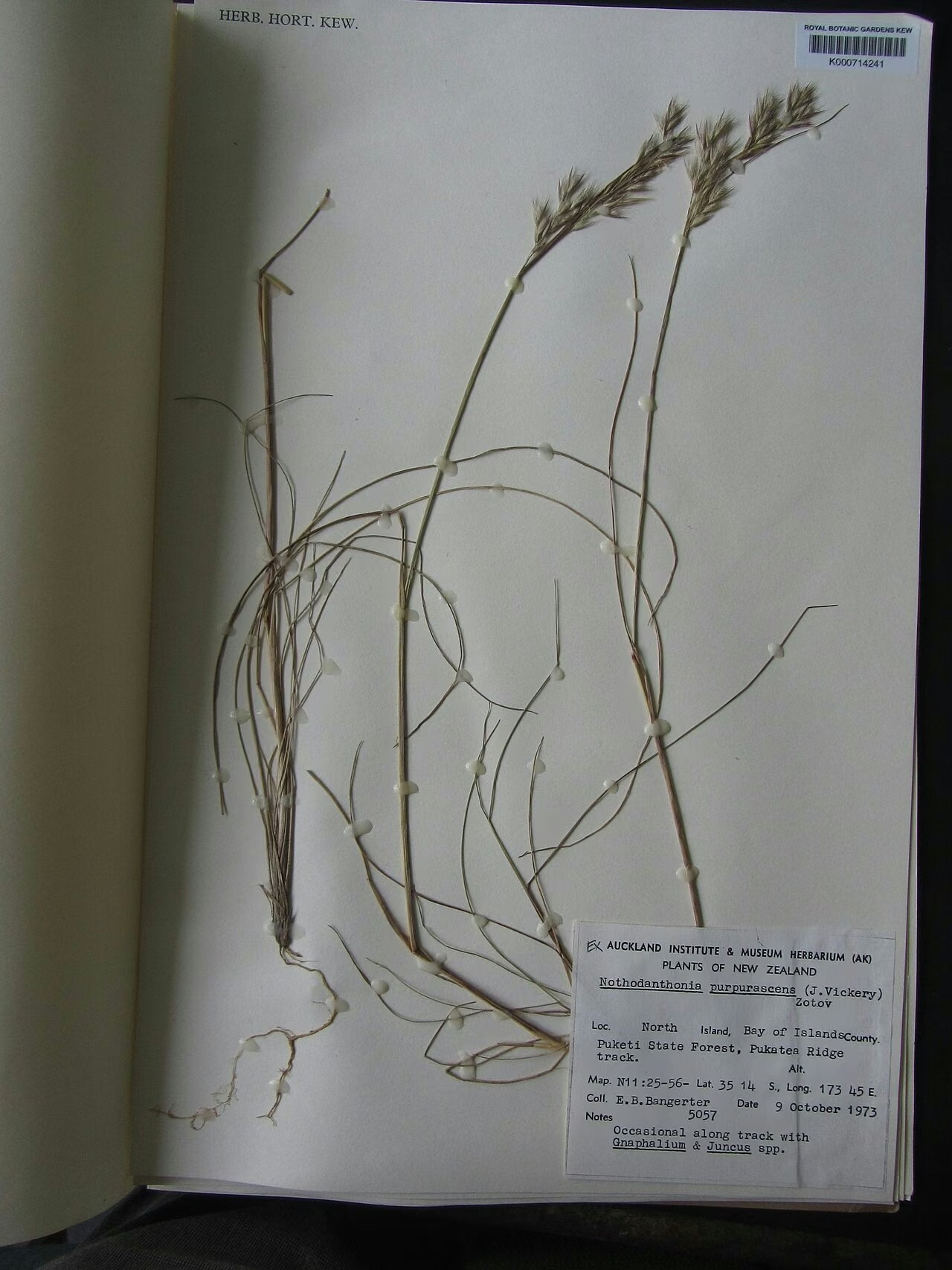
Gumland bristle grass (Rytidosperma biannulare) is a narrow-leaved, green tussock grass with flowering stems up to about 85 cm tall. It grows mainly in the northern North Island, from Surville Cliffs near North Cape south to Auckland, with scattered records at Taumarunui and Wellington, and in the South Island in North-West Nelson, D'Urville Island and the Wairau Valley. It is ranked Not Threatened nationally, but the Wellington region lists it as Regionally Critical. Its purple-margined glumes and long-awned lemmas mark it as one of the larger New Zealand Rytidosperma species. It has also been trialled as a forage grass in the United States. Explore more native grasses and flaxes in our native plant guide.
Plant Description
Rytidosperma biannulare forms narrow-leaved, green tussocks in which the leaves are much shorter than the flowering culms. New shoots arise inside the leaf sheaths, giving a tight, upright clump. The leaf sheaths are pale straw coloured, often purplish towards the top, and the ligule is a short fringe 0.3 to 0.5 mm long. Leaf blades reach 30 to 40 cm, are usually rolled and become more or less hairless at maturity, with rough margins and tips.
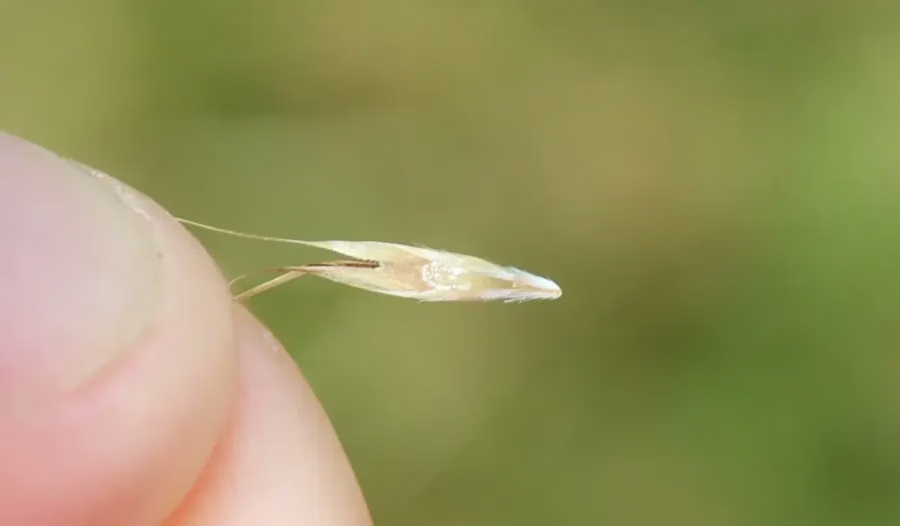
The culms grow up to 85 cm tall with smooth internodes. The panicle is often fairly dense and upright, 10 to 20 cm long. Each spikelet holds six or seven florets, and the awns usually stick out beyond the glumes. The glumes are lanceolate, purple-margined and about 7.6 to 13 mm long. The lemma is 1.8 to 2.8 mm long with two rings of hairs, side lobes about 4 to 5 mm long and a central awn of about 7 to 9.5 mm.
The species name biannulare refers to the two rings (annuli) of hairs on the lemma, a feature used to separate Rytidosperma species. Distinguishing it from other tall Rytidosperma such as Rytidosperma gracile or the introduced Australian wallaby grasses requires close examination of the lemma hairs and awns with a hand lens and the Manaaki Whenua grass key.
Quick Facts
| Scientific Name | Rytidosperma biannulare |
|---|---|
| Height | Flowering stems to 0.85 m; foliage to about 0.4 m |
| Spread | Compact tussock, roughly 0.2-0.3 m across |
| Water Needs | Low to moderate |
| Light | Full sun |
| Frost Tolerance | Moderate; mostly a lowland northern grass |
| Salt Tolerance | No information available |
| Growth Rate | Moderate |
| Lifespan | Perennial |
Climate Best Suited to
Suited to warm, mild lowland climates of the northern North Island and the sunnier, drier valleys of Nelson and Marlborough.
Regional Suitability
| City | Climate Suitability |
|---|---|
| Auckland | High |
| Wellington | Medium |
| Christchurch | Medium |
| Dunedin | Low |
Plant Habitat
The main range of gumland bristle grass runs from Surville Cliffs, near the northern tip of the North Island, south to Auckland. Outlying spot occurrences are recorded at Taumarunui and Wellington. In the South Island it is known from North-West Nelson, D'Urville Island and the Wairau Valley. The holotype was collected in Waitangi Forest, Northland.
Its common name associates it with the gumlands of Northland and Auckland, open low-fertility country of former kauri lands. Some herbarium records come from roadsides, suggesting it can grow on disturbed open ground. Detailed habitat descriptions have not been published in the sources consulted. It is Regionally Not Threatened in Northland and Auckland but Regionally Threatened - Regionally Critical in the Wellington region, where it is very rare.
Growing Requirements
Soil Requirements
Its association with gumland and roadsides suggests tolerance of poor, open soils, though specific soil tolerances have not been documented.
- Free-draining, low-fertility soils
- Clays and sands typical of northern gumland are likely suitable
- Avoid rich, heavily fertilised ground where exotic grasses will outcompete it
Light Requirements
A grass of open country, best in full sun.
- Full sun for strongest flowering
- Avoid deep shade under trees or tall shrubs
Water Requirements
Exact moisture needs are not recorded, but gumland grasses usually cope with summer dryness once established.
- Water young plants until established
- Established plants should need little watering
Planting and Establishing
Gumland bristle grass is not commercially available, so planting is mostly limited to restoration projects using locally collected seed. Plant small tussocks in autumn or early spring in an open, sunny spot, spacing them about 30 cm apart for a grassland effect.
Keep surrounding exotic pasture grasses and weeds down for the first couple of seasons. In Wellington, where the species is Regionally Critical, any planting should use eco-sourced material and be coordinated with regional botanists.
Ecological Role
Gumland bristle grass is wind pollinated, as are all Rytidosperma. Its seeds are carried inside the hairy, awned lemma, a structure that helps them lodge in soil crevices and catch on animal fur or clothing.
In northern gumland and scrub margins, it forms part of the native grass layer among low shrubs such as mānuka, contributing cover on infertile open ground. Its relationships with particular native insects have not been studied.
Uses & Significance
Garden Uses
It is a fine-textured green tussock that would suit naturalistic grassland plantings, although it is not sold by nurseries.
- Native meadow and grassland restoration in Northland and Auckland
- Dry, sunny banks where a light, airy grass is wanted
- Specialist native grass collections
Ecological Value
It adds to the diversity of native grasses in northern lowland ecosystems, many of which have been replaced by exotic pasture species.
- Native ground cover for low-fertility open sites
- Seed and shelter for ground-dwelling invertebrates
- Part of the distinctive gumland plant community
Landscaping Uses
Massed together, gumland bristle grass makes an upright, see-through grassland with purple-tinged flower heads standing well above the foliage. It pairs naturally with other northern open-country natives such as mānuka and low sedges.
Use it where its tall, airy flower heads can catch low sun, such as on a bank or along a path edge.
Seasonal Care Calendar
Spring
New leaves grow strongly and flowering culms begin to rise from the tussocks.
- Plant or divide tussocks
- Weed around young plants
Summer
Dense, upright panicles with purple-margined glumes are at their best.
- Check the lemma hair rings for identification
- Water new plantings in dry spells
Autumn
Seed ripens and the awned florets are shed from the panicles.
- Collect ripe seed
- Good time for planting in the north
Winter
Growth slows but tussocks stay green in mild northern winters.
- Little care needed
- Remove old flower stems if desired
When to Prune and How Much
Cut or pull out old flowering culms after seed has dropped to keep the tussock looking tidy. Dead leaves can be raked out with gloved fingers in late winter.
Do not shear the tussock to ground level, as this can weaken it.
How to Grow Gumland Bristle Grass
No specific propagation guidance has been published for Rytidosperma biannulare, and NZPCN notes it is not commercially available. The methods below are those normally used for native tufted grasses. The species was raised and grown in experimental forage trials in the United States from the early 1900s, which shows it can be cultivated from seed, but nurseries in New Zealand do not appear to grow it routinely. Collect material only with permission, and in Wellington, where it is Regionally Critical, leave wild plants alone.
From Seed
Seed is enclosed in the awned lemma. Collect panicles as they dry to straw colour and the florets start to drop. Fresh seed is generally best for native grasses.
- Collect panicles in late summer or autumn
- Dry in a paper bag and shake out the florets
- Sow on the surface of a free-draining seed mix and cover lightly
- Keep moist in a warm, bright place
- Pot up seedlings when they have three or four leaves
By Division
Established cultivated tussocks can be lifted and split, which keeps the parent's form and gives larger plants faster than seed.
- Lift a mature cultivated tussock in early spring or autumn
- Cut it into sections, each with several shoots and good roots
- Trim the leaves back by about half to reduce water loss
- Pot or plant out and keep watered until re-established
- Plant divisions out in an open, sunny position once a new root system has formed
Pests & Diseases
No specific pests or diseases are recorded. The greatest threat in the wild is likely competition from introduced pasture grasses and weeds on the open ground it occupies.
Cultivated plants may suffer if planted in rich, wet soils where they become soft and prone to rot.
Cultural Significance
No Māori name or traditional use is recorded for this grass in the sources consulted.
It was named Notodanthonia biannularis by Victor Zotov from a type collected in Waitangi Forest, Northland, before being moved to Rytidosperma by Connor and Edgar. Under the name Danthonia semiannularis it was grown experimentally in several American states from as early as 1905, and a few specimens document its persistence in Oregon and California.
Bonus Tip
If you are surveying northern gumland or scrubby roadsides, look for tall green tussocks with purple-edged glumes and awns poking beyond them, then check the lemma for two distinct rings of hairs. That combination is the clue to Rytidosperma biannulare.
Related Plants
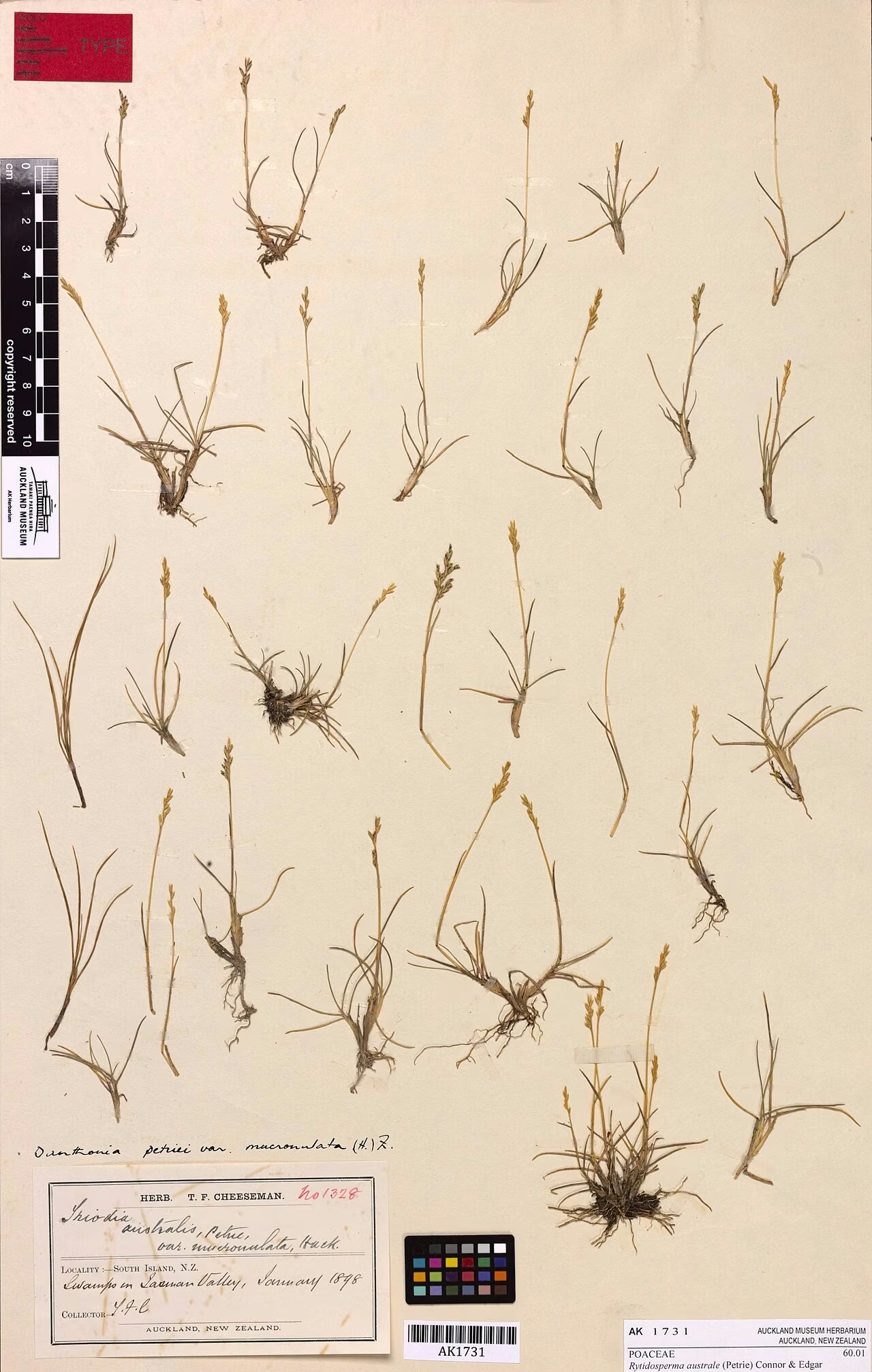
Explore other native plants that share similar characteristics or habitats with Gumland Bristle Grass (Rytidosperma biannulare), offering further insights into New Zealand's diverse flora. These related species provide context and opportunities for complementary planting in your garden.
Plant Conservation
Gumland bristle grass is ranked Not Threatened (2023) and has held that status in earlier assessments. Regionally it is Not Threatened in Northland and Auckland, but in the Wellington region it is ranked Regionally Critical because only spot occurrences are known there.
Protecting remnant gumland and open scrub from conversion, weed invasion and fire helps maintain its habitat. Reporting sightings outside its known range, especially in the southern North Island, improves understanding of its distribution.
Frequently Asked Questions
Why is it called gumland bristle grass?
The name links it to the gumlands of northern New Zealand, the infertile former kauri lands where kauri gum was dug, which fall within its main range from Surville Cliffs to Auckland.
Where is Rytidosperma biannulare found?
It grows from Surville Cliffs south to Auckland, with spot occurrences at Taumarunui and Wellington, and in North-West Nelson, D'Urville Island and the Wairau Valley in the South Island.
Is gumland bristle grass endemic to New Zealand?
It is currently treated as endemic, although NZPCN notes that its distribution and ecology suggest it could also turn up in Australia. It was taken to the United States for forage trials and has persisted in Oregon and California.
How tall does gumland bristle grass grow?
It forms green tussocks with leaves up to 30 to 40 cm long and flowering stems up to about 85 cm tall, carrying dense, upright panicles 10 to 20 cm long.
Sources and Further Reading
The botanical, growing, and conservation details for Gumland Bristle Grass (Rytidosperma biannulare) on this page draw on the New Zealand plant references below. Consult them for full technical records and the latest distribution data.