Horse's Mane Weed
Ruppia polycarpa
Last updated:
Horse's mane weed (Ruppia polycarpa), also called lakeweed, is a native submerged aquatic plant of brackish and fresh water. It spreads by rhizomes to form dense, grass-like underwater mats or looser stands of longer stems, with dark green, hair-thin leaves 5 to 30 cm long. Its flowers rise on stalks up to 50 cm long that coil into a spiral as the fruit ripens. It grows in saline ponds, coastal lagoons, brackish streams, slow freshwater streams and lakes from sea level to 700 m on the North, South and Chatham Islands, and also in Australia. Its beds shelter invertebrates and are grazed by waterfowl. Explore more native grasses and flaxes in our native plant guide.
Plant Description
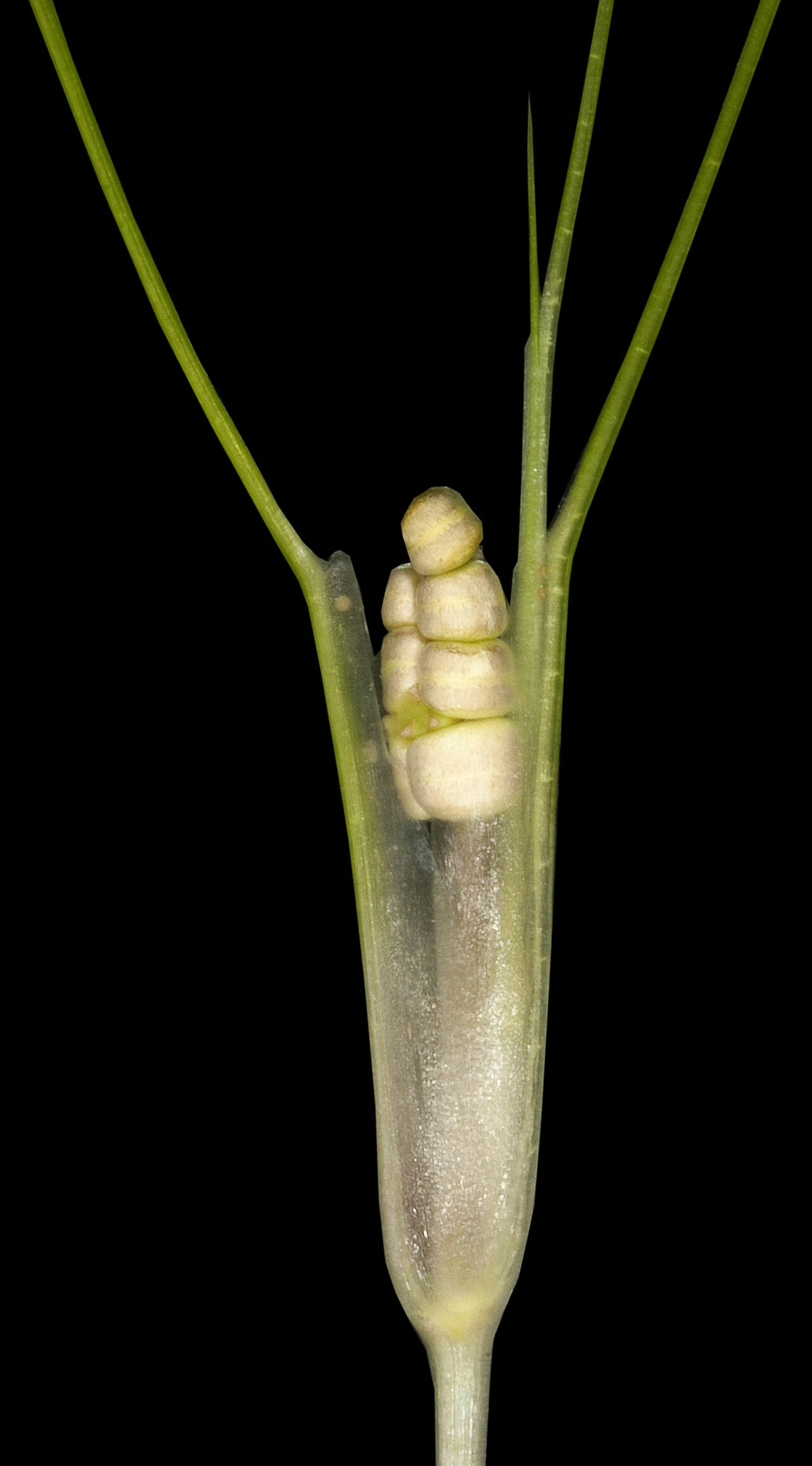
Ruppia polycarpa is a submerged aquatic herb with prominent rhizomes. These are either densely branched, giving rise to short stems and long leaves that form dense grass-like mats, or less closely branched, producing longer, sparsely branched stems. The leaves are dark green and almost thread-like, about 5 to 30 cm long and only 0.3 to 0.4 mm wide, with blunt tips.
The tiny flowers are carried on peduncles that can reach 50 cm long and become spirally coiled as the fruit matures, pulling the developing fruit back down into the water. Flowers usually have four carpels, each developing into an asymmetric brown achene 1.7 to 2.7 mm long with a smooth black inner wall. Flowering runs from October to February and fruiting from October to May.
It differs from Ruppia megacarpa in having curved to straight rather than zigzag branching, blunt rather than two-toothed leaf tips, usually four carpels rather than five to sixteen, and smaller fruits. Fennel-leaved pondweed (Stuckenia pectinata) is similar but has leaves with a ligule and acute tips, tuberous stems and spike-like flower heads.
Quick Facts
| Scientific Name | Ruppia polycarpa |
|---|---|
| Height | Leaves 5-30 cm long; flower stalks to 0.5 m |
| Spread | Spreads indefinitely by rhizomes |
| Water Needs | Aquatic; fully submerged |
| Light | Full sun; clear shallow water |
| Frost Tolerance | High; protected under water |
| Salt Tolerance | High; grows in saline and brackish water |
| Growth Rate | Moderate to fast |
| Lifespan | Perennial |
Climate Best Suited to
As a submerged plant it is buffered from air temperature extremes and grows in coastal and inland waters across a wide range of New Zealand climates.
Regional Suitability
| City | Climate Suitability |
|---|---|
| Auckland | Medium |
| Wellington | Medium |
| Christchurch | High |
| Dunedin | Medium |
Plant Habitat
Ruppia polycarpa is indigenous to New Zealand, recorded from the North, South and Chatham Islands, and also occurs in Australia. It is scarce in some northern and central regions, being regionally Endangered in Wellington and Vulnerable in Auckland, but is regionally Not Threatened in Otago.
It grows in saline ponds, coastal lagoons, brackish streams, slow-flowing freshwater streams and freshwater lakes, from sea level to 700 m. It is an obligate wetland plant that is always found in water.
Growing Requirements
Soil Requirements
It roots into soft sediments on the beds of lagoons, ponds and slow streams.
- Fine sand, silt or mud substrate
- Tolerates saline and brackish sediments
- Needs stable, undisturbed bottom sediments
Light Requirements
As a submerged plant, it depends on clear water for enough light to reach the leaves.
- Full sun on shallow, clear water
- Declines when water becomes turbid or algae-filled
Water Requirements
It is entirely aquatic, growing in fresh to saline water.
- Permanent standing or slow-moving water
- Salinity from fresh to saline
- Sensitive to nutrient enrichment and turbidity
Planting and Establishing
Ruppia polycarpa is not commercially available, and NZPCN considers it unlikely to be widely cultivated. Where it is used in restoration, rhizome sections or seed from a nearby population are anchored into soft sediment in shallow, clear water.
Before introducing it to a pond or lagoon, check the water quality: it will not persist where water is murky from sediment, algal blooms or nutrient runoff.
Ecological Role
Ruppia species have a specialised pollination system: pollen is released at or near the water surface, and the coiling peduncles then draw the developing fruit back down into the water. The fruits sink or are moved by water currents, and they are also eaten and dispersed by waterbirds.
Dense Ruppia beds stabilise sediments, provide shelter for small fish and invertebrates, and Ruppia is grazed by herbivorous waterfowl such as black swans in coastal lagoons and lakes.
Uses & Significance
Garden Uses
This is not a garden plant, but it has value in large-scale wetland and lagoon restoration.
- Restoration of brackish lagoons
- Constructed wetlands with saline influence
- Educational displays of native aquatic plants
Ecological Value
Ruppia beds are a key part of the food web in many shallow lagoons and lakes.
- Food for black swans and other waterfowl
- Habitat for invertebrates and juvenile fish
- Sediment stabilisation and water clarity
Landscaping Uses
In landscape terms, Ruppia polycarpa contributes underwater rather than above it. In a large constructed wetland or lagoon edge with brackish water, it can form submerged meadows that improve habitat value and help keep sediments in place.
Combine it with emergent native plants such as sea rush (Juncus kraussii) and three-square (Schoenoplectus pungens) at the water margin.
Seasonal Care Calendar
Spring
Growth resumes as water warms, and flowering can begin in October.
- Monitor water clarity
- Keep stock out of margins
Summer
Flowering peaks and the coiling flower stalks become visible near the water surface.
- Watch for algal blooms in warm weather
- Avoid nutrient runoff
Autumn
Fruits continue to ripen until about May.
- Collect fruits for restoration if required
- Note extent of beds for monitoring
Winter
Growth slows, and beds may die back partly in colder waters.
- No intervention needed
- Protect sediments from disturbance
When to Prune and How Much
No pruning is needed. In wild beds, plants should be left undisturbed.
In a constructed pond where growth becomes too dense, thin by hand rather than with machinery, removing only part of the bed so that wildlife and sediments remain undisturbed.
How to Grow Horse's Mane Weed
NZPCN states that the propagation technique for Ruppia polycarpa is uncertain, though it is probably easily grown in suitable conditions. The plant spreads naturally by rhizomes and sets abundant seed, so both rhizome fragments and seed are the likely options. Material should be eco-sourced from a nearby population and collected with permission, as the species is threatened in some regions.
By Rhizome Division
Sections of rhizome with attached shoots can be separated from a dense mat and replanted into soft sediment. This is the quickest way to establish a new bed, mirroring how the plant spreads in the wild. Shallow, sheltered water with little wave action gives the fragments the best chance of rooting before currents dislodge them.
- Lift a small portion of mat with rhizomes and sediment in spring
- Cut it into pieces each with several shoots
- Press the rhizomes into soft mud in shallow, clear water
- Weigh them down with a small stone or biodegradable pin if needed
- Keep water levels stable while new roots establish
From Seed
Fruits ripen between October and May on the coiled flower stalks. Seed of submerged aquatic plants often needs to stay wet, so keep collected fruit in water from the source site until it is sown.
- Collect ripe brown fruits from the coiled stalks
- Store them in water from the collection site
- Sow onto trays of fine sediment submerged in shallow water
- Transplant young plants with their sediment once established
Pests & Diseases
No particular pests are recorded. The main threats are environmental: nutrient enrichment, algal blooms, turbidity from sediment runoff and invasive aquatic weeds that can shade out Ruppia beds.
Heavy grazing by large numbers of waterfowl can also reduce beds in some lagoons.
Cultural Significance
No Māori name or traditional use is recorded for Ruppia polycarpa in the sources consulted. The genus is named after Heinrich Bernhard Ruppius (1689 to 1719), a German botanist, and polycarpa means many-fruited.
Coastal lagoons where Ruppia grows are often important mahinga kai sites, valued for waterfowl and fish, though no specific use of this plant has been documented.
Bonus Tip
To confirm you have a Ruppia rather than a pondweed, look for flower stalks that coil like a spring after flowering. That spiral coiling is a distinctive feature of Ruppia and is easiest to see in summer and autumn.
Related Plants
Explore other native plants that share similar characteristics or habitats with Horse's Mane Weed (Ruppia polycarpa), offering further insights into New Zealand's diverse flora. These related species provide context and opportunities for complementary planting in your garden.
Plant Conservation
Ruppia polycarpa is ranked Not Threatened in New Zealand (2023), with the qualifier SO (Secure Overseas). Regional assessments list it as Regionally Endangered in Wellington, Regionally Vulnerable in Auckland and Regionally Naturally Uncommon in Northland.
Declining water quality, drainage of coastal wetlands and changes to lagoon openings and salinity threaten its beds. Reducing nutrient and sediment runoff and protecting lagoon margins are the most effective ways to help.
Frequently Asked Questions
What is horse's mane weed?
It is Ruppia polycarpa, a native submerged aquatic plant with hair-like leaves that forms dense mats in brackish lagoons, saline ponds, slow streams and lakes.
How do you tell Ruppia polycarpa from Ruppia megacarpa?
Ruppia polycarpa has blunt leaf tips, usually four carpels per flower and fruits under 3 mm long, whereas Ruppia megacarpa has two-toothed leaf tips, more carpels and larger fruits 4 to 5 mm long.
Is Ruppia polycarpa a seagrass?
No. Although it grows in brackish water, it belongs to the Ruppiaceae and is distinct from true seagrass (Zostera), which grows in fully marine intertidal and subtidal areas.
Can I grow Ruppia polycarpa in a pond?
NZPCN notes it is probably easily grown in suitable conditions but is not commercially available and is unlikely to be widely cultivated, if at all.
Sources and Further Reading
The botanical, growing, and conservation details for Horse's Mane Weed (Ruppia polycarpa) on this page draw on the New Zealand plant references below. Consult them for full technical records and the latest distribution data.