Meadow Grass
Poa tonsa
Last updated:
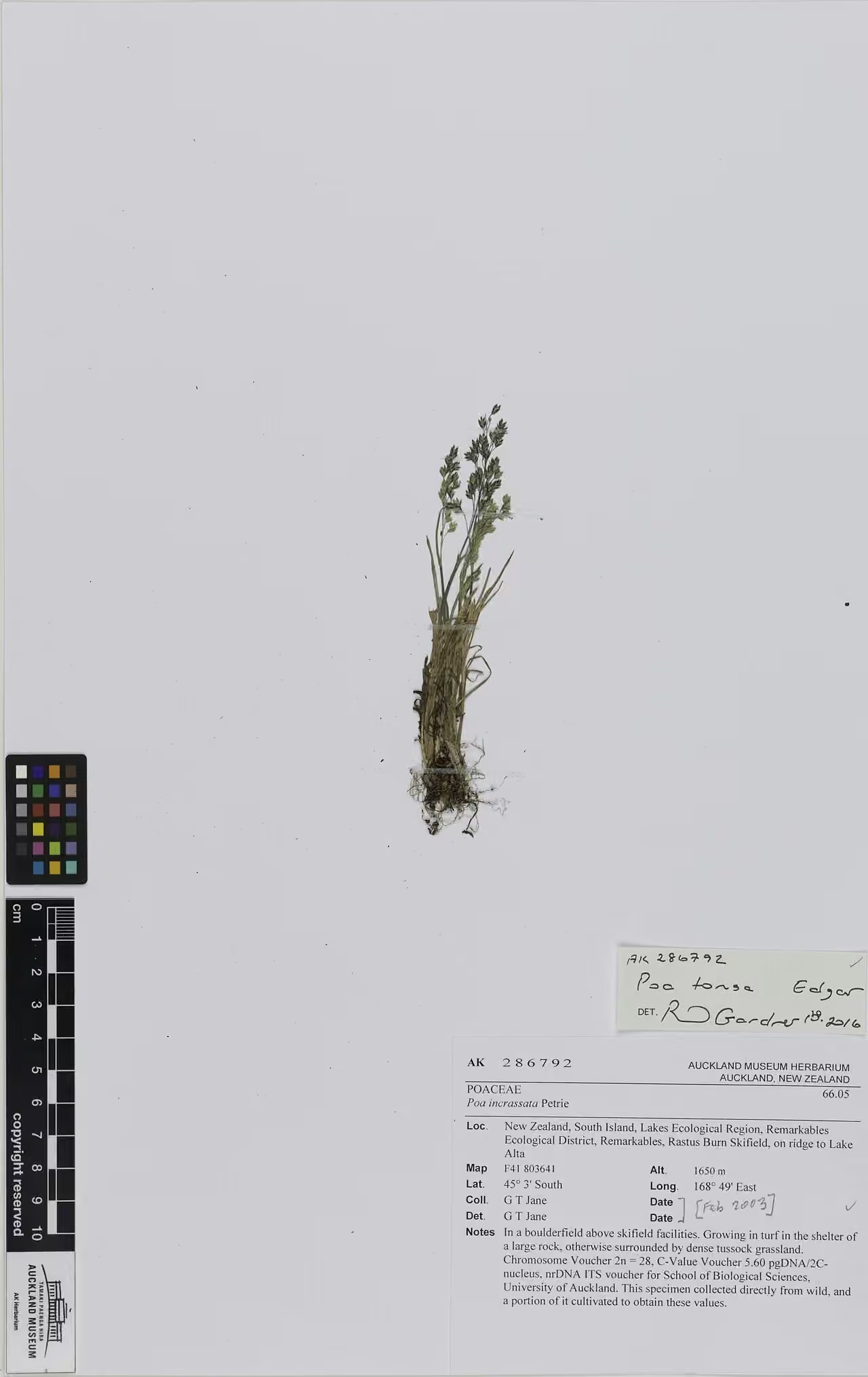
Poa tonsa is a small, compact, light green tufted grass endemic to the South Island mountains. Tufts grow to about 15 cm tall, with leaf sheaths ranging from creamy brown to reddish purple and short panicles of purplish-green spikelets. It is recorded from the Shingle Range and upper Awatere Valley in Marlborough and from the mountains of Central and west Otago, in subalpine to alpine snow tussock grassland, on rock and on river flats. Its name means 'shaved' or 'smooth', referring to the hairless upper part of the lemma that separates it from its close relative Poa lindsayi. Explore more native grasses and flaxes in our native plant guide.
Plant Description
Poa tonsa forms small, compact, light green perennial tufts up to about 15 cm tall. New shoots branch within the old leaf sheaths, keeping the tuft tight, and old leaf blades persist on the plant. The leaf sheaths range in colour from light creamy brown to reddish purple, which can give the base of the tuft a warm tint.
The panicles are short, 1 to 7 cm long, and carry purplish-green spikelets with three to five florets. In the wild the low flowering stems stand among the bases of snow tussocks and other grasses.
It is easily confused with Poa lindsayi, a small grey-green or blue-green poa. NZPCN separates them by the lemma: in Poa lindsayi the hairs extend further towards the tip, while in Poa tonsa the upper part is bare, the feature that gives it its name. The two also differ in how the spike is presented, in leaf characters and in colour, and herbarium specimens from the Rock and Pillar Range have been identified as each, showing that care is needed.
Quick Facts
| Scientific Name | Poa tonsa |
|---|---|
| Height | Up to about 0.15 m |
| Spread | Small compact tufts |
| Water Needs | Moderate; freely drained |
| Light | Full sun |
| Frost Tolerance | High; subalpine to alpine |
| Salt Tolerance | None recorded; an inland mountain grass |
| Growth Rate | Slow |
| Lifespan | Perennial |
Climate Best Suited to
Suited to the cold winters and dry, sunny continental summers of the eastern and central South Island ranges.
Regional Suitability
| City | Climate Suitability |
|---|---|
| Auckland | Low |
| Wellington | Low |
| Christchurch | Medium |
| Dunedin | Medium |
Plant Habitat
Poa tonsa is endemic to the South Island. It is recorded from the Shingle Range and the upper Awatere Valley in inland Marlborough, and from the mountains of Central and west Otago. The type locality is Omarama Saddle, between the Waitaki basin and Central Otago.
It grows in subalpine to alpine snow tussock grassland, on rock and on river flats. These are open, cold sites where short grasses grow between the larger tussocks.
Growing Requirements
Soil Requirements
Its habitats have thin, stony mountain soils and river-flat gravels.
- Gritty, free-draining mix in cultivation
- Low to moderate fertility
- Tolerates stony ground
Light Requirements
It grows in open tussock grassland and on rock with no tree cover.
- Full sun
- Avoid shading by taller plants
Water Requirements
The inland Marlborough and Central Otago ranges are relatively dry, with snow in winter.
- Water occasionally in long dry spells
- Keep winter wet away from the crown
Planting and Establishing
Plant into a rock garden, trough or scree bed with good drainage, in autumn or early spring. Grow it among other small alpines or between low tussocks where it will not be overshadowed.
It is not commercially available, so plants are usually raised from seed by specialist growers. A cold, dry-summer district such as inland Canterbury or Otago suits it better than humid northern gardens.
Ecological Role
Poa tonsa is wind-pollinated like other grasses. Within snow tussock grassland it occupies gaps between the large Chionochloa tussocks, part of a diverse layer of small grasses and herbs.
On river flats and rock it helps cover open ground. Flowering and fruiting times are not recorded in the sources consulted.
Uses & Significance
Garden Uses
It is a modest plant for collectors of South Island mountain grasses.
- Rock gardens and troughs
- Tussock grassland restoration plantings in its home range
- Alpine grass collections
Ecological Value
It adds to the species richness of high-country tussock grassland.
- Inter-tussock ground cover
- Part of endemic South Island mountain grass flora
- Regionally uncommon in Otago
Landscaping Uses
Its reddish-purple leaf sheaths and purplish spikelets give a subtle colour accent in a planting of grey stones and silver-leaved alpines. Use several tufts together to create a small patch of grassland effect in a trough.
Pair it with snow tussocks or blue tussock in a larger high-country themed garden, placing it at the front where it can be seen.
Seasonal Care Calendar
Spring
Tufts green up and new shoots develop after winter.
- Topdress with grit
- Weed around tufts
Summer
Short panicles of purplish-green spikelets appear during the growing season.
- Water only in prolonged drought
- Collect seed as panicles dry
Autumn
Growth slows as nights cool.
- Sow seed outdoors
- Remove spent stems
Winter
Dormant and frost hardy.
- Keep crown dry
- No feeding
When to Prune and How Much
Pruning is unnecessary. Pull out dead leaves gently in spring and snip off old flowering stems once seed has fallen.
Avoid trimming the living leaves, as this small grass has limited reserves.
How to Grow Meadow Grass
Poa tonsa is listed by NZPCN as not commercially available, and no propagation information specific to this species is published. The practical options are those used for other small tufted alpine poas: sowing seed from cultivated or legally collected plants, and dividing established tufts. Since it is regionally uncommon in Otago, avoid collecting from small local populations, and obtain permission before taking any seed from conservation land or private high-country stations.
From Seed
Sow seed fresh in autumn and leave it outdoors through winter. Cold exposure often improves germination in mountain grasses and mimics the conditions it would meet in snow tussock country.
Label seedlings carefully with their origin. Because Poa tonsa is so easily confused with Poa lindsayi, keeping a record of where the seed came from, and checking the lemma hairs on the parent, avoids mixing the two species in cultivation.
- Collect panicles when the spikelets have dried
- Sow thinly on a gritty seed mix
- Cover with a fine layer of grit and water in
- Leave in a cold, open spot outdoors over winter
- Pot on seedlings once they form small tufts
By Division
Because its shoots branch inside the leaf sheaths, the tuft can be split into a few smaller tufts once it is well established. Small tufts recover slowly, so divide only vigorous plants and leave each piece with plenty of shoots.
- Lift a cultivated tuft in early spring
- Ease it apart into pieces with roots and several shoots
- Pot each piece into gritty mix
- Keep in a cool, bright place until new growth begins
Pests & Diseases
No specific pests or diseases are recorded for Poa tonsa. In gardens, crown rot from excess winter wet is the most likely problem.
In its natural habitat, invasive weeds such as hawkweeds have spread through much South Island tussock grassland and can compete with small native grasses.
Cultural Significance
No Māori name or traditional use for Poa tonsa is recorded in the sources consulted. It was described in 1986 by Elizabeth Edgar in the New Zealand Journal of Botany, from a specimen collected at Omarama Saddle.
It is one of many small poas recognised during the detailed study of New Zealand grasses that culminated in the Flora of New Zealand grass volume.
Bonus Tip
To confirm Poa tonsa in the field, use a hand lens on a floret: if the lemma hairs stop well short of the tip, leaving the upper part smooth, you are likely looking at Poa tonsa rather than Poa lindsayi.
Related Plants
Explore other native plants that share similar characteristics or habitats with Meadow Grass (Poa tonsa), offering further insights into New Zealand's diverse flora. These related species provide context and opportunities for complementary planting in your garden.
Plant Conservation
Poa tonsa is ranked Not Threatened nationally (2023). In the 2025 Otago regional assessment it is listed as At Risk - Regionally Naturally Uncommon, with qualifiers indicating it is sparse and restricted in the region.
Protecting snow tussock grassland from weed invasion, overgrazing and conversion helps maintain it and the many other small native plants of the high country.
Frequently Asked Questions
How do you tell Poa tonsa from Poa lindsayi?
The two are very similar, but in Poa lindsayi the hairs on the lemma extend further towards the tip, whereas Poa tonsa has a lemma that is hairless in its upper part.
Where was Poa tonsa first collected?
The type specimen was collected at Omarama Saddle in Central Otago, at about 5500 feet, in snow tussock grassland. Elizabeth Edgar named the species in 1986.
What does tonsa mean?
Tonsa is Latin for 'shaved' or 'smooth', referring to the bare upper part of the lemma.
Is Poa tonsa a threatened plant?
Nationally it is ranked Not Threatened (2023), but in the 2025 Otago regional assessment it is listed as Regionally Naturally Uncommon.
Sources and Further Reading
The botanical, growing, and conservation details for Meadow Grass (Poa tonsa) on this page draw on the New Zealand plant references below. Consult them for full technical records and the latest distribution data.