Poa
Poa dipsacea
Last updated:
Poa dipsacea is a small alpine grass endemic to the South Island, forming erect, open, rather stiff tufts up to about 30 cm tall from short rhizomes. Its leaves are bright green above and blue-green beneath, and its open flower heads carry just one to three large, usually purplish spikelets. It grows in Nelson, Marlborough and Canterbury at subalpine to alpine altitudes, along streams and seepages in tussock grassland and herbfield, sometimes on rock. It has no common name and is ranked Not Threatened. Its name means teasel-like, a reference to its spikelets. Explore more native grasses and flaxes in our native plant guide.
Plant Description
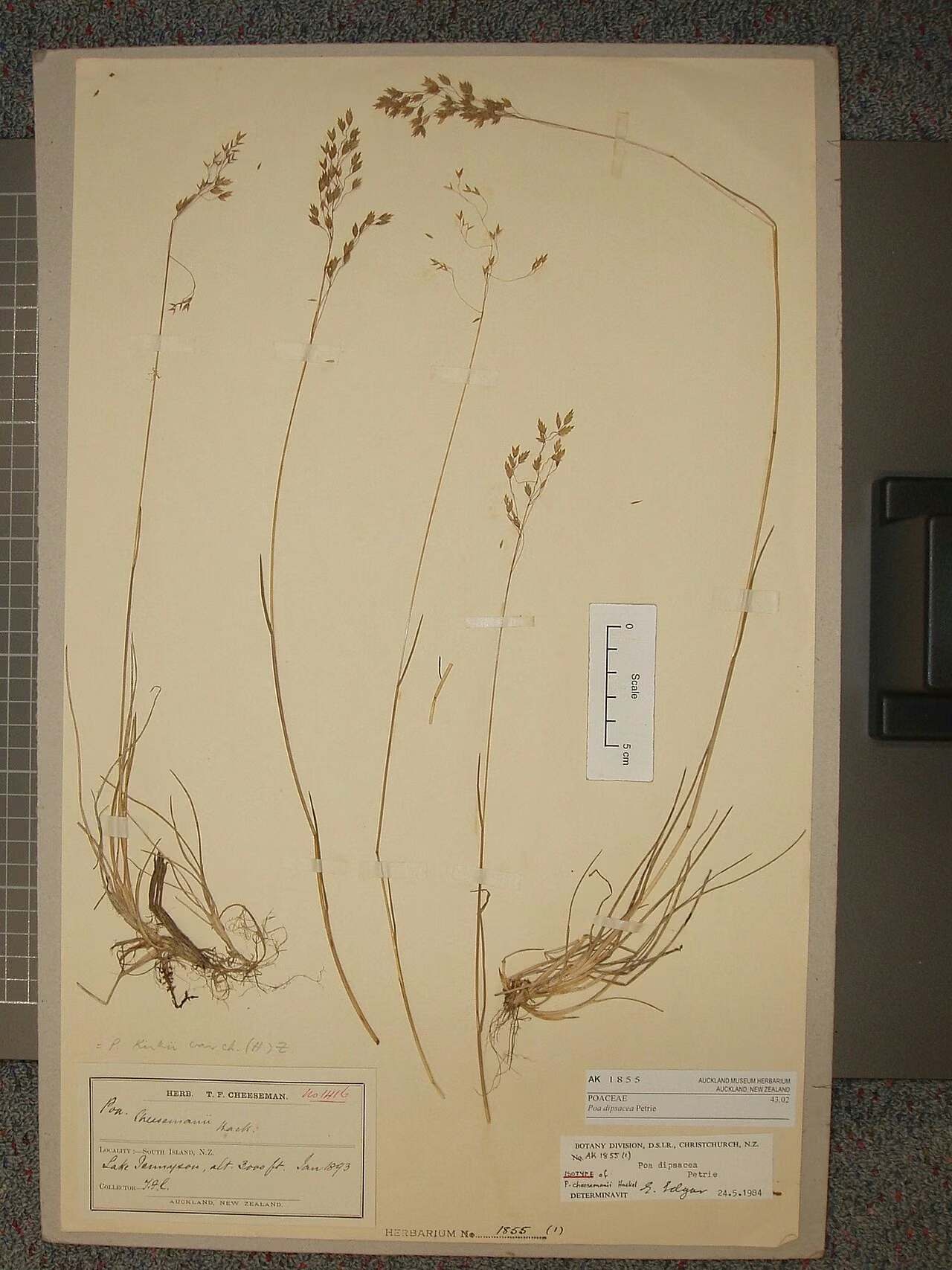
Poa dipsacea forms erect, open and rather stiff tufts up to about 30 cm tall, spreading by short rhizomes. The leaves are blue-green underneath and bright green on the upper surface. The leaf sheaths are light coloured, green to creamy brown or purplish, shining and hairless, turning grey with age. The leaf blades are usually 5 to 20 cm long and 1.5 to 3 mm wide, flat or folded and slightly leathery.
The flowering stems are usually 10 to 20 cm tall, sometimes only just above the leaves and sometimes well above them. The open panicle is 4 to 6 cm long and carries just one to three large spikelets at the tips of slender smooth branches. The spikelets are 5 to 8.5 mm long with usually four or five florets and are light green but usually purplish.
The species varies a great deal in size, which is why it was once split into three species. It may be confused with the introduced Poa pratensis, but Poa dipsacea has larger spikelets and thinner glumes with subacute to subobtuse tips. Its chromosome number is 2n = 28.
Quick Facts
| Scientific Name | Poa dipsacea |
|---|---|
| Height | Up to about 0.3 m |
| Spread | Small open tufts from short rhizomes |
| Water Needs | Moist; grows by streams and seepages |
| Light | Full sun |
| Frost Tolerance | High; subalpine to alpine |
| Salt Tolerance | No information available; an inland mountain species |
| Growth Rate | No information available |
| Lifespan | Perennial |
Climate Best Suited to
It suits a cold, snowy mountain climate with cool summers and reliable moisture. Hot, dry lowland conditions are unsuitable.
Regional Suitability
| City | Climate Suitability |
|---|---|
| Auckland | Low |
| Wellington | Low |
| Christchurch | Low |
| Dunedin | Medium |
Plant Habitat
Poa dipsacea is endemic to the South Island, recorded from Nelson, Marlborough and Canterbury. The type was collected at the source of Broken River at 3500 to 4000 ft, and other specimens come from Lake Tennyson in the Nelson mountains and the Craigieburn Range.
It grows at subalpine to alpine altitudes along streams and seepages in tussock grassland or herbfield, and sometimes on rock.
Growing Requirements
Soil Requirements
It favours permanently damp mineral soils beside running water.
- Moist, gritty or stony soil
- Good aeration from flowing water
- Low fertility is fine
Light Requirements
Its streamside and herbfield sites are open and sunny.
- Full sun
- Open sites without overhead cover
Water Requirements
It depends on seepage moisture and should never dry out.
- Keep constantly moist
- Moving water is better than stagnant
- A bog or seepage bed in a rock garden suits it
Planting and Establishing
It is not commercially available and is unlikely to be grown outside specialist alpine collections. If grown, place it in a cool, moist, sunny pocket of a rock garden with gritty soil and steady water.
Leave wild plants undisturbed; seed collected with permission is the most appropriate way to obtain material.
Ecological Role
Poa dipsacea is part of the herb and grass cover of mountain streamsides and seepages, damp habitats that are rich in alpine plant species.
It is wind pollinated like other Poa. No specific insect or animal associations are recorded in the sources consulted.
Uses & Significance
Garden Uses
Its main interest is botanical, but its large purplish spikelets make it attractive in a cool alpine garden.
- Moist pockets in an alpine rock garden
- Native grass collections
- Streamside planting in mountain restoration
Ecological Value
It contributes to the native vegetation of alpine wet sites.
- Part of seepage and streamside plant communities
- Holds damp stony ground
- A distinct South Island endemic grass
Landscaping Uses
In a specialist garden, plant it in small groups along a trickle or bog margin among cushion plants and small herbs, where its upright bright green tufts and purplish spikelets stand out.
It is too small and moisture-dependent for general landscape use.
Seasonal Care Calendar
Spring
Growth resumes as snow melts and seepages run.
- Check moisture levels
- Remove dead leaves
Summer
The short open panicles with large purplish spikelets appear in the alpine growing season. Exact months are not recorded in the sources consulted.
- Keep well watered
- Watch for seed ripening
Autumn
Seed is shed and growth slows.
- Collect and sow seed
Winter
In the wild it is covered by snow.
- No care required
- Keep drainage free from pooling
When to Prune and How Much
Pruning is not required. Tidy old leaves and spent stems by hand in spring.
Avoid cutting tufts hard, as small alpine grasses recover slowly.
How to Grow Poa
No published propagation records for Poa dipsacea were found, and NZPCN lists it as not commercially available. The guidance below follows standard practice for small rhizomatous alpine Poa species and should be treated as a starting point. Because it has short rhizomes and few-spikeleted heads, both seed and careful division are possible. For restoration, use seed from the same catchment to keep local genetic character, and collect only with permission.
From Seed
Each panicle carries only one to three spikelets, so seed quantities are small. Fresh seed sown promptly and kept cool gives the best chance of germination for alpine grasses.
- Collect spikelets when they turn straw coloured and the seed loosens
- Sow on a gritty, free-draining seed mix
- Cover with a thin layer of fine grit
- Stand the tray in a cool, bright place and keep it moist
- Pot seedlings individually once they have two or three leaves
- Keep young plants cool and moist through their first summer
By Division
The short rhizomes allow a clump to be split into a few rooted pieces. Do this in early spring as growth begins, keeping divisions reasonably large because small alpine pieces can be slow to recover.
- Lift the clump with plenty of soil
- Gently tease apart shoots that each have roots
- Pot into gritty mix and water well
- Keep shaded and cool for a few weeks, then move to full sun
- Plant out in autumn or the following spring once well rooted
Pests & Diseases
No specific pests or diseases are recorded for Poa dipsacea.
In cultivation, drying out and summer heat are much greater risks than pests. Slugs may graze young seedlings.
Cultural Significance
No Māori name or traditional use is recorded for Poa dipsacea in the sources consulted.
It was described by Donald Petrie in 1894. Two other names, Poa wallii by Petrie and Poa cheesemanii by Eduard Hackel, were later recognised as belonging to the same variable species.
Bonus Tip
If you find a small Poa with just one to three large purplish spikelets on a mountain streamside in Canterbury or Nelson, check the glumes with a hand lens: thin, blunt-tipped glumes help separate it from the weedy Poa pratensis that also turns up in high-country grassland.
Related Plants
Explore other native plants that share similar characteristics or habitats with Poa (Poa dipsacea), offering further insights into New Zealand's diverse flora. These related species provide context and opportunities for complementary planting in your garden.
Plant Conservation
Poa dipsacea is ranked Not Threatened (2023), the same ranking it has held in every assessment since 2004.
No specific threats are documented. Keeping alpine streamsides and seepages free of weeds and trampling helps protect the wetland plant communities it belongs to.
Frequently Asked Questions
What does dipsacea mean in Poa dipsacea?
NZPCN explains that dipsacea means teasel-like, referring to the spikelets, which are large and conspicuous for a Poa.
Where does Poa dipsacea grow?
It is found in Nelson, Marlborough and Canterbury at subalpine to alpine levels, along streams and seepages in tussock grassland or herbfield and sometimes on rock. Specimens come from places such as Broken River, the Craigieburn Range and Lake Tennyson.
How is Poa dipsacea different from Kentucky bluegrass?
Flora of New Zealand notes it can be confused with the introduced Poa pratensis, but Poa dipsacea has larger spikelets and thinner, subacute to subobtuse glumes.
Are Poa wallii and Poa cheesemanii the same as Poa dipsacea?
Yes. These names were given to small and large plants respectively, but they are now all treated as one variable species, Poa dipsacea.
Sources and Further Reading
The botanical, growing, and conservation details for Poa (Poa dipsacea) on this page draw on the New Zealand plant references below. Consult them for full technical records and the latest distribution data.