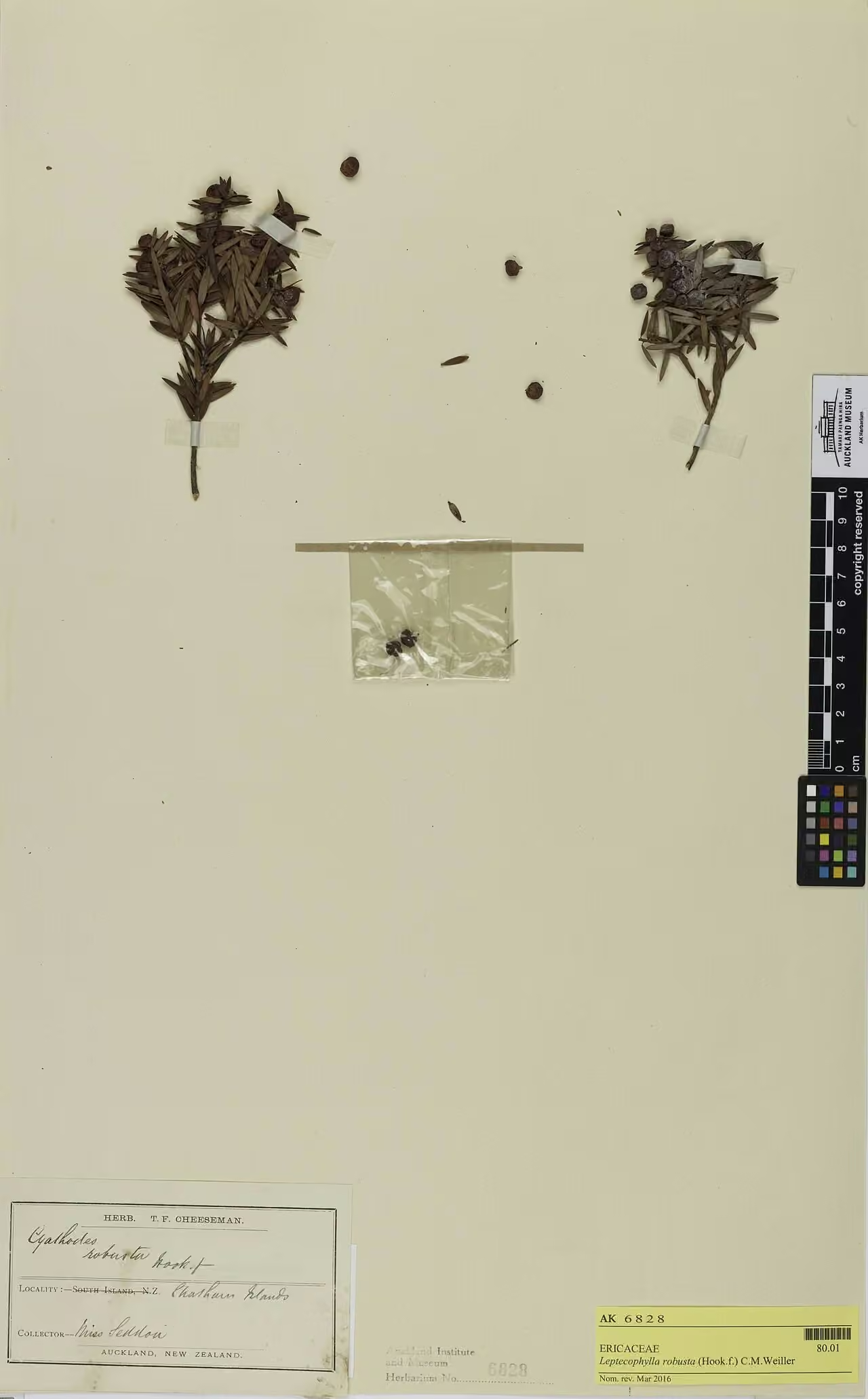
Pouteretere
Leptecophylla robusta
Last updated:
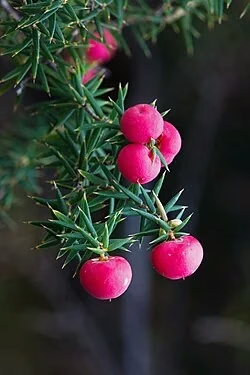
Pouteretere (Leptecophylla robusta), also called Chatham Island mingimingi, is a shrub or small tree in the heath family found only on Chatham Island (Rēkohu) and Pitt Island (Rangihaute). It can reach 8 m tall, with fibrous, deeply furrowed bark and small, stiff, sharp-pointed leaves that are dark green to bronze above and pale beneath. Sweetly scented cream to white flowers open from August to October, followed by red, pink or white berries that can be found all year. It grows in coastal and inland forest, scrub and restiad bog, sometimes forming the canopy. It is ranked At Risk - Naturally Uncommon. Explore more native shrubs in our native plant guide.
Plant Description
Leptecophylla robusta is a dioecious shrub or small tree up to 8 m tall, with male and female flowers on separate plants. The bark is dark grey to grey-brown, fibrous, somewhat tessellated and deeply furrowed. The small, stiff leaves are about 10 to 16 mm long and 2 to 3.5 mm wide, dark green, purple-green or bronze-green above and pale green or cream beneath, where six to eight conspicuous veins run along the leaf. They stand suberect to spreading, with short, blunt-pointed tips.
The flowers are white to cream and sickly-sweet in fragrance, appearing from August to October. They are followed on female plants by fleshy drupes 5 to 8 mm long and 6 to 10 mm wide, coloured red, pink or white, which can be found throughout the year.
It superficially resembles prickly mingimingi (Leptecophylla juniperina), which is widespread on the New Zealand mainland. Pouteretere differs in being confined to the Chatham Islands, in its greater stature, and in its suberect to spreading leaves with blunt, short tips.
Quick Facts
| Scientific Name | Leptecophylla robusta |
|---|---|
| Height | Usually 2-5 m, up to 8 m |
| Spread | 2-5 m |
| Water Needs | Moderate to high; tolerates wet, boggy soil |
| Light | Full sun to partial shade |
| Frost Tolerance | Moderate; no specific data found |
| Salt Tolerance | Good; grows in coastal forest and scrub |
| Growth Rate | Slow |
| Lifespan | Long-lived perennial |
Climate Best Suited to
Suited to the cool, windy, moist oceanic climate of the Chatham Islands, with mild winters and cool summers. It is best in cool, humid gardens rather than hot, dry ones.
Regional Suitability
| City | Climate Suitability |
|---|---|
| Auckland | Medium |
| Wellington | High |
| Christchurch | Medium |
| Dunedin | High |
Plant Habitat
Pouteretere is endemic to the Chatham Islands, where it is found on Chatham Island (Rēkohu) and Pitt Island (Rangihaute). It occurs both near the coast and inland.
It grows in forest and scrub and also within restiad bog, and on the southern tablelands of Chatham Island it sometimes forms the forest canopy. It is uncommon on sand and avoids active sand dune systems.
Growing Requirements
Soil Requirements
In the wild it grows on peaty and forest soils, including bog margins. Nursery growers recommend moist, humus-rich or peaty soil.
- Moist, humus-rich or peaty soil
- Tolerates wet ground and bog conditions
- Acidic soils suit this heath family plant
- Avoid dry, sandy sites
Light Requirements
It grows in both open scrub and forest canopy, so it accepts a range of light levels.
- Full sun to partial shade
- Tolerates exposure to wind
- Denser growth in brighter positions
Water Requirements
Consistent moisture suits it; it tolerates wetter ground than many native shrubs.
- Keep moist while establishing
- Mulch to retain soil moisture
- Do not let pots dry out
Planting and Establishing
Choose a permanent position, because plants are prone to collapse and resent any disturbance of the roots. Plant container-grown stock carefully, without breaking up the root ball, into moist, humus-rich soil, and mulch well.
Do not take plants from the wild: NZPCN states propagation is difficult and plants should not be removed from wild populations. Buy from specialist native nurseries that grow it from cultivated stock.
Ecological Role
The fragrant flowers open from August to October and are presumably insect-pollinated, though no pollinator studies were found. Because plants are either male or female, only female plants bear the red, pink or white berries, which are present throughout the year.
Fleshy berries of this kind are typically eaten by birds that spread the seed, but specific dispersers on the Chatham Islands have not been documented in the sources consulted. NZPCN notes the plant is not especially palatable to browsing stock, so it can persist in rough pasture where more palatable shrubs have gone.
Uses & Significance
Garden Uses
A slow, unusual shrub for collectors of Chatham Islands plants.
- Specimen shrub in cool, moist gardens
- Coastal gardens in mild, humid climates
- Bog garden margins
- Collections of New Zealand heath family plants
Ecological Value
On the Chatham Islands it is part of native forest, scrub and bog communities.
- Year-round fruit on female plants
- Spring flowers for insects
- Can form canopy on the southern tablelands
- Persists in rough pasture as a remnant of native cover
Landscaping Uses
Its fine, bronze-tinged foliage and colourful berries make an interesting textural shrub. Plant both male and female plants if you want fruit, and position the female where the berries can be seen.
It combines well with other Chatham Islands plants such as Chatham Island akeake and Chatham Island forget-me-not in a themed garden, as long as the soil stays moist.
Seasonal Care Calendar
Spring
Fragrant white to cream flowers appear from August to October.
- Mulch to conserve moisture
- Avoid cultivating near the roots
Summer
New growth develops and berries continue on female plants.
- Water during dry spells
- Check that the soil does not dry out
Autumn
Berries are still present, as fruit can be found year round.
- Collect ripe fruit for seed
- Top up mulch
Winter
An evergreen shrub that needs little winter care in mild climates.
- Protect young plants from hard frost
- Leave the roots undisturbed
When to Prune and How Much
Pruning is rarely needed for this slow-growing shrub. If shaping is required, lightly trim tips after flowering, but avoid heavy cutting, and never dig or fork around the base, since root disturbance can cause sudden collapse.
How to Grow Pouteretere
NZPCN describes propagation of Leptecophylla robusta as difficult and states that plants should not be removed from the wild. Cuttings are slow to establish, seed germinates only after two to six years, and plants are prone to collapse and resent any disturbance of the roots. Anyone attempting it should therefore plan for a long timeframe, use cultivated plants as the source where possible, and grow young plants in containers from which they can be planted without root disturbance.
From Seed
Ripe berries can be found throughout the year on female plants. The stony seeds germinate very slowly, so sow them where they can be left undisturbed for several years.
- Collect fully coloured berries from a cultivated female plant
- Clean the flesh from the seeds
- Sow in a deep tray or pot of free-draining, slightly acidic seed mix
- Cover lightly and place outdoors in a sheltered, shaded spot
- Keep the mix moist and weed-free
- Expect germination to take between two and six years
- Pot seedlings individually with minimal root disturbance
From Cuttings
Cuttings will root but are slow to establish, so give them a long time before potting on.
- Take semi-hardwood cuttings 5 to 8 cm long from cultivated plants
- Remove the lower leaves and wound the base lightly
- Insert into a mix of fine bark and pumice
- Keep humid and shaded in a cool propagating area
- Leave them undisturbed until roots are well developed
- Pot into deep containers and grow on slowly
Pests & Diseases
No specific pests or diseases are recorded for Leptecophylla robusta. The main cause of loss in cultivation is root damage or disturbance, which can trigger sudden collapse, along with drying out.
In the wild it is not especially palatable to stock, so browsing is a lesser concern than land clearance.
Cultural Significance
NZPCN records the name pouteretere for this species, but the sources consulted did not confirm whether it is a Moriori or Māori name, and no traditional use by Moriori or Māori was found. NZPCN does note that the plant has been used locally on the Chatham Islands for firewood, which has contributed to its decline.
The species was first described by Joseph Hooker as Cyathodes robusta and later moved to Leptecophylla; the epithet robusta means sturdy, reflecting its tree-like stature compared with its mainland relative.
Bonus Tip
Plant pouteretere once and leave it alone: water and mulch it, but never dig, hoe or transplant it, because NZPCN notes plants are prone to collapse when their roots are disturbed.
Related Plants
Explore other native plants that share similar characteristics or habitats with Pouteretere (Leptecophylla robusta), offering further insights into New Zealand's diverse flora. These related species provide context and opportunities for complementary planting in your garden.
Plant Conservation
Leptecophylla robusta is ranked At Risk - Naturally Uncommon (2023), with qualifiers IE (island endemic) and RR (range restricted), because it occurs only on Chatham and Pitt islands.
NZPCN identifies land clearance and local use for firewood as the main threats. Protecting remaining forest, scrub and bog remnants on the Chatham Islands, and fencing them from stock, helps secure the species.
Frequently Asked Questions
What is pouteretere?
Pouteretere is Leptecophylla robusta, a prickly-leaved shrub or small tree in the heath family that is endemic to the Chatham Islands and can grow up to 8 m tall.
How is Leptecophylla robusta different from prickly mingimingi?
It resembles Leptecophylla juniperina but is restricted to the Chatham Islands, grows taller, and has suberect to spreading leaves with short, blunt tips.
Is pouteretere easy to grow?
No. NZPCN describes propagation as difficult; cuttings are slow to establish, seed can take two to six years to germinate, and plants resent root disturbance.
What colour are pouteretere berries?
The fleshy drupes are red, pink or white, 5 to 8 mm long, and can be found on plants throughout the year.
Sources and Further Reading
The botanical, growing, and conservation details for Pouteretere (Leptecophylla robusta) on this page draw on the New Zealand plant references below. Consult them for full technical records and the latest distribution data.