Everlasting Daisy
Helichrysum plumeum
Last updated:
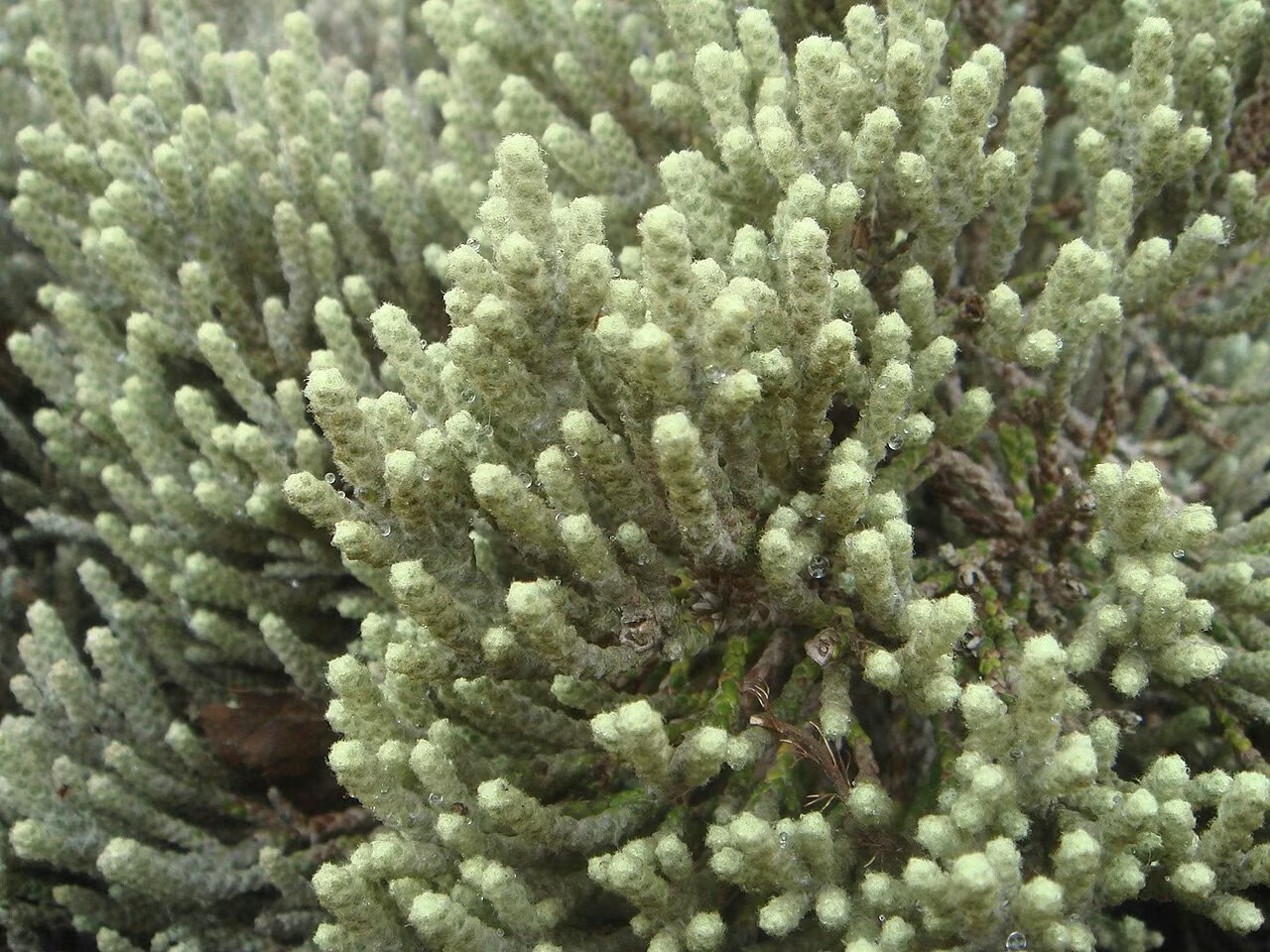
Helichrysum plumeum is a small, rounded whipcord shrub up to about 60 cm tall, endemic to the mountains of South Canterbury. Its erect stems look leafless because the tiny scale-like leaves are pressed flat and buried in dense yellow or occasionally white woolly hair, giving the plant a soft, feathery appearance that explains the name plumeum, Latin for feathery. Golden yellow flower heads sit at the stem tips. It grows in open rocky places at montane to subalpine altitudes, with records from Mt Dobson, Mt Dalgety, the Hunters Hills and Mt Edwards. It is ranked At Risk - Naturally Uncommon. Explore more native shrubs in our native plant guide.
Plant Description
Helichrysum plumeum is an ascending to erect, much-branched shrub up to 60 cm tall that forms a low, rounded mound with a stout main stem. The stems are about 2-4 mm thick including their leaves and look leafless from a distance.
The leaves are tiny scales about 2-2.5 mm long (rarely to 4 mm) and 1-1.5 mm wide, broadly triangular to ovate, blunt and slightly hooded, and closely overlapping along the stem. They are greenish but largely buried in long, tangled yellow (rarely white) woolly hairs, which give the whole plant its plumed look.
The flower heads are borne singly at the tips of the stems, about 3-6 mm across, with 30-40 yellow disc florets and membranous bracts; in the field they often appear as tight golden-orange clusters. The achenes are about 1.5 mm long and carry a pappus for wind dispersal. Other New Zealand whipcord everlastings, such as the H. selago group from which this species was separated, have scale leaves that are not hidden by such dense yellow wool.
Quick Facts
| Scientific Name | Helichrysum plumeum |
|---|---|
| Height | Up to 60 cm |
| Spread | Forms a rounded, compact mound |
| Water Needs | Low; needs sharp drainage |
| Light | Full sun |
| Frost Tolerance | Very hardy; a subalpine plant |
| Salt Tolerance | Not recorded; a mountain species |
| Growth Rate | Slow |
| Lifespan | Perennial (long-lived shrub) |
Climate Best Suited to
A dry to moderately wet eastern mountain climate with cold winters, snow, hard frost and strong sun and wind in summer.
Regional Suitability
| City | Climate Suitability |
|---|---|
| Auckland | Low |
| Wellington | Low |
| Christchurch | Medium |
| Dunedin | Medium |
Plant Habitat
Helichrysum plumeum is endemic to the South Island, where it is confined to the mountains of South Canterbury. The type specimen was collected by T.F. Cheeseman on Mt Dobson at about 4000 ft (around 1200 m) in January 1883, and other records include the Hunters Hills, Mt Edwards at about 900 m and Mt Dalgety.
It grows in open, montane to subalpine rocky places, such as outcrops, bluffs and rocky slopes, where low vegetation leaves it in full sun.
Growing Requirements
Soil Requirements
It grows among rocks on thin, stony soils that drain instantly after rain.
- Very gritty, free-draining scree mix
- Low fertility; do not feed
- Collar of stone chips around the stem to prevent rot
Light Requirements
A plant of exposed rock outcrops, it needs maximum sun.
- Full sun all day
- Open, airy position
- No overhanging plants
Water Requirements
Its woolly covering helps it cope with sun, wind and drought on exposed rock, and it is far more likely to fail from wet than dry.
- Water sparingly once established
- Never leave pots standing in water
- Protect from prolonged winter wet in mild lowland gardens
Planting and Establishing
Plant into a raised bed, scree, trough or crevice in a rock garden filled with a very gritty mix. Spring planting gives the roots a season to establish before winter.
Keep the base of the plant dry by top-dressing with stone chips. In humid northern districts it is best treated as a pot or alpine-house plant.
Ecological Role
Its flower heads offer pollen and nectar to insects on the mountain tops, although no studies of its pollinators were found. The achenes have a pappus and are wind dispersed.
On rocky outcrops, low woolly shrubs such as this species trap fine soil and provide sheltered microsites for small herbs, mosses and invertebrates.
Uses & Significance
Garden Uses
Best suited to specialist alpine growers who can give it perfect drainage and full sun.
- Alpine troughs and scree beds
- Crevice gardens
- Alpine house or cold frame collections
Ecological Value
As a narrow-range endemic, it is part of the distinctive mountain flora of South Canterbury.
- Contributes to rock outcrop plant diversity
- Flowers feed mountain insects
- Shelter for small invertebrates within the woolly stems
Landscaping Uses
Its rounded, golden-woolly form makes a striking feature among grey rocks in an alpine garden, especially when the stem tips are covered in yellow flower heads.
Combine it with other small mountain plants such as cushion Raoulia and small tussocks, keeping taller neighbours away so it stays in full sun.
Seasonal Care Calendar
Spring
New growth begins at the stem tips as the mountain snow melts.
- Plant or repot in gritty mix
- Refresh the stone mulch
Summer
Flower heads appear at the stem tips; plants have been photographed in flower at Mt Dalgety in January.
- Water pot plants in heatwaves only
- Collect seed heads as they fluff up
Autumn
Seed is shed on the wind and growth slows.
- Take small cuttings from cultivated plants
- Clear fallen leaves from around the plant
Winter
Wild plants endure snow and frost on exposed rock.
- Protect from prolonged rain in lowland gardens
- Do not water
When to Prune and How Much
Do not prune. The compact whipcord mound forms naturally and cut stems are slow to recover.
Remove any dead stems carefully with fine scissors, and snip off old flower heads if they hold moisture against the plant.
How to Grow Everlasting Daisy
No published propagation method for Helichrysum plumeum was found in NZPCN or the Flora of New Zealand, and it is not a common nursery plant. The approaches below are those generally used for whipcord Helichrysum and other small alpine everlasting daisies, and should be treated as a starting point rather than a proven protocol for this species. Expect slow growth and losses to rot if conditions are too warm or humid. The species is range restricted, so do not collect from wild plants without permission, and use material already in cultivation wherever possible.
From Cuttings
Small tip cuttings of whipcord stems are the usual way alpine growers propagate these plants.
Choose firm, healthy shoots without flower heads, and handle them by the tip so the woolly stem is not crushed.
- Take 3-5 cm tip cuttings from a cultivated plant in late summer
- Remove any old flower heads
- Insert into pure pumice or coarse sand
- Keep cool, lightly moist and very well ventilated
- Pot on into scree mix once rooted, which may take several months
From Seed
The small achenes have a pappus and blow away soon after ripening, so seed heads must be watched closely. Viable seed may be scarce on isolated garden plants.
- Collect seed heads as they become fluffy
- Sow fresh on the surface of a gritty seed mix
- Keep in a cool, bright, sheltered place
- Grow seedlings on slowly in gritty mix
Pests & Diseases
No pests or diseases specific to Helichrysum plumeum are recorded. The woolly stems can rot in humid, wet or still conditions, which is the main cause of failure in gardens.
Aphids and mealybugs occasionally hide in the dense hairs of whipcord plants in cultivation; check pot plants regularly.
Cultural Significance
No traditional Māori name or use is recorded for Helichrysum plumeum in the sources consulted.
Thomas Cheeseman first treated this plant as Helichrysum selago var. tomentosum in his 1906 Manual, after collecting it on Mt Dobson in 1883. H.H. Allan raised it to a separate species, H. plumeum, in his 1947 work, naming it for its feathery woolly stems.
Bonus Tip
When looking for this plant in the South Canterbury ranges, scan sunny rock outcrops for small domes that glow yellow in the sun. That golden cast comes from the wool on the stems rather than the flowers, so the plant is easy to pick out even when it is not in bloom.
Related Plants
Explore other native plants that share similar characteristics or habitats with Everlasting Daisy (Helichrysum plumeum), offering further insights into New Zealand's diverse flora. These related species provide context and opportunities for complementary planting in your garden.
Wairoa Koromiko
Veronica tairawhiti
Veronica truncatula
Veronica truncatula
Veronica urvilleana
Veronica urvilleana

Climbing Everlasting
Helichrysum dimorphum
Grass Lily
Herpolirion novae zelandiae
Anthoxanthum recurvatum
Anthoxanthum recurvatum
Kāretu
Anthoxanthum redolens
Filicaule Plant
Filicaule Plant
Plant Conservation
Helichrysum plumeum is ranked At Risk - Naturally Uncommon (2023), with the qualifiers Range Restricted and Sparse. It has been listed as uncommon or range restricted in every assessment since 2004.
Its rocky habitats are not under heavy development pressure, but small populations remain vulnerable to fire, weed invasion and browsing. Leaving plants undisturbed on outcrops and reporting sightings to NZPCN or iNaturalist NZ help track the species.
Frequently Asked Questions
What does plumeum mean?
Plumeum is classical Latin for feathery or composed of feathers. It describes the dense, fluffy yellow hairs that cover the stems and hide the tiny leaves.
Where does Helichrysum plumeum grow?
It is endemic to South Canterbury, growing in montane to subalpine rocky places. Recorded sites include Mt Dobson, where it was first collected in 1883, Mt Dalgety, the Hunters Hills and Mt Edwards.
Is Helichrysum plumeum a whipcord plant?
Yes. Like other whipcord everlastings its leaves are reduced to small scales tightly pressed against the stems, so the branches look like cords. In this species the cords are thickly covered in yellow fuzz.
What is the conservation status of Helichrysum plumeum?
It is ranked At Risk - Naturally Uncommon with the qualifiers Range Restricted and Sparse, reflecting its small natural range in the South Canterbury mountains.
Sources and Further Reading
The botanical, growing, and conservation details for Everlasting Daisy (Helichrysum plumeum) on this page draw on the New Zealand plant references below. Consult them for full technical records and the latest distribution data.