Holy Grass
Anthoxanthum recurvatum
Last updated:
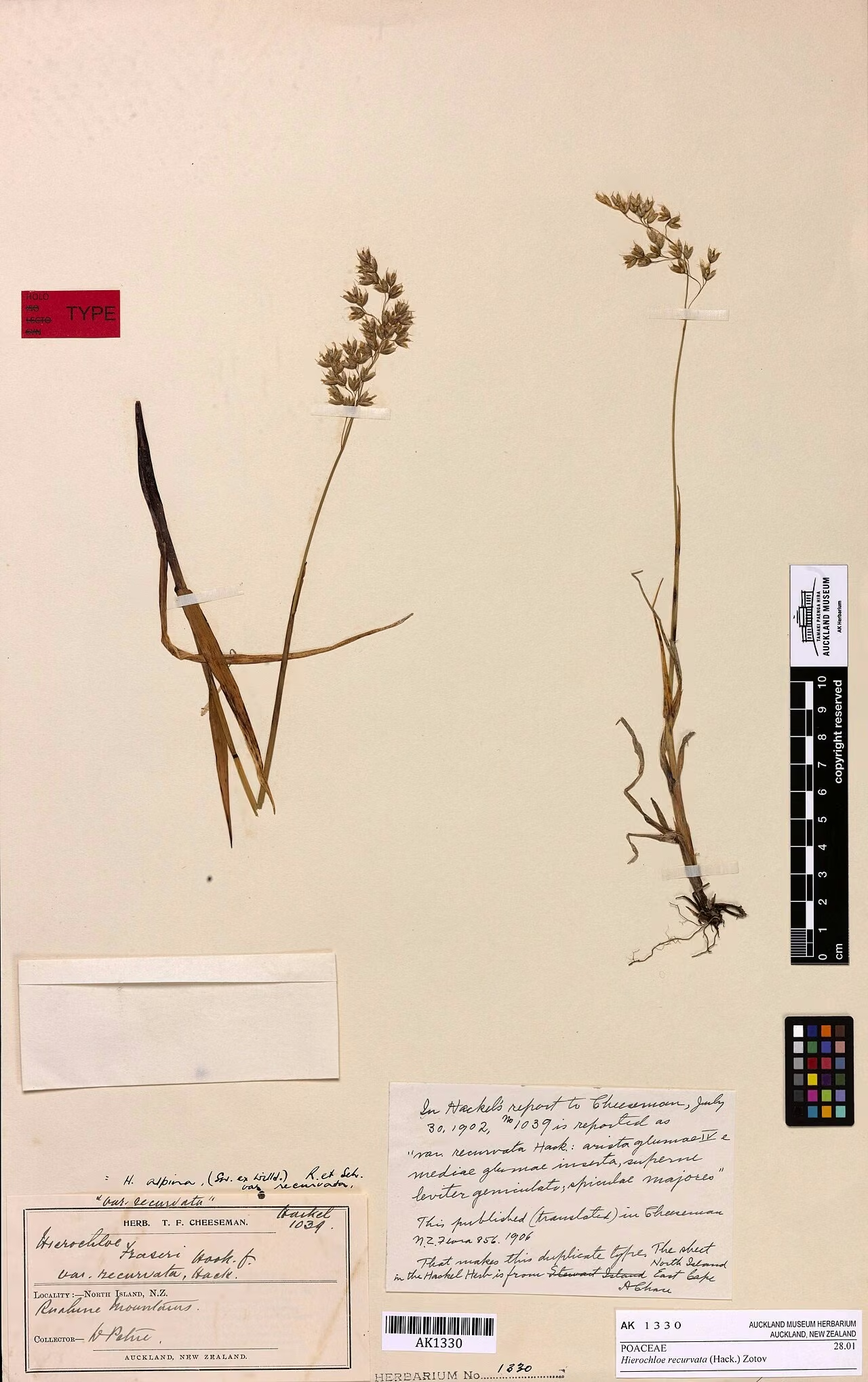
Hierochloe recurvata, now named Anthoxanthum recurvatum, is an endemic holy grass of New Zealand's mountains. It forms lax, rhizomatous tufts with deep purple leaf sheaths, short leaves 7-15 cm long and slender flowering stems 20-40 cm tall carrying a very open, spreading panicle. It is found in the North Island mountains from East Cape southwards and along the main divide of the South Island, more locally in eastern Canterbury and Otago, growing in subalpine to alpine tussock grassland and shrubland, often in damp sites. It is ranked Not Threatened. Explore more native grasses and flaxes in our native plant guide.
Plant Description
Anthoxanthum recurvatum is a robust but small grass that forms lax tufts connected by rhizomes. The leaf sheaths are deep purple and hairless. The leaf blades are 7-15 cm long and 3-6 mm wide, tapering, hairless to slightly rough on both surfaces, with prickle-toothed margins.
The flowering stems (culms) are 20-40 cm tall, with ridged, hairless internodes. The panicle is 8-16 cm long, very lax and spreading, with slender branches in ones or twos at each node, bare towards the base and with only a few spikelets near their tips.
Each spikelet has two male florets below a single bisexual floret. The male florets have lemmas 4-5.5 mm long with stout, unequal awns, about 1.5-3 mm on the lower floret and 4-6 mm on the second, while the bisexual floret has a short, stout awn of 2-3 mm just below its tip. These awn lengths, the purple sheaths and the small size help separate it from the larger, lowland to montane kāretu, Anthoxanthum redolens.
Quick Facts
| Scientific Name | Anthoxanthum recurvatum |
|---|---|
| Height | Flowering stems 20-40 cm |
| Spread | Spreads slowly by rhizomes into loose patches |
| Water Needs | Moderate to high; prefers damp soil |
| Light | Full sun to light shade |
| Frost Tolerance | Very hardy; an alpine grass |
| Salt Tolerance | Not recorded; a mountain species |
| Growth Rate | Slow to moderate |
| Lifespan | Perennial |
Climate Best Suited to
A cold, wet mountain climate with snow, frost and frequent cloud, from the central North Island ranges to the main divide of the South Island.
Regional Suitability
| City | Climate Suitability |
|---|---|
| Auckland | Low |
| Wellington | Medium |
| Christchurch | Medium |
| Dunedin | High |
Plant Habitat
This grass is endemic to New Zealand. NZPCN describes its distribution as the North Island mountains from East Cape south, and the South Island along the main divide, local in the east in Canterbury and Otago. Herbarium specimens come from places such as the Lake Ohau area, Fiordland National Park and Stewart Island.
Specimen labels record it mostly between about 700 m and over 1500 m, in subalpine and alpine tussock grassland, among low alpine herbs, and in damp positions in tussock shrubland and open tussock grassland.
Growing Requirements
Soil Requirements
In the mountains it grows in moist, acidic soils under tussock and shrubland.
- Moist, humus-rich, free-draining soil
- Tolerates acidic, low-fertility ground
- Avoid soils that dry out completely in summer
Light Requirements
It grows in open tussock grassland and among low shrubs, receiving good light but often under cloud.
- Full sun in cool districts
- Light shade in warmer gardens
- Avoid dense shade
Water Requirements
Its mountain habitats are wet for much of the year, and specimens are often collected from damp sites.
- Keep soil evenly moist
- Water during summer dry spells
- Good drainage still matters in winter
Planting and Establishing
Plant divisions or seedlings in spring into a cool, moist position, such as a damp corner of a rock garden or the edge of a tussock planting. Firm in and water well.
Because it spreads by rhizomes, allow room for it to form a loose patch. In warm, humid lowland gardens it is unlikely to thrive.
Ecological Role
Like other grasses it is wind pollinated. NZPCN records that its florets are dispersed by both water and wind, which suits its damp mountain habitats.
It forms part of the diverse ground layer in tussock grassland, where low grasses and herbs fill the spaces between the large tussocks and provide food and shelter for alpine insects such as grasshoppers and moth caterpillars.
Uses & Significance
Garden Uses
Mainly of interest for alpine and conservation collections, as it is not commercially available.
- Alpine and rock gardens in cool regions
- Tussock grassland restoration at altitude
- Botanical collections of native grasses
Ecological Value
An endemic part of New Zealand's mountain grassland flora.
- Adds diversity to the inter-tussock ground layer
- Helps bind soil on mountain slopes
- Food plant for grassland invertebrates
Landscaping Uses
Use it as a low infill grass between larger tussocks such as Chionochloa or Poa colensoi in an alpine planting, where its purple-based tufts and airy panicles add fine texture.
It suits naturalistic mountain-style plantings rather than formal borders.
Seasonal Care Calendar
Spring
New growth begins from the rhizomes after snowmelt.
- Divide and replant patches
- Clear dead leaves from tufts
Summer
The lax, open panicles appear above the leaves during the short mountain growing season.
- Keep soil moist
- Collect seed as it ripens
Autumn
Florets are shed and carried by wind and water.
- Sow fresh seed
- Cut back old flowering stems if untidy
Winter
Wild plants lie dormant under snow or frost.
- No care needed
- Check drainage in pots
When to Prune and How Much
Little pruning is needed. Remove old flowering stems once seed has fallen, and comb out dead leaves by hand in spring.
Avoid cutting the plant hard back, as growth in cool conditions is slow.
How to Grow Holy Grass
No propagation guidance specific to Anthoxanthum recurvatum was found, and NZPCN lists it as not commercially available. The methods below follow the usual approaches for rhizomatous native grasses, which are generally successful for related species. Division of an established clump is the most reliable way to increase a plant already in cultivation, while seed is better for restoration, as it retains genetic variation. Collect wild seed only with permission, particularly within conservation land, and grow plants from seed sourced near the planting site so they are adapted to local conditions.
By Division
The rhizomes make this grass straightforward to divide. Spring division gives the new pieces a full growing season to settle.
Keep new divisions in a cool, partly shaded spot until fresh leaves show they have rooted.
- Lift a cultivated clump in early spring
- Cut or pull apart sections each with roots, rhizome and several shoots
- Trim long leaves back by half to reduce water loss
- Replant into moist, humus-rich soil and water well
From Seed
Collect panicles when the florets are ripe and loosen easily, in late summer or early autumn. Grass seed from mountain species often germinates better after a period of cold.
- Rub ripe florets from the panicle into a paper bag
- Sow on the surface of a moist, free-draining seed mix
- Cover lightly with fine grit
- Leave the tray outside over winter for natural chilling
- Prick out seedlings into individual pots in spring
Pests & Diseases
No pests or diseases specific to this species are recorded. In cultivation, aphids and rust fungi occasionally affect native grasses, especially when plants are stressed by heat or drought.
In the wild, browsing by deer, chamois and hares, and invasion of tussock grassland by weeds such as Hieracium, change the grassland communities it belongs to.
Cultural Significance
No traditional Māori name or use is recorded specifically for Anthoxanthum recurvatum in the sources consulted. The related lowland holy grass, Anthoxanthum redolens, is the scented kāretu valued by Māori.
The plant was first named by Eduard Hackel as a variety of Hierochloe fraseri, raised to species rank by Victor Zotov, and transferred to Anthoxanthum by Peter de Lange and C.J. James.
Bonus Tip
To pick out this grass among tussocks, part the leaves at the base of a small tuft and look for deep purple sheaths, then check the flowering stem for a very open panicle with only a few spikelets clustered near the ends of its thread-like branches.
Related Plants
Explore other native plants that share similar characteristics or habitats with Holy Grass (Anthoxanthum recurvatum), offering further insights into New Zealand's diverse flora. These related species provide context and opportunities for complementary planting in your garden.

Climbing Everlasting
Helichrysum dimorphum
Helichrysum plumeum
Helichrysum plumeum
Grass Lily
Herpolirion novae zelandiae
Kāretu
Anthoxanthum redolens
Hoheria ovata
Hoheria ovata
Hydrocotyle dissecta
Hydrocotyle dissecta
Brunonis Grass
Anthoxanthum Brunonis Grass
Petriei Grass
Achnatherum Petriei Grass
Plant Conservation
Anthoxanthum recurvatum is ranked Not Threatened (2023). Otago lists it as Regionally Not Threatened, while the Wellington region assesses it as Regionally Data Deficient, reflecting how little it has been recorded there.
Much of its habitat is within national parks and conservation land. Controlling introduced browsers and invasive weeds in tussock grassland helps maintain the communities it belongs to.
Frequently Asked Questions
Is Hierochloe recurvata the same as Anthoxanthum recurvatum?
Yes. New Zealand Hierochloe species were moved into Anthoxanthum by de Lange and James, so Anthoxanthum recurvatum is now the accepted name and Hierochloe recurvata is a synonym.
How do you identify Anthoxanthum recurvatum?
Look for a small rhizomatous grass with deep purple leaf sheaths, leaves 7-15 cm long with prickle-toothed edges, and a very lax, spreading panicle 8-16 cm long with few spikelets near the branch tips.
Where does Anthoxanthum recurvatum grow?
It grows in the mountains of the North Island from East Cape south, and along the main divide of the South Island, more locally in eastern Canterbury and Otago, usually in subalpine and alpine tussock grassland.
Is Anthoxanthum recurvatum available to buy?
NZPCN lists it as not commercially available, so it is rarely seen in gardens and is mainly of interest to botanists and restoration projects.
Sources and Further Reading
The botanical, growing, and conservation details for Holy Grass (Anthoxanthum recurvatum) on this page draw on the New Zealand plant references below. Consult them for full technical records and the latest distribution data.