Coral Sea Shrub
Helichrysum coralloides
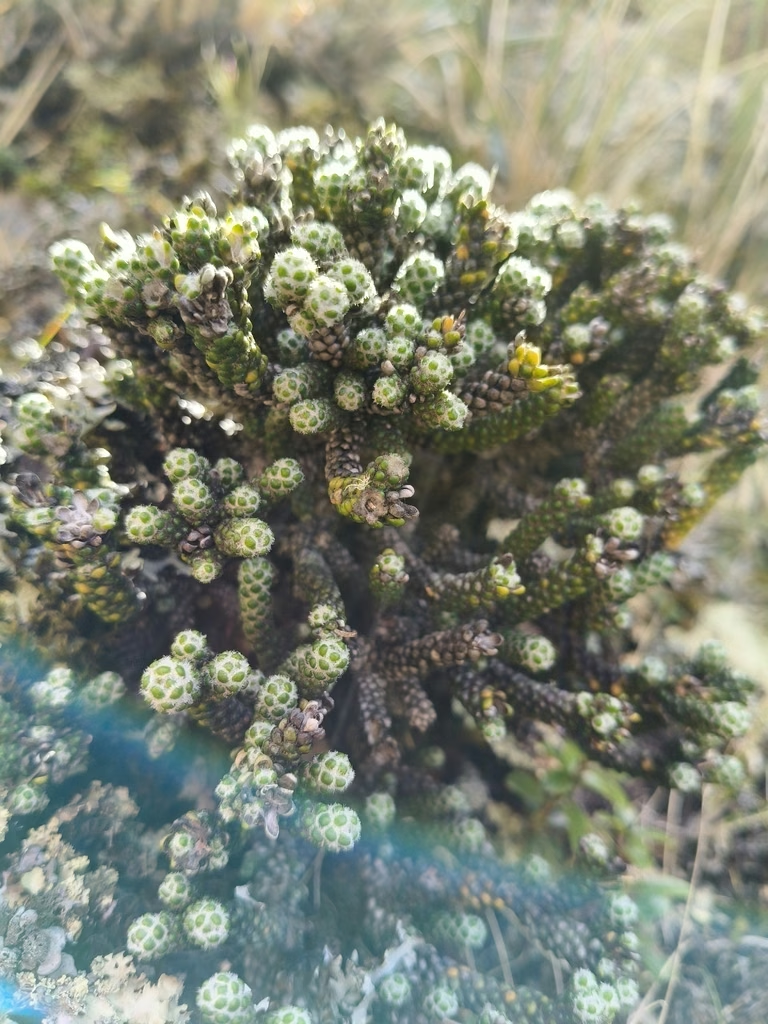
Helichrysum coralloides, the coral sea shrub, is an endemic New Zealand shrub with thick, knobbly branchlets and tiny overlapping leaves. Its yellow flower heads sit directly at the branch tips.
Identification
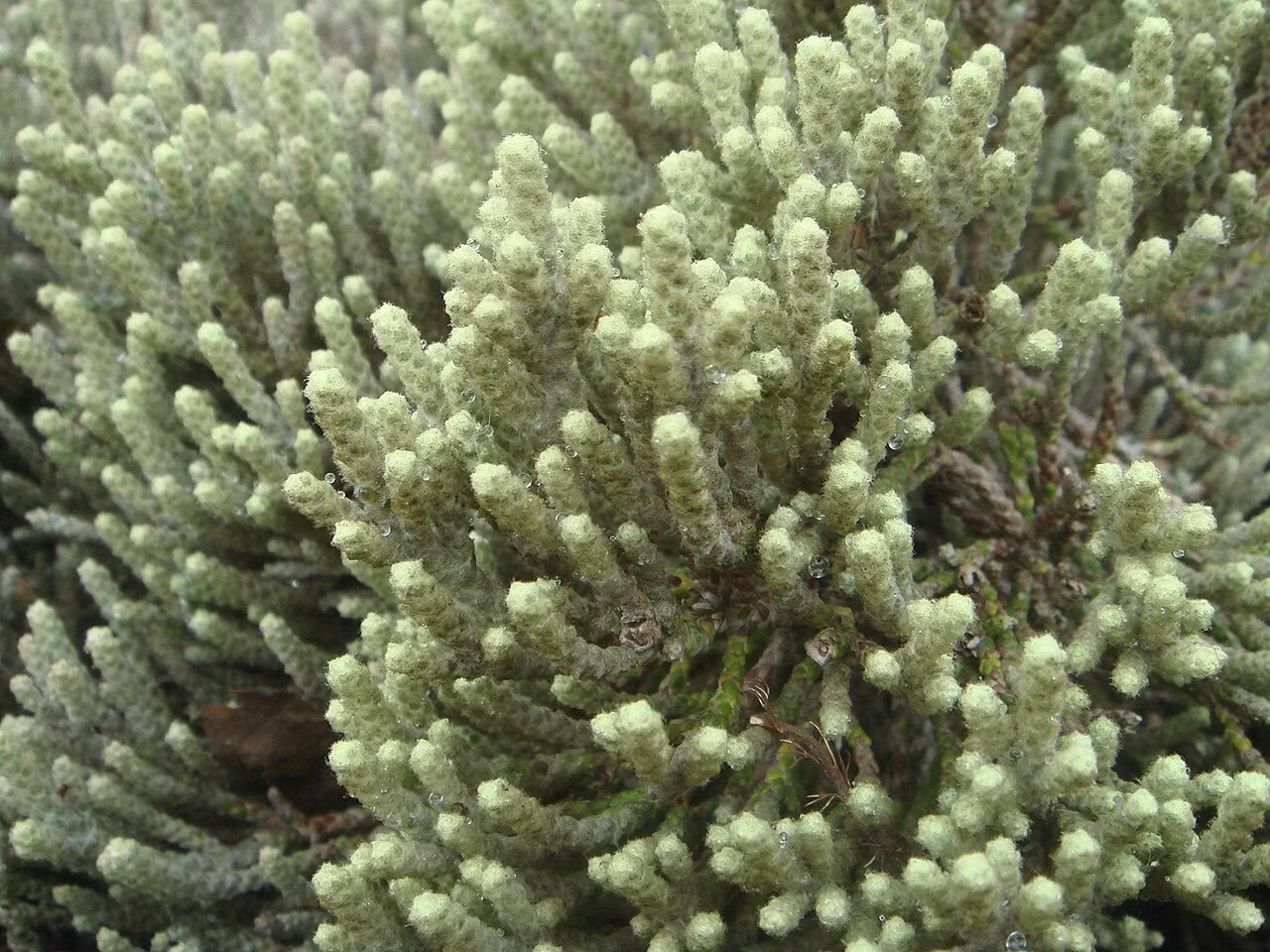
This much-branched shrub grows up to 60 cm tall. Its thick-looking branchlets are covered by overlapping, closely pressed leaves and white felt, creating a knobbly, coral-like appearance.
The stalkless adult leaves are about 4-6 mm long and rolled inward. The solitary flower heads are 6-10 mm across and have bright yellow discs.
Quick facts
| Scientific Name | Helichrysum coralloides |
|---|---|
| Alternative name | Ozothamnus coralloides |
| Family | Asteraceae |
| Height | Up to 60 cm |
| Adult leaves | About 4-6 mm long |
| Flower heads | 6-10 mm across, yellow-centred |
| National status | Not Threatened (2023) |
| Water Needs | Sharp drainage; protect from excessive winter wet |
| Light | Full sun |
| Spread | RHS cultivated spread 10-50 cm; conditions are UK-based |
| Frost Tolerance | RHS H3 (-5 to 1°C), assessed for UK growing conditions |
| Salt Tolerance | Salt tolerance is not documented |
| Growth Rate | RHS time to maturity 2-5 years; annual extension unquantified |
| Lifespan | Evergreen woody shrub |
Natural range
NZPCN records coral sea shrub in upland areas of southern Marlborough. It is endemic to New Zealand; the cited species profile does not give a tested garden temperature range.
| City | Climate Suitability |
|---|---|
| Auckland | Not assessed |
| Wellington | Not assessed |
| Christchurch | Not assessed |
Habitat and distribution
This shrub occurs in upland southern Marlborough according to NZPCN. Its branches can be erect, spreading or ascending, with the closely overlapping leaves and their felt obscuring the branchlets.
The available species profile identifies the region but does not describe a detailed soil or moisture range for individual populations.
Growing requirements
The Royal Horticultural Society recommends full sun and moderately fertile soil with sharp drainage for this species, together with protection from excessive winter wet. Its ratings describe UK cultivation; local New Zealand performance should be assessed in the actual site.
Rock-Garden or Container Establishment
The RHS records rock-garden and container use. For an alpine house it specifies equal proportions of loam, leaf mould and grit, a recommendation aimed at providing the sharp drainage listed in its species profile.
Growth and ecology
Adult leaves overlap and press closely against the branchlets, while seedling leaves and reversion shoots spread outward and carry dense felt on both surfaces. NZPCN reports that its pappus-bearing fruits disperse in wind.
Observing the shrub
Examine the branchlets closely: the tiny leaves have hairless outer surfaces and densely white-felted inner surfaces. Solitary flower heads sit directly on the stems and show a bright yellow disc.
Garden context
The shrub’s knobbly branchlets and compact height are distinctive, but the cited botanical profiles do not report landscape trials or species-specific growing advice. Flora describes branches as erect, spreading or ascending.
Flowers and fruit
Flora describes solitary, stalkless flower heads 6-10 mm across, with bright yellow discs. Its small cylindrical fruits are 1-1.5 mm long and carry short, closely pressed hairs; the profile does not specify flowering months.
Growth form
Coral sea shrub branches repeatedly and reaches about 60 cm high. Its persistent leaves and white felt cover the branchlets; the botanical sources do not prescribe a species-specific pruning schedule.
How to Grow Coral Sea Shrub (Helichrysum coralloides)
Fresh seed
The Royal Horticultural Society recommends sowing seed of this species as soon as it ripens, using an open frame. It treats the plant under the alternative generic name Ozothamnus, so retain the connection with Helichrysum coralloides when checking labels. The profile does not specify a germination temperature or a number of days to emergence.
Semi-Ripe Cuttings
Semi-ripe cuttings taken in summer are the other propagation method explicitly recommended by the RHS. Its guidance concerns the developmental stage and season, without specifying cutting length, rooting hormone or rooting time. In New Zealand, interpret the summer recommendation by season rather than transferring a northern-hemisphere calendar month unchanged.
Drainage and position
The RHS recommends a sunny position with moderately fertile, sharply drained soil, sheltered from excessive winter wet. For alpine-house cultivation it gives a mixture containing equal parts loam, leaf mould and grit. These are cultivation recommendations for this particular species, although the published hardiness and maturity ratings are based on UK conditions.
Following established growth
New Zealand Flora describes a branching shrub reaching about 60 cm. Closely overlapping leaves and white felt conceal much of the branchlets, producing the characteristic coral-like outline. Seedling and reversion-shoot leaves spread more widely and have felt on both surfaces. These documented juvenile differences help interpret new growth without assuming it should immediately match every mature shoot.
Plant health
The cited Flora and NZPCN profiles do not list species-specific pests, diseases or treatments. Dense white felt on the inner surfaces of adult leaves is a normal part of the shrub’s structure.
Naming and classification
New Zealand sources use Helichrysum coralloides and list Ozothamnus coralloides as its earlier name. Kew instead accepts the Ozothamnus combination, so the same plant may appear under either name in references.
Look at the leaves
Adult leaves are short, stalkless and rolled inward, with a blunt hooded tip. Seedling and reversion-shoot leaves differ: they spread away from the stem and are densely felted on both surfaces.
Related New Zealand shrubs
Explore other native everlasting shrubs and related daisy-family plants from New Zealand.

Conservation
Helichrysum coralloides is endemic to New Zealand and was assessed as Not Threatened in the 2023 national assessment. NZPCN describes its distribution as upland southern Marlborough.
Frequently asked questions
Which propagation methods are documented?
The RHS recommends freshly ripened seed in an open frame and semi-ripe cuttings taken in summer.
Why do seedling leaves look different?
Seedlings and reversion shoots have spreading leaves with dense felt on both surfaces, unlike the closely appressed adult foliage.
What cultivation problem is specifically mentioned?
The RHS recommends protection from excessive winter wet and stresses sharp soil drainage.
Sources
Botanical description and name: Flora of New Zealand. Distribution, dispersal and conservation: NZPCN. Alternative name: Kew Plants of the World Online. Royal Horticultural Society: cultivation, seed and semi-ripe cuttings.
Last updated: